






Data comparison of cross-chain bridge transactions, which bridge is the cheapest?


By Hart Lambur
Compiled by: TechFlow
in conclusion
For normal L2 to L2 transfers, @AcrossProtocol is clearly the fastest and cheapest cross-chain bridge. For normal ETH to L2 transfers, Across is much faster and cheaper than Stargate's fast bridge, and Across is roughly the same as Stargate's slow bridge in terms of fees (but Across is a full 20 times faster). For normal L2 to ETH transfers, Across is much faster and cheaper than Stargate's fast option, and while slightly more expensive than Stargate's slow option, Across is a full 100 times faster.
analyze
Over the past few days, @PrimoridalAA has accused me of cherry-picking when comparing our cross-chain bridges. I think the best response to this is to develop a way to explain what "cheaper" means, and then see who wins.
My approach is: for normal bridge transactions, which bridge is the cheapest? Since the transaction sizes and fees for L2 to L2, ETH to L2, and L2 to ETH vary greatly, I will look at these cases separately. For which L2 to choose, I suggest we look at the three largest: Arbitrum (Arb), Base, Optimism (OP).
Here are the rolling average L2-to-L2 bridge transaction sizes over the past 30 days, measured using Across and Stargate data:
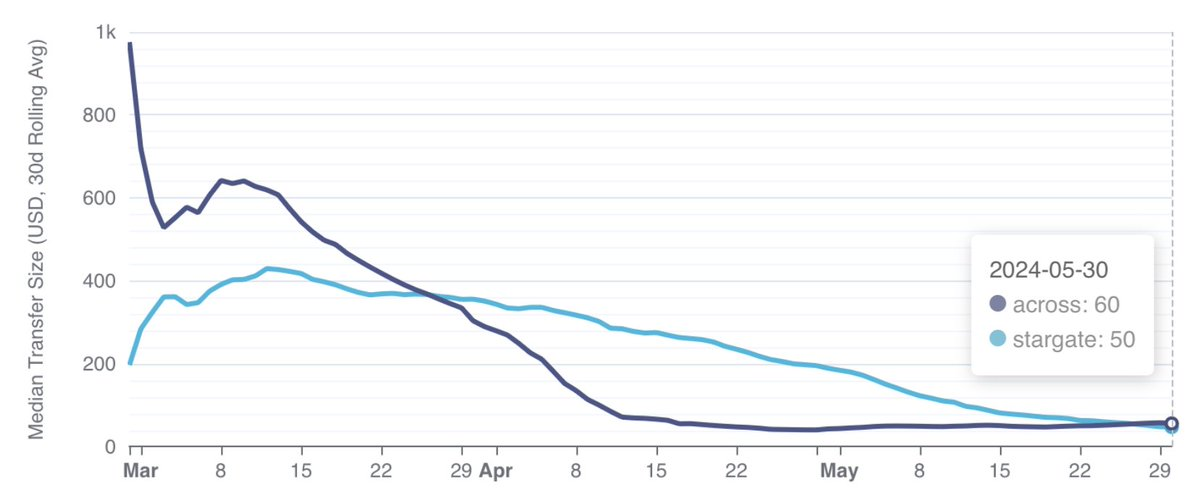
The average transaction size for both L2-to-L2 bridges is about $55, or about 0.015 ETH. (Note that the average size is trending downward; more on this later).
Great, so which bridge is cheaper to move 0.015 ETH between L2s? This should answer the question “which bridge is cheaper for a normal bridge transaction between L2s”.
The answer is: Across is cheaper and faster than Stargate to transfer 0.015 ETH between either L2.
I just bridged 0.015 ETH from Base to OP. Here are the results:
Across takes 4 seconds and costs 1.1 cents.
Stargate “fast” takes 50 seconds and costs 5.6 cents.
The "cheap" Stargate takes 1 minute and 2 seconds and costs 3.0 cents.
I’m sure I’ll be accused of cherry-picking Base to OP, but honestly, check any 0.015 ETH route and Across is significantly cheaper, and definitely faster in any L2 to L2 situation! There’s no doubt about it.
Conclusion: Across is clearly the fastest and cheapest cross-chain bridge for ordinary L2 to L2 transactions.
Next, let’s look at the data from ETH to L2.
Here are the 30-day rolling average ETH to L2 transaction sizes for the three largest L2s, measured using Across and Stargate data:
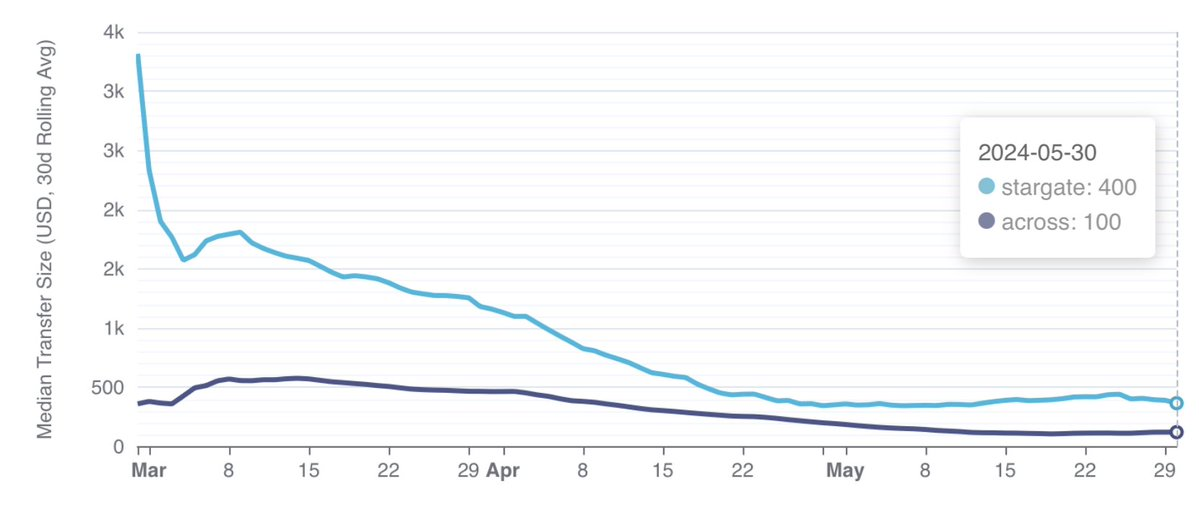
The average transaction size of Eth to [Arb, Base, OP] is ~$100 for Across and ~$400 for Stargate. Let's take the average of $250, or ~0.06 ETH.
Now let's bridge 0.06 ETH from ETH to OP.
result:
Across took 28 seconds and cost 2.6 cents.
Stargate "Fast" takes 4 minutes and costs 5.5 cents.
The "cheap" Stargate takes 9 minutes and 40 seconds and costs 2.2 cents.
Across is much cheaper and faster than Stargate's express option.
Compared to the cheaper options of Across, Stargate is 2.2 cents and Across is 2.6 cents, but Across takes 28 seconds while Stargate takes 9 minutes and 40 seconds.
As to whether this cost difference is worth the difference in speed, I'll leave it to the market to decide. Again, you can try it for yourself.
Finally, let’s look at the L2 to ETH data.
Here are the 30-day rolling average L2 to ETH transaction sizes for the three largest L2s, measured using Across and Stargate data:
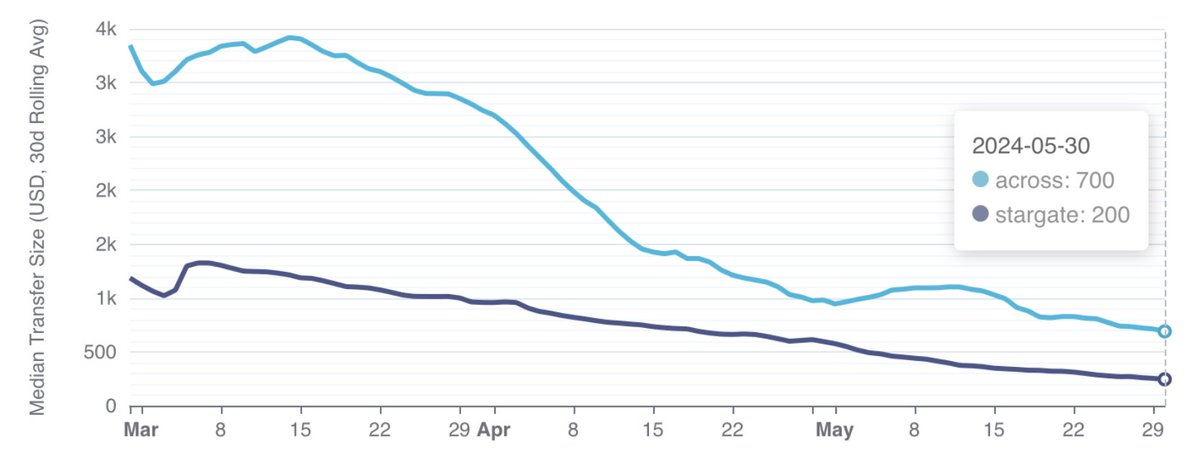
The average [Arb, Base, OP] transaction size Across to ETH is ~$700, and Stargate is ~$200. Let's take the average of $450, or ~0.06 ETH.
Now let's bridge 0.06 ETH from ETH to OP. Result:
Across took 4 seconds and cost $5.41.
Stargate "Fast" took 2 minutes and 12 seconds and cost $16.80.
Stargate "cheaply" took 6 minutes and 34 seconds and cost $4.41.
Likewise, Across dominates Stargate's fast options in both speed and cost.
The slower option of Stargate is slightly cheaper, but takes 6 minutes and 34 seconds, while Across only takes 4 seconds.
Where will the cross-chain bridge battle go?
I personally believe that as the next billion people enter the cryptocurrency space, they will (1) almost exclusively use L2 (or alt-L1), and (2) transaction sizes will continue to shrink. Across is already the cheapest and fastest bridge for L2 transactions, and as transaction sizes shrink, Across’ intent-based architecture will continue to dominate.
Stargate's "slow" option can save some costs when transacting with the Ethereum mainnet, but the speed compromise is very significant. I think it should be determined by the market whether it is worth sacrificing speed for marginal cost savings.
Regardless, users are the ultimate winners in these “bridge battles,” and I’m sure crypto Twitter users are at least mildly interested in the debate between me and my brother Bryan.


