






Stronger than Ethereum, here are 8 public chains worth watching


Original author: Terry
After the Ethereum Dencun upgrade was successfully completed on March 13, L2s such as Starknet, Optimism, and Arbitrum have also been integrated in the past two days. The sharp reduction in handling fees once again makes the Ethereum and L2 narrative look sexier.
However, at the same time, recently, outside of Ethereum, new public chains that have been struggling to save themselves under the water for a long time have generally ushered in their own Indian Summer moment, and many ecological projects and new variables have emerged that deserve attention.
A new public chain with outstanding performance
In the past six months, with the resurgence of heterogeneous chains represented by Solana and the development bottlenecks faced by Ethereum L2 itself, the industry has once again had a big discussion about Ethereum and L2, especially the new Layer that is continuously launched based on the concept of expansion. 2 caused problems such as liquidity fragmentation and mutual incompatibility, which once caused the narrative of Ethereum to appear sluggish.
The continued surge of SOL and AVAX is nothing more than a shot in the arm for new public chains. Market attention and funds are returning again, prompting new public chain ecosystems such as Solana to usher in their own Indian summer.
Solana: A model for post-disaster recovery
In 5 months, SOL went from US$20 to a peak of US$200, and its market value returned to tens of billions of US dollars. Solana completely walked out of the shadow of FTX, and also left new public chains such as Avalanche and NEAR far behind, becoming a smart contract. Except for Ethereum, there are almost no existing public chains.
With the surge in SOL, the Solana ecosystem has also developed one after another. Whether it is DeFi, NFT or the popular DePIN track, many ecological sub-projects worthy of attention have emerged. All directions are thriving and have become the basis for post-disaster reconstruction. Model model.
Especially recently, the top new-generation memes such as SILLY, DRAGON, and WIF have begun to clearly show a trend of moving from Ethereum to Solana, which is enough to show that Solana is indeed a new public chain in terms of on-chain funds and community traffic. The existence of a unique file.
Avalanche: RWA + Chain Games dual-line narrative takes shape
Last year, Avalanche became the first choice for traditional enterprises to issue encrypted assets on the chain by virtue of its cooperation with traditional financial giants such as Fidelity and JPMorgan, thus successfully labeling itself the RWA public chain, especially when combined with Avalanches customizable sub-chain. Due to the characteristics of Internet subnets, if more traditional companies want to issue RWA assets in the future, they will most likely directly cooperate with Avalanche, which has first-mover advantages.
In addition, after the RWA narrative was finalized, in March this year, South Korean game publisher Nexon Group announced that its 2D massively multiplayer online role-playing game MapleStory will cooperate with Ava Labs to officially enter the Avalanche network and launch a new game called MapleStory. The Web3 version of Universe, which sets the stage for further game empowerment of the Avalanche subnet.
Avalanche has also launched Arcad 3 before, aiming to help traditional game developers seamlessly transition to Web3 games. It plans to replicate the support path of RWA and use blockchain games as its second core growth point.
Overall, Avalanches two-line narrative about RWA + chain games is also vaguely taking shape. In 2024, some new variables and new products that go beyond the conventional competitive direction are likely to be born, which is worth looking forward to.
Sui: On-chain liquidity has improved significantly
The evolving trend of Sui’s popularity in the past six months has perfectly verified the logic that it’s never too late to eat well in the crypto world. In particular, Sui’s on-chain liquidity construction in the past six months can be regarded as a good example of success:
The three award-winning projects of the Liquidity Staking Hackathon held from August to October last year, Aftermath, Haedal, and Volo, have become the main drivers of TVL growth in the past half year.
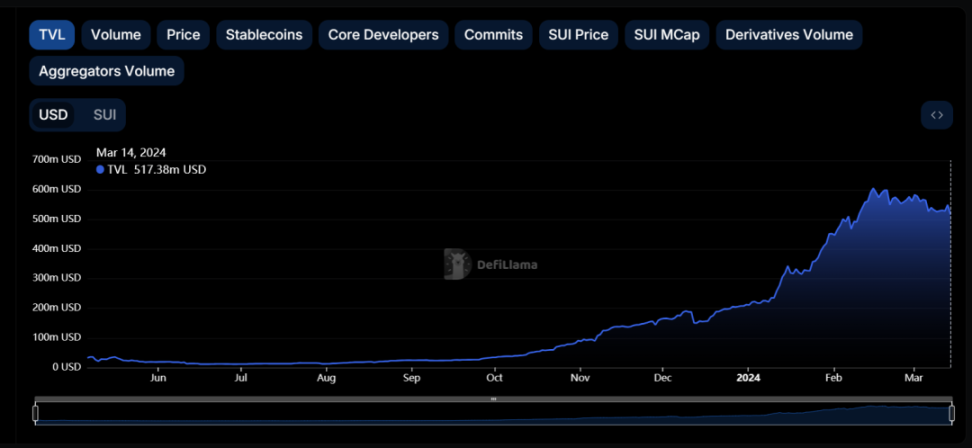
Sui’s market value trend this year, source: DeFillama
The most intuitive thing is that since October 14, 2023, Sui TVL exceeded 50 million US dollars for the first time, and then it has been rising all the way. On February 15, it hit a record high of more than 600 million US dollars. The liquidity situation on the chain has improved significantly, and community popularity and market The degree of discussion has also greatly exceeded that of Aptos, another top move public chain.
What other new public chain trends are worth paying attention to?
NEAR: DA+chain abstraction+AI
NEAR has rarely dropped a hot narrative these days.
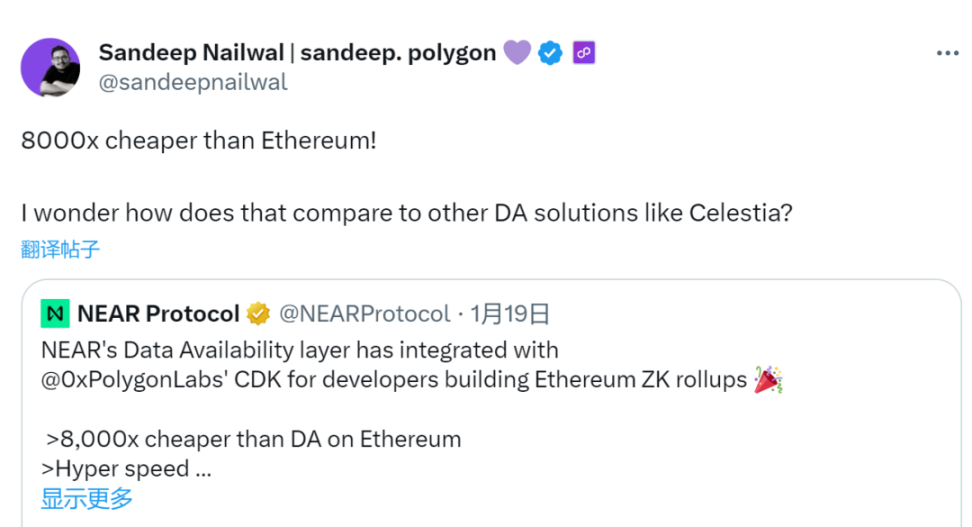
The first is the battle for DA legitimacy. When Celestia and other Ethereum external data availability (DA) solutions are killing everyone, NEAR has also begun to launch its own NEAR DA service. At present, Polygon has chosen to switch to NEAR, and bluntly said 8,000 times cheaper than Ethereum.
The second is the emerging new narrative of chain abstraction. As a further large-scale adoption plan for Web3 after account abstraction, the biggest imaginative space of chain abstraction is to separate the blockchain from users and re-engage DApps and project developers. Back to the user-centered paradigm.
To put it bluntly, it is to create a low-threshold Web3 product environment that is easy to get started and has an experience close to traditional Web2 applications, thereby eliminating the obstacles for users outside the circle to seamlessly enter the Web3 world.
After all, from a product perspective, many people may not need to know what Web3 is, and if it wants to become mainstream, Web3 must be easy for ordinary people to use - most people will not know the existence of Web3, this is enough, and currently Except for projects such as NEAR, the narrative of chain abstraction has not attracted widespread attention, so subsequent efforts may not be a new space for imagination.
Finally, there is the super narrative of AI, mainly due to the news that NEAR co-founder llia Polosukhin will appear at the NVIDIA AI Conference - he will attend the Transforming AI keynote speech and panel discussion during the GTC 24 conference on March 20. , NVIDIA founder Huang Jenxun will also participate in this event, which makes NEAR become the AI head public chain.
The reason behind it is simple and can be summarized in one sentence: llia Polosukhin is one of the co-authors of the AI research paper Attention Is All You Need released in 2017, and this paper is regarded as the foundation of the Transformer language model. , tracing back to its origins, all kinds of GPT that are emerging now originate from this paper.
Because of this, NEAR has recently become the only intersection project among the three popular narratives of DA + Chain Abstraction + AI, and its secondary market performance is even more impressive.
APT: Web3 mobile phone learns Solana, and on-chain liquidity accelerates
As two related projects that also come from Diem core team members, unlike Sui, where on-chain liquidity and secondary market performance have been booming in the past six months, Aptos seems to be lagging behind in the competition between the two.
However, some potential variables of Aptos are particularly worthy of attention recently. First of all, following the successful experience of Solanas first-generation Web3 mobile phone Saga, it launched its own Jambo Web3 mobile phone and plans to enter markets in Africa, Southeast Asia, Latin America and other markets through mobile phone hardware.
The $99 price does seem more attractive, but it remains to be seen whether it can ultimately be reused and achieve mass adoption in the blockchain era.
At the same time, since they are both Move-based public chains, liquidity switching within ecological protocols such as Cetus is more convenient. Therefore, with the large-scale improvement in liquidity on the Sui chain, the possibility of Aptos taking on part of the spillover funds for rotation is also Very high. The recent strength of APT compared to SUI may be a direct signal.
Arweave: Use AO to develop new narratives
The most indispensable thing in the crypto world is new narratives, but there are not many narratives that can form a linkage between the market and the track. Recently, Arweave is one, especially the public test network Arweave AO released at the end of February, which once ignited the popularity of AR and storage tracks. Especially the positioning of new generation Internet computer probably reminds many friends of Dfinitys grand vision. .
In general, with the help of AO, Arweave has gained additional verifiable distributed computing capabilities on the original storage layer. It can directly add a computing layer for calculation, thereby running various tasks on top of the data permanently stored in Arweave, allowing These data become more valuable and can actually be understood as a decentralized version of AWS based on SCP.
From this perspective, Arweave has implemented distributed verifiable cloud computing, which is a step further than traditional centralized cloud service providers such as AWS and Alibaba Cloud. It has expanded the narrative that was originally limited to permanent storage and completely opened up a new aspect of Arweave. The imagination space of decentralized data economy.
Telegram: With 900 million users, the elephant turns around
As a crypto user and Web3 player, apart from exchange applications, what is your most commonly used App? I believe that most people’s choice is Telegram, and TON, as an established L1 public chain, has recently experienced large gains due to Telegram and multiple expectations.
First of all, the expected spot listing after Binance lists the TON perpetual contract trading pair provides a trading environment with minimal liquidity for TON, stimulating the influx of large amounts of funds into TON and the TON ecosystem.
In addition, last month Telegram officially stated that the advertising platform will be officially open to all advertisers in nearly a hundred new countries. Channel owners in these countries will receive a 50% commission from Telegram’s revenue from displaying ads on their channels, and in order to To ensure fast and secure advertising payments and withdrawals, the TON blockchain will be used exclusively.
This has slowly opened up TONs biggest imagination space - to realize social + financial function scenarios such as encrypted asset transfer, trading, custody and so on directly in the Telegram application, with up to 900 million Telegram users, the potential is undoubtedly huge.
Filecoin: FVM ecology has a sudden death
On March 14, 2023, the Filecoin Virtual Machine (FVM) was officially launched on the Filecoin mainnet, by introducing programmable smart contracts and starting the Ethereum Virtual Machine (EVM) to run on FVM.
This also means that developers can deploy smart contracts written in Solidity or Yul and compile them into EVM, making the Filecoin network programmable for the first time.
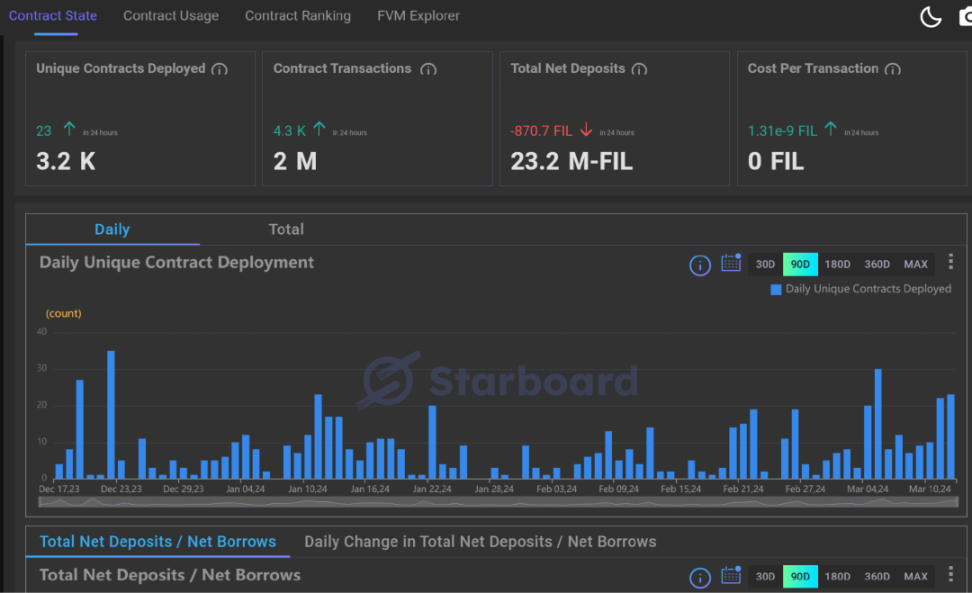
Starboard data shows that as of March 14, more than 3,000 contracts have been deployed on FVM, with net deposits exceeding 23.2 million FIL. Especially since 2024, Uniswap and others have begun to deploy on FVM. LSD protocols such as Glif and STFIL have also greatly improved the liquidity of the Filecoin ecosystem and the richness of DApp use cases.
summary
Generally speaking, public chains have always been the most imaginative long-term narrative in the Web3 world, from the new public chain craze of Polkadot, Cosmos, EOS, etc. in 2018 to the popularity of homogeneous chains and L2 networks such as BSC and Arbitrum in 2020. The rise of public chains in Solana, Avalanche and Move in 2021 and 2022 shows that public chains have never lacked protagonists.
Nowadays, as the prototype of a new bull market cycle is gradually emerging, the public chain track, which was full of hype and fanaticism in the early days, has also begun to move closer to the grand narrative and innovation. Peoples understanding of public chains is also constantly changing. In 2024, we may be able to see It is worth looking forward to the emergence of more practical and large-scale public chains.


