






To resolve disputes involving virtual currencies, should Hong Kong or Singapore be chosen as arbitration?


Original author: Lawyer Zhang Jun
01 Throwing of questions
Lawyer Mankiw has previously conducted legal education and everyone knows that arbitration has more advantages than litigation in resolving disputes involving virtual currencies. Under the New York Convention, arbitration can be widely recognized and enforced in more than 150 countries/regions, and has the advantage of being confidential and conducive to maintaining commercial relationships. In the current domestic environment where virtual currency investment transactions are prohibited or have limited or no protection, domestic arbitration is not considered and recommended, and international arbitration has entered our field of vision.
In international arbitration, the legal culture of Singapore and Hong Kong that blends Chinese and Western elements is more popular. Should you choose Hong Kong arbitration or Singapore arbitration? This article compares the Hong Kong International Arbitration Center and the Singapore International Arbitration Center to provide a reference for people in the currency circle when choosing international arbitration institutions.
02 What are the benefits of arbitration?
The Hong Kong International Arbitration Center defines arbitration as: Arbitration is a dispute resolution method based on the agreement of the parties. That is, the parties agree to submit the dispute to an arbitral tribunal composed of one or three neutral arbitrators appointed by or on behalf of the parties.
So what are the benefits of international arbitration? The main ones are neutrality, flexibility, saving time and cost, strong confidentiality, enforceability, and final decision.
neutral. When drafting an arbitration clause, the parties are free to choose a neutral seat of arbitration.
flexible. The parties can participate in selecting the arbitrator and agree on the applicable procedures, language and applicable law.
Save time and money. Because the arbitration procedure is flexible and the award is final, disputes can be resolved through arbitration more quickly than through court litigation or other dispute resolution methods, and are usually less expensive than court litigation.
Confidentiality. Arbitration hearings are held in private and awards are generally not public. Therefore, disputes are not leaked to the public, helping to maintain business relationships.
Enforceable. Enforcing foreign court judgments may be difficult without appropriate bilateral treaties. In the New York Convention, which is party to more than 150 countries and regions, each member state commits to recognize and enforce arbitral awards made in other member states.
One decision is final. Arbitral awards are usually final and not subject to review on merits, thus avoiding lengthy court appeals.
03 Where should I choose arbitration?
Queen Mary University of London, in association with White Case LLP, conducted the survey from October 2020 to March 2021 and published the International Arbitration Survey 2021: Adapting Arbitration to a Changing World. The 2021 Arbitration Survey shows that the top five most popular arbitration locations are London, Singapore, Hong Kong, Paris and Geneva. The five most popular arbitration institutions are the International Chamber of Commerce (ICC), Singapore International Arbitration Center (SIAC), Hong Kong International Arbitration Center (HKIAC), London Court of International Arbitration (LCIA) and China International Economic and Trade Arbitration Commission (CIETAC).
Therefore, we choose two typical international arbitration institutions for comparison, namely the Hong Kong International Arbitration Center and the Singapore International Arbitration Center, as a reference for selecting international arbitration institutions.
1. Characteristics and advantages of Hong Kong International Arbitration Center (HKIAC)
First of all, in terms of reputation, location, facilities and secretariat experience: the Hong Kong International Arbitration Center is an arbitration institution in Hong Kong that enjoys a high reputation in the field of international arbitration. It maintains a very high status in international arbitration with its good arbitration experience and is located in prosperous Hong Kong is an open and international city with modern arbitration facilities and, most importantly, an international and experienced secretariat.
Secondly, the Hong Kong International Arbitration Center has leading arbitration rules, which are relatively efficient and cost-saving. The 2018 Hong Kong International Arbitration Center Institutional Arbitration Rules (hereinafter referred to as the “2018 HKIAC Arbitration Rules”) are the most modern and comprehensive arbitration rules currently on the market. The main features are:
The method of payment of arbitrator fees is optional. One is based on hourly rates; the other is based on the size of the subject matter in dispute. The second payment method based on the subject matter of the dispute takes into account the payment habits of parties in mainland China, making the Hong Kong International Arbitration Center more able to attract parties from mainland China and making it more competitive.
More flexibility in handling complex cases. The legal system of Hong Kong, China, is inherited from the common law system. The 2018 HKIAC Arbitration Rules give the arbitration parties maximum flexibility. The Hong Kong International Arbitration Center procedures implement a light management model. The HKIACs 2018 HKIAC Rules The arbitration process will proceed in a minimal intervention mode with no unnecessary intervention.
Handle complex cases more efficiently. Comprehensive provisions such as the consolidation of arbitral proceedings when additional parties are added and the ability to initiate a single proceeding under multiple contracts make arbitration more efficient. The application of the 2018 HKIAC Arbitration Rules has increased flexibility in handling complex cases, allowing disputes under multiple contracts to be heard in one arbitration.
Provide emergency arbitrator proceedings. The HKIAC Rules provide for emergency arbitrator procedures to apply for enforceable emergency interim relief in arbitral proceedings. Although mainland China does not recognize emergency arbitration procedures due to different restrictions in the judicial system, the emergency arbitration procedures provided by the Hong Kong International Arbitration Center have great advantages in jurisdictions that recognize this procedure.
Thirdly, the Hong Kong International Arbitration Center has unique advantages in handling China-related disputes.
Can be preserved in mainland China. The Hong Kong International Arbitration Center is an international arbitration. The Arrangement Concerning Mutual Assistance and Preservation between the Courts of the Mainland and the Hong Kong Special Administrative Region in Arbitration Proceedings signed by Mainland China and Hong Kong, China and came into effect on October 1, 2019, enables the Hong Kong International Arbitration Center to China Insurance Asset Management has advantages over mainland property that other regional international arbitration institutions do not have.
Rich experience in handling cases involving mainland China. Data show that the Hong Kong International Arbitration Center is the arbitration institution that handles the largest number of cases involving mainland Chinese parties among all international arbitration centers.
Mainland China takes the lead in recognition and enforcement. The Hong Kong International Arbitration Center has an excellent record of enforcing awards in the Mainland. Chinese courts have so far only rejected three Hong Kong International Arbitration Center arbitrations. Hong Kong, China, is a party to the New York Convention, which means that Hong Kong arbitral awards can be enforced in more than 150 contracting states. However, Hong Kong and Mainland China have different regulations on the recognition and enforcement of arbitration. The ones that apply are the Arrangements of the Supreme Peoples Court on the Mutual Enforcement of Arbitral Awards between the Mainland and the Hong Kong Special Administrative Region on February 1, 2000 and November 27, 2020. On the same day, the Supreme Peoples Court of China and the Department of Justice of Hong Kong signed the Supplementary Arrangement on the Mutual Enforcement of Arbitral Awards between the Mainland and the Hong Kong Special Administrative Region (referred to as the Supplementary Arrangement) and other relevant bilateral mutual judicial assistance agreements.
To sum up, the Hong Kong International Arbitration Center not only has advantages over other international arbitration centers in terms of arbitration enforcement, preservation and case experience in mainland China, but also has made a series of positive and beneficial attempts in the legal protection of virtual currencies. However, on the basis of legal recognition, we are still constantly exploring and experimenting with how to achieve the orderly and beneficial development of virtual currencies. It can be seen that the Hong Kong International Arbitration Center is a good choice.
2. Features and advantages of the Singapore International Arbitration Center (SIAC)
According to the 2021 Arbitration Survey, Singapore is the second most preferred seat of arbitration in the world and the most popular seat of arbitration outside Europe.
First, in terms of reputation, location, facilities and secretariat experience: the Singapore International Arbitration Center has a strong record of providing neutral services to the global business community. It is located in Singapore, a city with a strong rule of law that combines East and West. The Singapore International Arbitration Center International Arbitration Group has 40 jurisdictions. It is composed of more than 600 expert arbitrators from the region and has an international team of case managers.
Secondly, Singapore’s arbitration legislation adopts a “dual-track system” and distinguishes between domestic and international arbitration. The basis is the Arbitration Act and the International Arbitration Act. The Arbitration Act applies to domestic arbitration. , the Application of International Arbitration Law applies to international arbitration.
The Singapore International Arbitration Center Rules, 2018 (the “SIAC Rules 2018”) are the currently applicable arbitration rules. The main features are:
Arbitration Fees. Under the SIAC Rules 2018, case costs include case management fees and arbitrator fees. The arbitrators fees are calculated according to the subject matter of the dispute, that is, based on the amount of the subject matter of the dispute, or can be agreed upon by both parties before/after submission for arbitration. The case management fee, that is, the management fee is linked to the subject amount of the disputed amount, and there is a minimum fee standard.
Provide emergency arbitration proceedings. The 2018 SIAC Rules require the appointment of an emergency arbitrator within 1 day from the date of receipt of the partys application and payment of the management fee and security deposit, which can provide timely and flexible emergency arbitration services to the arbitration parties.
The seat of arbitration does not default to Singapore. Under the 2018 SIAC Rules, if the parties have not agreed on the seat of arbitration, the arbitral tribunal shall determine the seat of arbitration after considering all the circumstances of the case. The clause stipulating that Singapore serves as the default seat of arbitration when the parties have not agreed on the seat of arbitration has been cancelled. This also reflects the Singapore International Arbitration Center’s ability to provide convenient and flexible arbitration in response to international business needs.
Recognition and Enforcement of Arbitration. Singapore is a party to the 1958 New York Convention, which means that arbitral awards from the Singapore International Arbitration Center can be enforced in more than 150 contracting states. Mainland China and Singapore have no special arrangements to facilitate the recognition and enforcement of arbitrations.
Have virtual currencies become officially recognized legal tender in Hong Kong and Singapore? the answer is negative. Singapore and Hong Kong recognize virtual currencies as “special” virtual commodities that can be used as the underlying asset allocation of trusts. Here, the interpretation of special is particularly important. The special thing is that virtual currency has no practical value, but can directly replace tangible property (for example, vehicles), intangible property (for example, trademark rights) or legal tender. (for example, Hong Kong dollars, Singapore dollars) as the underlying assets of the trust assets.
It can be seen that whether in Hong Kong or Singapore, virtual currencies are not protected as legal tender, but as virtual property. However, compared with mainland China, it has already taken a big step forward.
3. Comparison between the Hong Kong International Arbitration Center and the Singapore International Arbitration Center
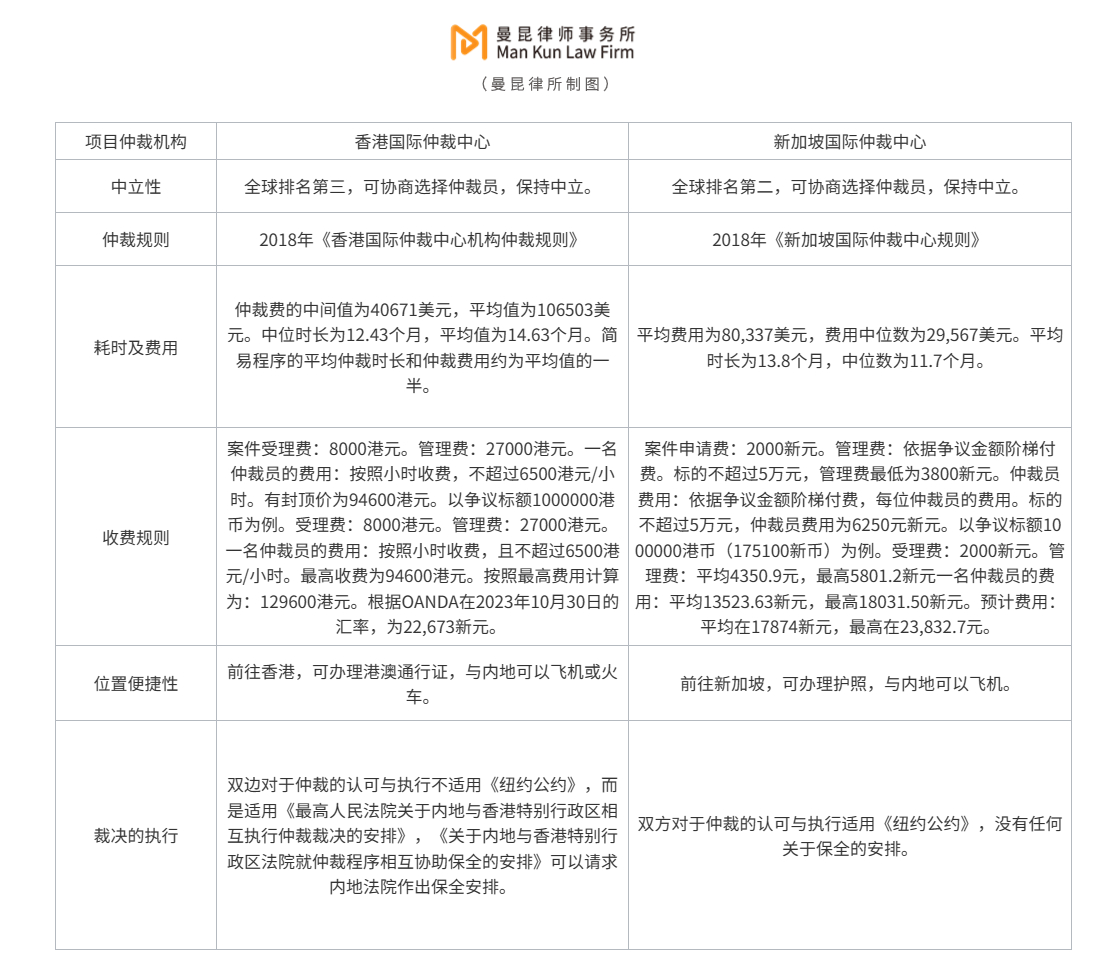
04 Mankiw lawyer’s advice
When agreeing on international arbitration for disputes involving virtual currency. Attorney Mankiw advises here:
In terms of fees, the estimated maximum fees at the Singapore International Arbitration Center are slightly higher than those at the Hong Kong International Arbitration Center;
From the perspective of being more familiar with the judicial environment in the mainland, the Hong Kong International Arbitration Center is more familiar with the judicial environment in the mainland of China as it is also a place where Chinese and foreign cultures blend;
From the perspective of application and enforcement in the mainland, it is relatively better to give priority to the Hong Kong International Arbitration Center. Of course, if the corporate entities of both parties are established in Singapore, or the property is located in Singapore, based on the principle of cheap arbitration, the Singapore International Arbitration Center is the best choice.


