






Arthur Hayes: Even if the Fed has to continue raising interest rates, Bitcoin can still survive.


Original Translation: GaryMa Wu about blockchain
Note: This article is a translated version of the original, and some content has been truncated and summarized during the translation process. Due to length restrictions or other reasons, some details or information may not be fully translated or may be deleted. We recommend that readers refer to the original text while reading this article to obtain more comprehensive information.
American market participants are not so patient in their journey to accumulate more wealth. As we endlessly search for the next bull market, we often ask ourselves, "Are we there yet?" And in the cryptocurrency market, we often ask ourselves, when will the crap coins in our wallets reach the highs of November 2021 again.
Smarter traders are looking for leading indicators that may indicate the approach of a bull market, with the goal of determining when to fully enter the cryptocurrency market. Like a Pavlovian dog, we have been trained by our central bank owners to buy financial assets whenever they cut interest rates or print money on a large scale to expand their balance sheets. We focus all our attention on every word of these charlatans, hoping they will provide free funds to drive risk asset returns.
Federal Reserve balance sheet (white) and Bitcoin (yellow), initial index value is 100
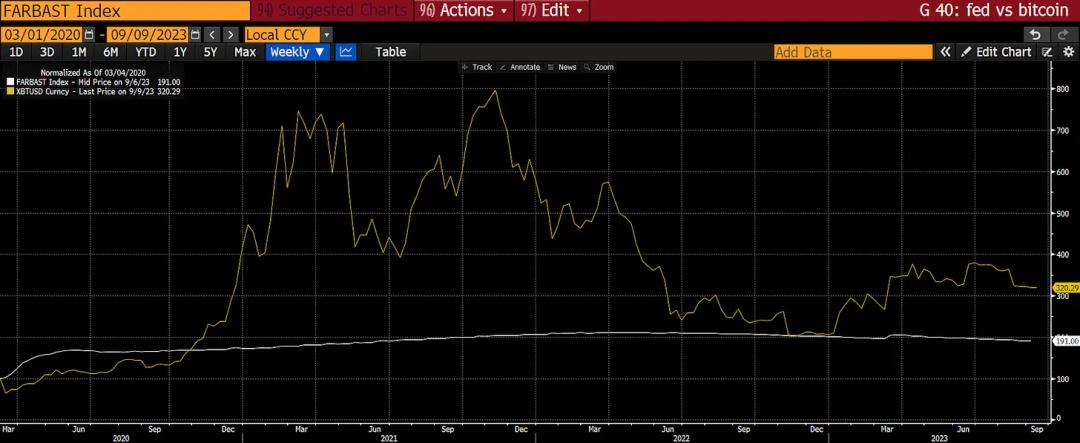
During the pandemic, Bitcoin outperformed the Federal Reserve's balance sheet growth of 129%, confirming that our reflex to invest based on the erroneous predictions of Federal Reserve Chairman Powell has been quite profitable.
Since the Federal Reserve began raising interest rates in March 2022, a group of macroeconomic analysts have been trying to guess when the Fed will stop. I have presented readers with a series of reasons why I believe the Fed's rate hike cycle will eventually lead to some form of financial disaster that will require them to cut rates and expand their balance sheets.
On March 10th of this year, Silicon Valley Bank and Signature Bank experienced serious balance sheet issues under the Fed's policies. By Sunday night, it was clear that these banks were hopeless, unless the Fed and the U.S. Treasury truly wanted to uphold the values of free market capitalism and let a poorly managed traditional financial company go bankrupt, some form of relief was imminent. As expected, the Fed and the Treasury intervened and provided a form of relief in the form of the Bank Term Funding Program (BTFP). The BTFP provided unlimited vitality to the U.S. banking system, as banks could hand over their junk U.S. bonds to the Fed and receive new dollars in return. These dollars were then provided to depositors, and depositors chose to flee because money market funds (MMFs) offered interest rates of over 5%, while bank deposit rates were close to 0%.
This is a critical moment. Me and many others believe that the Fed has definitely stopped raising interest rates. The real priority for the Fed is to protect banks and other financial institutions from failure, as the rot of underwater bond debt spreading throughout the financial sector threatens the entire system. It seems that the Fed's only choice is to cut interest rates, restore the health of the US banking system, and then watch Bitcoin soar to $70,000.
But that's not the case. On the contrary, the Fed has raised interest rates three times from March to now.
When your predictions have been consistently wrong, it's time to reconsider the facts you thought you knew and explore scenarios of "what if I continue to be wrong". In this case, it means starting to think about whether my investment portfolio can survive if the Fed continues to raise interest rates.
Last week, I delivered a keynote speech at the Korean Blockchain Week conference, exploring the question of whether Bitcoin can still rise if the Fed and other major central banks continue to raise interest rates. For those who weren't there or think I'm progressing too quickly on certain concepts, this is an essay discussing this issue.
What if?
What if the US doesn't go into a recession?
What if inflation doesn't go down?
What if the US financial system doesn't collapse?
If these hold true, then we can expect the Fed and other major central banks to not cut interest rates, but to further raise them.
Historical and current real yields
What is a real yield? It's a rather vague concept that varies depending on the individual. My (slightly simplified) definition is that if I lend money to the government, I should at least receive a return that matches the growth rate of nominal GDP. If I receive a return lower than this value, the government is profiting at my expense.
Clearly, the government wants to finance itself at rates lower than the economic value produced by its debt. Using financial repression to ensure that the growth rate of nominal GDP is higher than bond yields has been the policy of all the most successful export-oriented Asian economies since the end of World War II. Japan, South Korea, and others have utilized this strategy to recover from the destruction their nations experienced after World War I. Governments must employ their banking system to implement this type of financial repression. Banks are instructed to provide depositors with low interest rates. Then, the government introduces restrictions to prevent them from transferring funds out of the system. Then, banks are told to lend at low interest rates to state-supported or government-related large heavy industrial companies.
Deposit rates < corporate loan rates < nominal GDP growth rate
The result is that these capital-intensive industrial companies obtained cheap financing to rapidly build modern manufacturing bases. Then, the government used these manufacturing bases to accumulate sovereign wealth which was reinvested in US government bonds and other dollar-denominated financial assets. It is said these funds could be tapped during economic difficulties. Ordinary people were able to secure high-paying blue-collar manufacturing jobs, which offered lifelong security. Compared to their previous lives as agricultural farmers, their living standards were significantly improved as they now worked in big companies with full benefits, working eight hours a day. This was a major improvement for them.
The actual yield = government bond yield - nominal GDP growth
This financial repression strategy only works when funds cannot leave the banking system. That's why countries like South Korea have closed capital accounts. Or in the case of Japan, where it's practically impossible for foreign financial companies to promote or accept Japanese depositors, resulting in ordinary Japanese investors being trapped in a negative real yield situation by partnering with Japanese banks. However, in the current digital age, this strategy becomes more difficult to execute, especially considering the rise of alternative and decentralized financial systems like Bitcoin. When the actual yield is persistently negative, depositors can now leave before the door closes (or at least they think they can).
Let's take a look at the actual yield in the United States from 2022 till now.
U.S. 2-year Treasury bond yield minus U.S. nominal GDP growth rate
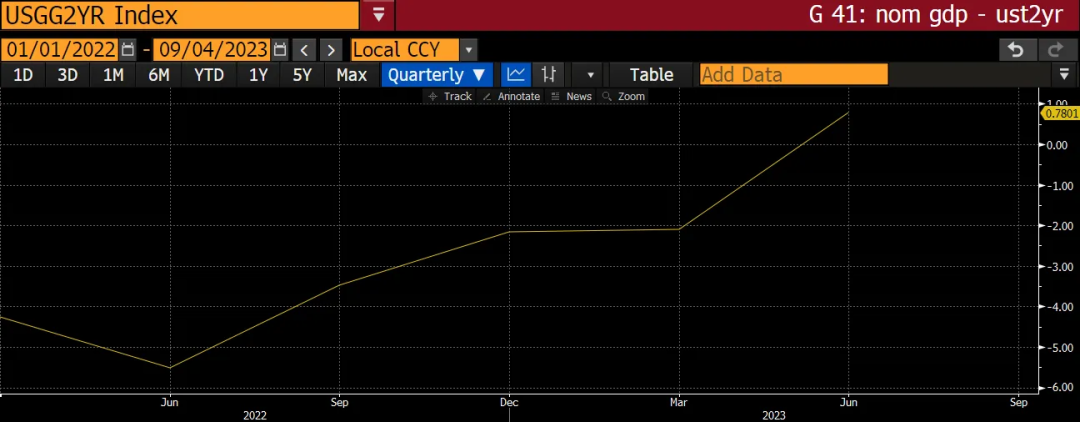
I use the 2-year U.S. Treasury bond yield to represent the government bond interest rate because it's the most popular and liquid instrument for tracking short-term rates. As you can see, when the Fed started raising rates in March 2022, the real interest rate did turn negative. Despite the Fed raising rates at an unprecedented pace, the real rate is now just a slight positive. Even if you substitute the 2-year yield with the 10-year or 30-year yield, the real rates remain negative. That's why it's foolish to buy long-term bonds with your own money. Institutions still do it because when you're a trustee playing with other people's money and earning hefty management fees for mediocrity in intellect and skill, financial accountability goes out the window.
When I look at the chart above, my next question is, "What can we expect for future real yields?" The Atlanta Fed publishes a "GDPNow" forecast, which is a real-time estimate of current-quarter GDP growth. As of September 8, the Fed is forecasting an incredibly massive growth for the third quarter of 5.7%. To come up with the nominal growth rate, I added 3.7%, which is the average difference between nominal and real growth over the past six quarters.
GDP actual growth of 5.7% + GDP deflator growth of 3.7% = 9.4% nominal GDP growth for the third quarter
Projected actual yield for the third quarter = 2-year U.S. Treasury bond yield of 5% - third quarter nominal GDP growth of 9.4% = -4.4% actual yield
What on earth is happening here! Traditional economics says that when the Fed raises rates, growth in credit-sensitive economies slows. Common sense tells us that in such a case, nominal GDP growth should decline, and real interest rates should rise. But that's not happening.
Let's take a look at why.
No money, no happiness
The government earns money through taxation and then spends it on various things. If the spending exceeds the tax revenue, they will issue debt to finance the deficit.
The main export of the United States is finance. Therefore, the government earns a significant amount of capital gains tax revenue from the stock and bond markets.
The pandemic bull market from 2020 to 2021 generated a lot of tax revenue from the wealthy. However, starting from early 2022, the Federal Reserve began raising interest rates. Higher rates quickly impacted the financial asset markets. This is the main reason why good guys like Sam Bankman-Fried and crypto entrepreneurs like Su Zhu and Kyle Davies collapsed.
Below is a chart from 2022 to present, benchmarked at 100, showing the returns of the S&P 500 Index (yellow), Nasdaq 100 Index (white), Russell 2000 Index (green), and Bloomberg US Agg Total Return Bond Index (magenta).
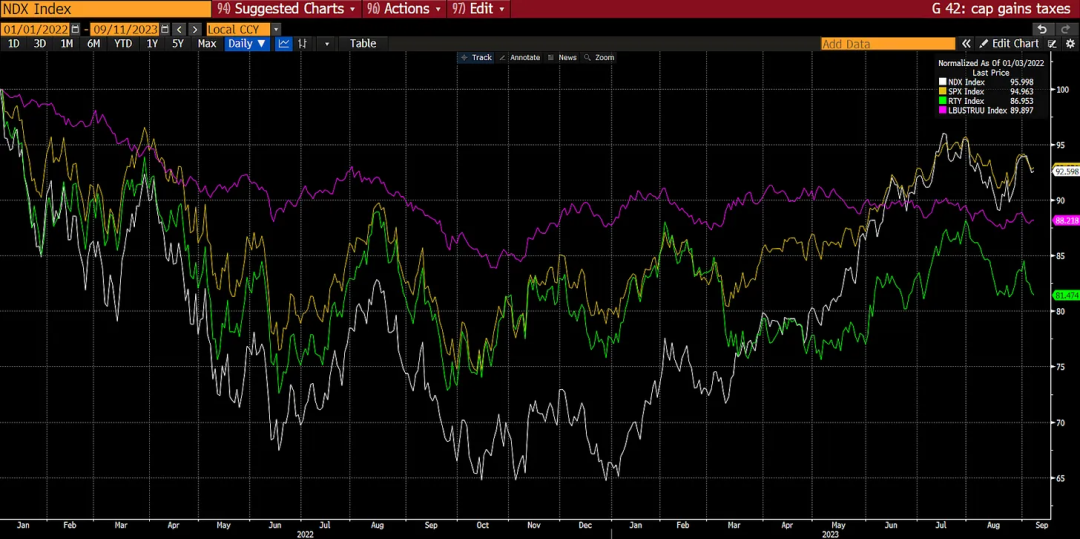
As you can see, no one has made money since early 2022. As a result, capital gains tax revenue has plummeted. The Congressional Budget Office estimates that capital gains realized in 2021 accounted for around 9% of GDP. These tax revenues have diminished rapidly as the Federal Reserve takes action against inflation.
"Data processing shows that the revenue realized in 2021 increased significantly – an estimated 8.7% of GDP, the highest level in over 40 years," according to the IRS.
Furthermore, it is important to remember that the top priority for any politician is re-election. The older generation of the "baby boom" has always promised relatively free healthcare, while the American public enjoys energy consumption levels far higher than anywhere else in the world. Given these two facts, it can be assumed with certainty that politicians who propose cutting healthcare expenditures and/or defense budgets will not be re-elected. Instead, as the population ages and the world becomes more multipolar, the government will continue to increase expenditures in these two areas. If spending increases while revenue decreases, deficits will inevitably rise. Since GDP is just a snapshot of economic activity, when the government spends money, it technically increases GDP – regardless of whether the spending is truly productive.
US government deficits as a percentage of nominal GDP
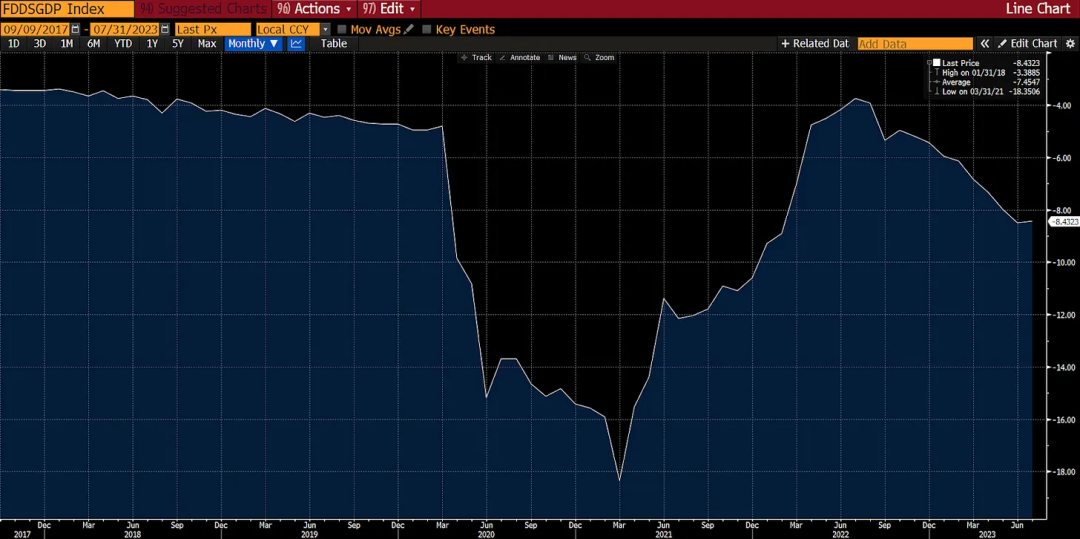
The rising deficit must be financed by selling more bonds. By the end of the year, the U.S. Treasury must sell an additional $1.85 trillion in bonds to repay old debts and cover the budget deficit. In addition to the need to issue these bonds, the Fed is also raising interest rates, further increasing the amount of interest that the U.S. Treasury must pay.
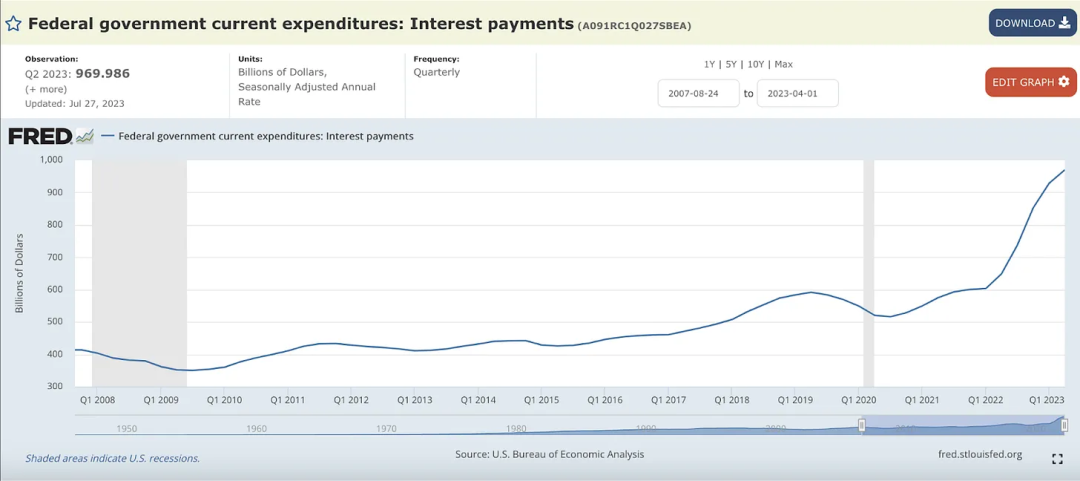
As of the end of the second quarter, the U.S. Treasury spends $1 trillion annually on interest payments to debt holders. Given that most of the wealth is concentrated in the top 10% of households (meaning these households hold most of the government debt), the U.S. Treasury is effectively distributing welfare to the rich in the form of interest payments.
When the elites have accumulated enough money to pay for the most essential parts of their lives (housing and food), what do they buy? They spend money on services. Approximately 77% of the U.S. economy is service-related. In summary, as interest rates rise, the government pays more interest to the wealthy, who in turn consume more services with their interest income, further increasing GDP.
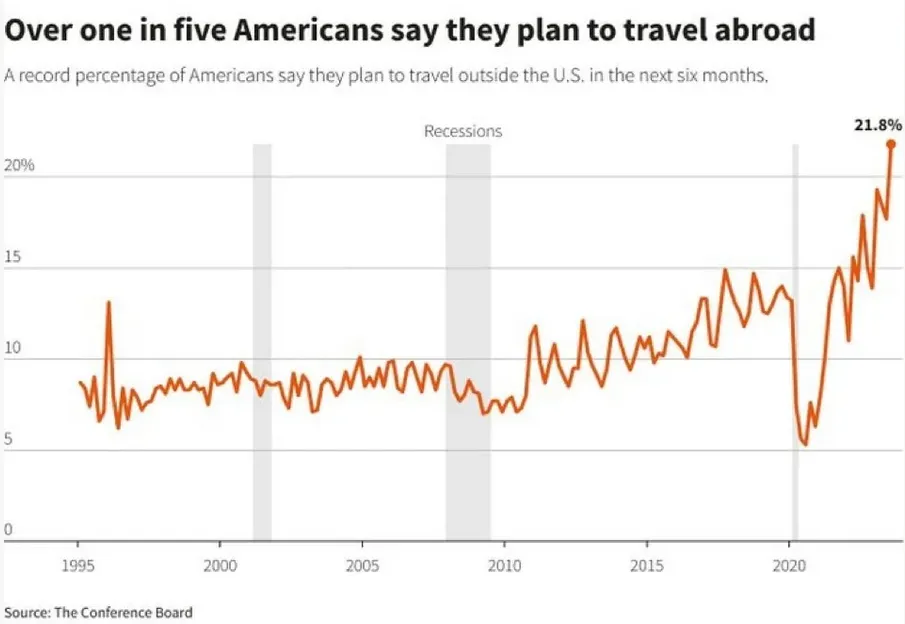
The Circle of Mutual Praise
Let's put it all together, step by step, and see how Fed rate hikes increase nominal GDP, resulting in more Fed monetary tightening.
The Fed must raise interest rates to combat inflation.
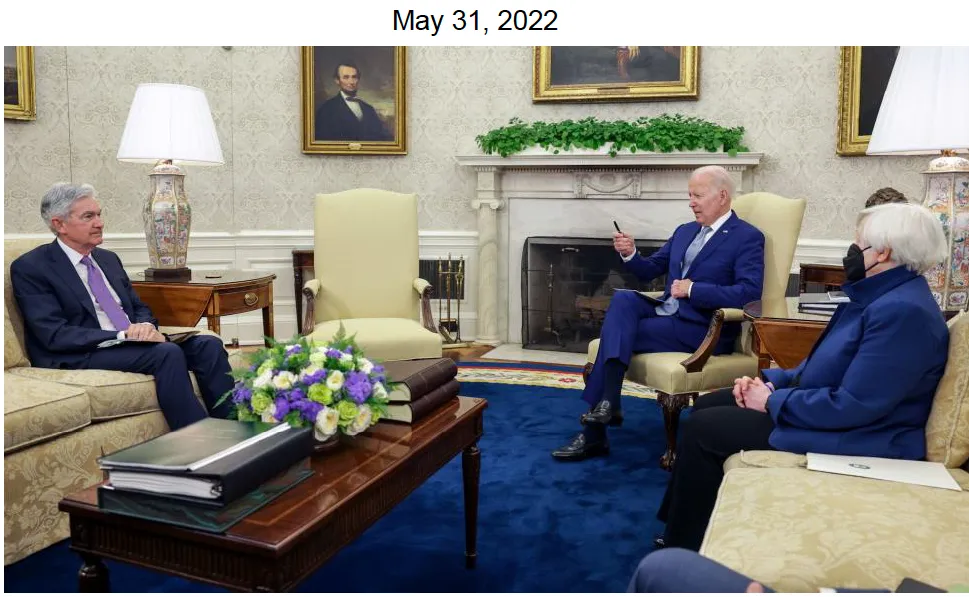
I will never get tired of this photo. Powell looks like a fool, while Biden points at him with a pen, directing the Fed to combat inflation.
Financial asset prices fall, and then tax revenues also decline.
Except for some outstanding tech stocks like Nvidia, most companies that produce physical products are struggling due to rising credit costs and a decrease in credit supply, which in turn causes their stock prices to fall. In the world's largest asset market, bonds are expected to suffer losses for the second consecutive year based on total returns. With broader stock and bond markets still below their 2021 highs, government capital gains tax revenue is sharply declining.
In the face of declining tax revenue, increasing government spending, and rising deficits, the deficit continues to grow. The more the government spends, the larger the deficit becomes. If more spending = higher deficit, and more spending also = higher nominal GDP growth, then logically, higher deficit = higher nominal GDP growth.
Due to high interest rates, the U.S. Treasury must issue more bonds at higher rates.
Wealthy savers have not had this much interest income in over twenty years.
The rich will use their interest income to consume more services, further driving nominal GDP growth.
About 77% of the U.S. GDP is made up of the service sector.
Inflation becomes stubborn because nominal GDP growth > government bond yields.
Higher bond yields have not curbed U.S. government spending because the U.S. government benefits netly from this situation. When the government finances itself at a rate lower than the rate of debt growth, the ratio of debt to GDP actually declines. This is exactly the same policy that the U.S. government implemented to repay its massive domestic war debt after World War II.
The Fed must raise rates to combat inflation.
As GDP growth continues to exceed bond yields, inflation will rise from its current "sluggish" level and remain high. As long as inflation is far above the Fed's 2% target, they must continue to raise rates.
Fatal Weakness
Mr. Powell can continue to raise rates as long as the market is willing to accept rates lower than nominal GDP growth. However, Mr. Nakamoto introduced an alternative financial system to the world, which includes a fixed supply of currency and a decentralized, almost instantaneous payment network called Bitcoin. Banks face unprecedented competition. (Of course, you could previously withdraw money from the bank to buy gold, but using heavy gold in daily life is impractical.)
If the market demands at least a 9.4% yield (equivalent to the predicted nominal GDP growth rate) on U.S. treasuries, the situation will reverse. Then, the Fed must either ban banks from allowing funds to be transferred to digital financial technology companies that offer physical cryptocurrencies or they must restart quantitative easing (also known as printing money) and buy bonds to ensure that their yields remain below nominal GDP growth. I will continue to remind you that buying ETFs will not remove your funds from the traditional financial system. The only way out is to buy Bitcoin and withdraw it to your own wallet, where you will hold the private keys.
It is reasonable to assume that when there is a financial escape channel like Bitcoin, the market will grow weary of paying profits to the government. But in the rest of this analysis, I will assume that the Fed will be able to continue on the path of raising rates without too much money escaping from the U.S. banking system.
Changing Financial Climate
We are taught to believe that when interest rates rise, the prices of risky financial assets such as Bitcoin, stocks, and gold should fall. However, due to the government's continued spending spree and the push for GDP growth, it appears that the actual returns earned on seemingly valuable government bonds of around 5% may actually be closer to -4% —— which means that risk assets are still a very attractive choice for investors.
Investors seeking a positive return on investment have created a Bitcoin bull market, which officially began on the fateful weekend of March 10, 2022. Since then, the price of Bitcoin has risen by nearly 29%. While the price has tested $30,000 multiple times without breaking through, Bitcoin is still trading at levels above its pre-banking subsidy level of $20,000.
The market is quietly telling us that if the Federal Reserve continues to raise interest rates, real interest rates will become more negative and will remain so for the foreseeable future. If that weren't the case, shouldn't Bitcoin be hovering around $16,000? The reason we haven't reached $70,000 is because everyone is focused on the nominal federal benchmark interest rates, rather than the real interest rates compared to the astonishing nominal GDP growth in the United States. However, this information is slowly spreading through various mainstream media government mouthpieces like The Washington Post:
Felman said, "It's really shocking to see this in an economy with low unemployment. It has never happened before. A good and strong economy without new emergency spending - but such a huge deficit. It is so big within a year that you think something strange is happening."
As people become increasingly aware that holding bonds is a fool's game even with short-term nominal interest rates at 5.5%, edge capital will start seeking hardcore financial assets. Certain assets such as Bitcoin, large tech/artificial intelligence stocks, and productive farmland will continue to rise and perplex most financial analysts (who are actually just average intelligence and ability trustees who can earn handsome management fees by using other people's money). They don't understand why Bitcoin can remain resilient because what they see is a manipulated market controlled by the Federal Reserve's asset purchases, such as the yield of inflation-protected bonds (TIPS) - which (seemingly) are positive and rising.
Setting aside the flawed analysis we will undoubtedly read in mainstream financial news, I believe I have demonstrated that Bitcoin can survive even if the Federal Reserve has to continue raising interest rates. This gives me peace of mind because even though I still believe the base case scenario is the Federal Reserve being forced to lower rates close to zero and restart the QE money printing machine, even if I'm wrong, I still believe cryptocurrencies can rise significantly.
The reason Bitcoin has such a positive convex relationship with Federal Reserve policy is that the level of debt to GDP is extremely high, and traditional economic relationships have collapsed. It's similar to raising the temperature of water to 100 degrees Celsius, it remains in liquid state until suddenly boiling and turning into gas. In extreme situations, things become nonlinear - sometimes binary.
The US and global economies are in such extreme states. Central banks and governments are trying to employ outdated economic theories to deal with present-day circumstances, while a global debt-to-GDP ratio of 360% is creating a reverse situation that requires rethinking the correlation between assets.
Indeed, it is possible to teach an old dog new tricks, but the prerequisite is that the dog must have a willingness to learn. The scoundrels ruling in our name, whom we tolerate, do not have such a desire to learn. Therefore, the great master Satoshi Nakamoto will punish them with a powerful Bitcoin.


