






Arbitrum launches the first L3 XAI, the competition with Optimism may just be beginning.


Original Author: yyy (@y_cryptoanalyst)
Focus on the Rollup track, the epic battle between Arbitrum and Optimism is truly exciting. Optimism expands its territory horizontally with its OP Stack, while Arbitrum takes a different path with Arbitrum Orbit to initiate vertical L3 transformation. The Arbitrum team personally launched the first L3-XAI based on Arbitrum Orbit and officially declared war on Optimism.
In my opinion, the launch of XAI holds strategic importance for Arbitrum as it is a direct challenge to OP. Leveraging its strong B-side resources, OP has successively driven the construction of L2 chains for Binance and Coinbase based on its OP Stack, greatly expanding the L2 ecosystem map. At that time, Arbitrum seemed silent and without much action. The rapid launch of XAI when OP is developing vigorously does not seem to be a coincidence.
Arbitrum Orbit
Before discussing XAI, we have to talk about Arbitrum Orbit. Arbitrum Orbit is a universal modular L3 stack that allows developers to build dedicated L3 chains on it. Transactions on the L3 will be settled through Arbitrum L2 (Arbitrum One or Nova). XAI is built on Arbitrum Orbit and focuses on gaming scenarios.
Arbitrum Nova vs. XAI
Nova is a universal L2 focused on gaming scenarios, which should already meet the needs of gaming scenarios. Why introduce XAI? The reason is simple: compared to the positioning of Nova as a gaming public chain, XAI as a gaming-specific L3 can achieve higher performance and have dedicated computing and storage resources. This makes resource-intensive use cases on the chain possible, such as computationally intensive AI models.
XAI benefits natively from Arbitrum's technology stack: Nitro+ BOLD+ Stylus. Nitro is the upgrade of One's technology stack. It directly compiles the core of Geth, which is a mainstream Ethereum client, through the underlying layer of client software, thereby achieving higher Ethereum compatibility. The differences between Arbitrum Nitro/One/Nova have been discussed separately before and will not be repeated here. (Related Link)
BOLD
BOLD is the permissionless verification mechanism proposed by the Arbitrum team, aiming to minimize the latency of settlement states. In plain terms, for optimistic Rollups, there is generally a challenge period of one week, during which users have to wait for one week to withdraw from L2 to L1. If the validators find any problems with the submitted L2 transactions during the challenge period, they can initiate a challenge.
There are two questions about this challenge: 1) Who has the authority to challenge? 2) Why isn't anyone allowed to challenge?
The current fraud proof challenge mechanism is not permissionless and is carried out by specific roles acting as challengers. If the challenge is permissionless, malicious challengers can prevent settlement states from being confirmed by launching DDoS attacks.
For example, a withdrawal may normally take a week to arrive, but in reality, it takes even longer.
By introducing the BOLD mechanism, on one hand, it allows for permissionless verification, which is more in line with the decentralized nature of blockchain; on the other hand, it minimizes the latency of settlement states. BOLD enables a single honest validator to win against any number of opponents on Ethereum while in dispute, making DDoS attacks ineffective.
Stylus
Stylus is an open-source SDK developed by Arbitrum that supports building applications in multiple languages. It is a product that achieves EVM+ compatibility. In short, developers can use both traditional Solidity language and WASM compatible languages such as Rust, C, and C++ to build applications on Arbitrum. Additionally, Stylus makes the execution of Dapps more efficient and significantly reduces gas costs.
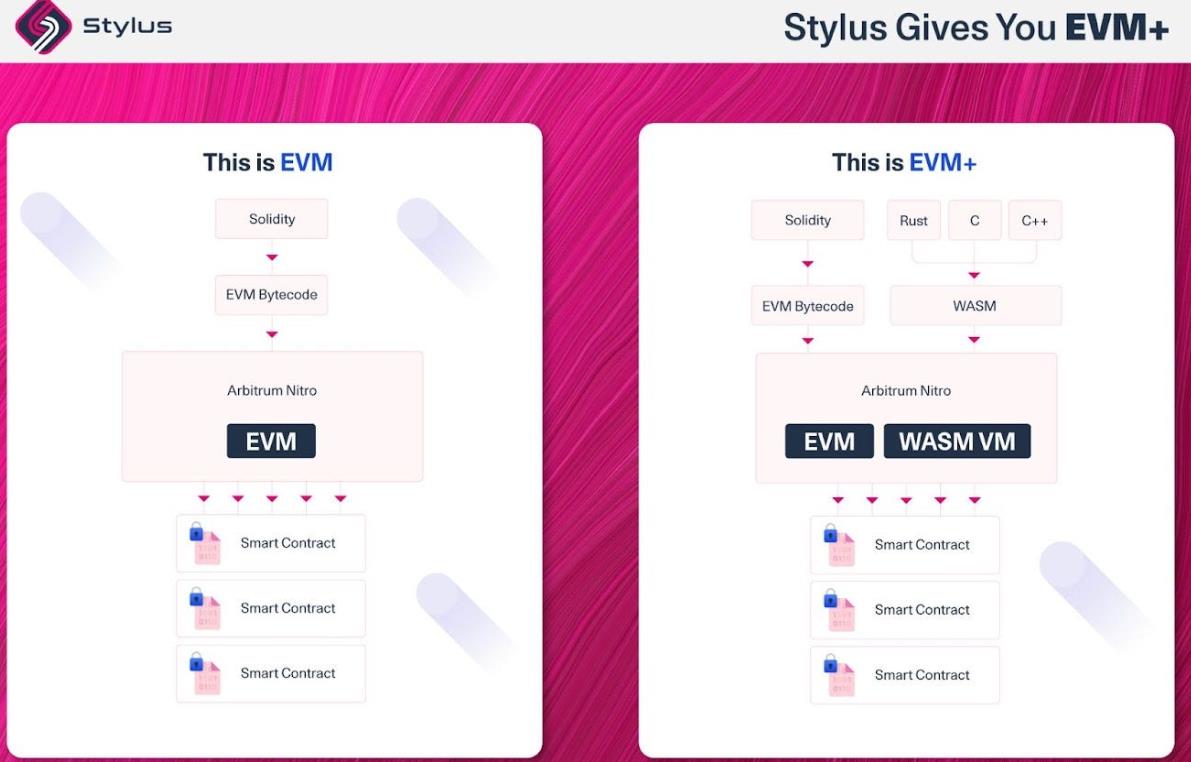
Stylus is not limited to supporting Rust, C, and C++. For example, it also supports Move, Sway, Cairo, and Go. Imagine in the future, dApps on Aptos/Fuel/StarkNet can easily migrate to Arbitrum. It can even achieve one-click chain upgrade of L3 chain through Arbitrum Orbit.
What's more interesting is that BOLD and Stylus are both universal modular components;
Developers can natively integrate BOLD and Stylus based on the launch of specific use cases on Arbitrum Orbit;
They can also vote to decide the integration of the above modular components after the smooth operation of L3 through decentralized DAO governance.
XAI has fired the first shot in the defense of Arbitrum L2, and this competition with Optimism may have just begun.


