






LD Capital: Is the importance of the MEV track underestimated?


Original Author: Yilan, LD Capital
1. Understanding MEV
When Ethereum still uses the PoW mechanism, MEV stands for value extracted by miners. Under the POS mechanism, miners have been replaced by validators, and MEV stands for maximum extractable value, which controls transactions with a small number of opaque mining pool operators under PoW. Sorting and obtaining benefits are different. Under the PoS mechanism, the right to sort and arbitrage transactions within the block is open to anyone, who can participate in the open market of block space arbitrage by playing different roles. Paradigm’s GP Dan categorizes MEV as EIP-1559 burn, hedging, rebalance loss, and price changes before and after transactions. The understanding of breaking the obscure term MEV is that part/all of the value captured through transaction ordering privileges on any chain can be classified as a certain type of MEV. Therefore, arbitrage on the chain is sometimes collectively referred to as MEV, and MEV is also regarded as A by-product, permissionless incentive in the blockchain that users can withdraw on a first-come, first-served basis.
For example, suppose user A sells 100 ETH in AMM. Due to the AMM algorithm mechanism, each unit of asset sold will lower the price. If an asset is sold in large quantities, the price of the asset will be lower than the current market price. Slippage occurs. After discovering such a transaction, MEV searchers will buy ETH at the new price and sell it at the market price, completing arbitrage. In this example, the transaction initiated by the MEV searcher needs to be the first transaction after user A in order for the arbitrage to be successfully completed. Therefore, it can be seen that MEV searchers face huge competition, and how to be the first transaction before and after a certain transaction usually depends on the priority fee paid to be included in the block first. , MEV searchers participate in the gas fee auction market in order to allow miners to package transactions in time, resulting in fierce competition that pushes the cost of gas fees very high.
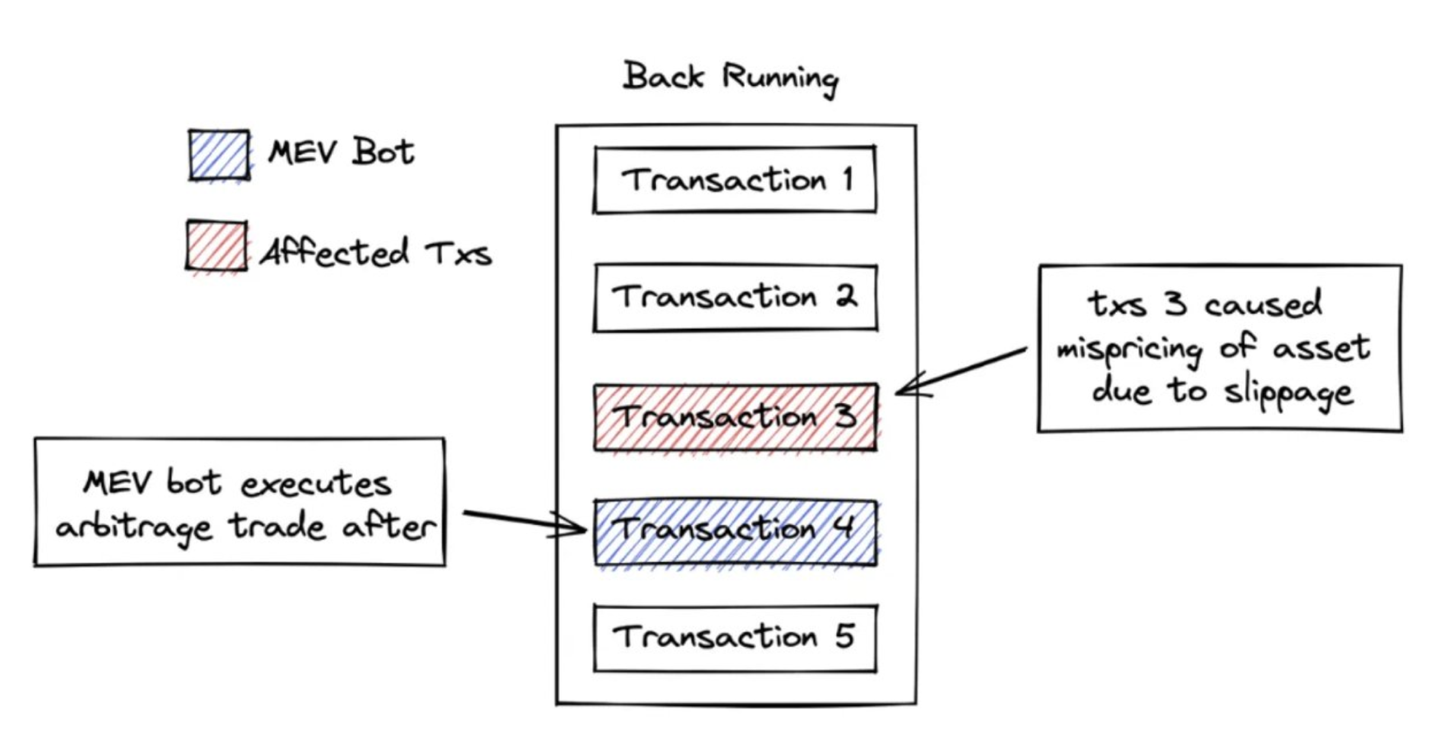
Source:wikibit
The more traditional explanation is that on the Ethereum blockchain, all new transactions must first wait in the public memory pool (or mempool) before being put into a block and added to the blockchain. In the past POW model, miners decided which transactions were put into the block and in what order. They just selected the transaction with the highest transaction fee and did not care about the order of the transactions. But in the huge transaction ecosystem spawned by Ethereum, MEV searchers soon began to realize that profits could be made by rearranging transactions, reviewing transactions, or creating new transactions based on transactions in the memory pool, and these profits were MEV. Although the searcher is the initiator of MEV, usually more profits are distributed to the remaining participants in MEVs conduction value chain, such as validators, rather than to the searcher itself.
From the perspective of user and ecological sustainable development, MEV activities are roughly divided into two types, arbitrage behavior that helps price discovery, liquidation and other beneficial MEV, as well as simple front-running, or more complex sandwich attacks (in a legal buying and selling process) Unfavorable MEV activities such as sandwiching two new orders between incoming orders (these two orders buy the target token at a higher price and sell), front-running and sandwich attacks will cause ordinary DEX traders to get worse. s price.
2. Overview of MEV track
1. Track characteristics
The MEV track belongs to the underlying basic track and is strongly related to all tracks related to transactions in the block space. It has the characteristics of high income effect, the more and more complex the transaction scenarios are, the more conducive to income acquisition, and relatively low risk. It is closely related to the entire market. The multi-L1 ecological expansion is mutually reinforcing.
2. Track development
(1) Solving the MEV problem is an important part of the Ethereum roadmap. On November 5 last year, Ethereum co-founder Vitalik Buterin (V God) released an updated version of the Ethereum development roadmap, which contained three major changes, including adding a new stage to the roadmap - The Scourge to ensure Reliable, fair and trustworthy neutral transactions and solve MEV problems. This means that the protocol that solves the centralization problem of MEV will attract attention, and the attention of this track will gradually increase.
(2) The future development of MEV should focus on cross-chain MEV acquisition, minimizing value loss, minimizing the potential negative impact of MEV on real users of the protocol, and ensuring fair distribution among participants.
3. Track size
The revenue scale of this track is almost in sync with the trading volume of the encryption market. Two main factors affect the size of MEV. First, there is a positive correlation between arbitrage frequency and price fluctuations. Second, there is also a positive correlation between arbitrage volume and total trading volume.
Judging from the revenue of Flashbots, the total gross withdrawal profit is 713.95 M. This part is considered a good MEV, which has a positive impact on price discovery and has a positive impact on completing the core functions of DeFi and the transaction volume of DEX. The sandwich attack revenue is 1206.11 M, this part is considered unfavorable MEV, and most MEV protected DEXs hope to control and democratize this part of the profit.
If we use the top three cumulative fee income Uniswap, Pancakeswap and Sushi as anchor points, the cumulative fees of the three DEXs are (3.24+ 1.2+ 0.77)billion, which is 5.21 billion. It is roughly estimated that the MEV income obtained through Flashbots accounts for 37% , in fact, in addition to the main DEX, other dapps, alt L1 and L2 on Ethereum will also generate considerable MEV income. Estimating the transmission of these costs along the entire value chain to form the size of each segment requires analysis of how MEV profits are distributed among different participants.
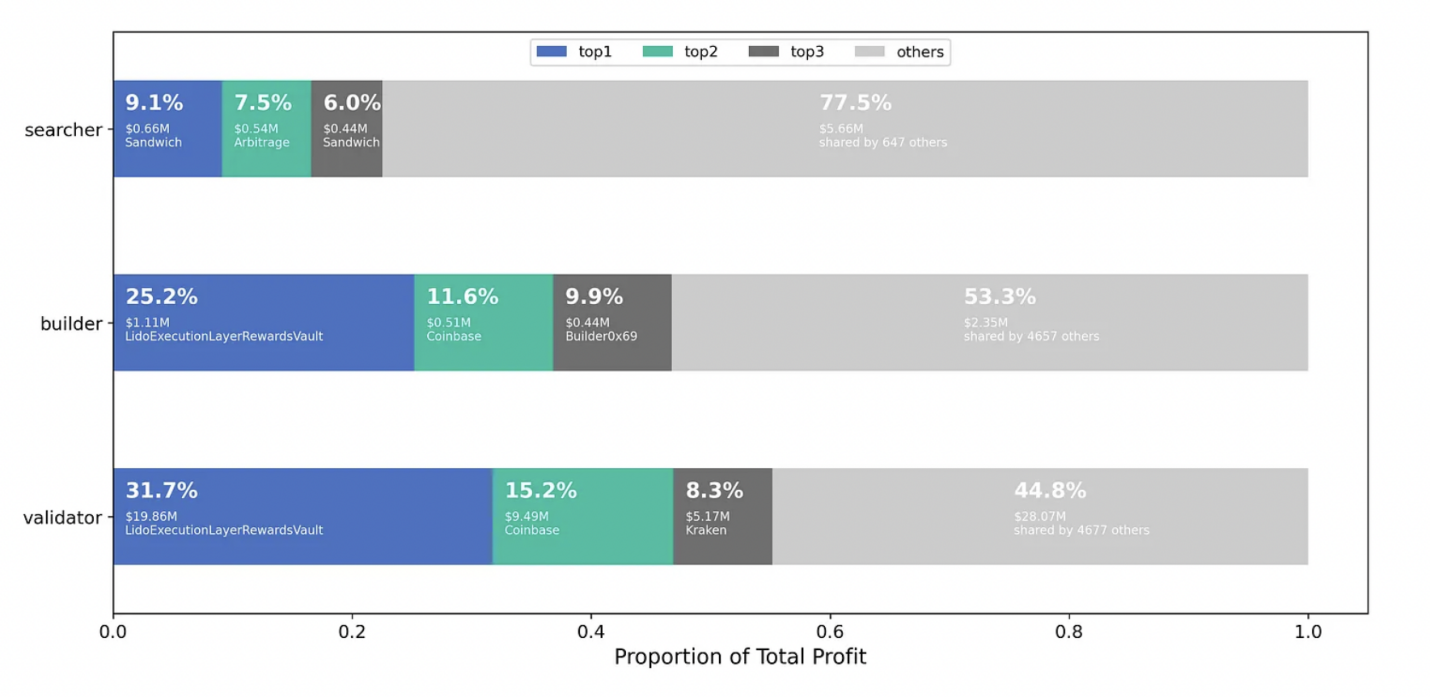
According to data from Eigenphi, in January and February 2023, MEV searchers generated $48.3 million in transactions from all users via wallets and RPC, with $34.7 million of that going to builders. The builders then sent $30.3 million to the validators.
Profit distribution: Searchers — $7.3 million (17.4%); Builders — $4.4 million (10.5%); Validators — $30.3 million (72.1%). (The specific roles of these participants will be introduced below) It is not difficult to see that most of the profits (72%) are still captured by downstream validators.
Of the $48.3 million, $6.3 million was used for the destruction of EIP 1559. The priority fee for an ordinary transaction transferred from wallets and RPCs to builders and then to validators is $32.554 million. Ordinary transactions across wallets and RPC destroyed $227.2 million for EIP 1559.
In the bull market of 2021, the overall revenue ceiling is US$476 million. Calculated at a lower 10 times PS, the overall track size is nearly US$5 billion. The track size of each subdivided track can be estimated based on the proportion of Searcher to exceed 1 billion U.S. dollars and Verifier to exceed 3.5 billion U.S. dollars. This is only a rough estimate.
However, bots that profit from on-chain transactions may still bear the cost of many failed transactions, as well as the impact of other off-chain hedging costs, which are not included in the calculation. And this is only a calculation of the revenue received by direct participants, and does not account for the indirect participant market. In fact, the entire track will be much larger than the above figures.
4. Two angles of MEV track pattern
(1) Value chain
Upstream (RPC provider): Upstream refers to the service provider that provides on-chain transaction information and data, usually an Ethereum node operator or an RPC (Remote Procedure Call) service provider. These service providers provide the necessary data interfaces for midstream and downstream participants, allowing them to obtain information about transactions and blocks to better participate in MEV-related activities. For example, Uniswap will transfer user-initiated transactions (TX ) are sent through RPC (remote procedure call), and these transactions will enter the Ethereum memory pool (mempool).
Midstream (Tools and Infrastructure): Midstream includes various tools, platforms, and infrastructure that help connect upstream and downstream participants to achieve the distribution of MEV value. These midstream tools may include search engines, transaction builders, transaction relayers, etc., which enable searchers, builders, block producers, etc. to more efficiently discover, execute, and distribute MEV opportunities.
Downstream (MEV profit earners): Downstream covers participants who truly benefit from the MEV value, including validators and other individuals or entities who actually receive MEV profits. Validators are nodes that participate in block verification in a Proof of Stake (PoS) network, and they can earn rewards from transaction fees and the network’s base interest, which are contributed by midstream and upstream activities. Downstream validators include crypto exchanges (CEX), liquid staking platforms (Liquid staking), institutional pledgers and individual pledgers, etc.
(2) Direct participants and indirect participants
MEV value chain transmission process
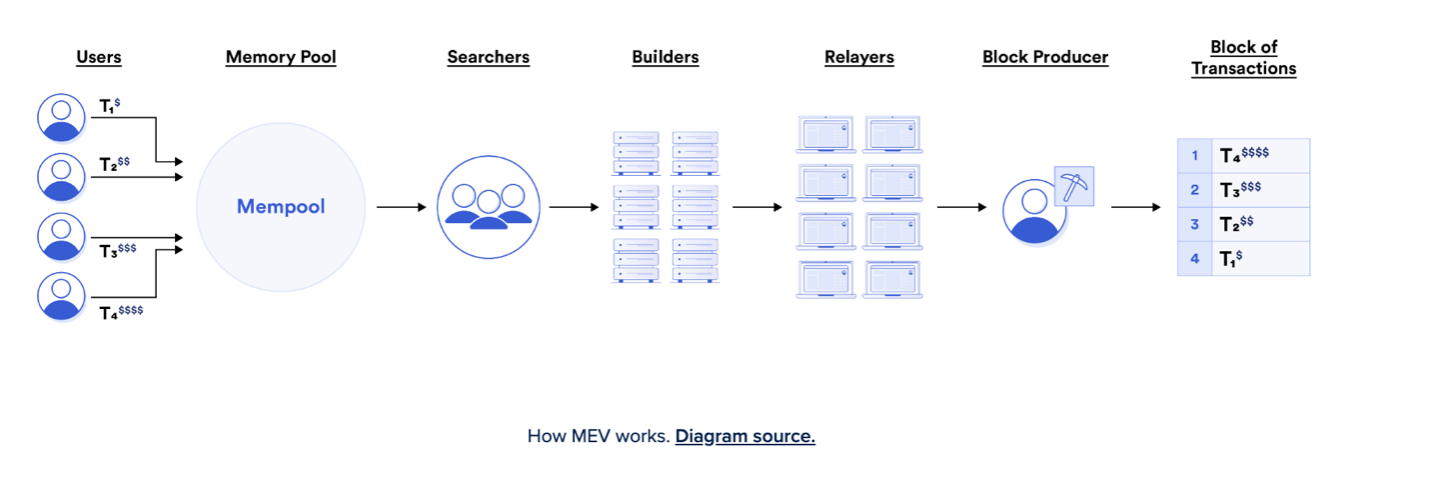
Source: https://chain.link/education-hub/maximal-extractable-value-mev
Direct participants include Searchers, Builders, Relayers and block producers/validators. These types of participants also make up the supply of MEV. chain pattern. Tools that provide better services to these direct participants, such as infrastructure designed to solve MEV-related challenges, include Flashbots, which just raised $60 million this month at a valuation of $1 billion, and plans to use the funding to develop the platform SUAVE.
SUAVE(Single Unified Auction for Value Expression) is an infrastructure designed to solve MEV-related challenges, and its vision is to become a common ordering layer for different chains. SUAVE focuses on separating the roles of mempool and block generation from existing blockchains, forming an independent network (ordering layer) that can serve as a plug-and-play mempool and decentralization for any blockchain Block builders act as Mempool and builders for other chains. The main purpose of SUAVE is to provide a more decentralized and fair ecosystem for MEV-related participants such as users, block builders, and validators. Separate the Mempool and builder of all chains from other roles to achieve professional management, so as to improve the efficiency of the whole chain and achieve a win-win situation, that is, the blockchain itself is more decentralized, the income of the validator is increased, and the searcher/builder can set preferences and The potential income increases, and users can conduct private transactions at the cheapest price.
· Seekers write code, often powered by proprietary complex algorithms, to identify MEV opportunities in mempools and are responsible for listening to public transaction pools and Flashbots private transaction pools. They compete to submit response packages to builders and give a gas bid expressing the maximum cost they are willing to pay (priority fee).
· Block builders are professional providers who compete in the live market to perform block construction on behalf of validators. Any user who downloads MEV-Boost can become a Block Builder. Builder accepts transactions from searcher and further selects profitable blocks from them, and then sends the blocks to the relayer through MEV-Boost.
· Relayers are intermediaries between block builders and block proposers, allowing validators to provide their block space to block builders. Some relayers include transactions for ETH that have passed through the Tornado Cash protocol in the past, while some exclude or censor these transactions. MEV repeaters have been controversial due to censorship issues. In August 2022, Tornado Cash was blacklisted by the U.S. Treasury Department’s Office of Foreign Assets Control (OFAC), making it illegal for U.S. citizens, residents, and companies to receive or send funds through the protocol. Since then, validators must carefully consider the relayers they use to generate MEV revenue, deciding whether to exclude such relayers that are considered OFAC compliant. Given the high number of Ethereum nodes in the US, it is likely that many US-based validators will want to choose to cooperate with the safety aspects of regulatory scrutiny and not risk non-compliance. And this runs counter to the principle of resistance to censorship. Flashbots own relayer was the first MEV-Boost relayer and chose to review non-compliant transactions, which explains the initial dominance of OFAC-compliant block offerings on Ethereum. As more relays become available, including uncensored ones, this trend has reversed, and now less than half of blocks are OFAC compliant. It can be seen that the market share of Flashbots repeaters has declined and is currently 23%.
MEV Boost Relay Market Share
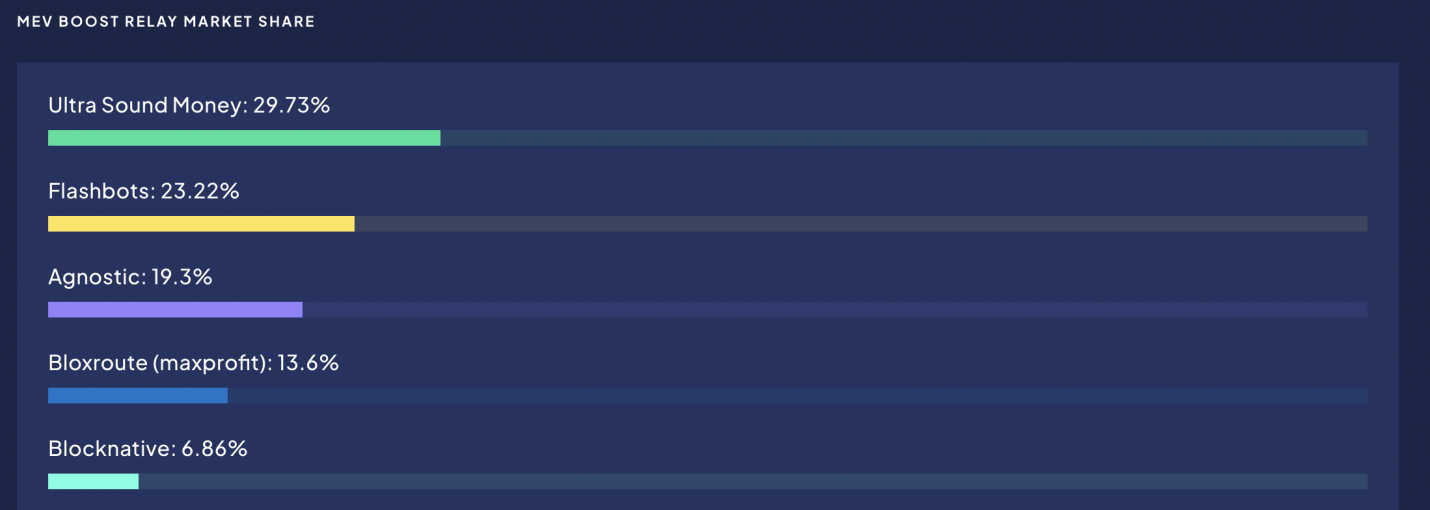
Source: https://www.rated.network/relays?network=mainnet&timeWindow=30d
· Block Producer/Verifier is the entity responsible for validating and proposing blocks to be added to the blockchain under PoS. They tend to be the biggest capturers of MEV revenue. Any user under POS can pledge 32 ETH to become a Validator. Lido is currently the largest Validator. As long as the Validator uses MEV-Boost, it can select the most profitable block from the proposals of multiple relayers and receive a priority fee. Then one of the many Validators is randomly selected as the Proposer to submit the final transaction (block).
Indirect participants include almost all underlying L1, L2, and Application level projects that generate transactions. The Application level is divided into DEX, Lending, and LSD (MEV activities throughout the entire DeFi ecosystem, including increasing handling fees, helping with liquidation, and helping verifiers improve APY at the execution layer, etc.), and then derived to protocols (including tool providers and benefit protocols) that help users avoid MEV in specific transaction scenarios, such as Unibot and other TGbot protocols.
Leading projects of different participants
Lido
Source: https://eigenphi.substack.com/p/30m-72-of-searchers-mev-revenue-went
MEV is still important to the Ethereum economy, accounting for more than 15% of all Ethereum transactions, and increasing the reward rate of stakers and validators by 25%, while Lido, as the largest beneficiary of downstream validators, earns 25% Accounting for 31.7% of all validators, 19.86 mln (two-month data from January to February this year). Taking Lido DAOs executive layer APR as an example, it is mainly MEV income, accounting for about 1/3 of stETHs total income. When the transaction on the chain is hot, it accounts for nearly 70%; therefore, it is speculated that when the bull market comes, MEV revenue will still account for 70% of Stake’s total revenue. It can be considered that the development of the MEV track and the LSD track are positively correlated. high.
Uniswap
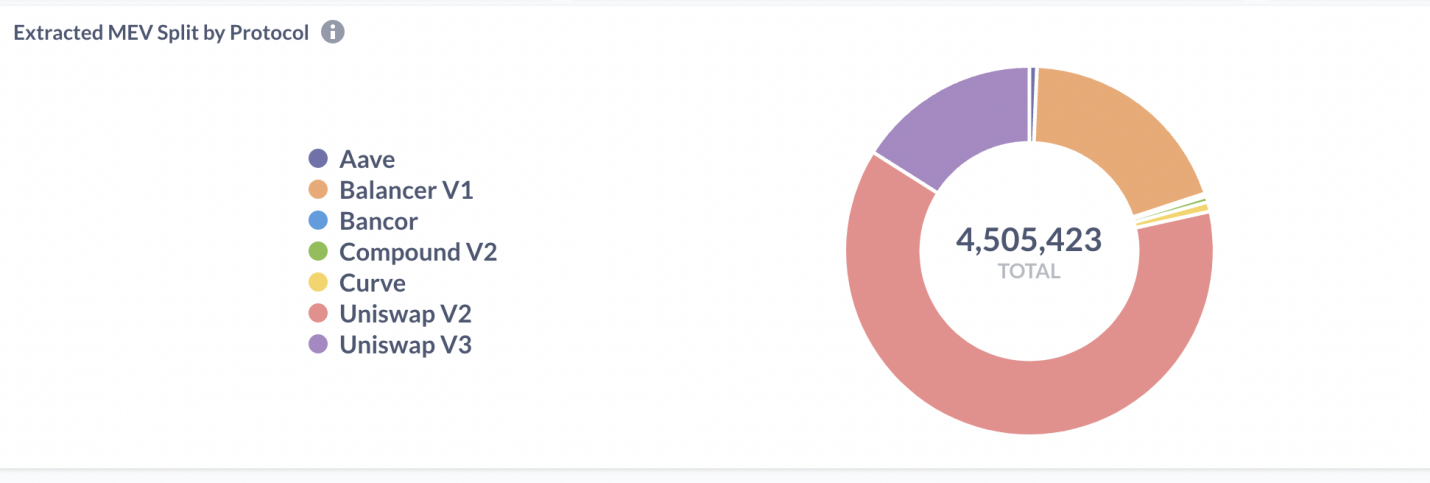
Different DEX protocols extract MEV shares
Source:Dune Analytics
The related MEV transaction on Uniswap generated a profit of 252 mln. In 2022 alone, arbitrage bots withdrew at least $85 million from market price asymmetries involving the Uniswap V3 liquidity pool; Sandwich bots withdrew at least $47 million from exchange users of the Uniswap V3 liquidity pool; JIT bots withdrew at least $47 million from Uniswap V3 liquidity pools; $6 million was withdrawn from interchange fee revenue.
The combined extraction value of these three types already exceeds 25% of supply-side revenue, or $540 million.
For real users of Uniswap, after UniswapX builds MEV income in the future, it can significantly improve the interests of swappers. UniswapXs aggregator and RFQ off-chain order matching mechanism will be a huge improvement for preventing MEV (although decentralization is sacrificed). For MEV cross-chain acquisition, the cross-chain technology planned to be launched by UniswapX is a key infrastructure.
Unibot
The current total market value of the TG Bot track is less than US$200 million, of which Unibot, the leader, occupies about 75% of the market share.
Judging from the 800 million users of Telegram, Unibot is trying to open a huge traffic portal through functional integration. Although the robot function is still in the early stage, doing one-stop transactions in the traffic pool is obviously different from most DeFi Applying customer acquisition methods, although in the end most transactions are still conducted on Uniswap.
Currently, Unibots daily active users surged from about 400 to a peak of 1,700 in two weeks in July. Objectively speaking, there is still a lot of room for growth, but this track user group is quite special, usually when memes are popular. User enthusiasm continues, the overall market value is still small, the business logic is established, the token has a reasonable dividend mechanism (40% revenue sharing to holder), and the growth ceiling is also high. In the long run, only price-insensitive users will use Unibot, which will incur a 5% higher tax than trading directly on Uniswap. This type of protocol also has significant shortcomings, as bots have different settings, but usually allow users to create dedicated wallets or connect existing wallets. In both cases, bots will have access to private keys, which may add an additional layer of risk to users.
Valuation
Unibot peak Vol/FDV = 12 mln/182 mln= 0.06
Uniswap: Vol/FDV = 429 mln/6193 mln= 0.069
Velo: Vol/FDV 7.5 mln/100 mln= 0.075
Judging from the Vol/FDV indicator, the market has pushed the price of Unibot to a reasonable valuation range, but as the popularity of meme fades, the trading volume of Unibot will obviously decrease accordingly.
In addition to the Ethereum ecosystem, MEV track opportunities also exist in other ecosystems. And more complex cross-chain transaction scenarios in the future will significantly amplify MEV activities.
3. Dynamic balance of MEV and DEX ecology
There is a positive correlation between MEV trading volume and total trading volume. Eigenphi data shows a correlation coefficient of 0.6 between volume (excluding arbitrage volume) and arbitrage volume, and a correlation coefficient of 0.62 between volume (excluding clip volume) and clip volume. Therefore, the greater the total transaction volume, the greater the MEV transaction volume. As more and more DEXs increase their Total Value Locked (TVL) on multiple chains, liquidity pools of the same asset pair will be formed on multiple channels, but their trading volumes and depths vary, which is also an important factor for trading and MEV Created new opportunities.
Other factors that can affect MEV activity include high or low gas fees (the lower the higher the potential profit, but searchers may still bid up gas across the network for a larger transaction) and the volatility of the market (the more volatile the market the sandwich The more trading opportunities there are for arbitrage)
The AMM is where most of the MEV is extracted. After the emergence of Uni V3, the concept of concentrated liquidity range was introduced, which allowed traders to trade within a smaller price range, thereby reducing some price differences and thus reducing the profit margin of certain MEV activities. In addition, because Uni v3 adopts a more refined price setting mechanism, slippage is usually smaller than previous versions, theoretically reducing some possible MEV profit opportunities and also helping to reduce some MEV activities. To put it simply, due to the deepening of concentrated liquidity at a certain price and users refined price settings, slippage has become smaller, and the profits that MEV can arbitrage have also declined significantly.
The further emergence of anti-MEV dex aims to protect ordinary users through the following mechanisms:
(1) Order openness and predictability - DEX can disclose the details of orders before the order is submitted, adopt mechanisms such as auctions, and use an off-chain matching mechanism similar to order books to reduce the chance of front-running attacks. By disclosing information in advance, traders can better predict market behavior, thereby reducing the probability of attacks.
(2) Time-locked transactions - Implement time locks to limit transactions to be executed after a specific block. This can reduce the impact of attack types such as flash loans because attackers cannot execute multiple transactions within the same block.
(3) Batch transactions - DEX can allow traders to submit multiple transactions and process them as a batch. This can increase the privacy of transactions and reduce an attackers ability to analyze transactions.
So how to understand the impact of this MEV defense on transaction volume? For anti-MEV dex, this part of the benefits is transferred to its users. Although the reduction of clipping behavior or the conversion into not directly generating handling fees will be the reason for the reduction in transaction volume, in fact, maintaining a good trading environment is important for The sustainable development of any trading system is beneficial.
MEV also has different impacts on traders, liquidity providers, and miners. For traders, it is obvious that MEV, especially adverse MEV, leads to increased transaction costs, and traders need to pay higher transaction fees to ensure that their transactions are confirmed first in the blockchain. This increases costs for traders, especially during times of high network congestion.
Secondly, there is information asymmetry. MEV causes some interested parties to use their ability to control the transaction sequence to obtain market information, thus gaining unfair advantages. This exposes other traders to the risk of information asymmetry.
Providing liquidity carries an increased risk for LPs. Liquidity providers may face the risk of flanking transactions, that is, the liquidity they provide may be used by other traders during transactions, resulting in losses. In addition, LPs are also facing the problem of cost-effectiveness damage. LPs need to consider higher gas fees and risks to balance their profits and risks.
For miners/validators, MEV may lead miners to optimize their mining strategies to obtain more transaction fees and rewards. But it also means increased competition, with miners/validators competing to earn MEV, leading to gas spikes and network congestion.
4. Solutions to prevent adverse MEV
There are some solutions to prevent unfavorable MEV from the consensus layer, execution layer, app layer, L2, MEV tools, etc.
At the consensus level, Ethereums The Scourge phase is dedicated to ensuring reliable, fair and credible neutral transactions and solving the MEV problem. At the transaction execution level, peer-to-peer and gas-free transactions prevent unfavorable MEV. Peer-to-peer transactions mean that transactions take place directly between the two parties, reducing the possibility of intermediary intervention and malicious behavior. Gas-free transactions and separation from the mempool reduce the chance for malicious actors to gain an advantage by raising gas fees. In addition, some innovative attempts also provide ideas for preventing adverse MEVs. For example, EigenLayer attempts to introduce MEV-boost and partial block auction mechanisms into partial blocks, which provides new ideas and methods for modular MEV stack design.
At Layer 2, the Taiko project takes a very different approach - outsourcing block creation to L1, providing a potential solution that leverages the capabilities of the Ethereum base layer to address the complexity of L2 MEV.
At the app layer, through Dex aggregator (in fact, the work done by Dex aggregator in preventing MEV has not been taken seriously. By placing orders through different routing channels, it reduces the impact of slippage on time-point prices, thereby preventing unfavorable MEV. find trading opportunities), backrunning service and off-chain matching orders, auctions or batch processing orders (unified pricing within batch processing orders fundamentally solves the MEV pinch problem. Since the trading interface directly matches between peers, there is no transaction order) and other ways to minimize the harm of MEV to users.
In terms of MEV tools, Flashbots aim to mitigate MEV-induced situations that negatively affect different players across the ecosystem, such as on-chain congestion. Flashbots has launched several products, Flashbots Auction (including Flashbots Relay), the Flashbots Protect RPC, MEV-Inspect, MEV-Explore and MEV-Boost, etc. The upcoming SUAVE serves as a sorting layer for different chains, turning the focus to user preferences and optimizing transaction paths, creating the most efficient route based on the searchers search wishes.
5. Conclusion
From the perspective of the importance of the track, MEV is a by-product of block generation, and it can even be said that the future of MEV is the future of the encrypted world. The characteristics of strong cash flow enable the Searcher, Builder, Relayer and Validator roles and the tool products that provide services and optimization around these roles to still have a strong revenue effect. However, because there are not many Searchers and Validators that have actually captured MEV income through agreements to issue coins, there are fewer secondary investment opportunities. However, some application-level applications will obtain additional edges by entering the MEV track, and tool projects are in the primary market. There are also good investment opportunities, but such tool projects need to think about how to capture value for their own protocols rather than just enhancing the profits of already profitable participants.
Although unfavorable MEV has a certain negative impact on users, the reasonable use and existence of MEV can also bring many positive factors. For example, arbitrage traders ensure the consistency of token pricing of each AMM and meet the anchoring mechanism of stable coins. , ensuring the smooth liquidation of DeFi loans, maintaining incentives for block proposers to increase the security of the blockchain (by providing higher execution layer rewards), etc.
In general, the development direction of the MEV track focuses on several key areas: cross-chain MEV acquisition, minimizing value loss, mitigating the potential negative impact of MEV on real users of the protocol, democratizing revenue, and promoting the removal of sorters. Centralization, and ensure fair distribution among participants, etc. At present, we can observe that UniswapXs cross-chain technology plays a key infrastructure role in realizing MEV cross-chain acquisition. On the whole, the value of the MEV market is related to more complex trading scenarios and market fluctuations in the future, which will bring more opportunities for traders. The potential negative impact that MEV may have on real users of the protocol can be mitigated by adopting fair distribution and privacy protection methods at the consensus level, as well as implementing mechanisms such as off-chain order matching and reducing point-in-time price slippage at the protocol level. In addition, the stacking and decentralization of MEV participants are also crucial components of the Ethereum roadmap and will help build a more robust and secure MEV ecosystem.
In terms of democratizing the benefits of MEV, there are still many areas worthy of further exploration. For a MEV-proof de-pinch attack (MEV) DEX, a portion of the revenue initially earned by the searcher is transferred to its transacting users. While MEV-proof designs may reduce or alter flanking behavior, which may result in reduced trading volume due to adverse MEV, maintaining a good trading environment is critical to the sustainable development of any trading system. Such positive MEV benefits gradually contribute to the healthy development of the entire on-chain transaction ecosystem.
A fair market competition environment provides a breeding ground for innovation, and a more efficient benefit distribution mechanism and decentralized architecture are the cornerstones of achieving this goal. Seekers and block-building techniques are inherently neutral, and their impact on the entire transactional environment depends on how people use them.


