






Sui 8192 Hot: Are small games the best entry point for the full-chain game industry?


A chain game based on Sui, "Sui 8192", has seen a significant increase in daily transactions. Provider of on-chain analysis, Artemis, recently posted an article on Twitter, even stating that this game has helped Sui Network briefly surpass Solana in terms of daily transaction volume.
Artemis' data shows that Sui Network's daily transaction count has recently exceeded 20 million, surpassing Solana's 16 million. However, the company acknowledges that it uses different methods to calculate Sui Network's daily transaction volume.
On-chain 2048, a popular crypto community
Unlike various GameFi products with complex mechanisms, complicated rules, and the need to calculate various costs, as well as next-generation chain game products that focus on blockchain AAA titles, Sui 8192 is different. Its mechanism design is extremely simple and anyone can get started immediately.
Sui 8192 is simple and lightweight. Its gameplay is exactly the same as the once popular 2048. Just use the arrow keys to move the blocks and make them overlap. When two identical numbers overlap, they can be combined into larger numbers. The goal is to combine larger numbers as much as possible and achieve a higher score.
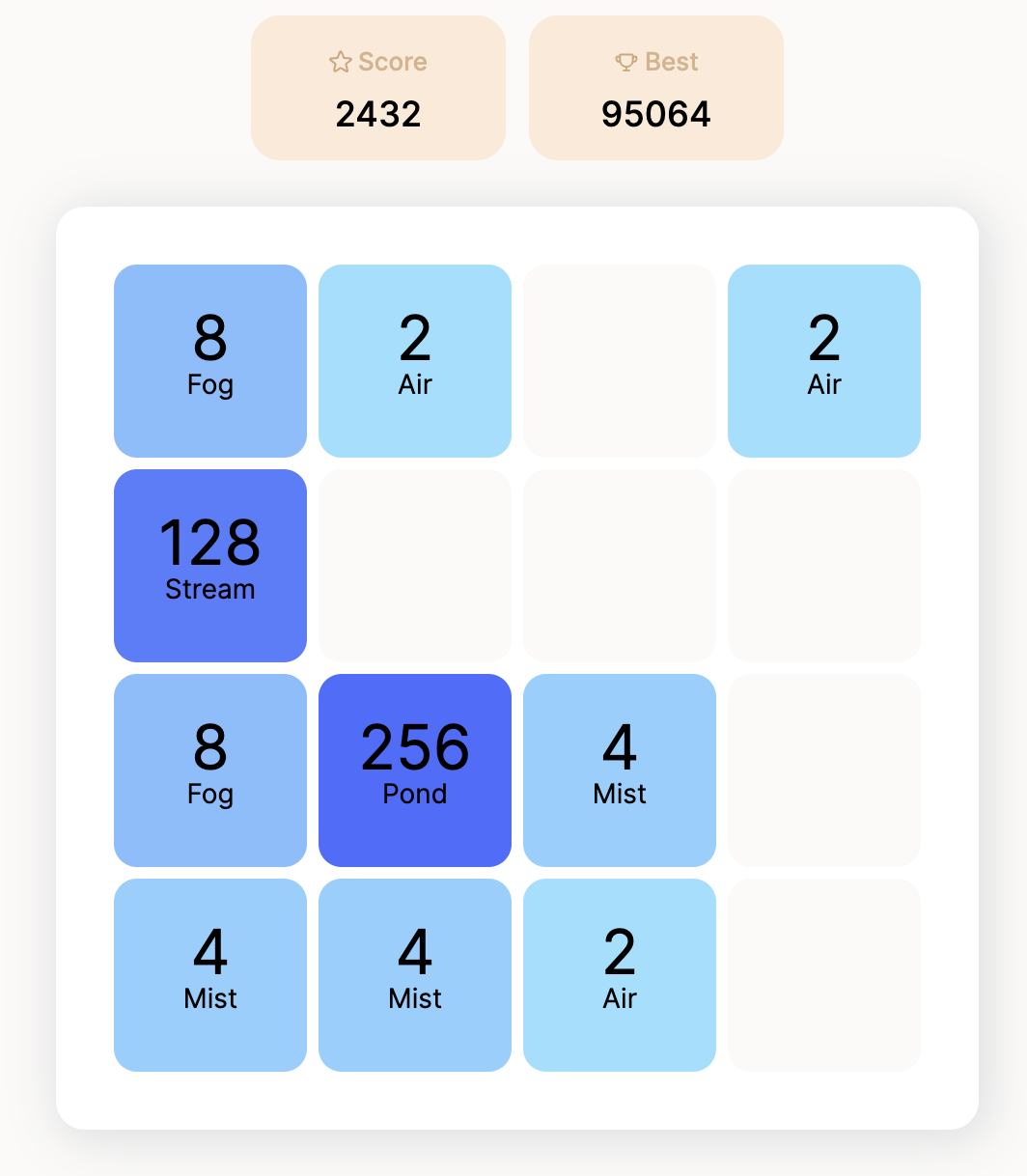
Although there is no innovation in the mechanism, Sui 8192 still attracts attention from the crypto community. In the current downturn of crypto games, Sui 8192 is one of the few fully on-chain games worth paying attention to.
Fully on-chain games are different from GameFi. In the current GameFi paradigm, only assets are often put on the chain, that is, only tokens are on the chain, while the game running logic is still processed by centralized servers. On the other hand, fully on-chain games put the complete game logic on the chain for processing. Taking Sui 8192 as an example, all the logic of this game is deployed on the Sui blockchain, mainly including three parts:
1. Game: Used to record the overall state of the game and player operations.
2. Game Board: The main logic of the game.
3. Leaderboard: Provides leaderboard functionality.
When playing a game, users need to pay gas fees to mint an NFT. After that, each move in the game will initiate a transaction on the chain and record the data on the chain.
Odaily's testing found that the initial minting cost is about 0.2 SUI, and the gas cost for each subsequent operation is around 0.0008 SUI.
According to on-chain data, players have minted over 741,000 game NFTs. And each NFT has a large
The content you provided is already in English, so there is no need for translation.
Similar to other middleware vendors, Ethos is not only a wallet but also provides wallet infrastructure for developers.
EthosConnect, developed by the team, is a developer-friendly API that aims to accelerate developers' workflow in building applications on Sui. With EthosConnect, developers can directly connect Sui's Move smart contracts with the Ethos wallet and build user-friendly interfaces using custom React components.
Ethos Explorer is an integrated encrypted portal within the wallet. This product allows users to easily discover dApps in the Sui ecosystem and manage their own encrypted assets.
Full-chain games, the next trend in blockchain gaming?
Since the combination of blockchain and gaming, the encrypted world has constantly been exploring ways to merge games with blockchain technology.
Based on the current mechanisms, games with "chain" elements can be divided into three categories: traditional games that do not require blockchain integration, traditional GameFi games that only have on-chain assets, and full-chain games that are completely on-chain.
In contrast to traditional blockchain games, the main difference in a full-chain game is that the game's business logic is also written on the blockchain. The smart contract handles a series of operations and business processes within the game.
In traditional GameFi, although in-game assets are put on the blockchain, the game rules, player interactions, and in-game reward systems are all controlled by centralized traditional servers. Despite players seemingly having "decentralized assets" within the game, the "decentralization" vision is more like a beautiful mirage due to game companies maintaining complete control over the game rules.
However, since the core logic of the game needs to be computed on the blockchain, its costs and performance requirements are much higher than traditional GameFi. This also makes it nearly impossible to create a modern AAA game at the "playable" level under existing infrastructure conditions.
Full-chain games are still a niche area within the crypto ecosystem. Currently, full-chain games are still in a very primitive stage of exploration, with insufficient infrastructure and systematic support for commercial activities. But this early exploration also lays the foundation for rich imagination.
The attention received by 8192 shows us another possibility. Although full-chain games cannot yet achieve the complexity of modern large-scale games, simple and enjoyable casual games seem to be a good path to explore. Would moving 4399 to the blockchain be a good choice?


