Hurricane ChatGPT, marching into the oracle


Foreword: If we say that the emergence of ChatGPT symbolizes that the germination of a new "smart" industrial revolution is breaking out. Then, the landing of the oracle machine represents a new trip to Columbus about the blockchain transformation of "data".
"Who are you?"
first level title
ChatGPT: mining data value
ChatGPT is undoubtedly the hottest topic on the Internet recently. Just five days after its release, ChatGPT achieved what took Facebook 10 months to complete — reaching more than 1 million users, according to Fortune. On February 1, ChatGPT’s monthly active users exceeded 100 million. It took two years for ins to achieve this data, nine months for TikTok, and only 60 days for ChatGPT.
The degree of popularity is evident.
As an outstanding crystallization of technology in this era, ChatGPT has brought about an unpredictable revolution. Whether you like it or not, AIGC (generated artificial intelligence) represented by ChatGPT will change the world.
Bill Gates also said meaningfully: The emergence of ChatGPT is of great historical significance, no less than the birth of PC and the Internet.
With the birth of ChatGPT, its increasingly powerful AIGC (generated artificial intelligence) capabilities have caused many professionals to fall into a "career crisis". Some people even worry about whether AI will replace humans. In fact, it is not the first time that the talk of AI replacing human work has appeared, and it first appeared a few years ago.
According to the report "Unemployment and Employment: Labor Transformation in the Age of Automation" released by the McKinsey Global Institute in December 2017, by 2030, it is conservatively estimated that 15% of the world's population will change jobs due to the development of AI technology. Radical estimates affect 30% of the global population, and China expects tens of millions to hundreds of millions of people to be reemployed.
While people are still not paying attention to the predictions in the report, in September 2022, in the digital category of the Colorado State Fair art competition, the AI painting "Space Opera House" won the first place in one fell swoop, which once again sparked a huge debate about whether AI can replace humans . Today, the emergence of ChatGPT has triggered a global discussion on the anxiety of occupational survival caused by AI "threat" employment.
There is no doubt that ChatGPT is a masterpiece of major breakthroughs in the current artificial intelligence field. At the same time, it is undeniable that ChatGPT still has many problems. Although ChatGPT is a large language model based on statistical laws, it has the impeccable language talent of human beings, but it can only make associations and cannot complete "logical reasoning". From this perspective, ChatGPT will tend to produce convincing responses, which of course may contain "generated" several factual errors, false statements and wrong data, because as a natural language processing model, it does not know up to What is the "fact" in tens of petabytes of unsupervised training data, which is more like a "virtual assistant" that is a bit slippery.
In addition, because in the training process, a large amount of "instruction" knowledge is injected in order to recognize human instructions, ChatGPT will be very sensitive to the "instruction" itself, but at the same time it will recognize some ambiguous words that are irrelevant to the context and require "factual basis" to make judgments not tall. Perhaps, for most ordinary people, ChatGPT is a qualified assistant, because it is proficient (or will be proficient in the foreseeable future) in all human language skills, such as summarizing, translating, writing articles, Style correction, translation, polishing, writing code, etc. Therefore, workers engaged in these jobs, if they cannot master the skills of using ChatGPT as an assistant, may become the earliest people to be replaced by machines.
In a nutshell, ChatGPT is a super tool, not a super intelligence. It will not replace humans, but upgrade the industry. It will greatly lower the barriers to creativity and execution, complementing humans.
The CEO of WPP, the world's largest advertising group, said: It is never AI that takes your job, but other people who have AI tools.
AI has been developed for so many years, so why can ChatGPT become a dark horse on the AI track?
In the final analysis, it comes from the "utilization" of data.
At present, the major research direction of artificial intelligence is the NLP task (Natural Language Processing), that is, the machine must understand human language. The NLP task (natural language processing) has two major directions, one direction is Google's two-way (BERT) technology, and the other direction is OpenAI's autoregressive (GPT) technology.
As early as June 2018, OpenAI proposed the first generation of GPT model. In October of the same year, Google announced its own BERT model, which greatly refreshed almost all the best records in the field of natural language processing, and opened the era of pre-training large models.
In the following 4 years, pre-trained language models such as BERT and GPT (GPT-1 and GPT-2, the predecessors of ChatGPT), have become the mainstream technology trend in the field of natural language processing. These model parameters range from 300 million to 1.75 trillion, which is why they are called Large Language Models.
The essence of these pre-trained large models is to use larger models and more data to find a better and more general "language model" for humans. It is precisely because of this that large language models including BERT and GPT have actually obtained a considerable amount of vocabulary, syntax and semantic knowledge during the pre-training process, and only need a small amount of labeled data to refine the model. A wide variety of natural language processing tasks.
By mining the value of "data" to endow the scene with ecology, is this similar bridge section very similar to the "oracle machine"? However, ChatGPT is still a product of the Web2.0 era and still has certain limitations.
first level title
Oracles: Linking Data Bridges
When it comes to blockchain, most people must think of Bitcoin and Ethereum, or even speculation, mining, DeFi, NFT, and some Web3.0 empowerment scenarios such as GameFi and SocailFi that rely on concept packaging. However, how to make data "AI" is to let the "blockchain" understand the predictions of the real world and add them to the ecological empowerment of the scene. The oracle machine is very important, just like the current ChatGPT.
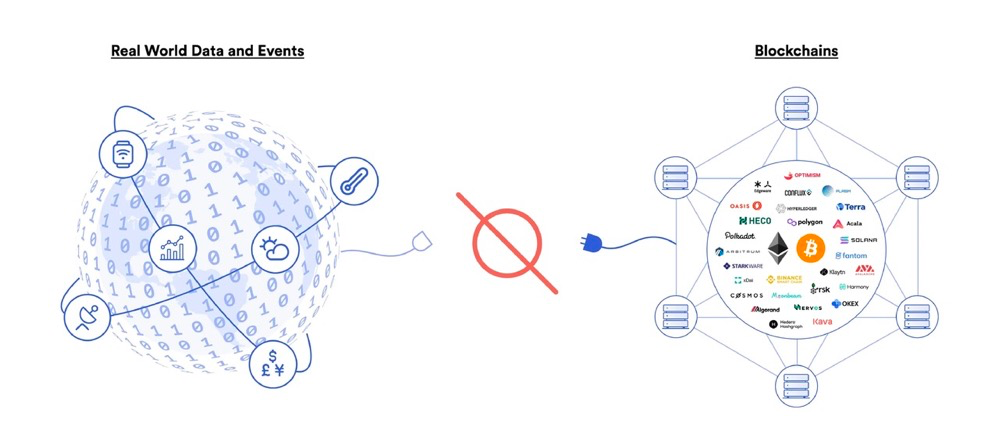
We all know that oracles and blockchains are very closely related. In blockchain, smart contracts can perform various operations such as money management, data storage, etc. However, smart contracts have no knowledge of events happening in the real world, which requires oracles. Because the oracle machine is a data bridge connecting the real world and the blockchain, it can convert events that occur in the real world into data that can be used in smart contracts.
In simple terms, oracles allow deterministic smart contracts to "react" to an uncertain external world. And isn't ChatGPT just a "reaction" to the accessed data?
Among them, the main function of the oracle machine is to obtain and verify external data and input it into the blockchain. They can obtain data in a variety of ways, such as APIs, sensors, web crawlers, etc. In terms of verifying data, the oracle needs to ensure the authenticity and accuracy of the data.
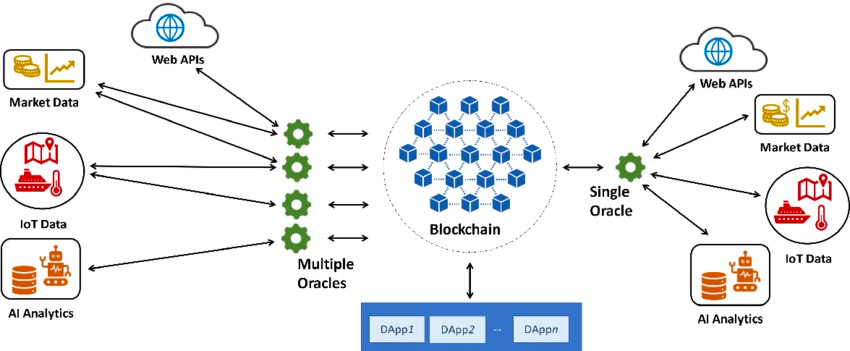
Therefore, the oracle must be carefully designed and tested to ensure the reliability of the data. These verification processes may include digital signatures, encryption algorithms, etc. But the development of oracles also faces some challenges, one of the biggest challenges is to ensure the reliability of data. The oracle machine needs to obtain a large amount of data and verify it.
If the blockchain is compared to a "black box", then the oracle machine is a ray of light in the dark, illuminating the bit world.
Of course, the current blockchain ecology is still in the initial stage of development. Compared with traditional industries, except for some achievements in the financial field, other places are still a little barren. It still takes a long time to develop the utilization, retrieval, mining, and analysis of its data.
Although many mainstream oracle public chains such as ChainLink, PlugChain, Oraclize, UMA, DIA, and API 3 have emerged in the market, each of them has its own breakthroughs and innovations in the technical field, but a closer look at ecological development, scene empowerment, Commercial implementation still has a long way to go.
It's like, if ChatGPT needs to be smarter, it needs more and larger data training. If the blockchain world needs to be smarter, the oracle machine's data reading, transmission, and capture are required to be more accurate and efficient.
At the same time, on more decentralized issues, single-source APIs are easy to crack and operate, and centralized oracles seem a bit tasteless. Therefore, nodes that focus on decentralized oracle networks like ChainLink, PlugChain, and NEST have higher accuracy in capturing data. Because their network nodes pull data from multiple sources, the data error rate is greatly reduced through data aggregation and weighting.
Conclusion:
Conclusion:Finally, when we compare ChatGPT and the oracle machine, it is not difficult to find a core point: the value of both is the extraction of "data value", the empowerment of "data ecology", and the support of "scene implementation". drive. The only difference is that one is in Web2.0 and one is in Web3.0. With the rapid development of technology, the boundary between Web2.0 and Web3.0 will become more and more blurred. When the oracle connects the data of the physical world to the bit world, the AI computing power represented by ChatGPT will continue to tap the "data potential". ".
By then, the ecology of Web3.0 may no longer be barren and monotonous, and it will be no different from our real world. That is the real Metaverse.