List of Winning Projects of the Ethereum Foundation's Layer 2 Community Donation Program in 2022



Original compilation: Peng SUN, Foresight News
Original compilation: Peng SUN, Foresight News
Layer 2 Community Grants 2022 is a grant program funded by the Ethereum Foundation to encourage application development and user education around Layer 2. The total funding for this round was originally planned to be US$750,000, but was later adjusted to US$948,000. The project submission period is from October 24, 2022 to December 5, 2022. In total, the Layer 2 Community Grants 2022 received more than 130 applications over a six-week period, covering a variety of areas, including Layer 2 browsers, cryptography and education. After being selected by the jury, the Ethereum Foundation Privacy and Scaling Exploration Team recently announced the winners.
In general, the submitted projects can be divided into six categories: community and education, data visualization, cryptography and zero-knowledge proof, data analysis, network security and user experience. The proportion of each category is shown in the figure below:
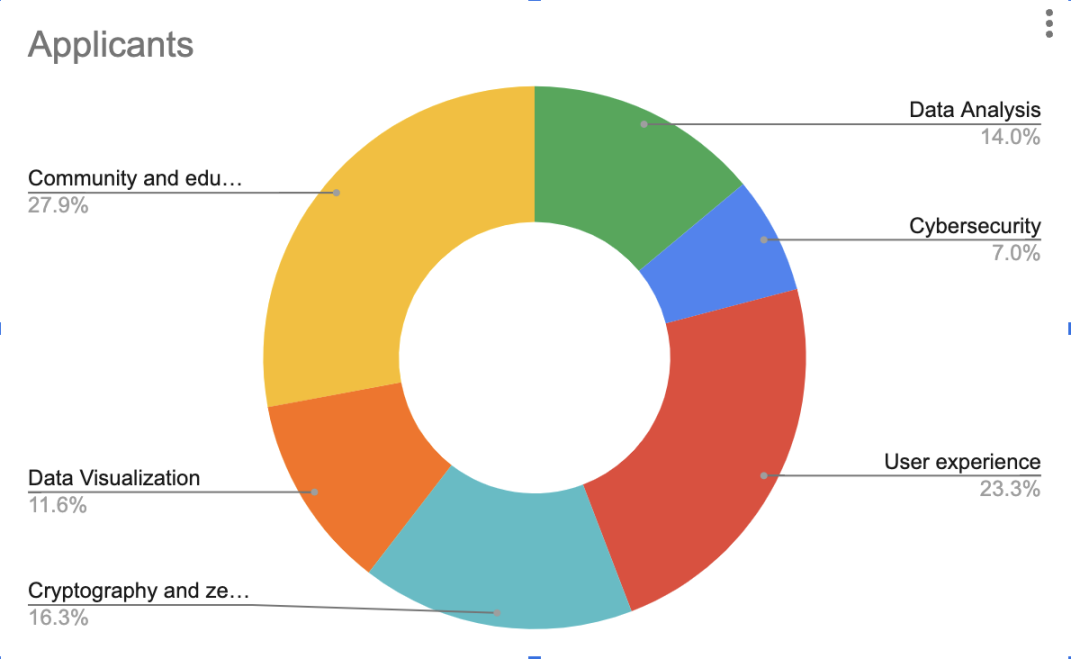
Due to the high quality of proposals, the Ethereum Foundation increased its budget from an initial $750,000 to $948,000.
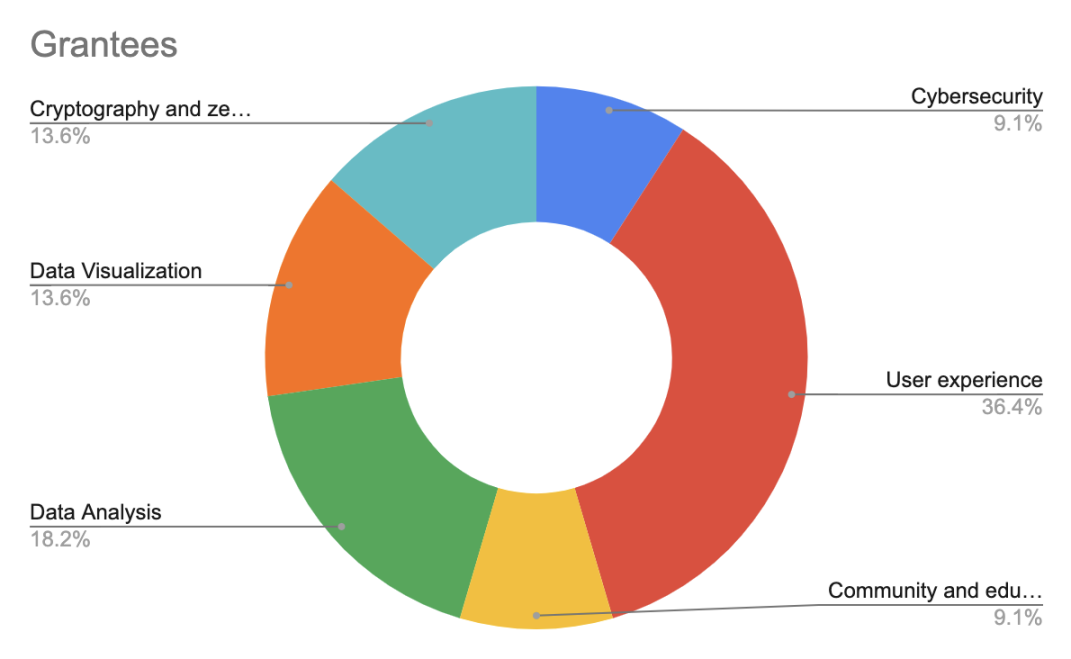
The proportion of award-winning projects in different categories is also different. Among them, user experience projects accounted for the highest proportion of 36.4%, data analysis projects ranked second with 18.2%, and cryptography, zero-knowledge proof, and data visualization projects each accounted for 13.6% %, network security and community and education projects each accounted for 9.1%:
Winners:
cyber security
cyber security
Candidelabs- ERC-4337 public infrastructure
This is an open source bundler (bundler) and payment (paymaster) service as an ERC-4337 smart contract wallet public goods infrastructure, focusing on Layer 2.
Quantstamp- Rollup Security Framework
This project will build a detailed security framework for the unique features of rollups, hoping to establish a foundation of best practices and transparency for these features to help new developers and enable the community to assess the security risks of a particular rollup before using it . Similar to those that can be used for smart contract development and likeL 2B eat.comuser experience
user experience
Spiro - zkWallet
Multi-party secure wallets (such as Gnosis Secure Multi-Sig) are a proven way to allow multiple users to share control of an account's digital assets and behavior. Unfortunately, the current implementation of multi-party wallets exposes the privacy of the total number of multi-signature addresses and their associated external accounts (EOAs). Spiro Wallet aims to build a private multi-party wallet that shields end users by employing account abstraction (EIP-4337) and zero-knowledge proofs.
Kautuk Kundan - Stackr Network
Stackr Network is an SDK for launching standalone, customizable application-specific rollups using familiar Web2-like tools. It focuses on the core principles of rollup, which is to run a state machine off-chain and use L1 to store transaction details. This can be achieved with a common language that maintains application state off-chain and provides an interface to interact with it, thus acting as an independent L2. It allows building a new class of applications that will have more freedom in their execution choices.
ScopeLift- L2 optimizer
The Layer 2 network shares security with the main network by publishing transaction call data to Layer 1. Thus, Layer 2 users pay their share of the mainnet gas cost when executing transactions. Layer 1 gas is more than 25,000 times more expensive than Layer 2 gas, so paying for call data is the main cost of L2 transactions. Using custom routing contracts with less call data than standard methods can drastically reduce transaction costs for interacting with popular protocols.
Testinprod - Layer 1.5
Layer 1.5 enables anyone to start their own Layer 2 by providing simple tools. For example, block explorers, asset bridges, monitoring tools, etc.
ScopeLift- Layer 2 governance with Flexible Voting
Flexible voting is an extension of the popular governance system used by many DAOs. It allows new types of delegation contracts to be written, making it easier for governance token holders to participate in on-chain voting. One such use case is the subject of this grant: Layer 2 governance voting. Holders of cross-chain bridge governance tokens can pay cheaper gas fees to vote on Layer 2. These votes will be fed back to L1 deploying the DAO governance system in a trustless manner.
Clement Walter - Starksheet
Starksheet aims to democratize access and usage of on-chain resources (data and logic). It leverages familiar spreadsheets to help users query and link on-chain resources. These behaviors are stored on the chain in the form of NFT, which can be queried from any other DApp or contract in the future.
Kristof Gazso - Typescript ERC-4337 Bundler
The project will consist of developing an ERC-4337 bundler (bundler) in Typescript, with associated modifications to Geth nodes for simulation purposes, so that the bundler can run on any directly Geth-compatible chain (including large Most L2) run on. The bundler will also expose the RPC calls defined in the specification and maintain an internal mempool to be future-proof when developing P2P broadcasts.
Soul Wallet- Open source ERC-4337 wallet
An easy-to-use browser wallet implementation powered by ERC-4337.
Community and Education
Jose Figueroa - L2 en Español
L2 en Español is an open community that aims to research, educate, and drive adoption of all Ethereum scaling solutions. These programs focus on developers and new users seeking to stay abreast of these technologies and their utility. L2 en Español creates content and carries out different activities, from publications to workshops, free of charge, while supporting the innovation of different projects in this space, while also maintaining a core neutrality.
Bruce Xu - MyFirstLayer 2
data analysis
data analysis
Blockscout- Blockscout block explorer
Currently, the L2 ecosystem needs an open source block explorer. Blockscout is already used by many L2 projects and will increase availability for specific requirements of L2 data. Additionally, new interface, features, analytics, and developer-friendly improvements will help create a more transparent and usable community browser.
Quantstamp- Evaluate Rollup compression
Compression is often overlooked when discussing rollup. By design, rollups are required to provide data to validate state transitions or state roots; however, this published method is different and may include compressed data. There are also differences in the compression techniques used. Quantstamp will explore the use of compression techniques in rollup settings. First, Quantstamp will illustrate scenarios where compression is used and document possible techniques to use. Second, Quantstamp will survey existing rollups to investigate the methods actually used. Third, Quantstamp will evaluate methods proposed or used in similar systems and try to determine why a particular method was used. Finally, Quantstamp will use the feedback collected to propose new methods for compressing rollup data and open questions to the community.
Diablobench- Performance and security evaluation of Layer 2 blockchain systems
The University of Sydney and EPFL designed a benchmark suite to assess the security and performance of blockchain systems. The first evaluation compares layer 1 blockchains such as Algorand, Solana and Diem and will be presented soon at a peer-reviewed international conference (Eurosys). Diablobench aims to add Layer 2 blockchain systems to the Diablo benchmark and use it to conduct the first extensive and realistic benchmark evaluation of Layer 2 blockchain systems deployed on a global scale.
Web3-data- Layer 2 activity tracking and comparison suite
Through this project, Web3-data aims to provide a set of high-quality dashboards to help data scientists, researchers and all community members better understand Layer 2 activities;
Web3-data will leverage sources such as Dune, L 2B eats, Santiment, CoinGecko, Github, Discord, and in many cases, aggregate data across the entire Layer 2 network directly from the project's API/RPCs.
Web3-data will clean and organize this data to provide a set of dashboards that allow the community to visualize changes in key L2 metrics such as tps, rent paid to Ethereum, growth in TVL, daily active addresses, new address, general address, paid fees, and developer activity based on commits from GitHub-affiliated repo).
The goal of Web3-data is to tokenize smart contracts (and ultimately enable the community to Token smart contract). This label will allow us to analyze and visualize usage patterns at a high level and show the "hottest" smart contracts in different usage categories. Web3-data is using known tags from Dune, Arbiscan, Etherscan and others.
L2 Beat - L2 Beat
Continue to work on transparent and verifiable insights into emerging L2 technologies through scaling metrics and education.
data visualization
Quantstamp- L2 block explorer backend API standard
Quantstamp will clearly define the properties that a block explorer should implement in order to be considered fully functional in a general Layer 2 setup. Additionally, Quantstamp's goal is to propose and specify a standard API interface that Layer 2 networks should expose to common block explorers. Quantstamp envisions that such a standardized interface will greatly simplify the development of multiple block explorers that can be plug-and-play and reused across all Layer 2 networks that support the standard. Ideally, the standard will turn the core development of a new block explorer into a project that can be completed in a weekend hackathon by an experienced team. Quantstamp's goal is to define a consumer-neutral standard. Therefore, it does not matter whether it is used by a commercial, open source, or possibly even decentralized block explorer. Quantstamp will pay special attention to what unique Layer 2 data block explorers should provide, with an emphasis on security-related data for the chains Quantstamp monitors.
The first block explorer to support blob transactions in EIP-4844. It indexes and presents them in a searchable format that users can visualize and navigate in an easy way, providing the necessary infrastructure for scaling Ethereum.
Cryptography and Zero-Knowledge Proofs
Specular - Zhe Ye, Ujval Misra and Dawn Song ( UC Berkeley )
Today's most popular Optimisic Rollups (ORUs), represented by Arbitrum and Optimism, strive to extend the existing Ethereum client software (Geth) to support the construction of Interactive Fraud Proofs (IFP), aiming to reuse previous L1 projects and EVM semantics are replicated at L2. Unfortunately, in order to do this, they tightly couple their on-chain IFP validators to a specific client program, ignorant of its higher-level semantics. This approach (1) precludes trust-minimization, unauthorized participation of multiple Ethereum client programs, magnifying the risk of monocolture failure; (2) leads to an unnecessarily large and complex Trusted Computing Base (TCB), which is difficult to Independent audits; and (3) suffer from frequently triggered, but opaque upgrade processes - both further increasing audit overhead and chronically complicating on-chain access controls.
Therefore, the team focused on building a secure, trust-minimized ORU that addresses these issues while maintaining scalability and dispute resolution efficiency. To this end, the team designed an EVM-native IFP system that precisely implements Ethereum's semi-formal semantics at the level of individual EVM instructions. As part of this work, the team built Specular, an ORU utilizing Geth modifications with only 99 lines of code to support the construction of IFP - a testament to the practicality, scalability, and trust minimization of our approach.
Nethermind,Justin Thaler (Georgetown University), Matthew Green (Johns Hopkins University), Pratyush Tiwari (Georgetown University) - Specific Security Analysis of L2 Proof of Deployment Systems
The team proposes to analyze the specific security of ensure-rollups security proof systems (SNARKs, STARKs). The team observed that some proof systems had security analysis in the interactive environment, but after applying the Fiat-Shamir transformation, their security was only guesswork. Furthermore, the team believes that, in some cases, attacks that are more effective than the supposed level of security are possible.
Ethstorage- Proof of storage for L2 dynamic datasets using Ethereum L1 contracts
Given the commitment list of BLOBs in L1 contracts (eg, KZG commitments from EIP-4844/Danksharding with index 0...n-1), this project is to research an efficient proof system to efficiently verify BLOBs on L1 are stored off-chain with the required degree of redundancy (eg, 30-50 physical copies). By putting these storage nodes in the L2 network, and assuming that 1/m nodes are honest, it is possible to build an L2 storage network that reuses the security of the main network while greatly extending the scalability of Ethereum.
Further research will attempt to answer the following questions: how to build proof/verification systems if BLOBs and commitments are constantly changing (e.g. new BLOBs are appended to a list, or an indexed BLOB is changed); and how to build incentives/payments system to ensure an ideal replication factor using ETH as payment; is it possible to require storage nodes to store partial BLOBs while maintaining the same level of security on the mainnet?