






Starting from bills, why are on-chain transactions worth analyzing?


“The biggest difference between Ethereum and Bitcoin is that Bitcoin is a platform and its ecosystem value comes from the value of the currency. But in Ethereum, the value of the currency comes from the value of the ecosystem”.
first level title
A fun annual Ethereum bill
"2d ao 3" is a dao organization with an interesting name. They made a gadget for annual bill review on a whim
https://api 700.com/? from=v
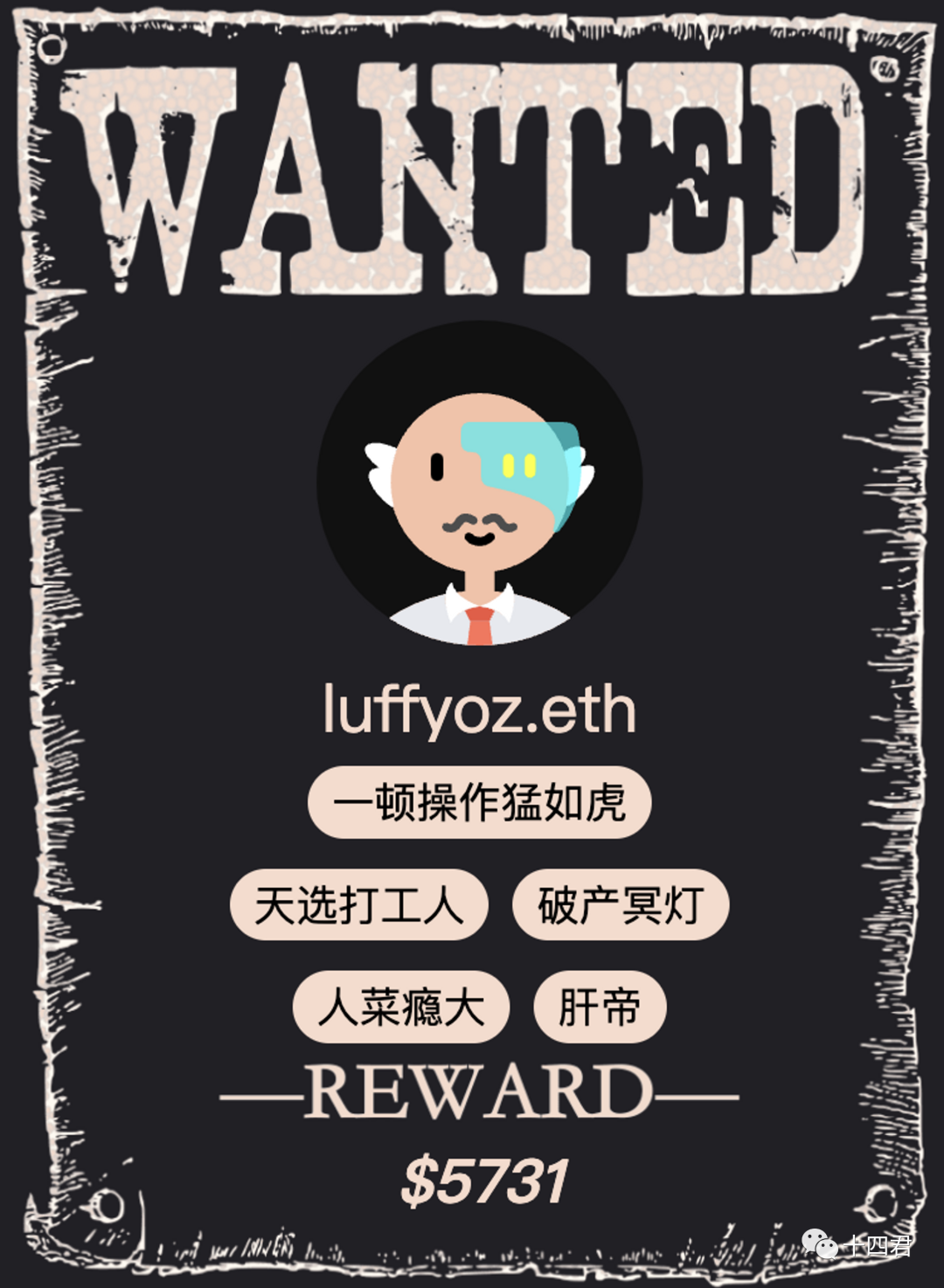
Among them, it is divided into "look at it casually" and "search by address". I have to say that there are still many interesting domain names on the chain. A series of10 U God of War, Hexagon Warrior, Chosen WorkerThe labels calculated based on the data on the chain bring a different touch. The address on the chain is no longer just a string of incomprehensible numbers and a bunch of intricate transaction records.
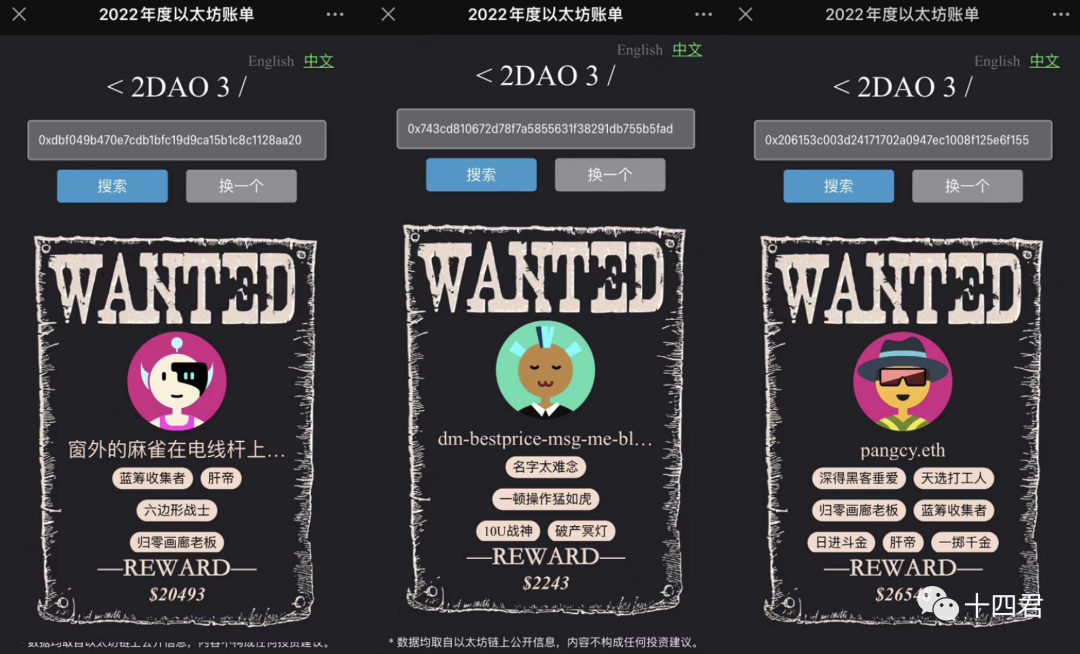
Therefore, after seeing such a concrete image on the chain today, I also want to continue to talk about the important feature of data disclosure on the blockchain. This is the most distinct point between web2 and web3!
Why is on-chain data worth analyzing?
Today, Ethereum has become a huge financial settlement network. If we look at it from another perspective, when every transaction requireswhen paying an average cost of a few dollars, its business itself must have corresponding investment or use value.
The cost and value of the information itself, as well as the blockchain infrastructure for information disclosure, are buried in motivation and gains and losses between the high and the low. Those who understand it can obtain huge data mining value.
Just imagine, if the user business data of all banks and central banks are public, any commercial organization can use these massive data to analyze each user's consumption habits, income, preferences and other characteristics. But because this will violate the privacy of users, it is impossible for financial institutions to disclose these data, although it is impossible even if it does not violate privacy, because the data itself is the basis for many moats in web2, and the flow of traffic is all the rage. The project will be questioned, if xx big factory also makes your same product, what should you do? At this time, it is incomparable to the breadth of data, and it is incomparable to the scale of traffic.
The core reason why the data can be associated with the traffic here is that the major web2 manufacturers have already mastered more real identity data, and some information such as ip, ua, and device fingerprints that cannot be understood by individual applications can be obtained by the major web2 manufacturers. It is easy to be reversed by the application of the breadth matrix to solve the behavior trajectory, and finally correspond to the individual.
first level title
On-chain identity verification is the focus of competition
But in the blockchain network, the user's account canAnonymous is selected by default, so even your transaction data is public, but it is also impossible to know which person an account corresponds to in real life, unless the user chooses to actively disclose, or when the account has interacted with a business (such as an exchange) that has undergone real-name authentication, private information may also be leaked .
Therefore, in terms of user classification, there may be two situations: real-name users on the chain and anonymous users on the chain. But for data analysis, both have their value.
Real-name users on the chain: such as Vitalik
For users with real names on the chain, they may themselves be public figures in the industry, so each of their transactions may have an impact on the market itself. For example, when Vitalik Butrin chooses to sell or destroy various dog tokens, will have a drastic impact on the market.
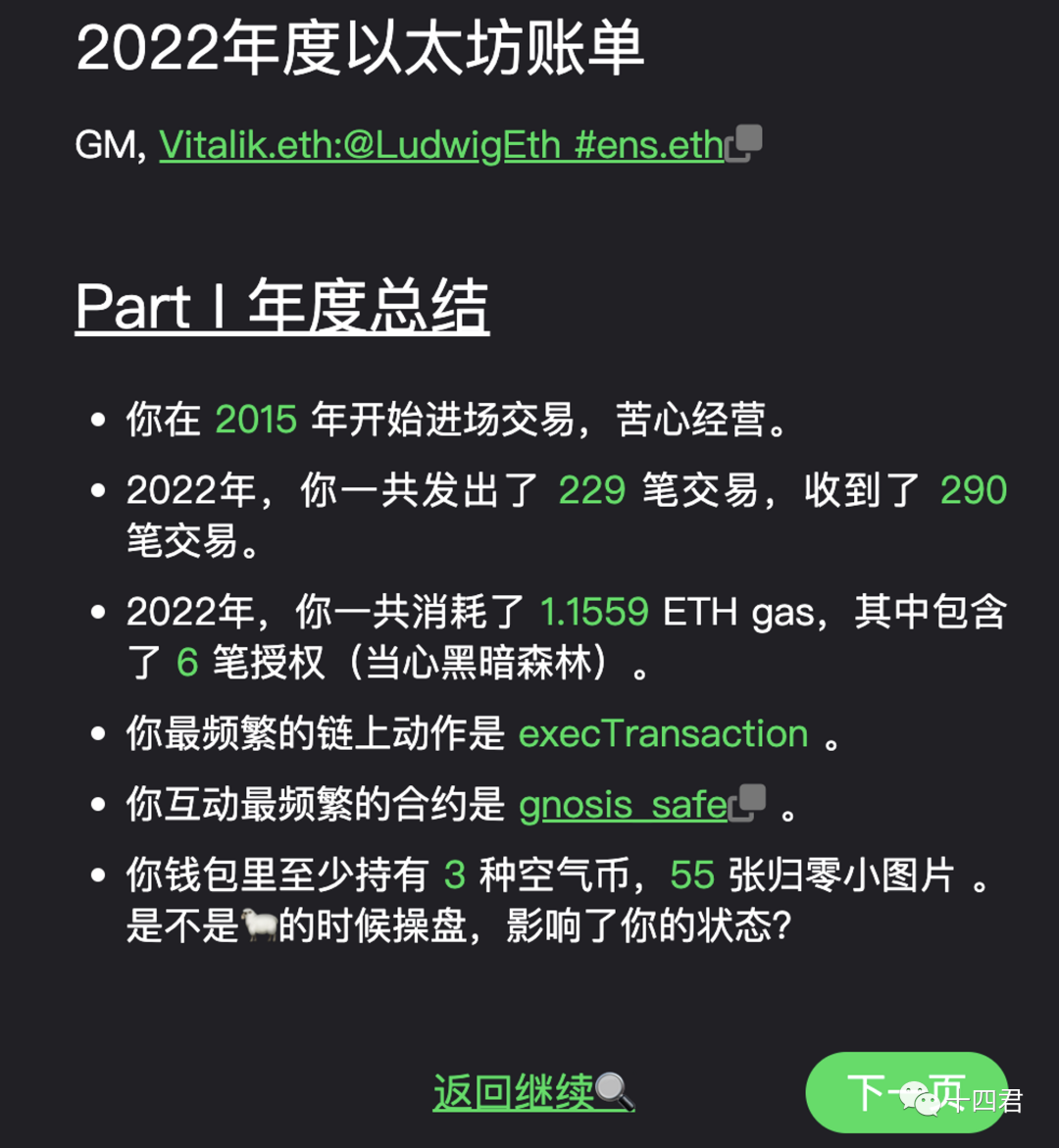
The large number of zeroed small pictures and unknowns (not yet fully aired) here are not Vitalik's own trading operations, but passive airdrops!
If you just follow real-name users, you should pay attentionThis is the noise of the on-chain datafirst level title
Anonymous users on the chain: such as addresses with good historical returns
On the other hand, for those addresses that are unwilling to disclose their identity information, there are actually many places to explore.
For example, many addresses will conduct frequent token transactions, or participate in some unheard of new projects. If these historical data are counted, you can roughly judge the historical income of a certain address, or learn about new projects that may be ignored by everyone in the market.
Some users on Twitter also pay attention to the movement of Smart Money funds calculated by Nansen
Of course I'd prefer to watch Stupid Money (laughs)
These information and data are crucial to this fast-changing market, because there are too many new projects, so if you can start with these high-quality addresses and obtain information from these addresses, the effect will be better than finding a needle in a haystack a lot of.
Flaws of on-chain data: always unable to see the whole picture
The analysis of each address may help users better understand the core information in the market, but there are some risks: a single address may not be the whole picture of an investment strategy, and the address holder may put all behavior and strategy,scattered across many addresses. Especially with the continuous improvement of the current DeFi stack and NFT scenarios, the risks and problems in this area will become more and more obvious.
For example, for an address with frequent transactions (through a DEX such as Uniswap), it may appear that the historical record of this address is very good, but in fact, the holder of the address has another address that has performed a lot of hedging operations, such as buying and selling For derivatives such as options and futures, if the spot of a certain transaction suffers a loss, the risk hedging in another address can play a protective role.
As the DeFi protocol becomes more and more abundant and perfect, there should be more risk hedging mechanisms in the future, whether it is options, futures, insurance, or even more complex or structured derivatives, the ways for users to avoid risks will gradually increase .
first level title
How to do transaction traceability?
A few months ago, a paper by a Stanford researcher was expected to be able to trace transaction related parties and capital flows to realize the refund capability of ERC 20/721. If you are interested, you can read further
at last
With the popularization of ZK in the future and the characteristics of open data on the chain, a blockchain system that is both open and private will completely change the current Internet landscape.
Looking back at history, the core of the entire commercial society is transactions, and the four elements surrounding transactions are: information, subjects, objects, and credit. In the past, we can clearly see the changes made by the Internet to the four elements of business.
The change of information is the transmission of the first generation of Internet information, and the docking of intermediary information.
The change to the object subject is to remove the commercial intermediary and realize the second generation of Internet around consumption.
In the future, with the chaining of objects and products and services, we will see the arrival of the real industrial Internet and the era of the industrial Internet, a real-name Internet that is truly traceable, trustworthy, unified management of identities, and unified authentication.
When all the business data is running on the blockchain, we will truly usher in the era of the Internet of Credit. It is not just the credit created by the behavior of a group. In the future, we will see the blockchain as the infrastructure , promoting the transformation of the Internet from the original information Internet and consumer Internet to the industrial Internet, industrial Internet, and credit Internet, extending the original single-layer Internet from width to depth, breaking the limitations of groups and regions, and forming a real ecology.
If you also want to experience the bill of 2D ao 3, clickread the original text
Reference link:
https://api 700.com/
https://api 700.com/result.html? lang=zh&address=0x d 8 da 6 bf 26964 af 9 d 7 eed 9 e 03 e 53415 d 37 aa 96045


