From AI infrastructure to application scenarios, which Web3 projects deserve attention?


Original Author: Cookie & alertcat.eth, ChainCatcher
OpenAI's chatbot ChatGPT reached 100 million monthly active users just two months after its launch, making it the fastest-growing app in history. Such a powerful ability to "increase fans" quickly spread the popularity of AI to the encryption field. On January 10, Bloomberg reported that Microsoft was considering investing $10 billion in ChatGPT developer OpenAI. All AI-concept cryptocurrencies were completely detonated. FET, AGIX Wait for an increase of more than 200% within a month.
With the help of capital, can these two high-profile cutting-edge technologies be integrated? Artificial intelligence uses computers to solve problems by mimicking the thinking abilities of the human brain. OpenAI feeds natural language processing (NLP) models with massive amounts of training data to make them more powerful. In the encrypted world built by blockchain technology, the huge data on the chain every day can provide "fuel" for the AI engine, allowing AIGC to feed back better strategies.
image description
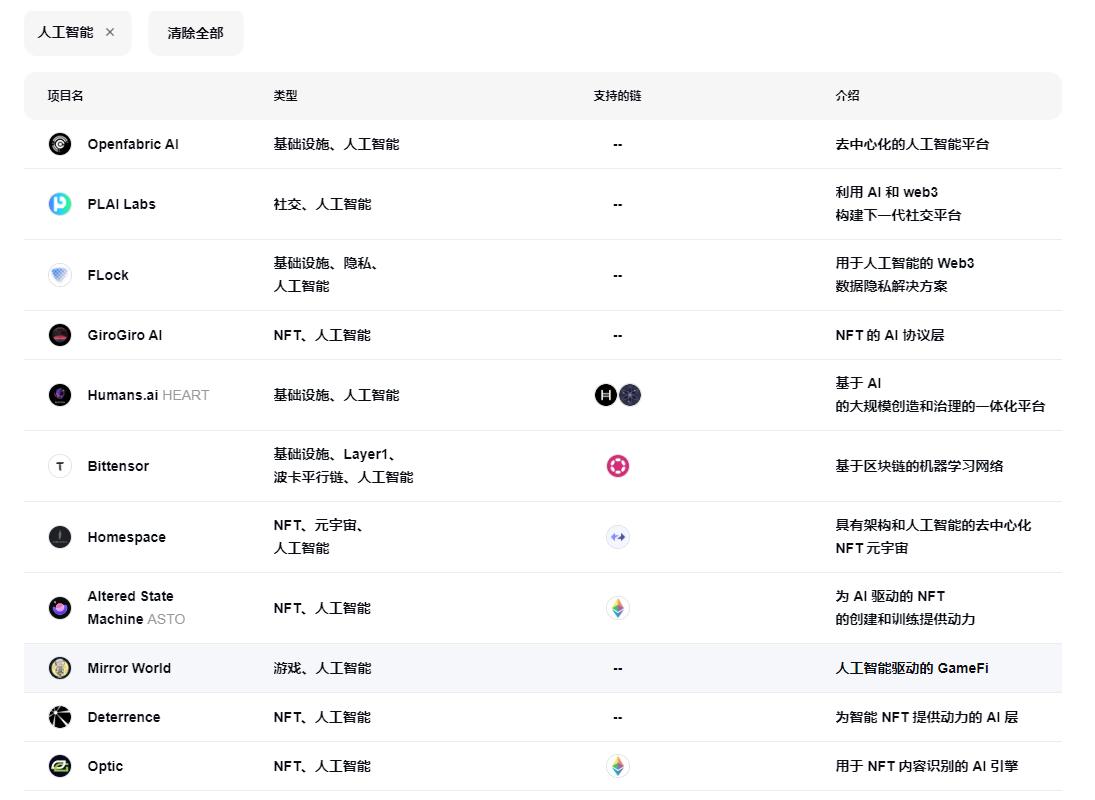
Crypto project for AI concepts (source:Rootdata)
Compared with Stability AI, ChatGPT and other artificial intelligence that have gained a lot of attention and adoption in traditional fields, the greater imagination of blockchain lies in the economic system that can change the AI model. When the FOMO sentiment fades, this article willfirst level title
AI infrastructure
secondary title
Openfabric AI
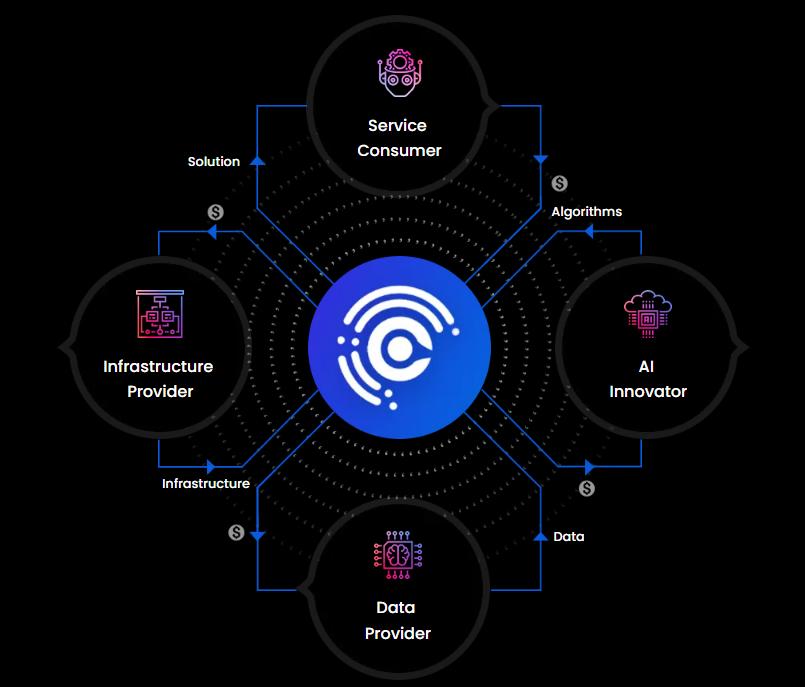
Openfabric is a platform for building and connecting AI applications. Through the platform, collaboration among AI innovators, data providers, enterprises and infrastructure providers will facilitate the creation and use of new intelligent algorithms and services. The Openfabric ecosystem consists of four roles: algorithm creators, data providers, infrastructure providers, and service consumers, among which service consumers need to pay the other three types of service providers.
Algorithm creators: Leverage their expertise to create AI algorithms that solve complex business problems.
Data Providers: Ensure the distribution of large volumes of data needed to train AI algorithms.
Infrastructure Provider: All the hardware that runs the AI platform.
secondary title
Oraichain
secondary title
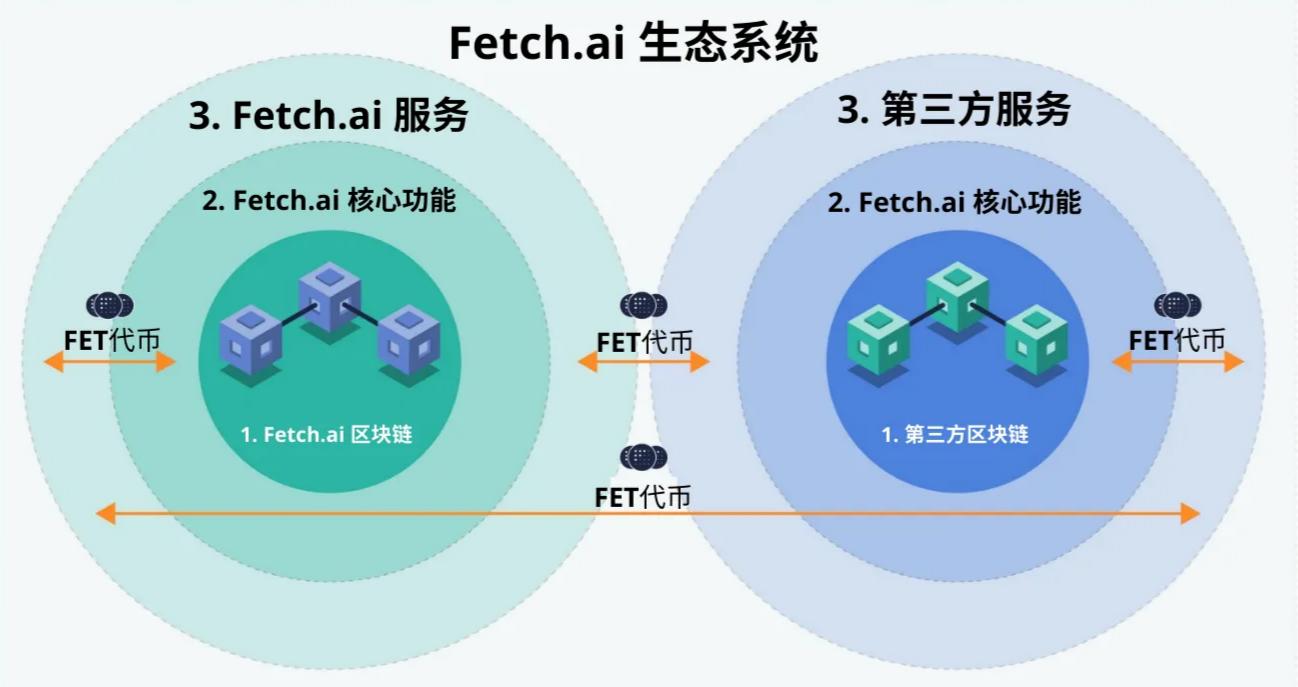
Fetch.ai
source:
source:secondary title
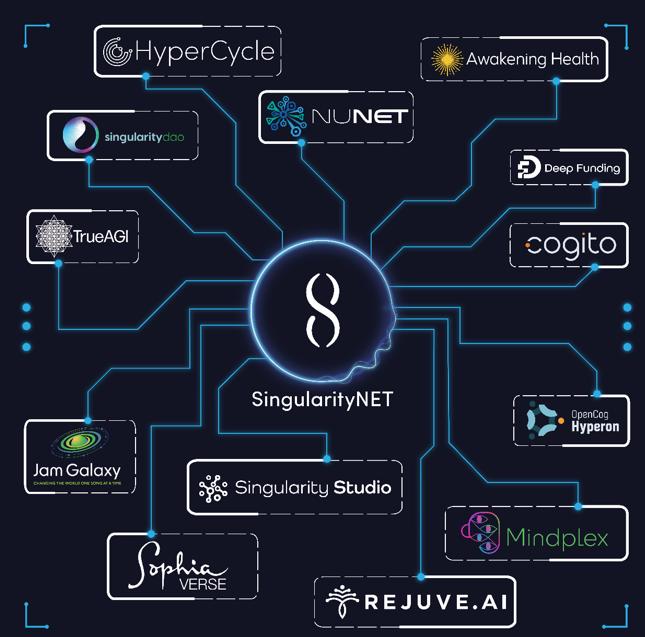
SingularityNET
image description
secondary title
Gensyn
The Gensyn Protocol is a Layer 1 network for deep learning computing that rewards supply-side participants instantly for devoting computing time to the network and performing ML (machine learning) tasks. The protocol does not require administrative oversight or enforcement, but instead facilitates task assignment and payment programmatically through smart contracts. The fundamental challenge of this network is to validate the done ML work. This is a problem at the intersection of complexity theory, game theory, cryptography, and optimization. The Gensyn ecosystem consists of 4 roles: Committer, Resolver, Validator, and Reporter.
Submitters: Provide tasks to be computed and pay for completed units of work.
Solvers: Perform model training and generate proofs for verification by verifiers.
Verifiers: Keys to linking non-deterministic training procedures to deterministic linear computations, replicating parts of solver proofs and comparing distances to expected thresholds.
Whistleblowers: Check the work of validators and pose challenges in hopes of winning jackpots.
Application Scenario
Application Scenario
In such application scenarios, the project aims to deal with the emerging needs arising from the development of blockchain in recent years in the form of AI.
secondary title
Chain tour direction
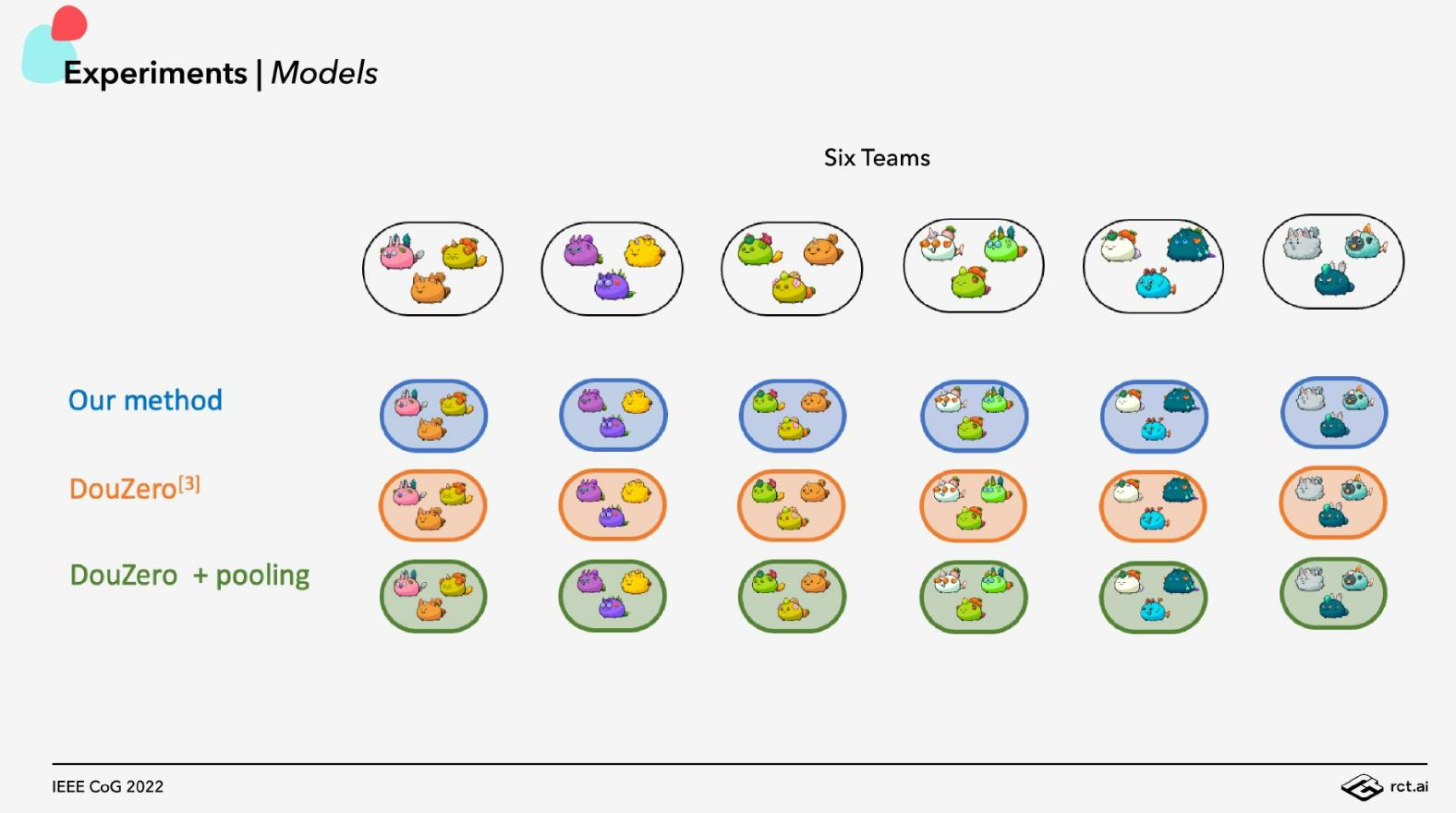
Under the mainstream financial system of the encrypted game "P2E" model, users are faced with constantly changing gameplay and a large number of repetitive basic operations. AI can provide players with a stable automated process and formulate game strategies with a higher winning rate. rct AI uses AI to provide a complete solution for the game industry. Its core technology, Chaos Box, is an AI engine based on deep reinforcement learning. rct AI has developed an AI-trained DRL (Deep Reinforcement Learning) model for Axie Infinity. Since there are about 10 ^ 23 combinations of all cards in Axie Infinity, as well as the characteristics of games such as games, the model of rct AI is simulating a large number of Increased efficiency and win rate in battle statistics.
secondary title
social direction
PLAI Labs focuses on using AI and web3 to build a next-generation social platform for users to play, talk, fight, trade and adventure together. The platform received $32 million in financing from a16z in January 2023. Currently, PLAI Labs has shown 2 products to the outside world:
Champions Ascension, a massively multiplayer online role-playing game (MMORPG), players can choose to own their own characters in the form of NFT, and can fight in the large Colosseum arena, do quests, and play in custom dungeons Build and compete and trade digital items in .
An AI protocol platform that will help handle everything from user-generated content (UGC) to matching to 2D to 3D asset rendering.
secondary title
NFT direction
Aletha AI proposed the concept of iNFT, which is a technology combining artificial intelligence and blockchain. After incorporating AI, NFT has various personality characteristics of interactivity, generativeness, scalability and uniqueness.
To put it simply, if NFT is a digital human work, after incorporating AI, it becomes iNFT, an NFT work with the ability to chat with users. On June 10, 2021, the world's first iNFTAliceSold at Sotheby's for $478,800.
Altered State Machine (ASM) is an innovative project that combines NFT, artificial intelligence and machine learning to provide training power for AI-driven NFT. Its vision is to become the ownership and monetization protocol for AI using NFT technology. In the ASM ecosystem, the AI-based Avatar is called an Agent, which consists of two parts: the brain and the avatar. The project also issued ASTO tokens to power the ASM ecosystem.
Optic is building an artificial intelligence NFT verification protocol, focusing on NFT fraud analysis and NFT value discovery within the community, aiming to help the entire NFT market achieve higher authenticity and transparency. The Optic intelligent engine retrieves the NFT collections on the market by learning the real NFT series. Optic then returns a match score indicating how well the checked NFT matches the real NFT.
first level title
trend analysis
Judging from the current development path of blockchain AI projects, the infrastructure of AI is composed of three parts: data, algorithms, and computing power. If a normal AI project wants to realize the ability of artificial intelligence generation or analysis, it needs a model and data set, as well as a software ontology and its GUI for calling the model. Then the distribution of models and data sets in this field, the training of models (computing power leasing), and the development of software front-ends have intermediaries, which will give birth to blockchain AI projects aimed at efficiently meeting customer needs.
For example, above, Fetch.ai acts as an intermediary, allowing customers to use its native token transaction data set. SingularityNET allows customers to purchase computing power training services from developers. Openfabric AI customers need to obtain models (algorithms), data sets, infrastructure (software) and other services from providers. Humans.ai is essentially encapsulated in NFT The AI model trained by the data set is purchased by the user with native tokens,
Gensyn is essentially a decentralized computing power rental platform. These are tasks that traditional AI needs to complete, such as natural language processing, AI voice, and image generation projects that use DApp as an intermediary platform for transactions.
Then the decentralized application in the blockchain has created new demands, then the AI projects based on the chain game direction, social direction and NFT direction aim to solve the user pain points in the blockchain, for example, rct.ai solves the chain game user For the problem of manual repetitive operations, Mirror World solves the development of chain games, and other projects are developed for blockchain social and NFT.
At present, in the initial stage of Web3 social networking, the introduction of AI is more of a narrative method. In the future, some possible directions for AI project research and development:
Enhance data privacy: Web3 can maximize data privacy protection by using zk technology, and AI can analyze data without compromising privacy.
Smart contract: Web3 technology can integrate AI applications into Web3 applications through smart contracts, so as to realize the controllability of AI models. This type of application can be used in the transaction of models and datasets to automate the transaction process and use ZK technology to protect user data. However, this type of project faces the impact of open source datasets and open source models. Just imagine: If users can obtain open source data and models on Hugging face and use auto train training, why would they trade on the blockchain platform? Facing the impact of Web2 companies, Web3 AI model and data set transactions do not have sufficient moats.
Summarize
Summarize
At present, whether it is the native AI infrastructure of the blockchain, or the encryption project that uses the AI engine to realize the application scenario, it is in its infancy. The main goal is to create an applicable underlying infrastructure and integrate token economics and hardware providers. , data providers, AI algorithms and other artificial intelligence solutions.
However, the integration of the two also faces many challenges. First of all, blockchain tends to be complex technologies such as Rollup and ZK, which will bring challenges to AI to obtain data. Secondly, there is not enough continuous experimental data to support the applicability of AI in the blockchain ecosystem and the ability of the AI engine to adjust to emergencies. Finally, the frequent occurrence of false projects in the encryption field that rubs off on the concept of AI makes it easy for people to lose confidence in the exploration of this field.
All blockchain AI projects that solve traditional AI problems need to answer a question: why does this platform need to introduce tokens on the blockchain? This makes the trading targets existing targets in the Web2 market, such as models, data and computing power, have the disadvantage of onboarding.
Token economics is like a flywheel that can change the cycle of a project's rise and fall. At the moment, if you want to move forward, you need to consider the actual users of the platform, that is, the problem of customer acquisition. The irreplaceability of demand is the moat of a project. Projects lacking a moat can achieve short-term success, but there will not be enough Users and a robust developer ecosystem. When demand is a false proposition, economic incentives are unsustainable, and the life cycle of the project will be shortened. We look forward to the emergence of more AI+Web3 projects based on real users and irreplaceable needs. They are designed to fulfill the requirements that are not or poorly completed in web2, so that they need to be introduced into Web3 natively.
In any case, the integration of AI into Web3 is a future technology trend, and some examples of Web3 applications combined with artificial intelligence have appeared at this stage. As time goes by, more related Web3 infrastructure and new models will emerge one after another.