Inventory of the 7 Layer 2 expansion projects that have recently launched the test network


Original author: ChainCatcher
according to
according toRootdatafirst level title
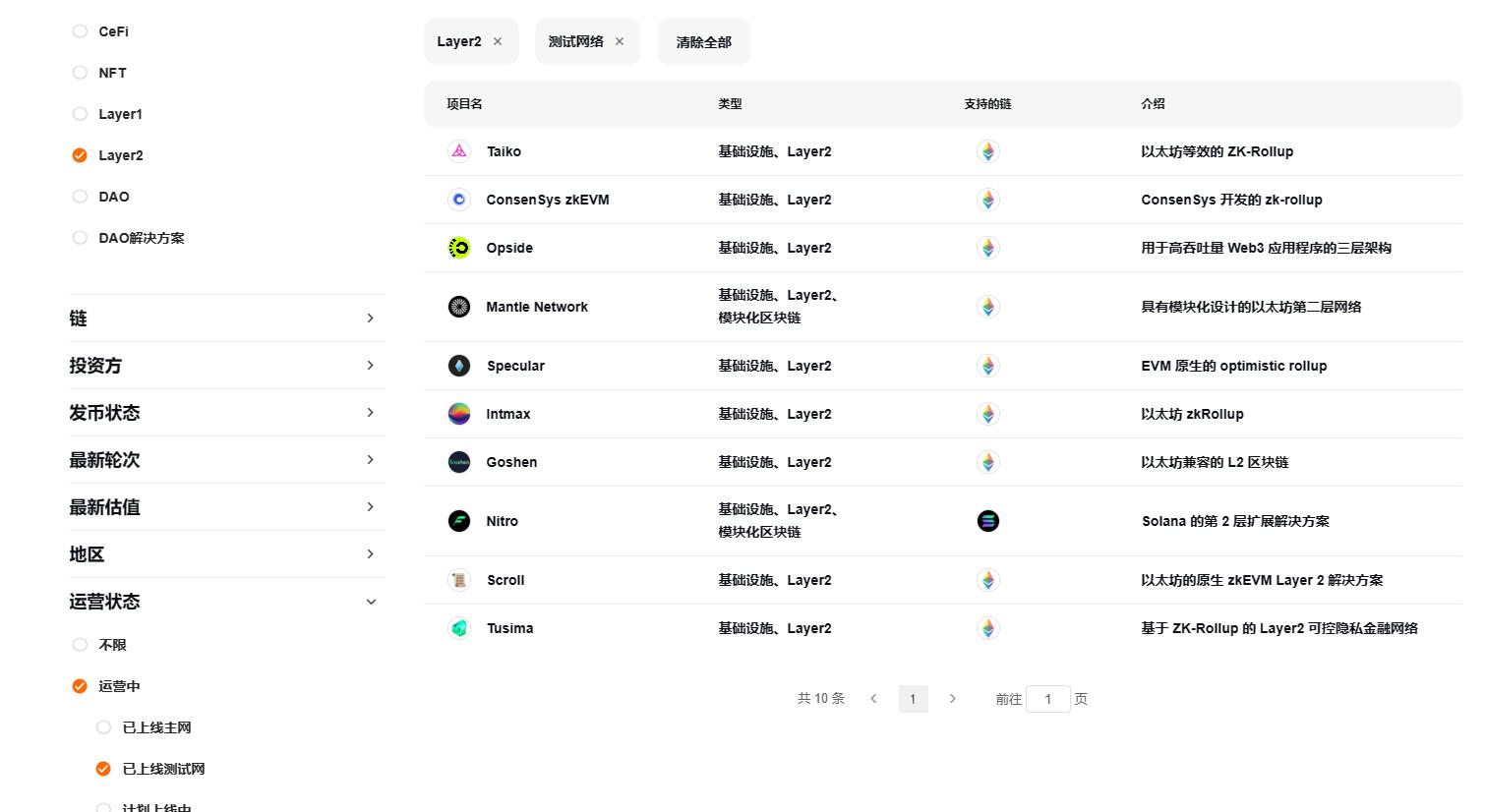
IntroductionTaiko
Introduction
The word Taiko comes from the old Chinese saying "drum", meanwhile, Taiko means "drum" in Japanese. A "drum" that expresses courage and achievement of goals. Taiko was launched in 2022 Q1 and was co-founded by Loopring founder Wang Dong (Daniel Wang) and former Loopring chief architect Brecht Devo. Most of Taiko's team members have worked in the field of scalability and ZK Rollup.
Taiko is a Type-1 type of zk-EVM (refer to the article: "Vitalik: The Future of Different Types of ZK-EVM" https://www.chaincatcher.com/article/2077517 ), which is completely decentralized, and Ethereum Fang equivalent ZK-Rollup. Currently, only the Privacy and Scaling Explorations (PSE) team and Taiko are working on Type 1 ZK-EVM. Also, Taiko has open-sourced the code.
secondary title
schedule
Taiko has not yet announced the launch time of the main network, which is expected to be launched at the end of 2023 or next year. On December 28, 2022, Taiko released the first public testnet, Alpha-1, which was named Snæfellsjökull. Users can test Taiko by bridging the Ethereum A 1 and Taiko A 1 networks, transfer tokens between accounts, interact with contracts, and run a proposer node. at present,Taiko L2 networkThere have been over 2.9 million transactions and over 340,000 wallet addresses. However, the Taiko testnet cannot yet generate validity proofs, and users cannot become validators. Taiko intends to launch a new testnet with zero-knowledge proof capabilities and release token economics in the coming months.
first level titlehttps://taiko.xyz/docs/testnet-guide
IntroductionMantle
Introduction
Mantle was founded by BitDAO at the end of November 2022. Mantle is a product of BitDAO, managed by the $BIT community, and transaction fees are paid using BIT tokens. BitDAO is one of the largest token governance vaults, with $1.9 billion in assets. In June 2021, BitDAO received a $230 million financing led by Founders fund, Pantera Capital, and Dragonfly, and participated by Alan Howard, Jump Capital, Spartan Group, and Kain Warwick.
Mantle is a modular Ethereum Layer 2 network that takes security from Ethereum via Rollup and is building a separate data availability layer with partner EigenLayer. The network stack consists of three layers, one for transaction execution, while the other two handle transaction completion and data availability, respectively. Mantle offers several improvements over traditional L2 solutions:
Modular Data Availability: By using feature layers, Mantle is able to increase transaction throughput beyond traditional L2. Accessible data availability also means that Mantle can increase throughput without compromising security and reducing node operation overhead. Reduces processing requirements for validators and promotes decentralization.
Multi-Party Computation (MPC): Mantle uses MPC to minimize the trust risk of L2 execution results. Dedicated nodes provide multi-party signatures to improve the correctness of off-chain transaction execution results and shorten the questioning period for withdrawals.
secondary title
schedule
Mantle launched a public testnet, Wadsley, on January 10, primarily for developers, and requires filling out a form to gain access to the Mantle testnet. 37,000 developers signed up within a day of launch. The release date of the mainnet has not been disclosed yet.
first level titlehttps://airtable.com/shruUIyhG 4 xDKBftH
IntroductionScroll
Introduction
Scroll was founded in 2021 and completed a $30 million Series A round of financing at the end of last year. Similar to Polygon zkEVM, Scroll is also committed to creating an EVM-equivalent zk-Rollup, and is even better in compatibility. It claims to be the most EVM-compatible zk-Rollup, so that applications on Ethereum can be almost seamlessly migrated to the second layer network. Compatibility at the bytecode level can achieve compatibility with all languages on the Ethereum, and can also be compatible with the tools on the Ethereum, which greatly reduces the difficulty of development on the second-tier network.
secondary title
schedule
On October 11, 2022, Scroll released an upgraded version of the Pre-Alpha test network. There are already some pre-deployed applications such as Uniswap v2, etc., allowing users to perform some functions such as transfers between L1 and L2. However, due to the restrictions of the white list, a large number of spam robots appeared, which caused the official to temporarily slow down the review of test applications and tighten the list access. A few weeks later, the official launch of the permissionless Pre-Alpha test network allows anyone to interact on the test network, and developers can also deploy contracts on the network without permission.
On January 9, 2023, Scroll will perform a Pre-Alpha network reset. The purpose is to increase the throughput of the Pre-Alpha test network and remove the restrictions on social accounts. Each user can claim a test coin within 24 hours. A week after the network reset, the number of unique addresses on the Scroll testnet has exceeded 270,000, and 110,000 transactions are processed on L2 every day.
first level titlehttps://scroll.io/prealpha
IntroductionIntmax
Introduction
Intmax is a zk-rollup for various network services and finance, and its goal is to help Ethereum users to make payments, NFT and global investment projects. Privacy and decentralized sequencing are the characteristics of Intmax. After the mainnet is launched in the second quarter of 2023, Intmax can immediately realize the decentralized sequencer, open block mining and get rewards. Last November, Intmax was selected as one of 18 recipients of the Mask Network Grant's first grant program.
Intmax claims that its zkRollup has "extremely high call data efficiency". According to the official website, the protocol uses 3 new technologies in the zkRollup architecture:
Limited online assumption: This is a hybrid of zkRollup and Plasma Prime, by immediately returning Merkle proofs of tx results to users, and ZKP proofs to delete historical data. In addition, the technique can also use old Merkle proofs by proving that the state is not updated.
Client-side ZKP: Aggregates many transactions into one transaction, including the case where the recipient has many addresses.
secondary title
schedule
On December 19, 2022, Intmax announced the launch of testnet v1. The testnet is a command-line type, mainly for developers. The official website also provides 3 small programming games using the circom language. Intmax plans to launch a general-purpose testnet in the first quarter of 2023 and launch the mainnet in the second quarter.
first level titlehttps://github.com/InternetMaximalism/intmax-rollup-cli
IntroductionConsenSys zkEVM
Introduction
secondary title
schedule
On December 14, 2022, ConsenSys released a private beta version of zkEVM, which has been made available to selected applicants on Infura, allowing developers to deploy and test smart contracts, and migrate DApps from existing networks, as well as bridge tokens . On January 10, 2023, the ConsenSys zkEVM Beta testnet registration has opened the application system for more external users, but they need to pass the registration application and wait for the waitlist. The official made it clear in the community that it will give back to the early community and participating testers.
first level titlehttps://www.infura.io/resources/network/consensys-zkevm-beta-signup
IntroductionOpside
Introduction
Opside is a zk-based three-tier blockchain architecture with advantages such as asset diversity and infinite scalability. Opside provides RaaS, which is a rollup service for DApps, introducing another three-tier architecture for applications, where the second layer is a sidechain connected to the first layer through a bridge, and the third layer is run on the second layer rollup. Opside has multiple chain cross-chain bridges, supporting the interoperability of BTC, ETH and other public chains with Opside's assets.
secondary title
schedule
At present, Opside has launched L2 Bridge, L2 Pledge Testnet and L3 Bridge Testnet. Anyone can participate in the test after connecting the wallet.
first level titlehttps://staking-testnet.opside.network/
https://bridge-testnet.opside.network/
IntroductionSpecular
Introduction
secondary title
schedule
Specular announced the test RPC endpoint and chain ID, as well as the faucet and SpecSwap on the official website. Users need to configure the Web3 wallet according to the requirements before they can receive test coins and complete token exchange and other interactions.
Testnet registration:https://specular.network