






4D Explains the Composition and Architecture of Web3


Original source: public account Keegan Xiaogang
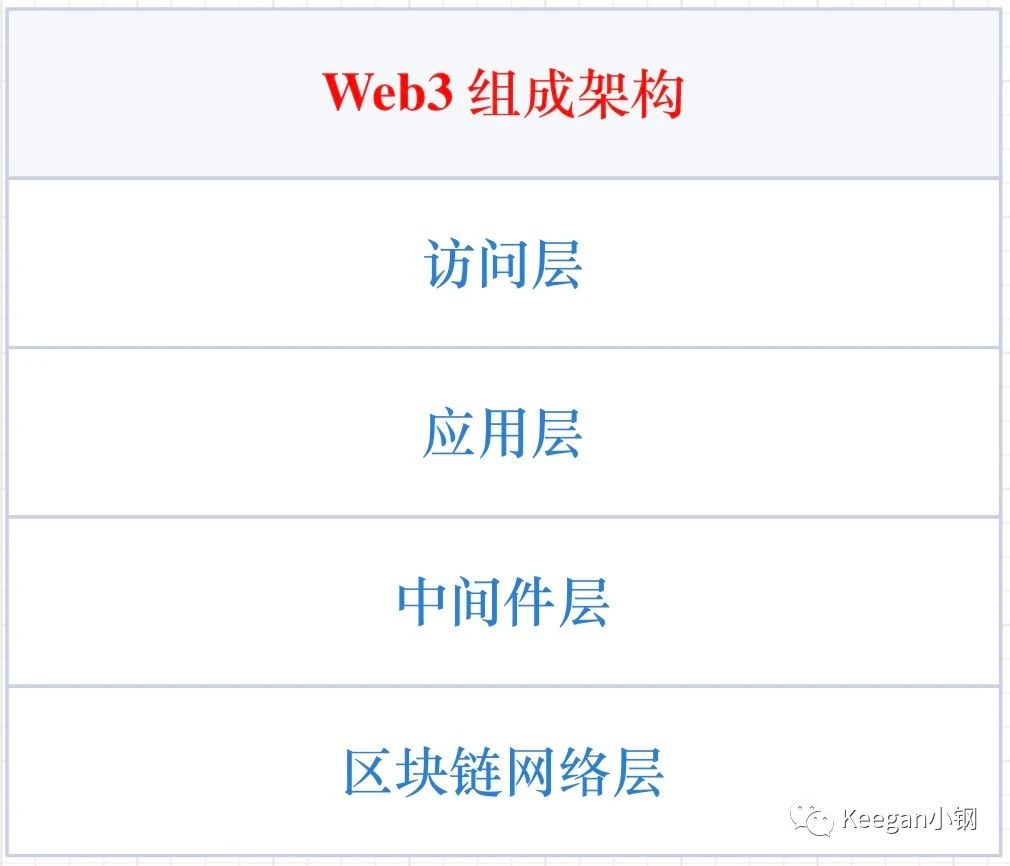
Since the development of Web3, the ecology has already begun to take shape. If we abstract the current stage of the Web3 ecological composition structure into a bird's-eye view, it can be divided into four levels from bottom to top:Blockchain network layer, middleware layer, application layer, access layer. Let's take a closer look at what each level has. In addition, this chapter will involve the names of many projects, which will not be introduced one by one due to space reasons. If you are interested, you can refer to relevant information for in-depth understanding.
Blockchain network layer
The bottom layer is the "blockchain network layer", which is also the cornerstone layer of Web3, mainly composed of various blockchain networks.
There are quite a few blockchain networks that make up this level, such as Bitcoin, Ethereum, BNB Chain (BSC), Polygon, Arbitrum, Polkadot, Cosmos, Celestia, Avalanche, Aptos, Sui, etc., and many more. According to Blockchain-Comparison, there are at least 150 blockchains as of the date of writing. Here we mainly talk about the public chain, and the alliance chain is not included. Because there are too many blockchains, it will be a bit dazzling, so it is necessary to classify them.
First of all, there is a hierarchical structure between different blockchains.Layer 0、Layer 1、Layer 2 points. Secondly, the prosperity and development of Web3 relies on smart contract technology, and the operating environment of smart contracts is a virtual machine. The relationship between smart contracts and virtual machines is similar to that between Java programs and JVM. Dividing the blockchain from different virtual machine dimensions can be divided into two categories:EVM chain and Non-EVM chain. EVM is Ethereum Virtual Machine, which is the abbreviation of Ethereum Virtual Machine. The EVM chain is an EVM-compatible blockchain, and Non-EVM, as the name suggests, is a blockchain that is not compatible with EVM. Finally, it can also be classified according to the size of the stored data, which can be divided into computational blockchains and storage blockchains.
Let's start with the hierarchical structure. The best understanding is Layer 1. The well-known Bitcoin, Ethereum, EOS, and BSC all belong to Layer 1, also known as the main chain. In distributed systems, there is the CAP theorem, that is, a distributed system cannot satisfy three characteristics at the same time: consistency, availability, and partition fault tolerance. A distributed system can only satisfy two of the three. The Layer 1 blockchain is also a distributed system in nature, and it also has the impossible triangle problem, but the three characteristics are different from CAP, namely: scalability, security, and decentralization. Each blockchain can only Two of the three items can be met. Bitcoin and Ethereum are biased towards security and decentralization, so the scalability is relatively weak and the TPS is relatively low. EOS and BSC only rely on a small number of nodes to maintain consensus. Compared with Bitcoin and Ethereum, they reduce the characteristics of decentralization, but improve scalability, so as to achieve high TPS.
In order to solve the scalability problem of Bitcoin and Ethereum, Layer 2 was slowly derived. Layer 2 exists as a sub-chain attached to the main chain, and is mainly used to carry the transaction volume of Layer 1 and assume the role of the execution layer, while Layer 1 can become a settlement layer, which can greatly reduce transaction pressure. The current mainstream Layer 2 is to extend the sub-chain of Ethereum, including Arbitrum, Optimism, zkSync, StarkNet, Polygon, etc. Bitcoin also has Layer 2, mainly including Lightning Network, Stacks, RSK and Liquid, but they are all relatively small at present.
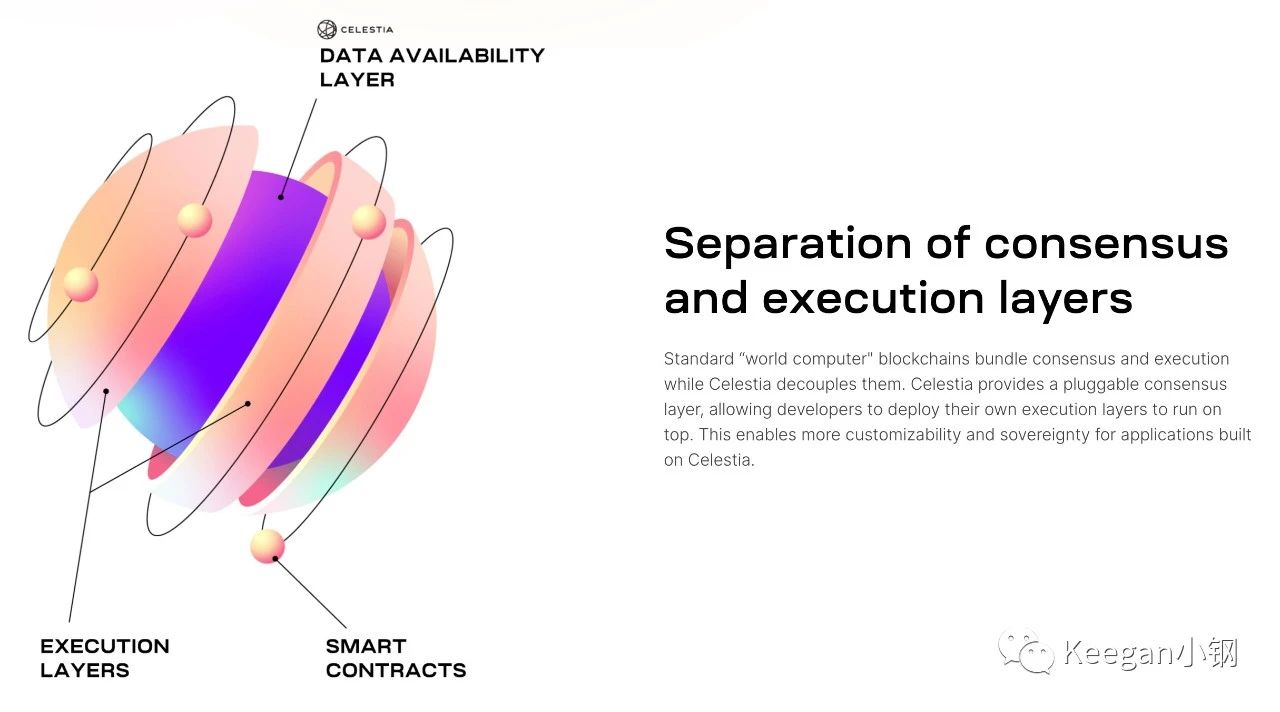
Layer 0 is more abstract, generally defined as the blockchain infrastructure service layer, mainly composed of modular blockchains, including Celestia, Polkadot, Cosmos, etc. The concept of modular blockchain was mainly proposed by Celestia. Its core design idea is to separate the core modules of blockchain consensus, execution, and data availability. Each module is completed by a separate chain. , and then combine several modules together to complete the whole work. This is the same as the modular design idea advocated in software architecture design, which can achieve high cohesion and low coupling.
Cross-chain bridges or cross-chain protocols that realize cross-chain communication can also be included in Layer 0. The number of cross-chain bridges is also very large. At the time of writing this article, there are as many as 113 cross-chain bridges on debridges.com, among which the three with the highest TVL ranking are the official cross-chain bridges of Polygon, Arbitrum, and Optimism. The two bridges realize the asset cross-chain between their respective Layer 2 and Ethereum. The fourth place in TVL is Multichain, formerly known as Anyswap, which is a third-party cross-chain bridge that connects the most blockchains. As of January this year, it has connected as many as 81 blockchains.
After talking about the division of the hierarchical structure, let's sort out the different blockchains from the perspective of EVM. As mentioned earlier, from the EVM dimension, it can be divided into two categories: EVM chain and Non-EVM chain.
The EVM chain is currently the most mainstream direction, and the DApp and user groups based on the EVM chain are currently the largest in the entire Web3 ecosystem. Some are natively compatible with EVM, such as BSC, Heco, Arbitrum, Optimism, etc.; some are extended to be compatible with EVM later, for example, zkSync 1.0 is not compatible with EVM, while zkSync 2.0 is compatible with EVM. Many blockchains are gradually embracing EVM even if they were not compatible with EVM in the early days. For example, Polkadot launched the Moonbeam parachain to be compatible with EVM, and Cosmos has Evmos.
At present, most of the top-ranked blockchains are compatible with EVM, but there are still a few Non-EVM chains, such as Solana, Terra, NEAR, Aptos, and Sui. In addition, the smart contracts of the EVM chain mainly use Solidity as the development language, while the Non-EVM chain mainly uses Rust or Move language to develop smart contracts.
The blockchains mentioned above are mainly biased towards blockchains that solve decentralized computing. These blockchains generally do not support the storage of big data, such as file storage. The storage-type blockchain focuses on solving the problem of big data storage. There are not many such blockchains at present, mainly including Filecoin, Arweave, Storj, Siacoin and EthStorage.
At present, the blockchain members that make up the "blockchain network layer" mainly include these. In the future, new members will continue to join, but there are also many old members that are gradually declining and left in the corner.
middleware layer
The layer above the blockchain network layer, which I call the "middleware layer", mainly provides various general services and functions for upper-layer applications. The general services and functions provided include but are not limited to:Security audit, oracle machine, index query service, API service, data analysis, data storage, basic financial services, digital identity, DAO governance, etc.. Components that provide general services and functions can be called "middleware". These middleware also exist in various forms, which can be on-chain protocols, off-chain platforms, or off-chain organizations, including centralized enterprises or decentralized Centralized autonomous organization DAO. Let's talk about the specific middleware in this layer.
Let’s talk about security audit first. This is a very core middleware, because most of the blockchains and applications in Web3 are open source, and many of them are closely related to finance. Therefore, security has become the top priority. , Security audit has naturally become a rigid demand. Most of the security audit services are provided by some security audit companies. The well-known audit companies include: CertiK, OpenZeppelin, ConsenSys, Hacken, Quantstamp, and the main domestic companies are SlowMist, Lianan, Paidun, etc. In addition, there are many small audit firms that are not well-known.
In addition to auditing companies, there are also some platforms that provide Bug Bounty. Generally, tasks are posted on these platforms to let white hat hackers come to find bugs. The higher the security vulnerability level of the bug found, the higher the bounty you can get. Currently, the world's largest Bug Bounty platform is Immunefi.
Next, let’s talk about the oracle machine (Oracle Machine, referred to as Oracle), which also plays a very important role in the Web3 ecosystem. It is a bridge between the blockchain system and external data sources. It mainly realizes smart contracts and off-chain real data. The world's data interoperability. Because the blockchain network itself has restrictions on state consistency, it is necessary to ensure that each node must obtain the same result given the same input, so the blockchain is designed as a closed system, and only the information in the chain can be obtained. data, but cannot actively obtain data from external systems. However, in many application scenarios, external data is required, and these external data are provided by oracle machines. This is currently the only way for blockchains to communicate with external data.
According to the specific functions provided by the oracle machine, the current classification of oracle machines is roughly as follows: DeFi oracle machine, NFT oracle machine, SocialFi oracle machine, cross-chain oracle machine, privacy oracle machine, credit oracle machine, and decentralized oracle machine network. Specific oracle projects include CreDA, Privy, UMA, Banksea, DOS, NEST, Chainlink, etc. Among them, Chainlink is the leader of oracle machines, which is positioned as a decentralized oracle network and has launched Data Feeds, VRF, Keepers, Proof of Reserve, CCIP and a series of products and services.
Then, the index query service is also a key middleware, which solves the complex query problem of data on the chain. For example, if you want to query the total transaction volume of a certain day on Uniswap, it is very troublesome to query directly on the chain. So there is a demand for index query services, the main representatives of which are The Graph and Covalent. The implementation of The Graph is mainly to customize the data on the monitoring chain and map it into custom data for storage, so as to facilitate query. Covalent, on the other hand, encapsulates many common and widely used data into a unified API service for users to query.
When it comes to API services, in addition to Covalent, there are other API providers that address different needs, such as: NFTScan, which focuses on providing NFT API data services; Infura and Alchemy, which mainly provide blockchain network node services; API 3, It aims to create a decentralized API service.
Both index query service and API service are data-related services on the chain, and data analysis is also a data-related service. The members of this section mainly include Dune Analytics, Flipside Crypto, DeBank, Chainalysis, etc.
Data storage middleware is easy to confuse with several underlying blockchains dedicated to storage, and some people divide the underlying Filecoin, Arweave, Storj, etc. into this layer, but I think these are essentially underlying blockchains, so I Include it in the blockchain network layer. The data storage of the middleware layer is currently mainly IPFS. The full name of IPFS is InterPlanetary File System, and the Chinese name is Interstellar File System. It is a new hypermedia transmission protocol based on content addressing, distributed, and point-to-point. It aims to replace the HTTP protocol. IPFS is very similar to the blockchain network, but it does not belong to the blockchain network. Filecoin based on IPFS is the blockchain network.
Next, let's see which middleware provides basic financial services. The representative components of this block mainly include Uniswap, Curve, Compound, Aave, etc. Uniswap and Curve provide on-chain transaction functions, while Compound and Aave are on-chain lending platforms. These are essentially on-chain protocols at the application layer, but because these protocols are gradually relied on by more and more other applications, they are similar to Lego building blocks, which can be used to combine to build different applications, so they become It has become a universal application protocol, that is, sinking into the role of middleware.
In fact, any component with composability, whether it is an application protocol on the chain, or a centralized entity providing different services under the chain, or a DAO, as long as the services and functions it provides are required by most applications, it can be composed into the "middleware layer". Different middleware is like different Lego blocks, and different applications can be created by assembling different blocks. Including digital identity, DAO governance tools, etc., in fact, the same is true.
application layer
The application layer is the most prosperous layer in the Web3 ecosystem. This layer is filled with various DApps, which can be described as a hundred flowers blooming and a hundred schools of thought contending. Below we mainly introduce several sectors that have developed relatively prosperously.
NFT
The full name of NFT is Non-Fungible Token, which means "non-homogeneous token". It is also called digital collection in China and is used to represent unique digital assets such as artworks.
The first real NFT project is called CryptoPunks, which was released in June 2017 and consists of 10,000 24 x 24 pixel avatars. Each avatar is generated by an algorithm, unique and all avatars are uploaded to Ethereum. It is also the only NFT project so far that has all avatar data on the chain. The picture below shows some avatars displayed on the CryptoPunks official website:
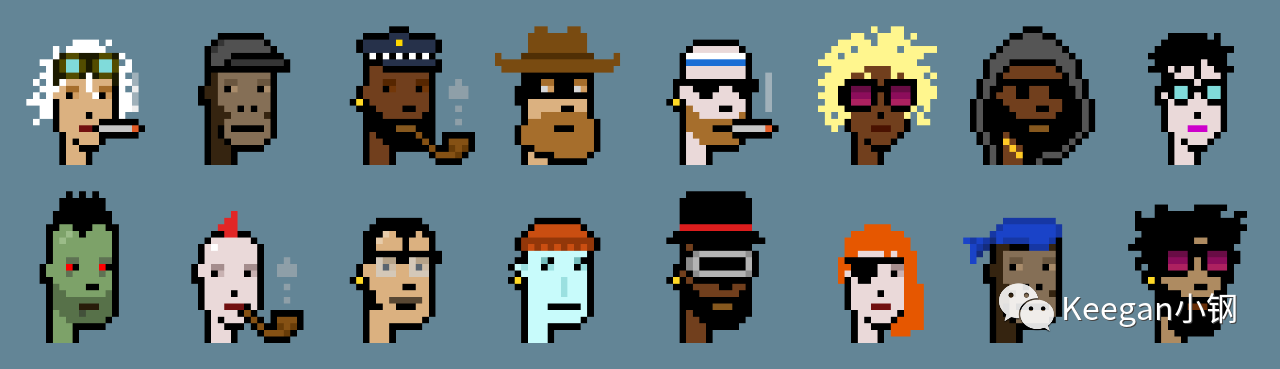
As of the date of writing, the floor price (lowest price) of CryptoPunks is 66.88 ETH, which is about $84,397.21 when converted to US dollars based on the price of ETH. The most expensive CryptoPunk, with a transaction price of 8,000 ETH, was sold on February 12, 2022. Why an NFT avatar is so expensive is difficult for many people to understand. Among them, the most important reason is that it is the first NFT project, just like Bitcoin is the first blockchain, the value potential brought by its pioneering status is very great.
Inspired by CryptoPunks, a company called Axiom Zen (the predecessor of Dapper Labs) released CryptoKitties at the end of November 2017, also known as CryptoKitties, EtherKitties, and Mystery Love Kitties in China. After CryptoKitties went live, it spread virally and caused congestion in Ethereum, exposing the performance problems of Ethereum. Before the release of CryptoKitties, Dieter Shirley, technical director of Axiom Zen, took CryptoKitties as a case and proposed the ERC 721 Token protocol as the general technical standard for NFT. After the explosion of CryptoKitties, NFT with ERC 721 as the main technical standard was further adopted , and now ERC 721 has become one of the basic standards for all NFTs.
After CryptoPunks and CryptoKitties, NFT began to bloom everywhere, and the NFT ecology gradually flourished. Since the development of NFT, it has been involved in many fields. If all the components of the NFT ecology are classified in detail, there can be as many as dozens of types. If we only focus on NFT itself, that is, the different use cases of NFT, we can roughly make the following classifications:Collectibles, artwork, music, film and television, games, sports, virtual land, finance, branding, DID.The following mainly introduces some representative NFT projects of each category.
Collectibles are actually difficult to define as a category alone. Broadly speaking, almost anything can be classified as collectibles, including artworks, game props, virtual land, etc. NFTs that can be defined as collectibles mainly need to have one characteristic: scarcity. For example, out of 10,000 CryptoPunks, the number of aliens is the least, so there is a high scarcity, and the males are the most, so the scarcity is very low. The most well-known collectible NFT, in addition to CryptoPunks, and BAYC, the full name is Bored Ape Yacht Club, also known as Bored Ape. Bored Ape is not just a set of separate NFTs, it is actually just the beginning of the "Bored Ape Universe". The Yacht Club (Mutant Ape Yacht Club, MAYC) also issued ApeCoin (APE) tokens, and also launched Otherside, a virtual land specially created for the Metaverse. These have formed the "Boring Ape Universe" series of IPs, and Boring Ape is not only popular in the encryption circle, but also peripheral products outside the circle are also increasing, such as Boring Ape hats, clothes, statues, restaurants, etc. The success of Boring Ape has surpassed that of CryptoPunks, and Yuga Labs has since acquired CryptoPunks outright.
The characteristics of NFT can effectively protect the ownership of copyright, so it is only natural that it is popular in the field of art. There are several representative works of artwork NFT worth introducing. The first one is the work of the artist Beeple, titled "EVERYDAYS: THE FIRST 5000 DAYS (EVERYDAYS: THE FIRST 5000 DAYS)", which is his past 5000 All the works (5,000 pieces in total) created one a day within a day were combined into one NFT image, which was sold for $69,346,250 in March 2021. The second one worth introducing is generative art, also known as derivative art. The works of art in generative art are not created by humans, but are automatically generated by programming algorithms. The most well-known NFT generative art platform is called Art Blocks, which is a random generative art platform based on Ethereum. Artists can upload their own unique algorithm to the Art Blocks platform, and set a specific number of NFTs for issuance, and the NFTs will be automatically generated according to the algorithm. Finally, I will introduce the most expensive NFT artwork at present, called "The Merge", which was sold at a sky-high price of US$91.8 million in December 2021. Unlike other NFTs, "The Merge" is not actually a single work, but a dynamic combination of multiple "mass" tokens. The sale is actually mass tokens. A total of 312,686 mass tokens were sold at the beginning, with a total of 28,983 buyers. That is to say, "The Merge" is jointly owned by these 28,983 buyers. The number of mass tokens owned by each buyer represents the share of ownership. "The Merge" can also be understood as a fragmented NFT work.
The rise of music NFT is similar to works of art, mainly because of copyright. The following introduces several representative music NFT-related figures. The first one to introduce is Justin David Blau, an American DJ and electronic dance music producer known by his stage name 3 LAU. He was one of the early adopters of music NFTs, selling his first NFT in the fall of 2020. And at the end of February 2021, the Ultraviolet NFT album brought him $11.68 million in revenue. In May 2021, Royal, an NFT music platform, was established. In August, it completed a seed round of financing of 16 million US dollars, with the participation of top institutions such as a16z and Coinbase. The second to introduce is Don Diablo, a Dutch DJ, digital artist, record producer, musician and electronic dance music creator who sold his first full concert movie NFT in 2021 called "Destination Hexagonia" , with a transaction price of 600 ETH (US$1.26 million at the time). Finally, there is a rock band called Kingship, a virtual band made up of bored apes, formed by Universal Music Group.
NFT has also swept across the film and television industry. Several well-known film and television dramas have released NFT one after another. Abroad, there are "Game of Thrones", "Batman", "Lord of the Rings", "The Matrix", "The Walking Dead", etc., and there are "Journey to the West" in China. "The Wandering Earth", "I'm Not the God of Medicine", "Feng Shen Trilogy" and so on.
NFT is mainly used in games as a carrier of game assets. Compared with assets in traditional games, the form of NFT can truly own the ownership of game assets for game players, and NFT can be circulated and traded outside the game. The first game NFT project is CryptoKitties, each cat is an independent NFT. I will talk about the GameFi section later, and then continue to talk about the game in depth.
The field of sports has also been involved in NFT. Currently, the two most well-known sports NFT platforms are NBA Top Shot and Sorare. NBA Top Shot, as the name suggests, mainly focuses on the NBA, while Sorare serves the football field. In addition to NBA and football, football, baseball, boxing, and wrestling have also launched their own NFT souvenirs.
Virtual land NFTs are mainly promoted by some projects that focus on the concept of "Metaverse", such as Decentraland, The Sandbox, Roblox, Axie Infinity Land, Otherdeed, etc. are well-known.
The combination of finance and NFT is mainly to apply NFT to DeFi. For example, the liquidity position in Uniswap V3 is NFT. In addition, another idea is to fragment the NFT first, and then endow these fragmented NFTs with DeFi functions, such as transactions, loans, pledge mining and other functions.
The combination of brand and NFT is mainly used as a new marketing method. In the past two or three years, various brands have successively joined this camp. For example, luxury brands include GUCCI, LV, Hermes, etc., food and beverage brands include Taco Bell, Starbucks, Pizza Hut, Coca-Cola, etc., car brands include McLaren, Chevrolet, etc., sports brands, etc. Brands include Adidas, Li-Ning, Nike, and many others.
Finally, let’s talk about DID, which is called Decentralized Identity, that is, decentralized identity. Everyone knows that DID is very important, but its development is still relatively slow. At present, there is no mature DID system to form a network effect except for ENS domain names in subdivided fields. At present, domain names are the most widely used, and ENS based on Ethereum is the leader. ENS is to Web3 what DNS is to Web2. The difference is that the domain name resolved by ENS maps not the website IP, but the user's Ethereum address. For example, the ENS of V God, the founder of Ethereum, is "vitalik.eth", and the mapped address is 0x d 8 da 6 bf 26964 af 9 d 7 eed 9 e 03 e 53415 d 37 aa 96045.
There are too many applicable scenarios for NFT, and the categories listed above have not yet covered all of them. Because of the characteristics of NFT, anything with ownership can be referred to, so there is a saying in the market that "everything can be NFT".
DeFi
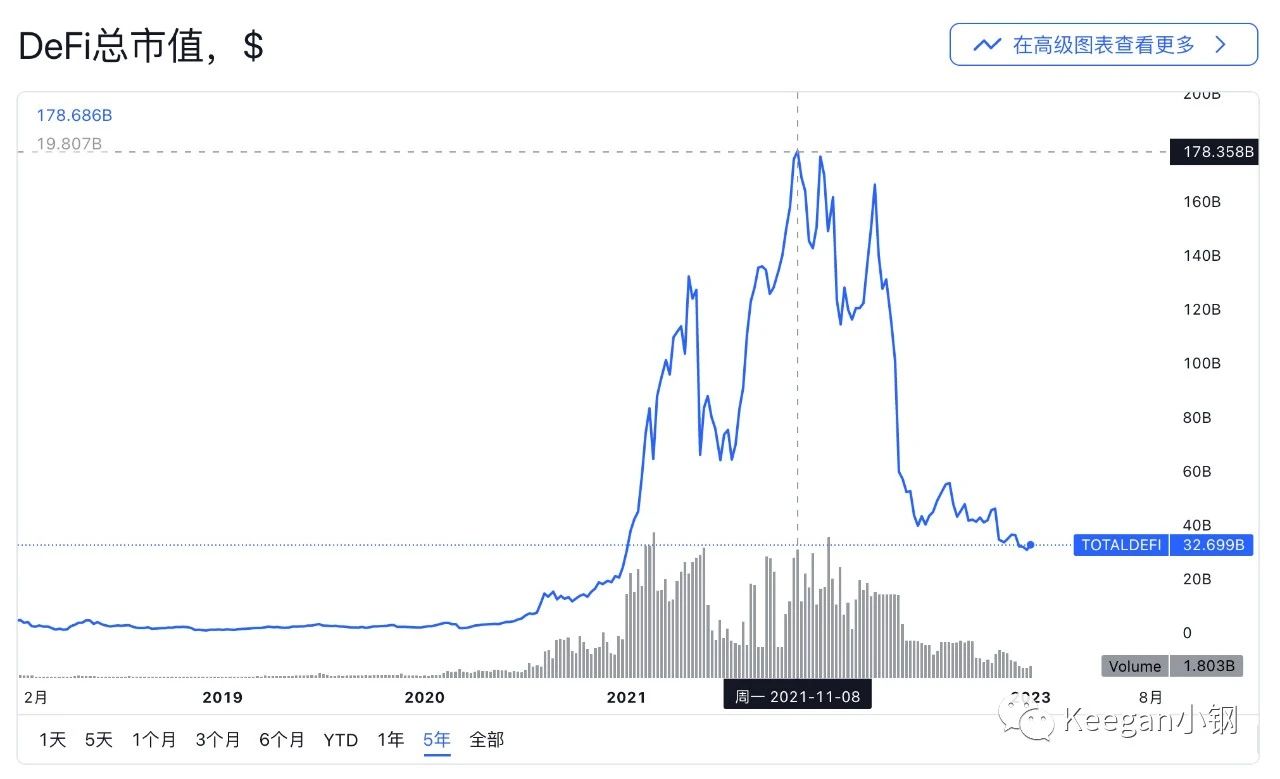
DeFi, or decentralized finance, emerged in the summer of 2020, so that period was also called DeFi Summer. According to TradingView statistics, when it first emerged in the summer of 2020, the total market value of DeFi was only US$5 billion, and then soared all the way, reaching its peak at the end of 2021, nearly US$180 billion.
DeFi has many subdivisions, mainly including:wait.wait.
Stablecoins can be mainly divided into three categories:Centralized stablecoins, over-collateralized stablecoins, algorithmic stablecoins. in,Over-collateralized stablecoins and algorithmic stablecoins are decentralized stablecoins。
Centralized stablecoins are directly linked to legal tender and are issued by centralized institutions. Each unit of stablecoin is required to have a 1:1 reserve of legal currency. Currently, the two most traded stablecoins, USDT and USDC, are fiat-collateralized stablecoins pegged to the U.S. dollar 1:1 and issued by two centralized institutions, Tether and Circle, respectively. In addition, Binance, the world's largest centralized digital currency exchange, and Paxos jointly issued its own fiat-backed stablecoin BUSD, which is currently the third-ranked stablecoin in the world in terms of trading volume, second only to USDT and USDC.
The over-collateralized stablecoin is forged by overcollateralizing other cryptocurrencies. The collateral will be locked in the smart contract. The smart contract will forge a corresponding number of stablecoins according to the value of the collateral. The smart contract relies on the price oracle to maintain the relationship with the legal currency. Anchored. This type of stable currency is mainly represented by DAI, launched by MakerDAO, and maintains a 1: 1 anchor with the US dollar, and currently ranks fourth in trading volume.
Algorithmic stablecoins are relatively new. As the name suggests, they mainly use algorithms to control the supply of stablecoins. There are also many players on this track, including UST, FEI, AMPL, ESD, BAC, FRAX, CUSD, USDD, USDN, etc., but there is no algorithmic stablecoin that truly achieves stability.
Next, let’s talk about exchanges,The exchange in DeFi refers to the decentralized exchange, referred to as DEX. DEX is the sector with the highest market value among all DeFi sectors, and it is also the cornerstone sector of DeFi. If DEX is further subdivided, it can also be divided into spot DEX and derivatives DEX. Derivatives DEX mainly trades perpetual contracts or options. If divided from the transaction mode, DEX can be divided into two main types:Orderbook mode and AMM mode. The DEX in the Orderbook mode mainly includes dYdX, apeX, 0x, Loopring, etc. There are more DEXs in the AMM mode, mainly including Uniswap, SushiSwap, PancakeSwap, Curve, Balancer, Bancor, GMX, Perpetual, etc.
Orderbook mode is the earliest type of transaction. The transaction method is the same as that of the stock market. The transaction user can choose to be the maker or the taker. The transaction will be matched according to the rules of price priority and time priority . The DEX using Orderbook can be further divided into three modes according to its development history:Pure on-chain matching + settlement mode, off-chain matching + on-chain settlement mode, Layer 2 mode。
Pure on-chain matching and settlement mode, the pending orders and taker orders submitted by users are directly on the chain, and the taker orders will be directly traded with the pending orders on the chain. The representative of this model is EtherDelta. Its advantage is that it is completely on the chain and has a high degree of decentralization, but its disadvantages are that the transaction performance is very low and the transaction cost is very expensive. Users need to pay gas fees for placing and canceling orders.
The representative of the off-chain matching + on-chain settlement mode is the 0x protocol. Compared with the first mode, it mainly has the role of "repeater" under the chain. Users generate orders through off-chain signatures and submit them to the The repeater maintains the Orderbook, and the successfully matched orders are then submitted to the chain by the repeater for settlement. Because the matching is moved to off-chain processing, the transaction performance is greatly improved, but the settlement is settled separately, so the settlement performance has become a bottleneck.
The representative of the Layer 2 model is dYdX, and the technology behind it is mainly supported by the product StarkEx provided by StarkWare. The basic principle is to deploy a separate and dedicated Layer 2. The user's matching transactions and settlements all occur on this Layer 2, and then all transaction records (including settlement records) are packaged to generate proofs and sent to Layer 1 for verification. verify. Different from the Layer 2 public chain, the Layer 2 public chain provides general transactions, and the Layer 2 used behind dYdX can only be used for special transaction scenarios. This is actually a private chain, which can also be called an application chain. It is also a new application mode. The trading experience of this model is almost the same as that of centralized exchanges, but the degree of centralization is relatively high.
A trading model that is completely decentralized and has a better trading experience. The current mainstream is the AMM model. AMM is the abbreviation of Automated Market Maker, also known as the automatic market maker model. It was Uniswap that ignited the AMM model, which was launched in November 2018. Subsequent SushiSwap, PancakeSwap, Curve, etc. were all transformed based on the Uniswap model. This model requires the support of a liquidity pool. The liquidity provider (LP for short) injects assets into the trading pool as liquidity, which is actually a fund pool. Then users directly trade with the liquidity pool, and LP earns users' money from it. Transaction Fees.
Let’s talk so much about exchanges for the time being, and then let’s look at derivatives. The DeFi derivatives sector mainly includes several directions:Perpetual contracts, options, synthetic assets, interest rate derivatives。
Perpetual contracts are also futures contracts, and leveraged trading products. The aforementioned dYdX, apeX, GMX, and Perpetual are several well-known perpetual contract DEXs. Options are more complicated than futures. Players in the DeFi options field mainly include Hegic, Charm, Opium, Primitive, Opyn, etc. However, the options market is still small and not much attention has been paid to it. Synthetic assets are encrypted assets that are combined and tokenized by one or more assets/derivatives. In the early days, digital assets such as DAI and WBTC were mainly synthesized, and synthetic assets based on real-world stocks, currencies, precious metals, etc. At present, the leading project on this track is Synthetix, and there are also projects such as Mirror, UMA, Linear, Duet, and Coinversation. DeFi’s interest rate derivatives are mainly based on the development of different types of derivative products based on encrypted asset interest rates to meet the different needs of DeFi users for deterministic returns. The main players are BarnBridge, Swivel Finance, Element Finance, etc.
borrow moneyborrow money, which is also a section with a high TVL, and it is also the cornerstone of DeFi like DEX. The lending agreements in this area mainly include Compound, Aave, Maker, Cream, Liquity, Venus, Euler, Fuse, etc. Currently, most lending protocols useOvercollateralized Lending Model, the so-called over-collateralization, for example, if you want to lend 80 US dollars of assets, you need to deposit at least 100 US dollars of collateral assets, that is, the value of the mortgage assets is higher than the value of the loan assets.
Although the over-collateralization model is the mainstream, there are several innovative directions:Interest-free loans, asset isolation pools, cross-chain loans, and credit loans.The representative of interest-free loans is Liquity. When users lend their stable currency LUSD on Liquity, the user pays the borrowing and redemption fees at one time, and there is no need to pay interest after lending. The asset isolation pool is to separate different loan assets into different pools. Each loan pool is independent, so as to avoid the damage of a non-performing asset or a pool that will cause the entire platform to be implicated. At present, the asset isolation pool has almost become a standard configuration. Many lending protocols have introduced this model. Except for Fuse, which used this model from the beginning, protocols including Compound, Aave, and Euler have also joined the camp. Cross-chain lending is also a new trend, and Flux, Compound, Aave, etc. are all expanding in this direction. Credit loans are very common in traditional finance, but they are still relatively rare in the DeFi field, mainly due to the lack of an effective on-chain credit system. The current representative project is Wing Finance.
aggregatoraggregator, DeFi aggregators are also divided into several types:DEX aggregator, yield aggregator, asset management aggregator, information aggregator. The DEX aggregator is mainly to aggregate multiple DEXs together and find the optimal trading path through algorithms. The mainstream DEX aggregators include 1inch, Matcha, ParaSwap, and MetaMask Swap built into the MetaMask wallet. Yield aggregators mainly include Yearn Finance, Alpha Finance, Harvest Finance, Convex Finance, etc., which mainly aggregate various liquidity mining to automate Yield Farming (yield farming) that participates in multiple platforms. Asset management aggregators are mainly to monitor, track and manage the assets and liabilities of DeFi users, mainly represented by Zapper and Zerion. Finally, there are information aggregators, mainly including CoinMarketCap, DeFiPulse, DeBank, DeFiPrime and other platforms. In addition, these are actually centralized data platforms, but they still play an important role in the DeFi ecosystem. Not all DeFi ecosystems are decentralized applications.
InsuranceInsurance. We know that insurance is a very large market in traditional finance, but the development of insurance in DeFi has been very slow so far. In the entire Web3 industry, there are many risks, such as protocol vulnerability risks, project runaway risks, regulatory risks, etc., so in fact, the demand for DeFi insurance market itself is very large, but because the development and design threshold is high and the liquidity is relatively low, so This has led to the slow development of the entire insurance track, which is still in a very early stage. Projects such as Nexus Mutual, Cover, Unslashed, and Opium are the main players in this field.
Then, look againprediction market. The prediction market is a data-based market that can be used to bet and predict all future events. It is also one of the earliest application scenarios in the Ethereum ecosystem, and it will usher in explosive growth in the 2020 US election. The main projects include PolyMarket, Augur , Omen et al.
finallyIndex plate, Index funds that provide a package of asset exposure are gradually emerging in the DeFi field. But there are not many well-known indexes, mainly: DPI, sDEFI, PIPT, DEFI++. The full name of DPI is DeFi Pulse Index, which was jointly created by DeFi Pulse and Set Protocol. It is a market capitalization-weighted index that includes some mainstream DeFi protocol tokens as underlying assets, including Uniswap, Aave, Maker, Synthetix, Loopring, Compound, Sushi et al. DPI can be redeemed for a basket of underlying assets. sDEFI is an index token launched by Synthetix, which is the index with the longest history in this field. sDEFI is a synthetic asset that does not hold any underlying token, but uses an oracle feed to track token value. The full name of PIPT is Power Index Pool Token, which is issued by PowerPool and consists of 8 token assets. In addition to PIPT, the indices issued by PowerPool also include Yearn Lazy Ape Index, Yearn Ecosystem Token Index and ASSY Index. DEFI++ is issued by PieDAO, which consists of 14 assets. PieDAO also issued BCP and PLAY. BCP is composed of three tokens: WBTC, WETH, and DEFI++, and PLAY is composed of tokens from some Metaverse projects.
GameFi
GameFi literally means Game Finance, which is the fusion of games and finance, and is also synonymous with the current Web3 games. Before the word GameFi was born, Web3 games were often referred to as blockchain games, or blockchain games for short.
CryptoKitties is the first well-known blockchain game. This is a virtual cat raising game. Each cat is an independent NFT. There are a total of 50,000 cats in the first generation, and each cat has different attributes. After players purchase the cat NFT, they can start playing the game of breeding kittens. The kittens born will have some genetic attributes inherited from the previous generation, while some genes will be randomly generated. The cats born are essentially new NFTs that can be sold for cash. If the new cats generated have rare genetic attributes, they can also be sold for a good price. As of the date of writing (the end of January 2023), 2,021,774 cats have been produced, holding 136,283 wallet addresses.
Following CryptoKitties, more and more developmental games have appeared one after another, such as Dongle Dog, Crypto Rabbit, Crypto Frog and so on. What breaks this situation is a game called Fomo 3D, which is an open, transparent, and decentralized gambling fund game. The rules of the game are also simple. Users purchase Keys by paying ETH to participate in the game, and the ETH paid by users will be allocated to prize pools, dividend pools, airdrop pools, official pools, etc. If you have a Key, you can get continuous dividends. The more Keys you have, the more dividends you will get. And there is a countdown (24 hours) in each round of the game. When the countdown ends, the last player who buys the Key can get most of the ETH in the prize pool. But every time a user purchases a Key, the remaining time of the countdown will increase by 30 seconds. The first round of the game lasted for a long time, and finally someone used technical means to win the prize pool. After Fomo 3D became popular, various optimized and upgraded versions of similar games continued to appear, but it turned out that such games could not last long.
After that, the game that exploded the market again was Axie Infinity, which is called "Axie" (homophonic with Axie) in China. This is a game that combines Pokémon and CryptoKitties. Axies in the game can be upgraded, reproduced, fought, traded, etc. Different from games such as Crypto Kitties, Axie Infinity's economic system also introduces SLP and AXS tokens. Players can win SLP tokens through battles, and by consuming SLP and AXS, new Axies can be bred to earn SLP Both tokens and spawned Axies can be sold on the market to earn income.
However, Axie Infinity actually came out in 2018, but it didn’t become popular until 2021. The main reason for its popularity is that its Play-To-Earn model has been promoted, that is, the feature of earning while playing It went viral. The main way to make money is to buy Axies first, then earn SLP tokens and breed new Axies by playing games, then sell SLP tokens and Axies for ETH or stable coins, and finally exchange ETH or stable coins for legal tender. This money-making model gradually became popular in the Philippines at the beginning. At that time, when the new crown epidemic broke out, many local people in the Philippines fell into the plight of no income, and Axie Infinity's earning while playing feature gave these people hope. Moreover, this money-making model has also attracted many gold-making studios, and has gradually expanded from the Philippines to India, Indonesia, Brazil, and China. As of the date of writing, the number of daily active users has reached 2.8 million.
Now, the earning while playing mode has almost become the standard configuration of Web3 games.
Other well-known games include Decentraland, The Sandbox, Illuvium, Star Atlas, Alien Worlds, etc. I won’t expand on these, and those who are interested can search and understand by themselves.
SocialFi
As the name suggests, SocialFi is Social Finance, which is an organic combination of social and financial in the Web3 field. In fact, it is decentralized social networking, a concept that has only become popular in the past two years. At present, there are relatively few well-known projects on this track, and the current leader is Lens Protocol.
Lens Protocol was developed by the Aave team and will be launched in May 2022. It is not an independent social application, nor is it a complete social product with a front end, but a social graph platform that provides a series of modular components, and specific application products can be built using these components. Therefore, the definition of Lens is actually the infrastructure of Web3 social applications. At the beginning of its launch, it has already owned more than 50 ecological projects, among which the more popular ones include Lenster, Lenstube, ORB, Phaver, re:meme, Lensport, Lensta, etc.
Lenster is a decentralized social media application that can be logged in by connecting to a Web3 wallet and using Lens. Logged-in users can post content on Lenster, which is similar to posting content on Weibo or Twitter. The difference is that you can choose to charge when posting content on Lenster. It is also possible to comment on other users' content, but hierarchical comments are not yet supported.
Lenstube is a decentralized video platform, which can be understood as a decentralized Youtube.
ORB is a decentralized professional social media application with an end-to-end on-chain reputation system. Specifically, ORB can create personal decentralized professional profiles and build on-chain credibility, as well as explore job opportunities and apply for on-chain identities by connecting various NFTs and POAPs with user experience, education, skills, and projects , you can also use it to share your thoughts on the chain, connect with Web3 people and build a community. In addition, ORB also allows users to use fragmented time to obtain NFT by learning Web3 knowledge, that is, Learn-to-Earn.
Phaver is a Share-to-Earn social app for iOS and Android, where users can publish posts, which can be pictures, links, product applications, etc. Users can also browse all content within Lens. After Lens Profile users connect their wallets, they can also post directly to Lens through Phaver.
re:meme is an on-chain meme generator that allows users to upload meme templates, and can also choose to charge or not, and then others can add text, drawings, and supplementary images with an image editor. :meme can also be extended to media formats such as music, video, and academic papers.
Lensport is a social NFT marketplace focused only on the Lens protocol, where users can discover, publish and sell posts, as well as invest in supporting creators.
Lensta is a photo streaming application focused on the Lens protocol. You can browse the latest, hottest and most collected posts in Lens with pictures in Lens, Lensport, etc.
access layer
The access layer is the top layer in the Web3 composition architecture, and it is also the entry layer directly facing end users. This layer mainly includes wallets, browsers, aggregators, etc. In addition, some social media platforms of Web2 have also become the entrance of Web3.
Let's take a look at the wallet first, which is also the main entrance. There are many types of wallets, including browser wallets, mobile wallets, hardware wallets, multi-signature wallets, MPC wallets, and smart contract wallets.
A browser wallet is an encrypted wallet used through a web browser. It is the most widely used wallet by most users. The most commonly used ones are MetaMask, Coinbase Wallet, WalletConnect, etc. MetaMask is one of the most widely supported wallets. It supports all EVM chains and has become the standard for all DApps. The currently supported browsers include Chrome, Brave, Firefox, and Edge, which exist as browser plug-ins. Coinbase Wallet, as the name suggests, is a wallet issued by the exchange Coinbase. It has developed rapidly since its launch in November 2021 and has become a comparable opponent to MetaMask, but the browser still only supports Chrome. WalletConnect is quite special. It is not a specific wallet application, but an open source protocol that connects DApps and wallets. The most commonly used is to connect to the mobile wallet. When the DApp on the browser chooses to connect to WalletConnect, a QR code will be displayed. Scan the QR code with your mobile wallet to authorize your mobile wallet to connect to the browser on the wallet. DApps. Moreover, WalletConnect supports all blockchains, not just the EVM chain, but also supports access to all wallets. In addition, unlike MetaMask and Coinbase Wallet, which need to install their browser plug-ins, WalletConnect does not need to install browser plug-ins, so it can support all browsers, such as Safari, while MetaMask and Coinbase Wallet do not support Safari. Therefore, WalletConnect has become the most popular wallet and the standard configuration for all DApp access wallets.
Mobile wallet, that is, mobile digital asset wallet, is supported by many wallets. MetaMask and Coinbase Wallet also have wallet apps on mobile phones. In addition, well-known mobile wallets include TokenPocket, BitKeep, Rainbow, imToken, Crypto.com, etc. Most popular mobile wallets support multiple chains, including EVM chains and Non-EVM chains. For example, TokenPocket currently supports Bitcoin, Ethereum, BSC, TRON, Polygon, Arbitrum, Avalanche, Solana, Cosmos, Polkadot, Aptos, etc.
Hardware wallets store digital asset private keys in secure hardware devices, isolated from the Internet, and can be plug-and-play via USB. The most widely used hardware wallets today are Ledger and Trezor. Ledger currently has three different models of hardware wallets: Ledger Stax, Ledger Nano X, and Ledger Nano S Plus. Ledger Stax is a new model that will be launched in 2023 and supports touch screens, while the other two do not. Trezor has two models: Trezor Model T and Trezor Model One. Model T supports touchscreens. In addition to Ledger and Trezor, there are also SafePal, OneKey, imKey, KeepKey, ColdLar and other hardware wallets on the market.
A multi-signature wallet, as the name suggests, refers to a wallet that requires multiple signatures to perform operations. The most well-known multi-signature wallet is Gnosis Safe, which is essentially a set of smart contracts on the chain. The most commonly used is the 2/3 signature, that is, there are a total of three users who manage the wallet together. At least two signatures are required to trigger on-chain execution.
The full name of MPC is Multi-Party Computation, and MPC wallet is also called multi-party computing wallet. It is a new generation of wallet type. It realizes complex verification methods such as multi-signature and cross-chain under the chain by performing multi-party computation on the private key. To put it simply, the private key is split into multiple shards, and each shard is stored and managed by multiple parties. When signing, the shards are reassembled into a complete private key in conjunction with multiple parties. MPC wallets are similar to multi-signature signatures, and can also achieve 2/3 signatures. The difference is that multi-signature wallets implement signature verification at the smart contract level, while MPC wallets are implemented through off-chain calculations. At present, there are not many MPC wallet services, mainly ZenGo, Safeheron, Fordefi, OpenBlock, web3 auth, etc.
A smart contract wallet is a wallet that uses a smart contract account as an address, and the multi-signature wallet Gnosis Safe is also a smart contract wallet. In the past one or two years, the latest attempt at smart contract wallets is a new generation of wallets that combine "Account Abstraction". Account abstraction is mainly to separate the signer from the account. The wallet address is no longer strongly bound to the unique private key. It can realize the replacement of the signer, multi-signature, and the replacement of the signature algorithm. In addition to Gnosis Safe, players currently on this track also include UniPass, Argent, Blocto, etc.
That’s all for the wallet, let’s talk about the browser. Many DApps still only provide the front end of the web version, so the browser becomes an important access point. But because not all browsers support wallet extensions, not all browsers can be good Web3 portals. The most commonly used browser is Chrome, and all browser wallets will develop Chrome wallet plug-ins. Safari is rarely used as a Web3 DApp portal, because no other browser wallet can support it except WalletConnect. Another browser worth introducing is Brave, a browser with a built-in wallet called Brave Wallet.
Some aggregators are also the access portals of Web3. For example, DappRadar collects various DApps through which users can browse and connect to these DApps. There are also aggregators such as Zapper, DeBank, Zerion, etc., which can help users track all their assets and operation records in various Web3 applications.
Finally, Web3 social media platforms such as Twitter and Reddit have gradually become Web3 access portals because they gather many Web3 communities.


