After the merger of Ethereum, DVT distributed verification will become an important key technology


On September 15, 2022, the Ethereum blockchain completed the most important merger in seven years, that is, the transition from PoW to the proof-of-stake PoS consensus mechanism.In addition to reducing energy consumption and lowering the threshold, people are also worried that the PoS consensus mechanism will bring greater centralized control of the network, because PoS will give more voting rights to those who hold a large number of shares. Therefore, after the merger is completed, developers need to participate in development and testing to minimize potential network failures, increase the degree of decentralization, and expand the network.
first level title
What are DVTs?
Distributed verification technology, Distributed Validator Technology (DVT for short) is similar to the multi-signature of consensus voting, which allows the Ethereum PoS verifier to be performed on multiple nodes or machines, so that the verifier can vote on multiple nodes and support Ethereum Validating its distributed operation is the core purpose of the technology.secondary title

Related concepts
Consensus: The responsibilities of a single validator are assigned to multiple co-validators, and signing a message requires the co-validators to agree on a vote.
working principle
working principle
DVT consists of 4 key parts: distributed key generation, Shamir key sharing for BLS signatures, secure multi-party computation, and DVT BFT consensus layer.
Distributed Key Generation (DKG): Encrypted private keys are distributed by all participants, preventing one party from directly controlling the entire private key.
Shamir's private key sharing: private key sharing refers to the private key is split and distributed to different participants, if the private key needs to be reset, it needs to combine the predefined share threshold (for example, 3 out of 4 ).
Multi-party computation (MPC): Multi-party computation is the most critical in distributed validator technology. By scaling computation, operators can use their shared private key to sign messages and perform computation without rebuilding on any single device; multi-party computation enables operators to securely coordinate keys in a distributed manner across different machines Generate and rebuild.
Consensus reached: Fault tolerance is achieved through the consensus algorithm between Beacon nodes in the threshold signature scheme. After the ETH validator is connected to the Beacon node, a consensus can be reached.
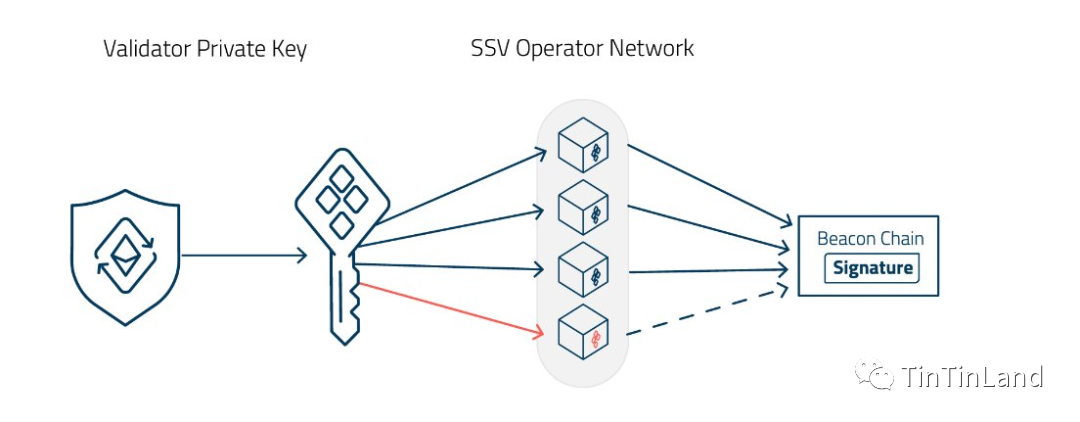
As shown in the figure above, firstly, the DVT operator calculates the process of generating the shared public key and private key encryption; then the split private key is shared with different participants, and at the same time, the private key share will be distributed to the operator next, the operator conducts multi-party calculations to randomly select a verification node (the node will share information with other nodes),first level title
Why is DVT needed?
DVT is to solve many problems that arise after the merger, among which centralization is the core threat that needs to be dealt with.secondary title
centralization risk
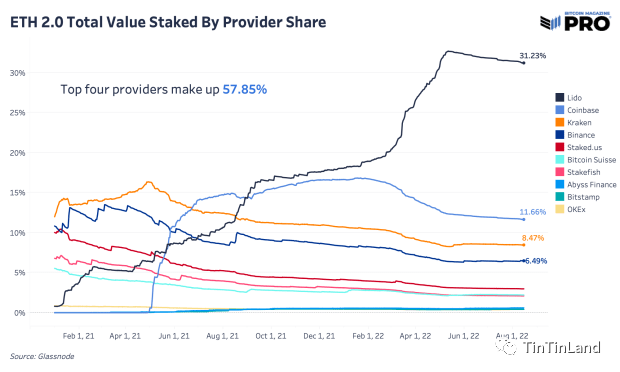
Ethereum rules stipulate that users who hold less than 32 ETH will be restricted from maintaining validators. For these users, staking services are the only solution, which further leads to a large number of encrypted assets being stored in centralized exchanges. Lido Finance, the largest Ethereum staking service provider, has deposited more than 4 million ETH, accounting for 32% of the total amount of pledged encrypted assets.secondary title
single point of failure
secondary title
Double Signature Penalty
secondary title
fork penalty
Under the PoS system, after the Beacon node connected to the validator fails, a fork will be established. But in such a case, if the verifier is affected and considered offline, the verifier will still be punished.
first level title
What growth potential does DVT have?
Advantage
Advantage
DVT is a validator running as a node cluster with high elasticity and low risk, so it can improve the stability of pledge.
For large validators, DVT can guarantee high availability and reduce infrastructure costs: improved redundancy and lower curtailment risk allow fewer validators to operate more nodes, thereby reducing hardware costs; by allowing clients to configure and With addresses running on multiple nodes, DVT reduces the risk of failure of a single address or client.
For small validators, DVT can provide a level of protection comparable to larger validators: using DVT small validators can provide comparable efficiency to large validators; by reducing the ETH requirements to run nodes, DVT can enable its users to use community pledge A pool or home validator implements validation.
Example
Example
Application in decentralized staking pools: Using DVT, staking pools can switch to a decentralized model, reducing penalties and slashing by reducing downtime.
Staking Infrastructure Providers: With DVT, infrastructure providers are able to enable active-active cluster redundancy for dynamic deployment and configuration. Previously, in order to meet individual or institutional pledges, infrastructure providers needed to provide redundant solutions for active-passive configurations of institutions. Active-active redundancy can now create fault tolerance by spreading validators across multiple machines with the goal of ensuring that the redundant system is always up and running.
related items
related items
Since DVT was proposed, both Obol Network and SSV Network have developed DVT-based projects.
1. Obol Network
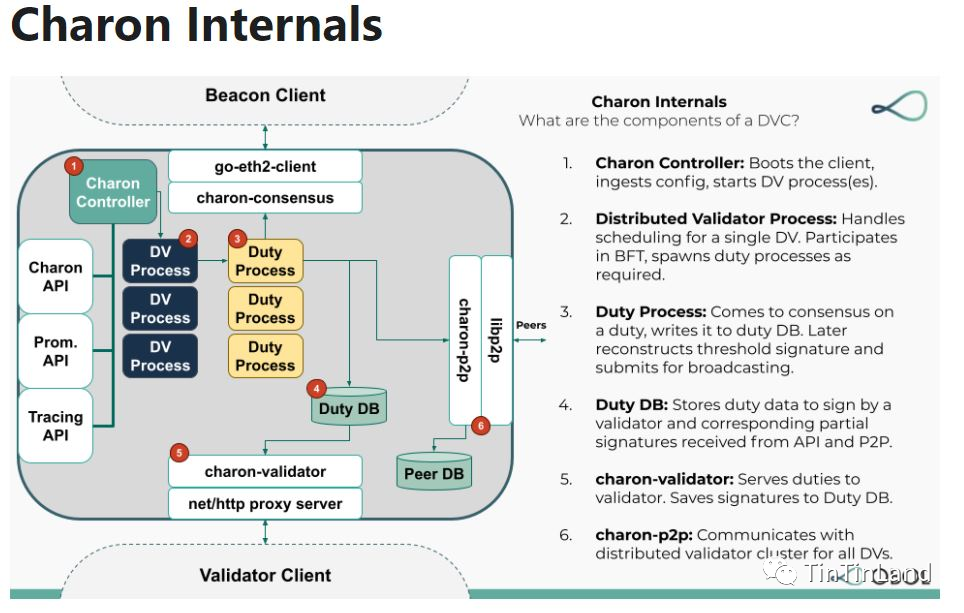
Obol Network launched the plug-in client Charon to enable DVT, which can run in a fault-tolerant distributed manner. By adapting the DVT technique, Obol introduced active-active redundancy to address the disadvantages of running an active-passive system. Instead of running on one machine, validators run on multiple machines to create fault tolerance, withstanding partial node failures. By communicating and reaching consensus, multiple Charon clients act together, simulating a unified validator. In the process, Charon enables validators to work with any client that supports the Beacon Chain standard HTTP API and maintains existing remote signing infrastructure. So, for validators, Charon provides an easier path to adoption.
In terms of future development, Obol Labs will continue to pay attention to DVT and promote its application in applied cryptography and cryptoeconomics.
2. SSV Network
SSV Network has released a network infrastructure layer for decentralized staking. In the SSV model, each validator needs to select 4 nodes from the operator network for multi-signature voting. The SSV Network has two different layers, the SSV peer-to-peer (P2P) network layer and the Ethereum contract layer for network governance: the former mainly reads the operator list and validator equity allocation from the smart contract to operate the validator; the latter Add operators, create them, and assign assets based primarily on DVT operator ranking and evaluation.
epilogue
epilogue
For users, DVT solves many challenges of staking and lowers the entry barrier for ordinary people. For developers, DVT is equally beneficial. With DVT, institutions or independent verifiers can enjoy the security and flexibility of the protocol, enjoy active-active redundant configuration, and realize operation diversification according to various factors.references
references
Understanding Distributed Validator Technology (DVT)
What is DVT and How Does It Improve Staking on Ethereum?
Biggest Ether Staking Service Has a Centralization Problem
Assessing the role of ‘Distributed Validator Technology’ in ETH’s anticipated growth