Will Uniswap lose to Curve in the battle for DEX leadership?



Original source:DeFi Cheetah
Compilation of the original text: Kyle
Original source:
Compilation of the original text: Kyle
This post is about my analytical framework for DEXs: why I think Curve Finance is better than Uniswap, and why Uni v3 is a wrong product!In short, two reasons: (i) pricing power and (ii) profitability@DeFi_Made_Here previously published a piece on Curve Finance
post
, comparing Curve and Uniswap.
This prompted me to write this post to provide a perspective that many people don't consider when comparing DEXs.
First of all, after the launch of Uniswap v3, Uniswap gave up its pricing power. what does that mean? For any asset traded between multiple exchanges, only one exchange can have pricing power.
An example would be: ADR of a stock versus the stock on the main exchange.
In the crypto industry, a token can be listed on multiple exchanges, CEX or DEX.
Why is it said that Uniswap gave up pricing power after launching v3?
This has to do with how LPs provide liquidity in v3 - LPs choose a price range for where the most liquidity is provided. This is called concentrated liquidity.
In Uniswap v2, liquidity is evenly distributed along the invariant curve of xy=k, but since most trading activities occur simultaneously within a range, liquidity in other parts of the xy=k curve is not utilized, i.e. capital inefficiency . The v3 design is to solve this problem.
Why?
v3 is more capital efficient than v2, but it requires LPs to actively manage their positions, as the price range of trading pairs changes from time to time (except for anchor assets). This prevents new projects from building new liquidity pools for their native tokens in v3.
Why?
Due to the shallow initial liquidity, the price range of new tokens fluctuates greatly, and new projects with capital pools in v3 need to frequently adjust the price range.
This creates a huge cost of managing liquidity, which they cannot afford. Therefore, most new coins are not listed on v3.
what happened? To find the price of a blue-chip token such as $ETH, one would refer to the price on the Binance platform. For tokens not listed on Binance, since more new tokens were listed on v2 before v3 was released, people usually refer to v2 for price information.
so what?
Due to the huge cost of managing liquidity, the pools on v3 are mostly blue-chip tokens with strong liquidity and are unlikely to fluctuate violently, and Uniswap's position as the main source of price information has fallen apart.
so what?https://twitter.com/DeFi_Cheetah/status/1608677561919508480
LPs in DEXs without pricing power will suffer huge losses due to arbitrage, and the order flow of uninformed orders is much smaller than that of exchanges with pricing power. Arbitrage is one of the main sources of toxic traffic that does a lot of harm to LPs.
For more information:
Why do LPs suffer more in DEXs without pricing power?@thiccythot_,ANS: less uninformed order flow (people mostly trade on major exchanges) + more toxic flow (arbitrageurs take cues from primary sources of price information and leverage LPs in other AMMs' price discovery process)
as
As pointed out by @0x94305 @0xShitTrader, v3 LPs continue to lose money due to huge toxic traffic - ~43% of v3 volume comes from MEV bots! Why bother? This doesn't encourage users to become v3 LPs! This affects the profitability of v3.
It is difficult for an exchange without pricing power to occupy a leading position in the industry, which in turn affects its profitability.
In contrast, when checking whether a stablecoin has been depegged, users refer to Curve Finance instead of CEX! By comparison, the importance of pricing power is self-evident.
Curve Finance takes 50% of the fees from LPs, and Uniswap gives 100% of the fees to LPs; Uniswap gets nothing from all transactions. A business without profits is never a good business, no matter how big the revenue looks.
Uniswap realized this and proposed to take a cut from LPs.
But things are not that easy. Uniswap could be in serious trouble doing this. As mentioned earlier, without pricing power, LPs will be more vulnerable to toxic flows and thus have less incentive to provide liquidity. If Uniswap takes a cut now, it will further hit LPs.
What will this lead to?
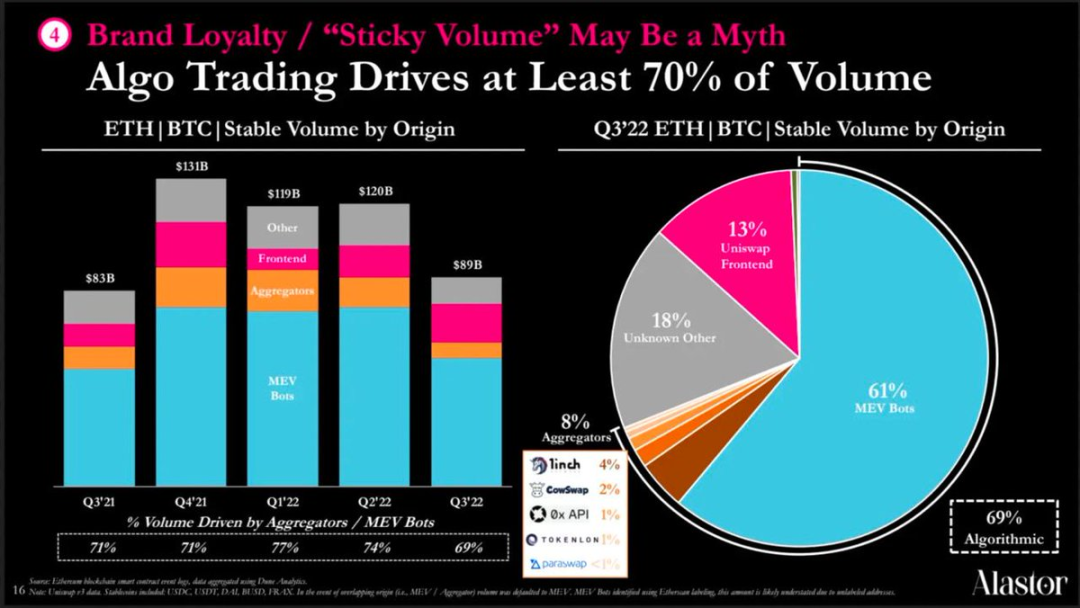
Most of the volume on Uni v3 is not "sticky" as over 70% of volume is algorithm driven. Volume just follows pricing.
So less incentives for LPs -> less TVL and liquidity -> higher slippage and worse execution prices -> lower volumes -> lower LP fees and lower LP incentives
Then, into this death spiral.
How about raising transaction fees for LPs to maintain TVL and liquidity?
A death spiral is inevitable:
Reduced incentives for LPs -> increased transaction fees for LPs -> worse execution prices -> lower volumes -> lower LP fees and LP incentives
This is why Uniswap has not pushed for a fee switch.
Many web2 technology companies have not made profits in the past few years, but they are actually building a "moat" to enhance customer stickiness.
Uniswap is unprofitable, but unable to foster sticky user behavior as only <15% of volume comes from its frontend…
Why is Curve Finance better than Uniswap? Can you imagine what would happen to Uni v3's TVL and transaction volume if it only gave 50% of the fees to LPs like Curve did?
Guide liquidity through the ve model Curve, and endow $CRV with practicality.
In contrast, $UNI has no utility at all and has no relevance to Uniswap business. If Uni v3 can collect 50% fees from LPs and still maintain TVL and volume, then Uniswap beats Curve. But that's not the case, as most of its volume is not "sticky" or organic.
Uniswap can’t guarantee that — “over time, more users get used to our platform, leading to more fees and more liquidity.” Trading volume on Uniswap is not loyal unless it can learn from other The front end dramatically increases transaction volume that would otherwise simply disappear with the rollout of fee transitions.
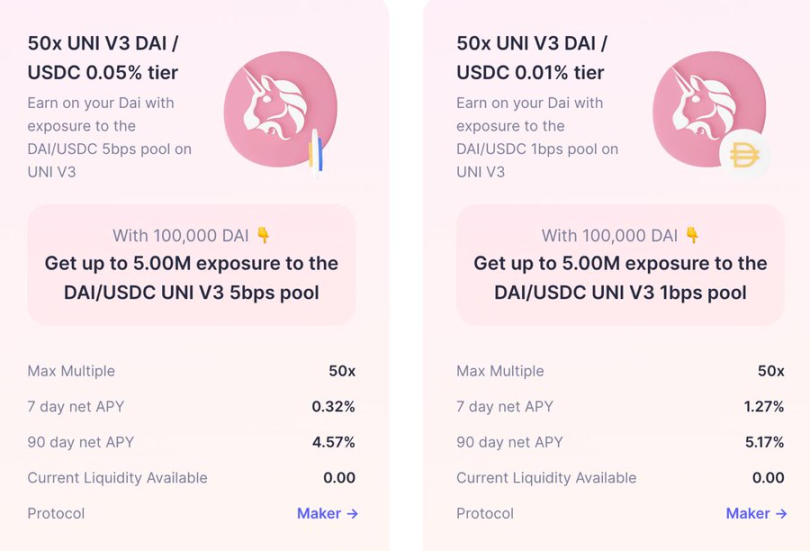
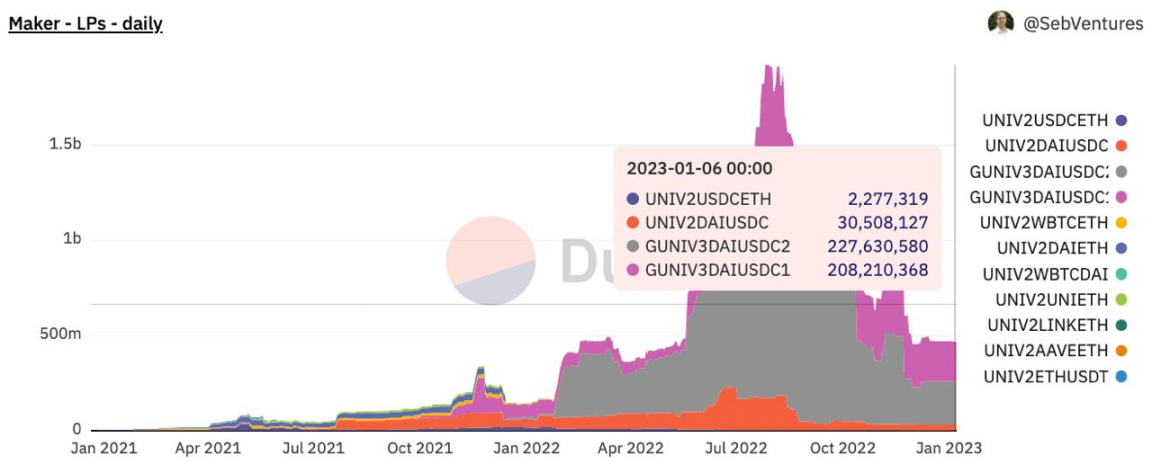
Additionally, Uniswap TVL is leveraged: of the $3.4B TVL, about 435M comes from the $DAI/$USDC pair, and MakerDAO increases its leverage up to 50x as it accepts Uni $DAI/$USDC LP tokens coins as collateral to mint $DAI! $DAI can then be re-deposited there to get LP tokens to mint more $DAI!
Therefore, Curve Finance is superior to Uniswap because (i) it has pricing power and can be the main source of price information for anchored assets, and (ii) it takes 50% of LP transaction fees, but can still trade without leverage. Next attract huge TVL through its superior ve token economics!
@DeFi_Made_Here made a good counter-argument: If Curve Finance TVL is so dependent on $CRV release, once $CRV drops significantly, TVL will drop significantly due to lower APR. This is true, but also true for Ethereum: if $ETH plummets, it is more vulnerable and less secure.
What makes web3 so special to me is the ability for each of us to issue digital assets in a non-custodial manner and leverage token issuance to bootstrap liquidity or other metrics. So far, Curve Finance epitomizes how web3 projects can do this.
Finally, why did Uni v3 take a wrong step? It increases the cost of the project managing on-chain liquidity, thereby giving up its pricing power. Instead of improving the capital efficiency of the Uni v2 sticky curve by introducing multiple curves to cater to different crypto assets, it just creates a new model, which I think is a worse version of the order book. Now, by competing with aggregators (NFT aggregators or DEX aggregators 1 inch), it has transformed from being a basic utility in the industry to one of the competing candidates in the consumer space.