






VPNs in the Crypto Land: What's So Magical About Aztec?


Table of contents
Table of contents
What is Aztec
Aztec from a Privacy Perspective
write at the end
write at the end
Aztec NetworkEthereumprivacyofEthereum ZK-Rollup。
it's like enhancedTornado CashorAaveorLido FinanceWait for other smart contracts to interact. Aztec has also developed the underlying zero-knowledge proof technology and provides a complete set of related tools, including SDKs and programming languages.
When Tornado Cash gradually faded out of people's sight,Aztec Closes $100M Series B Funding Round Led by a16z,Aztec’s last round of financing was led by Paradigm. What's so amazing about Aztec that the top Crypto investors are vying to become its shareholders?
This article will first explore what Aztec is, and then discuss its unique positioning as a fusion of the two hot topics of privacy and ZK-Rollup.
What is Aztec
andZac WilliamsonandThomas Walton-PocockFounded in 2017. Zac is currently CEO, but Thomas has resigned to focus on other businesses. Other key team members include Co-Founder and Head of Product Joe Andrewsimage descriptionAriel Gabizon。
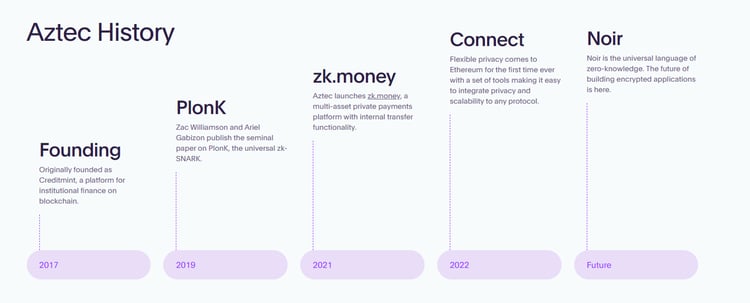
Source: Aztec website
image description
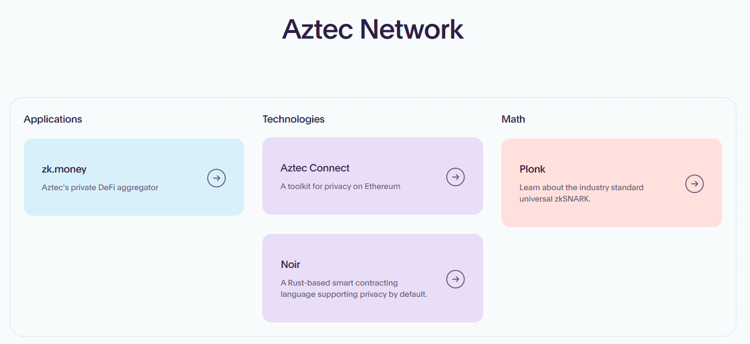
Source: Aztec website
PlonK
The full name of PlonK is Permutations over Lagrange-bases for Oecumenical Noninteractive arguments of Knowledge. If you understand well, you can try to readPlonk's white paper. But if you're like me and don't understand a single word in the full name, I won't try to translate it either.You just have to remember that PlonK is an efficient zero-knowledge proof technology used not only by Aztec, but also by Mina, Dust, zkSync, Polygon Zero, etc.
PlonK is a SNARK-type zero-knowledge proof technology. The STARK type is theoretically more scalable and resistant to attacks, but it is also less mature. Their relationship is similar to Optimistic-Rollup and ZK-Rollup. Optimistic-Rollup may be technically inferior to zk, but it is currently more popular and the technology is more mature. (Related Reading:zkSync vs. StarkWare - What's the difference between the top two ZK Rollups?)
zk.money
After releasing PlonK, Aztec developed zk.money, a DApp that provides Ethereum DeFi users with private transactions and cost savings.
Users send funds to zk.money and corresponding private notes are created on Layer 2. Private notes can be traded and pledged to earn income like ordinary Ethereum assets, but all transactions are privacy-protected through zero-knowledge proofs.
The entire system records users' assets on the Ethereum mainnet through a fully encrypted state system. When users deposit funds into Aztec, Aztec generates cash-like encrypted notes through its off-chain UTXO state system. The state tree updates encrypted tickets as transactions are submitted and executed. Only the owner can see the contents of the ticket. Therefore, user identities and account balances are fully protected.
zk.money batches user transactions, executes them on the Ethereum mainnet, and returns funds proportionally toRollupUsers on the network effectively share the gas cost among users. This cost saving approach is typical in Rollup.
zk.money is not yet decentralized. The current version relies on Aztec as the sole Rollup provider. Aztec is responsible for relaying transactions between the Ethereum mainnet and Rollup. But zk.money plans to integrate more providers to make the system more decentralized.
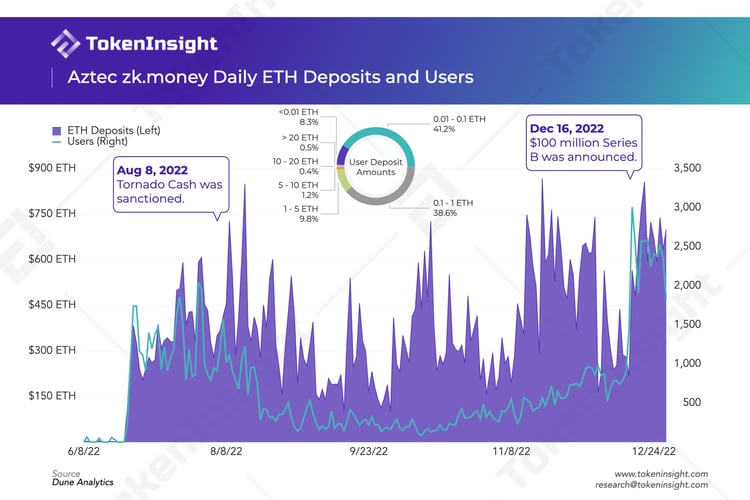
zk.money attracted a fair amount of transaction volume and users even before Tornado Cash was sanctioned, but the sanctions did drive up deposits in the short term. zk.money experienced another massive user influx after announcing its Series B round, but deposits didn’t increase much. New users depositing small amounts of funds in hopes of receiving airdrops in the future may not develop into active users. This is also reflected in the user deposit amount, nearly 90% of users deposited less than 1$ETH, 49.5% of users deposited less than 0.1 $ETH.
As of December 28, 2022, a total of 69,779 $ETH has been deposited into zk.money from 93,889 users; the average deposit amount is 0.37 $ETH, and the maximum deposit amount of a single user is 1,236 $ETH .
Because zk.money allows users to mix funds, Aztec also faces a significant risk of being sanctioned. And that risk has already happened on a smaller scale. Cointelegram reported that,FTX blocks some users who transfer funds via zk.money. FTX identified DApps as coin mixers — a service it considers a “high-risk activity” prohibited by exchanges.
Aztec Connect
Aztec Connect is an SDK (third-party development tool) that allows any Ethereum protocol to be integrated into Aztec's private Rollup. It enables users to create and submit transactions to Aztec, and enables Aztec to interact with other Ethereum smart contracts.
Features of Aztec ConnectLike a proxy service for DeFi. Anyone can deposit funds into Aztec and still interact with the Ethereum mainnet protocol, enjoying additional privacy and reduced costs.
When a user sends funds to another zk.money account, the recipient will receive zkETH. If the payee is a normal Ethereum address, the wallet will receive normal $ETH and Etherscan will show that the funds were sent from the official Aztec contract.
Noir
Noir is a Rust-based programming language for creating and verifying zero-knowledge proofs.
Currently, developers in the zero-knowledge space need to understand cryptography, which is challenging. Noir plans to solve this problem and allow any developer, not just those with knowledge of cryptography, to build zero-knowledge applications.
Noir doesn't directly impact Aztec's user experience, but it helps build a strong developer community around its zero-knowledge technology. More developers building more applications is a prerequisite for Aztec to attract more users.
Aztec from a Privacy Perspective
and
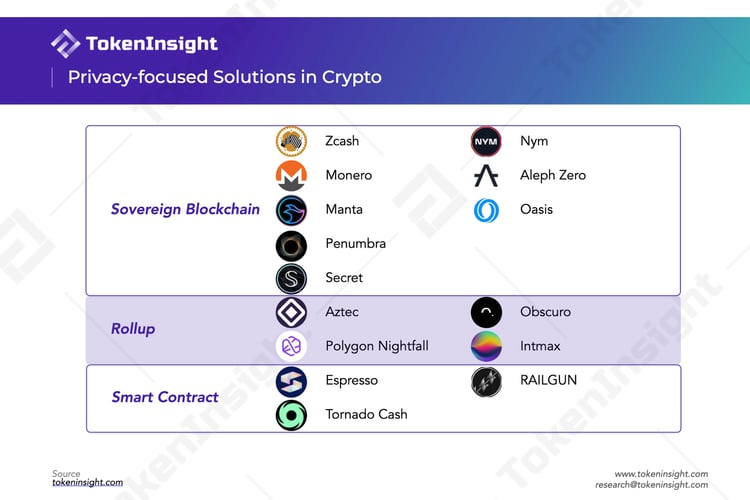
ZcashandMoneroare pioneers in the privacy space, but they require more smart contract functionality. Other blockchain solutions have yet to gain much traction. For a blockchain solution, users (both sender and receiver) must be on the blockchain. They can only transact and pay for gas in blockchain-native tokens, which limits interactivity, hurts user experience, and increases security risks associated with cross-chain bridges.
Aztec is the leading privacy rollup. Competitors also include Polygon Nightfall, Obscuro and Intmax. Rollup solutions can reduce costs while enabling private transactions. Rollup seems to be the most promising solution, although it is affected by the underlying public chain ecology in which it is located.
wait.BNB Chain、Polygon、Avalanchewait.
Aztec from a Rollup perspective
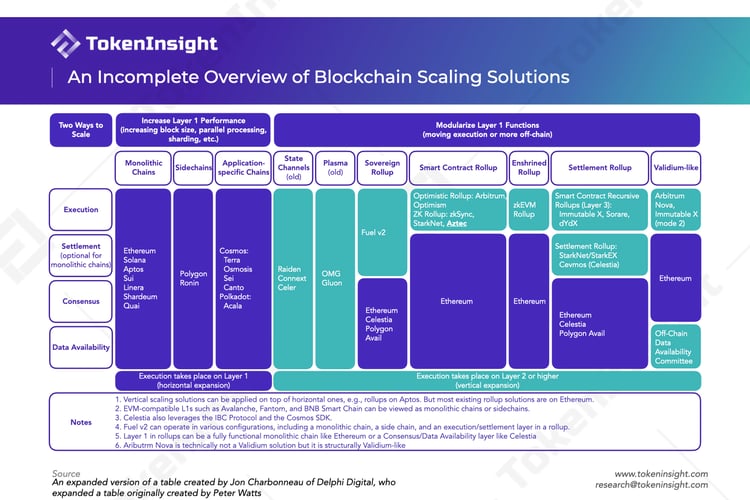
From the perspective of Rollup, Aztec is a smart contract Rollup. It interacts with the Ethereum mainnet through smart contracts deployed on the Ethereum mainnet. Currently there is only one app on Aztec, zk.money, and it doesn't have many features. With the release of Aztec Connect and Noir, more developers may be able to build new applications on Aztec. After the financing, Aztec will presumably allocate dedicated funds, such as setting up an ecosystem fund, to encourage developers to come to the platform.
write at the end
write at the end
AztecNo native tokens have been issued yet. But given its decentralized roadmap, it is likely to be issued in the future. If you want to become an early user, you might as well go to his official website to set up a new account and try it out.
andParadigmanda16zOriginal link
Original link


