






Ice and Fire Facing ENS, the Leader of Web3 Domain Name Track


Summary
Summary
Web3 is not only compatible with blockchain and EVM, but also a DID system for the entire Web3. This article will analyze the DID track from the following aspects.
1. Popular Science: Web3 Domain Name Features and Application Scenarios
2. Current status: Web3 domain name market size, distribution, industry KSF and pain points
3. Case: How does the open source decentralized identity protocol .bit challenge ENS
4. Comments: From the Web3 domain name track to specific case innovations
Frontier: The author may hold the assets issued by the related projects mentioned in the article, and there is an interest in it, which does not constitute any investment advice.
Web3 domain name track analysis
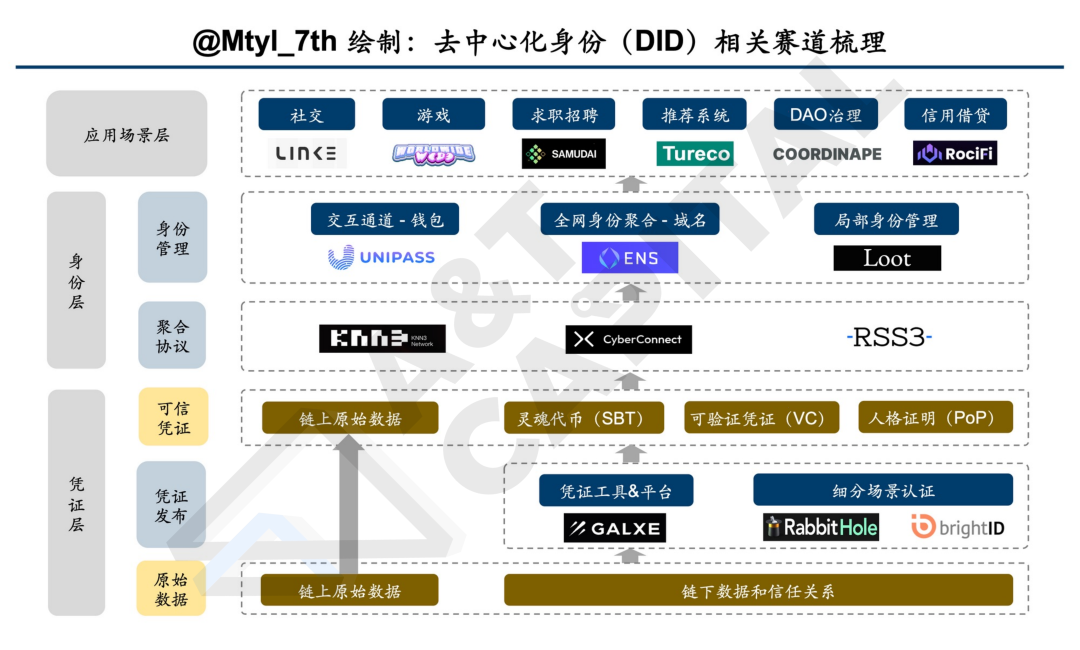
Here we quote AnT Capital Lin Chuan’s review of the DID track. The web3 projects currently seen can be divided into four layers, from upstream to downstream:
Credentials layer - Credentials issuance, representative projects include GALXE, Rabbithole, POAP, BrightID, etc.
Identity Layer - Aggregation protocol, represented by projects such as KNN 3, RSS3, Cyberconnect, etc.
Identity layer-identity management, mainly including wallets and domain names, representative projects consist of UNIPASS, ENS, LOOT, .bit, etc.
At the application scenario layer, projects are roughly divided into two categories: Reputation (reputation) and Relationship (relationship)
Reputation: reputation/resume/social presence. This type of application scenario focuses on evaluating and classifying users by simplifying digital identities into some explicit and trusted labels, so as to achieve a rapid screening effect. For example: credit lending, job hunting, socializing with strangers, etc.
Relationship: DID's relationship application scenario narrative. This type of application scenario focuses on doing some more complex and comprehensive application analysis by treating digital identity as the accumulation of user data in Web3. For example: recommendation system, social networking with acquaintances, Web3 games, DAO voting governance, etc.
What is a Web3 domain name?
Web3 domain names generally refer to domain names with suffixes such as .eth, .bnb, nft, .wallet and other public chain abbreviations or abbreviations with strong Web3 characteristics, and the application scenarios are mainly in the blockchain/Web3 field. Ethereum's ENS is the most well-known and representative project on this track.
The concept of a domain name originated in the early Internet era. In the earliest days, everyone directly accessed the web page through the IP address. For example, if you enter "202.108. Baidu's IP address. But obviously, this string of numbers is not readable and difficult to remember. Therefore, the early Internet designers built the Domain Name System DNS (Domain Name System), which encapsulates digital IP addresses by using more readable domain names such as www.baidu.com as "web address", so that People use it every day. Now, every Internet user knows the concept of "web page address", even though most of them don't know the underlying IP address, DNS, etc., but this does not hinder their experience on the Internet at all.
The most intuitive value of the Web3 domain name is also similar. It is the user's "Web3 nickname" and encapsulates the address on the chain. For example, vitalik.eth encapsulates this Ethereum address: 0 xd 8 da 6 bf 26964 af 9 d 7 eed 9 e 03 e 53415 d 37 aa 96045
Every Web3 user will hold at least one address on the chain, but I am afraid that no one will think about remembering their own addresses, let alone remembering others. Domain names such as vitalik.eth, 2089.bit, and jack.bnb are obviously more readable and memorable than the long string of address characters, and can better meet people's daily needs. For example, if you need to ask your friend to transfer money to you, you may find your on-chain address in your wallet or notepad, and then send it to your friend; but if you hold a domain name, such as vincent.eth, you can Directly tell your friends to transfer funds to this domain name.

From a technical point of view, the technical essence of a domain name is not complicated, it is the data relationship of "mapping". Therefore, it can be realized in many ways: in Web2, the registration and management of all domain names are in the charge of ICANN located in California, USA, which is highly centralized and supervised by the US government; but in Web3, the most The mainstream domain name implementation method is the on-chain smart contract represented by ENS, which casts each domain name into the form of Ethereum NFT, which can be freely registered and traded without permission, and the corresponding resolution address can be set by the user himself.
Application Scenarios of Web3 Domain Names
Domain names mainly have four types of application scenarios: domain name + dapp application, domain name + wallet, domain name + web2 and domain name application ontology
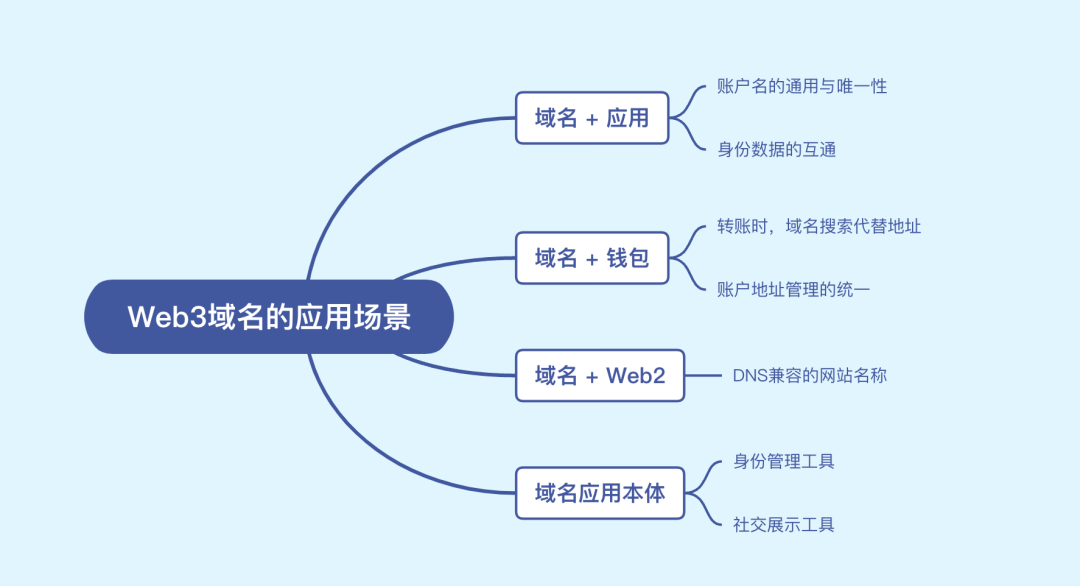
Domain name + dapp application: The most direct application is to use the domain name directly as the account name of each Web3-related application. In Web3, due to wallet address login and chain resolution of domain names, DApp can easily support users to use a certain domain name as their account name. And because of the uniqueness of the domain name, as the domain name’s support for multiple chains matures, you can ensure that the same person is using the same domain name on Opensea (ETH) and Magic Eden (Solana). Even Web2 applications such as Twitter and Jike can authenticate those who use their own NFT domain name as their username through some plug-ins
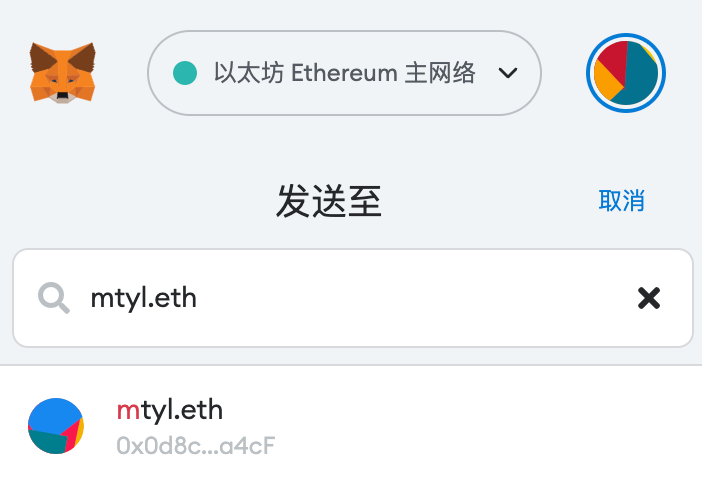
Domain name + wallet: Supports domain name search when transferring money, and saves users from remembering the transfer address. For example, Metamask, a leading wallet product, has already realized ENS domain name search support. Further extension, after the wallet integrates the domain name and its various resolution relationships, it can also be displayed in the wallet. For example, it displays the relationship between Twitter, Reddit and other Web2 social platforms corresponding to a domain name account, and the credentials held by users in each DApp. At present, there are also some wallet projects that focus on DID and have related explorations
Domain name + web2: Domain name resolution directly in the browser requires an application with ICANN in the United States, the Web2 domain name manager. Since the connection of Web2 websites is not the core value of Web3 domain names, plus the above-mentioned reasons, there is no Web3 domain name project that can realize "direct Web3 domain names as website addresses". Under the unremitting exploration of members of the Web3 community, a relatively mature "curve to save the country" plan has been formed: using the Web3 domain name as a second-level domain name under the top-level domain.
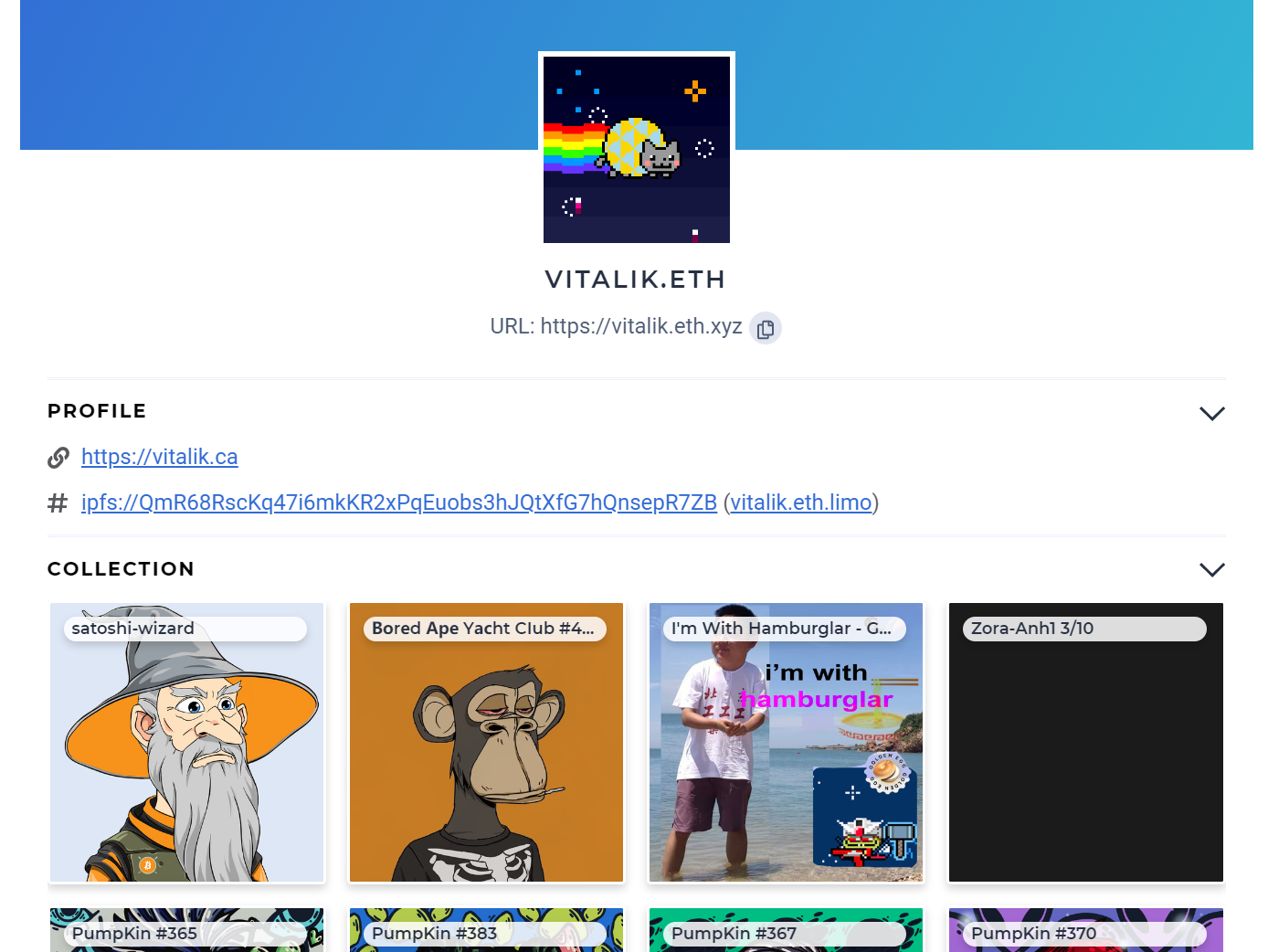
Although "vitalik.eth" cannot be directly input into the browser to be parsed, such as "vitalik.eth.xyz" "vitalik.eth.link" can be. Readers may wish to give it a try, for example, enter "vitalik.eth.xyz" in the browser, you can see the ENS Profile generated by Vitalik by default; enter vitalik.eth.link", you can see Vitalik's personal homepage
Domain name application ontology: identity management tool & social display homepage, that is, the DID attribute of domain name. As more and more applications and wallets support domain names with applications, wallets, and Web2, domain name application ontology will also carry more identity management functions. Specific examples are as follows: set the analysis targets corresponding to each chain and each Web2 platform, set the address, format and display information of the personal homepage, set some private content/content that requires specific permissions to access, etc.
Market size of Web3 domain name track
If other income other than domain name registration fees is not considered, the TAM of the entire web3 domain name track can be split into: the number of web3 users x the number of web3 domain names owned by a single user x the annual subscription fee for a single domain name
According to ConsenSys, there are 20 million monthly active Web3
Because a single user can register different numbers of domain names in different projects. According to ENS data, there are 594k users who own ENS, the total number of ENS registrations is 2.76 mm, and a single user owns an average of 4.6. It is conservatively estimated that each person registers 3 Web3 domain names on average
Calculated at $5 per year per single domain name, you need to pay a subscription fee of $5 per year to register a domain name on ENS, registration fee for .bit = annual fee * length of registration period + storage fee, the cheapest annual fee is $4.99 per year
Addressable market size = 20 mm x 3 x 5 $ = 300 mm $, or $300 million per year
The registration fee is only part of the most direct income of the domain name project. With the development of the DID track in the future, the domain name project, as an identity management service provider, can explore more different business models and increase sources of income
According to Nick Johnson, the lead developer of ENS, in May 2022, ENS achieved a record monthly revenue of more than 8 million US dollars
Refer to the entire domain name industry: In 2020, the global domain name registration market size will be 374 million, a year-on-year increase of 0.7%, and the domain name registration market size in my country will reach 43.008 million. According to Straits Research, the global domain name registrar market size is expected to reach US$1,025 billion by 2027, with a compound annual growth rate of 4.70%.
main project
Divide the current domain name projects into the following three categories: single-chain domain names, multi-chain domain names, and DNS alternative domain names. Among them, single-chain domain names can be further refined. As shown below:
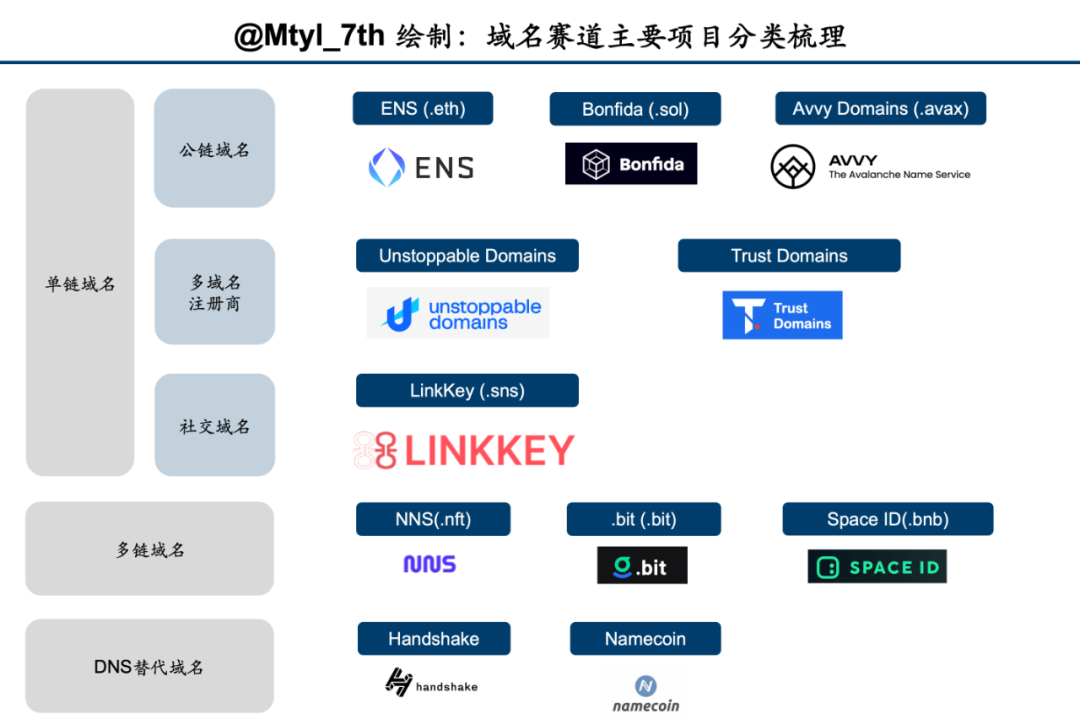
1) Single chain domain name
>>Public chain domain names: represented by ENS
Such projects are highly recognizable: they all have public chain abbreviations as suffixes, such as .eth, .sol, and .avax, and all have official public chain backgrounds or official support. Their implementation logic and application scenarios are also highly similar, nothing more than being on different public chains. Therefore, to study this type of project, you only need to focus on ENS.
ENS is the leading project in the field of Web3 domain names. It was founded in 2016 by Nick Johnson, a former software engineer at Google. Initially, ENS was a sideline project authorized by the ETH Foundation, and then the ENS team was established with the support of the ETH Foundation. ENS has not received any external financing, and has only accepted donations from institutions such as the Ethereum Foundation.
ENS launched the beta version in May 2017 and the official version in May 2019. The trading volume of ENS ranks in the top ten of Opensea all the year round, and there will be two peak trading periods in November 2021 and April-May in 2022. As of the beginning of November 2022, ENS has registered 2.62 million domain names, 573,000 registered users, and 508 ecological cooperation projects. These data are far ahead of many other similar projects. ENS will be airdropped + issued in November 2021. At the beginning of November 2022, its fully diluted market value will be about 1.5 billion US dollars.
ENS currently has no plans to directly expand to other public chains. The recent actions of the project party are mainly reflected in the connectivity of Web2 web pages, such as the second-level domain name web pages and their corresponding applications mentioned above. In addition, ENS is also working with Spruce ID to promote the new login method of Sign-in with Ethereum (EIP -4361), hoping to realize the connection of identity data through it, which is very worthy of attention and expectation.
>>Web3 Domain Name Registrar: Represented by Unstoppable Domains
Such projects often sell Web3 domain names with multiple suffixes at the same time, and these domain name suffixes are often highly related to Web3. Representative among them are Unstoppable Domains.
Unstoppable Domains completed financing of US$65 million in July this year, with a valuation of US$1 billion, which is close to the level of ENS. It also supports the registration of 9 domain names: .crypto/.nft/.x/.wallet/.bitcoin/.dao/.888/.zil/.blockchain. It is worth mentioning that, unlike most domain name projects that require annual renewal registration, Unstoppable is a permanent registration mechanism, so the fees for some rare domain names will also be more expensive.
The registration process of Unstoppble Domains is not completely on the chain like ENS and other projects, but a model of centralized registration management + NFT mint on the chain: users can log in with Google + credit card payment when registering, and then go to Polygon mint NFT (except for .zil domain names, go to mint on Zilliqa).
In terms of project development, Unstoppable Domains will also focus on the concept of "Web3 name", but its actual product design and publicity focus more on the experience of Web2 users, as well as the interoperability between its domain name and Web2 website.
Unstoppable Domains may not be particularly well-known in the Chinese circle, but its overseas popularity and overseas marketing efforts are very strong. At present, the number of domain names registered by Unstoppable Domains has exceeded 2.7 million, and more than 500 applications have integrated Unstoppable Domains.
>>Social Domain Name Application: Represented by Linkkey
Such projects may not have special innovations in domain name technology, but they focus more on innovations in gameplay—combining domain names with social applications.
Linkkey's SNS is one of the representatives, and it hopes to use the domain name as a carrier to do "value social networking" in the Web3 field. According to the theory that "one person can only maintain deep social links with 150 people at the same time", each SNS user can issue NFT that symbolizes his social value, and the user's social value is determined by the market price. Linkkey’s token model design is also innovative. Its domain name registration function and some product functions have already been launched. Complete products will be available at the end of this year and early next year. Interested friends can go to its official website to experience and learn more.
2) Multi-chain domain names
NNS, .bit, and Space ID are the three main projects in this category. In the promotion and development of the project, they all emphasize the nature of "Web3 identity business card" and "Web3 identity management", and have written a clear multi-chain support plan. However, on the issue of how to implement "multi-chain support", the solutions of the three domain names have their own characteristics. The following is a brief introduction to the two projects of NNS and SpaceID, and .bit will be introduced in detail in the later part.
>> NNS
NNS is a domain name system with .nft suffix launched by Metascan.pro (Twitterscan’s parent company). Currently, it mainly implements core functions such as registration and resolution on the Ethereum main chain.
Metascan's project team will launch NNS contracts on other public chains (such as BSC) in the next few weeks, so that users can register and manage domain names with lower GAS fees. The NNS domain name systems on different public chains are unified. The specific realization of this "unification" may involve the deployment of some information cross-chain nodes, and may also involve some forms of centralized management.
Theoretically speaking, cross-chain domain names are not complicated, as long as the domain name resolution information on all chains can be unified through cross-chain nodes. But in fact, when multiple public chains are involved at the same time, maintaining the synchronization and real-time consistency of domain name registry information still faces many challenges under the current Web3 infrastructure. This is why most domain name projects currently only support one public chain. How NNS realizes this kind of cross-chain, its stability and degree of decentralization are worthy of attention.
>> Space ID
Space ID launches .bnb domain at BSC. At present, as far as the domain name smart contract itself is concerned, its nature is highly similar to that of ENS. It only supports the communication and analysis of projects on BSC, and there is nothing very special about it. However, Space ID plans to launch a set of "Namespace" (NameSpace) to integrate the domain name projects of various public chains, and even allow Web2 platform companies to issue their own domain name space. Rather than hope that your domain name suffix can become a common name in the Web3 field like .bit
This namespace can be roughly understood as follows: if a person holds Solo.bnb on BSC, then in the namespace of Space ID, he will hold bnb:solo in the future; if he holds Solo.eth, then in the namespace eth:solo; even the account names of Apple and Google can be transformed into forms like apple:solo, google:solo, etc.
This vision is worthy of attention and expectation, but the part of Space ID that is already online is still far from this vision, and it may take longer iterations.
In summary, although most Web3 domain names regard identity management as a core narrative, once multi-chain smart contract domain name intercommunication is involved, they will face more complex technical details in cross-chain and multi-chain. At present, .bit's multi-chain solution is the fastest in terms of implementation.
3) DNS domain name replacement: Handshake, Namecoin
Due to the centralized management of the Web2 ICANN domain name, it has caused quite a lot of dissatisfaction among decentralized believers. Therefore, some people are exploring the implementation of domain name resolution for decentralized websites. The main vision of these two projects is to supplement and replace the Web2 DNS system.
Since their concepts, development directions and most Web3 domain names are very different, and they have not attracted too much market attention recently, this article will not focus on the introduction, and interested readers can do in-depth understanding on their own.
Industry KSF (Key Success Factor)
The author believes that the key success factors of web3 domain name projects are: support for multi-chain, rich project ecology and scientific domain name registration mechanism
Support multiple chains
One of the core narratives of domain name projects is their uniqueness as a "Web3 common name" on the public chain or even within the entire Web3 system. If this uniqueness is compromised, the value of the entire domain name is compromised. Just imagine, if there are two .eth projects open for registration at the same time, and both have their own cooperative applications, which project's .eth domain name are you going to register? If a friend gives you a domain name instead of an address as the transfer target, do you still have to ask, is the domain name project supported by the wallet you are using now the same as the one registered by your friend? Obviously, this will bring great confusion to the identity system on the chain.
Intuitively, the issuance of domain name suffixes generally follows a "first come, first served" principle. The domain name project that starts the corresponding business first can obtain the control right of the corresponding domain name project first. The later project is more like an imitation disk and should not be accepted by the mainstream community. . For example, if the author now copies the ENS contract and issues the exact same .eth domain name on Ethereum, it is hard to imagine what kind of users would know the details of the two projects without using fraudulent means such as phishing websites. Will come to pay to register the .eth domain name issued by the author.
However, things are often not that simple, because the two projects may not be on the same public chain, the judgment of "first/last" for business development may not be clear, the business focus of the project may also be different, and the users attracted at launch may not be the same. Same. Therefore, in the early days, the consequences of this conflict were not obvious, and the two projects could be developed at the same time. For application project parties, how should they solve related cooperative support issues?
A recent controversy in the field of domain names is that the .nft domain name issued by NNS was taken off the shelves by Opensea (other exchanges did not), because Opensea received a complaint from Unstoppable Domains, who sold .nft domain names in the market before the former , and has registered the ".nft" trademark in Hong Kong. But in fact, the .nft domain name NFT issued by NNS and Unstoppable Domains are not on the same public chain, and the business focus of the two is not the same, and it is not the relationship between the imitation disk and the imitation disk; from the perspective of trademark infringement, NNS It also registered the ".nft" trademark in Japan, South Korea and other countries and regions earlier, so the rationality of Opensea's removal of NNS is actually open to question.
Therefore, there are currently two ways for the industry to solve this problem:
1) A single project covers as many public chains as possible to avoid more incidents like .nft;
2) Establish a Web3 domain name alliance to coordinate the interests of various domain name project parties
In fact, on November 2, 2022, Unstoppable Domains announced the establishment of the Web3 Domain Alliance (W3DA) at the Web Summit in Lisbon. The current members include Bonfida, Tezos Domains, Polkadot Name System, Hedera, Syscoin, and Klaytn Name Service
Enrich the project ecology
The author believes that the Matthew effect of the Web3 domain name track is extremely strong, and a single wallet of a single user will often only use a domain name as its own Web3 business card (except for speculative purposes).
In order to allow users to choose their own domain names, the project party needs to carry out cooperative promotion with as many upstream and downstream as possible to enrich its own project ecology. The upstream involves aggregation protocols, wallets, etc., and the downstream is more Dapps and even Web2 applications in different scenarios. If the domain name can support being used in different projects, it can better help users realize identity management.
The author believes that the long-term development of the domain name project mainly depends on the development of the Web3 application ecology, especially the development of Web3 social projects. Because it is difficult to bring a fundamental large-scale increase to the entire field only by the domain name project itself in the promotion of application and wallet account names; only the vigorous development of application projects can highlight the account name system associated with the domain name , The importance of the identity management system, highlighting the value of the domain name itself. However, before that, the domain name project must make sufficient preparations, so as not to find that its core functions such as identity management, cross-chain solutions, and Web2 URL connectivity are still not mature enough when the real application wave hits. In addition, it is also a possible development path for the domain name project to end up as a social application or a login system similar to a wallet.
Scientific Domain Name Registration Mechanism
According to statistics, due to the scarcity, ease of memory and strong potential brand value of short-number and short-English domain names, the current domain name transactions are concentrated in short-number and short-English domain names, and users are more speculative; this will to a certain extent Affects KOL and big brands to settle in, because once their domain names are registered by other speculators, they need to be purchased at a relatively expensive price, and domain name projects need the endorsement and promotion of KOLs and big brands to attract more common User login.
Whenever a new domain name project appears, there will always be speculative users who will register a large number of three-digit and four-digit domain names first, and the project party is also aware of this. Some project parties will explicitly increase the registration fee for short domain names when registering, while some project parties will reserve short domain names as a special commodity for relevant brand parties.
When users choose a domain name project, they also need to conduct more detailed investigations and pay more attention to the actual progress of its application scenarios, including: the quantity and quality of application projects supporting the domain name, the vision described by the project party (such as social Presentation, multi-chain interoperability, Web2 web page support, etc.) progress and possibility.
Pain points in the industry
One of the main pain points is the suffix domain name collision mentioned above. After all, there is almost no threshold for making a smart contract imitating ENS and issuing an NFT of a certain domain name suffix to the public.
Secondly, the domain name is not just what the current Web3 users need, and the speculative nature is serious, and the number of users who really use the domain name as a Web3 business card is limited. Even if the user does not purchase any Web3 domain name, it will not affect his normal Web3 application experience at all; even if he loses the Web3 domain name he purchased, unless he has used this domain name on a large scale for his social account (just like the author used stevensu.eth ), otherwise his perception is limited.
Specific analysis of .bit project
The .bit project is a Dapp running on the Nervos public chain, using CKB tokens for settlement; to a certain extent, it is subject to the development of the Nervos ecosystem and the acceptance of CKB tokens by users
The main data are as follows, the number of registered accounts is 246,000 (about 9% of ENS), and the number of users is 83,000 (about 14% of ENS)

Project Highlights
The biggest difference between .bit and other projects is cross-chain. It can be said that .bit supports any kind of public chain address, thanks to the high scalability and high abstraction level Nervos CKB network it relies on, so almost any public chain can be compatible with .bit without any modification. At present, .bit has cross-chain support for Ethereum, Tron, BNB Chain, and Polygon four public chains, that is, you can register your own .bit on any of these four public chains, you just need to keep your The private key on the public chain can be
.bit plans to add Bitcoin, Dogecoin, Polkadot, Dfinity, Solana, Filecoin, Cardano, NEM, Monero, Flow, NEAR, Litecoin, Nervos, Terra, Celo, Dash, Cosmos and other common public chain support in the future
.bit not only supports public chains that can run smart contracts, but also supports public chains such as Bitcoin and Dogecoin that do not support smart contracts. Such operations are difficult or even impossible for similar products
The .bit account is universal, and you can analyze any kind of public chain information on this account
.bit supports the analysis of information such as identity addresses and blockchain addresses on Web2. After the information is analyzed, you no longer need to remember your lengthy addresses. You only need to provide your .bit account number, and the other party can view all your relevant information
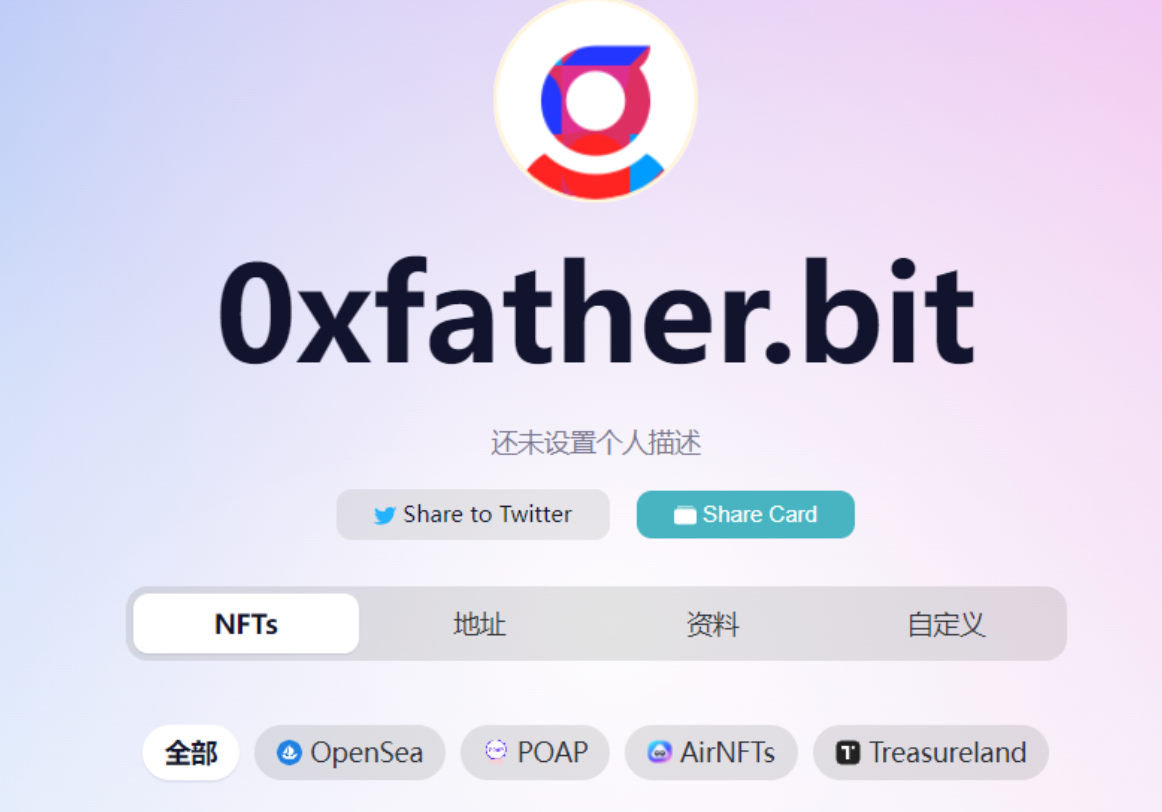
.bit is not only a DID account, but also can be used as a cross-chain asset aggregator. When you own a .bit account, you also automatically own .bit.host and .bit.cc. If you own 0 xfather.bit, you also own It also has two domain names, 0 xfather.bit.host and 0 xfather.bit.cc, through which you can view your public chain assets. In addition, .bit has realized the integration of NFT, POAP, .bit account, public chain address and other content. With a .bit account, you are equivalent to having a cross-chain and cross-resource exclusive identity card.
The second highlight of .bit is its full support for decentralized services. Currently, .bit can be registered not only on the official did.id, but also through service providers such as DeName (China), mybit.jp (Japan), COCH (Indonesia), das.la, etc., because the intelligence of .bit The contract allows third-party interaction, and the service provider can independently create relevant registration or data services by calling the smart contract data resources of .bit. Compared with this, products such as ENS are currently unable to achieve this kind of decentralized support
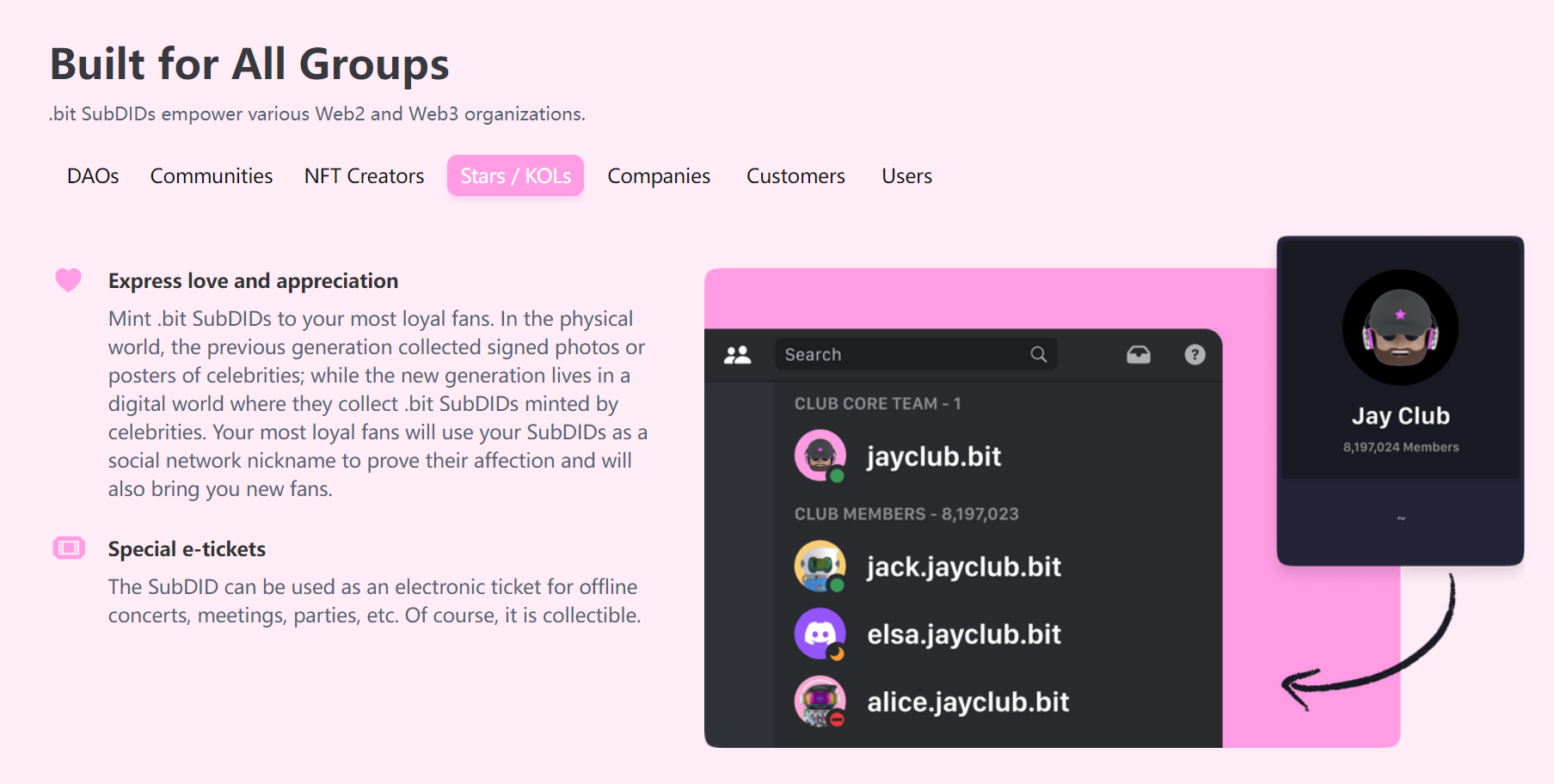
The third highlight of .bit is the sub-account function. The sub-account function is based on the .bit account. The holder of the .bit account can create a sub-account of the account at a very low cost. The function of the sub-account is no different from that of the parent account. Once created, it will exist as an independent account
For example: Suppose Jay Chou holds a jay.bit account, then Jay Chou can independently create sub-accounts such as jay#fans 001.bit, jay#fans 002.bit and distribute them to fans. There is no difference between the sub-account and the parent account except for the function. The pricing power of the sub-account is determined by the parent account. For example, jay.bit can determine how much jay#fans 001.bit sells, which effectively manages the hype and abuse of the sub-account. At the same time, the sub-account can renew the main account to ensure the security of the main account. This kind of gameplay is a bit similar to the SBT that has been mentioned more.
The sub-account function can be said to be the first function in the industry. It is foreseeable that the launch of the sub-account function will help the management of DAO organizations, the NFT community, and the creation of IP brands.
Currently in Beta version, you can apply for experience
future development
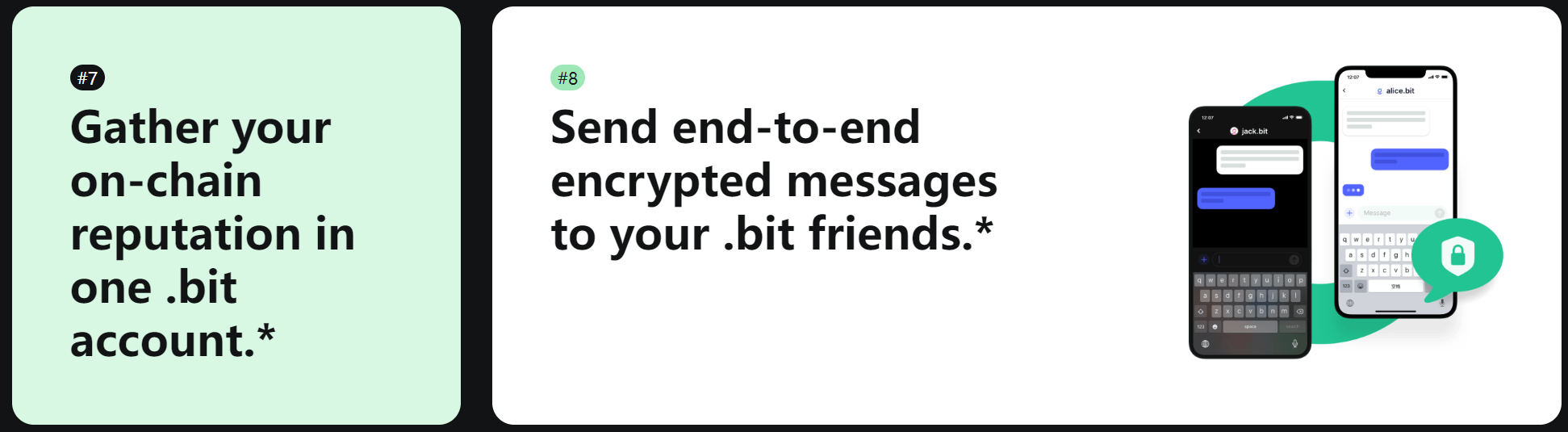
The official website lists two functions that will be launched in the future:
1) Aggregating user activity information on the chain seems to want to cut into the track of information aggregation on the chain;
2) End-to-end encrypted communication between friends to strengthen the social attributes of the product
business model
Source of income: annual fee for domain name registration and possible interest on storage deposits
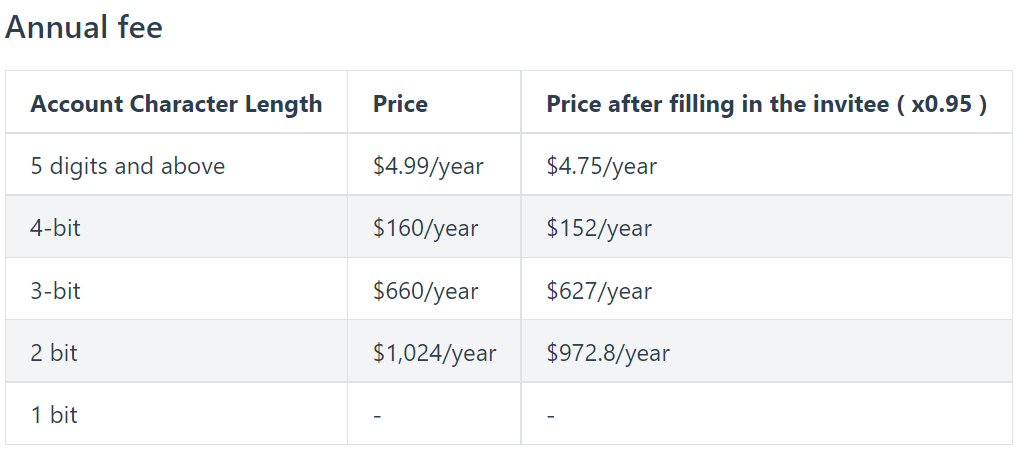
The price list of domain name registration annual fee is as follows:
.bit stores account information on the Nervos CKB chain, which needs to occupy a certain amount of storage space on the chain, so a storage deposit is required. There is a fixed storage fee of 206 CKB per account. If the user account is not renewed upon maturity, the deposit will be returned to the account's owner address at maturity. This deposit may generate some interest income for the project
token economy
The project has not yet issued coins
Financing History & Investors
On June 21, 2021, the cross-chain decentralized domain name/account system DAS (the predecessor of .bit) has previously completed its seed round of financing, led by HashKey and SNZ, and other investors include SevenX, Nervos Foundation, etc.
On August 15, 2022, announced the completion of a $13 million Series A round led by CMB International, HashKey Capital, QingSong Fund, GSR Ventures, GGV Capital and SNZ
Summary and Evaluation
For the DID track, the mainstream investment view on the market is to start from the user and put the application before the agreement. Specific priority: identity management > application scenarios ≈ credential release > (not user-oriented) identity aggregation protocol
Projects of identity management tools: wallets and domain name projects are preferred. From the perspective of the ultimate form of DID, both of them occupy a very core position
Projects of application scenarios: As mentioned earlier, more opportunities appear in the native application requirements of Web3, rather than the reproduction of Web2 products. Credential-based Web3 recruitment, NFT-based interest social/heterosexual social, etc., all belong to this irreplaceable Web3 scenario
Voucher issuance projects: In the area of voucher issuance tools/platforms, there may be 1-2 head general projects and several corresponding tools for subdivided application scenarios; if a specific voucher issuance project can provide high-value Credentials, that's also worth looking at
Since .bit is currently 1) not supported by mainstream metamask and coinbase wallets, 2) dapps that support displaying domain names are also limited, 3) registration does not need to be paid through CKB, but the deposit of CKB must be paid for binding, so the author temporarily No .bit domain name bound
.bit is one of the only multi-chain domain name projects in the web3 domain name category that can compete with ENS. Although at present, .bit is about 1/10 of the leading ENS in terms of the number of domain name registrations and the number of users, but in order to compete with ENS Carry out differentiated competition, and actively explore sub-accounts, on-chain information aggregation, social interaction, etc.
DAOrayaki & THUBA DAO |Multi-case analysis of token economy design ideas
thank you
DAOrayaki, a decentralized media and research organization, publicly funded THUBADAO to conduct independent research and share results publicly. The research topics mainly focus on Web3, DAO and other related fields. This article is the fourth sharing of funding results.
DAOrayaki is a fully functional decentralized media platform and research organization representing the will of the community. It aims to link creators, funders, and readers, and provide multiple governance tools such as Bounty, Grant, and prediction markets, and encourage the community to freely conduct research, curate, and report on various topics.
THUBA DAO is a decentralized organization initiated by members of the Tsinghua University Blockchain Association (THUBA). THUBA DAO is committed to bringing the Web3 world to every student, becoming a bridge connecting blockchain communities at home and abroad, and cultivating the best next-generation Web youth and pioneers.
Early sharing can refer to:
DAOrayaki & THUBA DAO |Multi-case analysis of token economy design ideas
DAOrayaki & THUBA DAO|NFTFi's core mechanism and track analysis
References
https://mp.weixin.qq.com/s/AHHBRRPRWrohIVg-rmuNbw
https://decrypt.co/101163/ethereum-name-service-hits-all-time-high-monthly-revenue-may-not-over
https://mp.weixin.qq.com/s/JwIITX 3 LAIQ1VvrRbEA 2 RA
https://mp.weixin.qq.com/s? src= 11 ×tamp= 1668845578&ver= 4175&signature=cHrXogOqs2b96 E 6*m 9 spWYAIfNBZ 0 oatDZ 85 XN 6*H 6 iSyrtp 8 z 1 eIUghFEBuPN 6 ukUcWmJOyDAWamX 8 doVgcZs 9 Zi-P 7 uOeraXlWnfUddiNA 8 Dg 5 oaBahNrMSsXDLNRv&new= 1
https://mp.weixin.qq.com/s? src= 11 ×tamp= 1668845578&ver= 4175&signature=L-xaO 2 WvBd*oNPmM 7 UyWKo 39 pqM 3 O 5 roKJtK 7 ldeeRByiVBFeUgJOaAz 274 egwMX 89 puC 6 NMr 6 WhZ 6 h 0 r 9 dKyRB 9 Yj 6 R 0 b 9 uthMl*O 73 Vm-JgyCZX 8 t 32 Lcnc 3 U 1 voh 1&new= 1
https://cointelegraph.com/news/unstoppable-domains-launches-web3-alliance-and-seeks-self-regulating-boards
https://mp.weixin.qq.com/s/x 2 vnACbpZnEpx 6 NpFYRhyQ


