Proof of Read? Can ChatGPT help ReadON defeat the Wool Party?



"We have seen that ReadON is the first to use OpenAI's artificial intelligence chat AI prototype ChatGPT, providing users with a new way of interaction. In addition, ReadON has also introduced a new blockchain proof mechanism "Proof of Read", It is used to prove the user's reading behavior and provide rewards for users who actually read. By combining these two technologies, ReadON brings new possibilities for the application of blockchain technology in the content field."
OpenAI recently launched ChatGPT, an artificial intelligence chat AI prototype, which can conduct instant conversations with users and provide users with fluent answers. ChatGPT is a powerful and efficient natural language generation model that can help us with various natural language understanding and generation tasks.
We saw that ReadON took the lead in combining this technology with products, and launched the Sphinx product, a tool used to improve Proof of Read. This mechanism not only provides users with a new way of interaction, but also allows more people to I saw the possibility of combining AIGC technology and the blockchain world.
Throughout the development of blockchain technology, many new proof mechanisms have been proposed, such as Proof of Authority, Proof of Burn, Proof of Capacity, etc. These mechanisms have their own characteristics, and they are constantly promoting the progress of blockchain technology. Gradually, people began to explore more proof mechanisms and seek more application scenarios. The "Proof of Read" mechanism launched by ReadON is a new proof mechanism for reading content. By using AIGC technology to randomly generate Quiz, ReadON can efficiently verify the user's reading behavior and provide users with corresponding rewards. The author believes that the emergence of this proof mechanism provides new possibilities for the application of blockchain technology in the content field.
ReadON is a web3 decentralized content distribution and aggregation platform. ReadON's Proof of Read mechanism requires users to complete specific operations when reading articles to prove that users have actually read articles, and provides token rewards for users who actually read. This technology can be applied to content platforms or advertising platforms to prove that users have actually read advertisements or articles, and provide advertisers or authors with benefits to increase the value of advertisements. In this way, the ReadON platform can not only effectively provide excellent content, but also provide incentives for users, thereby promoting the healthy development and growth of the community.
The author learned that in ReadON, the Game-Fi mechanism and system are used to reshape digital reading behavior, and Read tokens are used as rewards to motivate users to read articles. In many Game-Fi projects, mining coins exist only as mining and selling, causing many projects to fall into a death spiral. But in ReadON, READ tokens not only play an important role in the economic model, but also bring great significance to the optimization and construction of the distribution model. As the essence of rewards, READ tokens are because users provide massive data support for ReadON through reading behaviors. These data include reposts, likes, comments, page stays, etc., which can allow ReadON’s distribution model AI to receive a lot of training and improve rapidly.
But for the Game-fi project, how to judge the user's real reading behavior is a crucial part. In the process of preventing cheating, offense and defense are a cyclical upgrading process: discovering suspected cheaters-analyzing their cheating behavior-judging whether it is cheating-handling. It can be seen that there is a lag in the anti-cheating logic in the traditional field, and there is a huge risk exposure. Therefore, ReadON is committed to building a more advanced anti-fraud system to minimize risk exposure.
A large number of cheating behaviors are extremely unfair to ordinary users and will cause irreversible damage to the economic model, so the author believes that anti-cheating is a crucial link in all blockchain projects, and it is currently a common challenge in Read-Fi have:
Cannot effectively verify that the user has read the content.
Machine behavior cannot be strongly identified.
It is impossible to distinguish the depth of content understood by different users.
Although the ReadON team has extensive anti-fraud experience, it still faces challenges. To solve the above common problems, Sphinx launched by ReadON, a product based on ChatGPT, can intelligently analyze the content of articles and generate corresponding Quiz, and users can perform Proof of Read by answering questions. Sphinx can significantly increase the gold content of proof of reading at a very low cost, turning proof of work into proof of reading. The emergence of this revolutionary technology solves the core problem of Proof of Read - attack and defense logic. The AIGC technology is used to randomly generate questions, which eliminates the hysteresis problem of anti-cheating, increases the cheating cost of cheaters, and transforms the logic of offense and defense into the logic of offense.
Let's take a look at the production usage of Sphinx:
First, visit the website readon.me/lab/sphinx.
Official information about the ReadON program can be found by clicking the link in the upper right corner of the website.
The information in the News and quiz at the bottom of the website comes from the content in the ReadON App.
In short, visit readon.me/lab/sphinx to see information about Sphinx and read content from within the ReadON App in News and quiz.

You can enter the quiz link by clicking any article, let's see the quiz display after clicking open

For example, in the picture we have selected an article of over 6000 words (an article from Coindesk titled "What DeFi-Inspired Debt Crisis Means for DeFi Crypto Lending by Decentralized Finance Lender Maple Finance's $54M FTX") , It will be very time-consuming and labor-intensive to summarize and issue questions manually.However, ReadON can quickly generate questions for any article by using the Sphinx tool, which makes the concept of Proof of Read feasible.
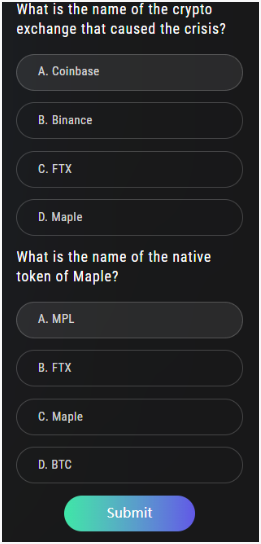
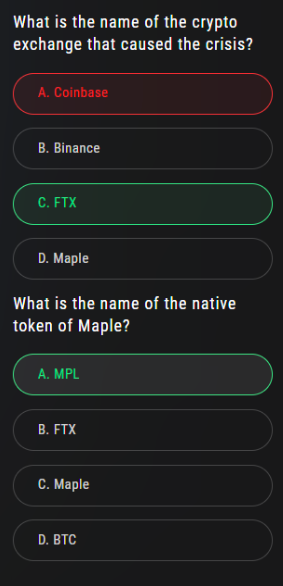
Next, we can choose the answer we think is correct on the right and click submit. The system will automatically judge whether our choice is correct, and prompt us with the correct option. In this way, we can quickly verify our reading comprehension ability, and provide data support for Proof of Read.
Through the case of Sphinx, we will bring the topic back to anti-cheating. In Web3, many of our activities will involve cryptocurrency transactions. In these transactions, if there is cheating, it will cause losses to both parties. Therefore, compared with Web2, in Web3, the importance of anti-cheating is higher to ensure the fairness and security of transactions. In addition, in Web2, since the data is stored on a centralized server, it is possible to set a reasonable Security measures to prevent cheating. But in web3, since the data is stored in a distributed blockchain network, it is difficult to effectively protect the data. Therefore, preventing cheating has become an important issue in blockchain applications.
Qutoutiao is an app with the attribute of making money by reading in web2. Let’s analyze how it performs anti-cheating. It implements anti-cheating function by reviewing and monitoring the content posted by users. When a user is found to publish illegal content, the system will automatically ban the user's account and delete the illegal content. It also developed a business-independent anti-cheat SDK to obtain real and credible device environment information and improve the accuracy of anti-cheat. In addition, Qutoutiao also uses the help of third-party technical service providers to improve anti-cheating capabilities.
The anti-cheat SDK usually contains some commonly used anti-cheat algorithms, which can be used to detect whether the user has used cheating tools, or analyze user behavior to find anomalies. For example, an anti-cheat SDK can be used to detect if a user has used a cheat tool that alters the outcome of a game, or to analyze a user's click behavior to detect cheating.
In actual implementation, developers need to integrate the anti-cheating SDK in the software or game, and call the algorithm in it for detection or analysis. For example, in a game, developers can use the anti-cheat SDK to detect whether a user has used a cheat tool, or analyze the user's click behavior to discover cheating behavior. If it is found that the user has used cheating tools or other cheating behaviors, the developer can take corresponding measures according to their own business rules, such as banning the user account, deleting cheating content, etc.
In short, by using the anti-cheat SDK, developers can more easily implement anti-cheat functions in their own software or games, thereby protecting the fairness and credibility of their works.
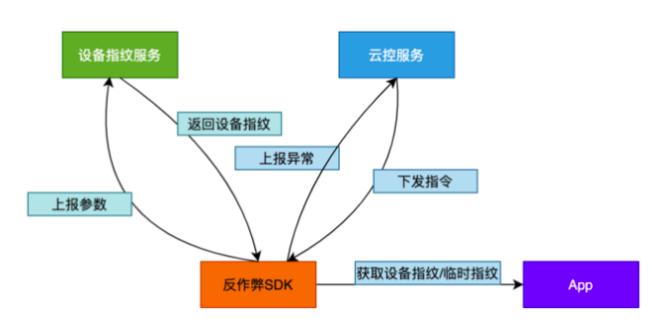
So why is the anti-cheat SDK so important, mainly for the following reasons:
Decoupled from business. Anti-cheating in many companies does not collect data by itself, and relies on business data for analysis. This is certainly possible for anti-cheating, but the volume of business data is large, equipment information is incomplete, user behavior is diverse, and data formats cannot be unified. Or, the change of the business field may not notify the anti-cheating team at all, which will cause the policy to fail. With the anti-cheating SDK independent of the business, not only the data format is unified, but also the release of new functions is more free, and the strategy is controllable and easy to maintain.
Get a real and credible device environment. Business data generally directly calls the system interface to obtain device environment parameters, but these parameters are very easy to be tampered with by Hooks. There are a large number of special machine modification tools that can modify system parameters. Therefore, to protect system parameters, it is necessary to identify this level of modification, or Bypassing or using other methods to obtain real and credible device environment data requires an independent professional SDK.
Device fingerprint. With your own SDK, you can do unique device identification. In the mobile field, not limited to mobile security, device fingerprints play an extremely important role, not only for anti-cheating, but also for business data statistics and product strategy formulation (for example, a single device can only participate in one event), and for advertising, New channels and so on.
The Anti-Cheat SDK fulfills two most important tasks:
Combined with server-side algorithm to generate device fingerprint and tuid, in order to uniquely identify the device.
Report client environment parameters to identify false devices and modify device information. The parameters collected by the SDK tend to be explicit, such as boot time, volume, light perception, etc. These parameters meet national security compliance requirements, and some parameters will only be obtained with the user's consent. A large number of repeated acquisitions will not be made in a single session. Depending on these parameters, various strategies such as emulator, jailbreak, and parameter aggregation can be made to identify fake devices.
It is not difficult to see that the basic logic of the Anti-cheat SDK (Anti-cheat SDK) is to detect cheating in games. It usually contains some pre-written code, which is executed when the game is running, and detects the game process and various indicators on the game device, such as memory usage, processor usage, network connection, etc. If abnormal situations are found, the anti-cheat SDK will report these situations for further processing by game developers.
Although anti-cheating is very important for Qutoutiao, it is not difficult to find that the anti-cheating SDK can only detect the user's cheating behavior, and cannot determine whether the user really paid attention to the advertisement. This creates a problem: Even if users aren't cheating, if they aren't actually paying attention to the ad, the value of the ad is greatly reduced. Therefore, Qutoutiao may need to develop more advanced technology to judge the user's attention and reading comprehension to ensure the effectiveness of advertisements.
However, we see that ReadON in Web3 is the first to use the Proof of Read mechanism, which is likely to be an application scenario that improves user attention, thereby increasing the value of the attention economy.
"The attention economy refers to an economic model that treats people's attention as a scarce resource in exchange for getting something. In advertising, the attention economy refers to the way advertisers pay To get the attention of potential customers. Advertisers use various means to attract users' attention, let users see the advertisement, and in this process, the user's attention becomes the source of income for the advertiser. Attention Economy It can help advertisers place their ads effectively, and it can also help advertisers get paid."
In the author's opinion, Proof of Read can not only be widely used to judge users' reading comprehension, but also greatly increase the value of advertising, and can really avoid the appearance of wool parties. As such, ReadON could very well be one of those apps that can break the so-called death spiral with Game-fi properties.
Of course, the value of Proof of Read is not limited to enhancing advertising value. Here are a few more visions and usage scenarios, including but not limited to:
1. Provide credible reading statistics for the news media field, so as to improve the credibility of the news media.
2. Provide credible online reading comprehension tests for the education field to help better assess learners' reading ability.
3. Provide credible user engagement statistics for online platforms to help platform operators better assess users' interest in content.
4. Provide credible user information collection mechanisms for network platforms to help platform operators better understand user needs and preferences.
5. Provide a credible execution check mechanism for smart contracts to help developers better evaluate the reliability of smart contracts.
For web2 users to enter the Web3 world, the biggest obstacle is the knowledge level of web2 users to enter the web3 world. Under the Proof of Read mechanism, the Sphinx tool is essentially a Feynman learning method, which aims to help people understand and remember new information more effectively. This method emphasizes understanding in an in-depth and participatory way New knowledge, not simply rote memorization. Using Proof of Read to prove that you have read and learned, combined with Feynman learning method, can help improve the knowledge level of Web2 users.Combined with this point of imagination, ReadON is likely to serve as a traffic bridge between web2-web3 in the future.
Blockchain technology has come a long way, with great achievements in many fields. Through blockchain technology, people can achieve more secure, transparent and decentralized data storage and transactions.
In the future, we can expect blockchain technology to be widely used in more fields, such as finance, logistics, government, medical care and other fields. In addition, with the continuous improvement and perfection of blockchain technology, it will also bring people more possibilities and room for imagination.
It is hoped that more web2 users can participate in the world of web3 and jointly promote the development of blockchain technology.