This article explores how to design sustainable rewards for Web3: from "fast food" to "slow food"


image description
Compilation of the original text: The Way of DeFi
Image source: Generated by Unbounded Layout AI tool
TL;DR (too long to read version)
Money is not the ultimate reward—relationships and culture are
Social and cultural capital grows slowly, but lasts longer
Introduction
Introduction
"We just have to send money - and they will come."
When I asked my friend how to attract users to her DeFi protocol, she answered me like this.
Rewards keep the fire burning and act as brain stimulants. Rewards attract users and motivate them to stay. Most importantly, rewards are one of the core functions of Web3.
Unfortunately, my friend's answer confirms the consensus of most people today. Most people think that sending money can win the favor of users. That's a problem -- because a lot of people think it's okay. Rewards done right can create a positive cycle for growth, and done wrong can be a death sentence for the product and community.
Besides the utility of the product, capital is arguably the most powerful reward. But capital has more forms than money.
This article is based on the theory of sociologist Pierre Bourdieu - who has analyzed capital longer than crypto - and aims to provide better guidance for those who design crypto rewards.
First, we'll delve into three different types of capital that drive social interaction. We will then use Bourdieu's framework to provide a clearer description of the different types of rewards in Web3. Finally, we will derive a builder-oriented reward strategy.
different types of capital
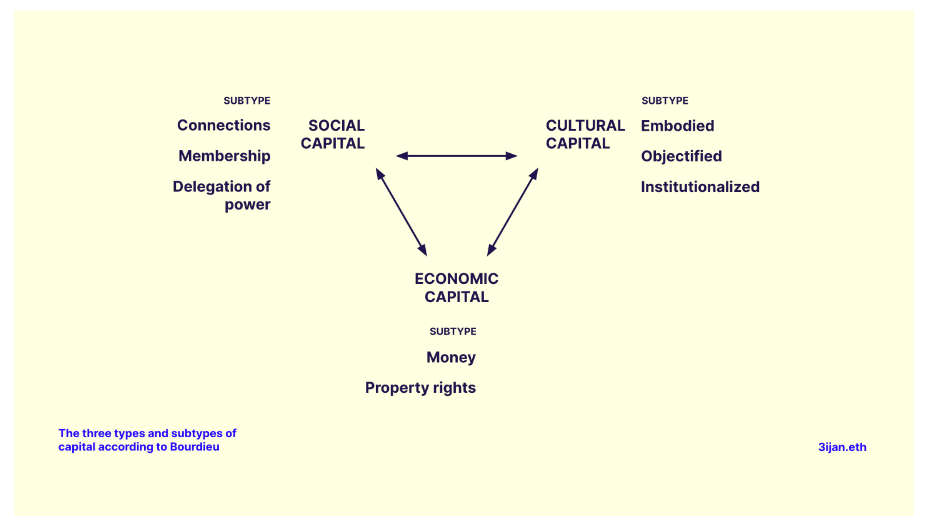
When most people think of the word capital, they think of money or assets. But according to French sociologist Pierre Bourdieu (1930-2002), this is just a reward dimension. According to his analysis, there are three types of capital: economic, social and cultural.
economic capital
Let's start with the type of capital we are most familiar with: economic capital. According to Bourdieu, this includes everything that can be converted directly into money, such as fiat currency and precious metals. It can also come in the form of property rights that pay dividends, such as condominiums or shares. It's something you pay taxes and put on your balance sheet. It is the most liquid version of capital. Economic capital can be easily transferred to other people.
social capital
Social capital is the value a person can derive from their relationships. Social capital answers these questions: Who do you know? What potential circles do you reach based on your social status? It is the approval within a group plus the approval of those who are not part of the group. Social capital is expressed through emotions such as gratitude, solidarity, respect, and friendship.
Another aspect of social capital is membership, which refers to the benefits of being a member of a group. Membership is exclusive; there are some people who are not members. Moreover, there are still some barriers to access, which cannot be easily joined. These barriers themselves come in the form of different types of capital. For example, when you want to be part of a club, you have to pay a fee (economic capital). Cultural capital (more on that later) comes into play when we need credentials to join a group. For example, physicians need certification to become"Doctors Club"a member of When a club can only be joined through referrals from its members, it represents the presence of social capital. We all have multiple memberships: an adult; an artist; an employee; a family member. Each role lends credibility to the individual group.
Exclusivity is necessary to protect a group's social capital. The same goes for "inclusive" groups. Existing members are very interested in designing barriers to entry, since each new member can either add to or destroy the social capital of the group. Imagine if you could just pay to join a "doctor's club" and start treating patients.
It is the job of elected leaders to defend the social capital of a group—such as a family, country, political party, club, or association—because group members have placed individual decision-making power in their hands, and they have centralized social capital .
Social capital is why referral and referral behaviors work. We intuitively trust recommendations from friends and experts because we know their social capital will take a hit if the information is wrong.
More from Bourdieu on social capital:
Social capital has a powerful multiplier effect. The stronger a person's relationship is, the more money they have. For example, the stronger an investor's network is, the more uniquely she can find ways to deploy it. Also, social capital degrades over time, which is why we have to maintain our connections. You might be able to buy a lifetime membership to a club -- but it won't do anything if you never show up.
cultural capital
The third type proposed by Bourdieu is cultural capital, which consists of material and immaterial assets that enable a person to navigate social life, reach out to groups, and project status. There are three forms of cultural capital: embodied state, objectified state and institutionalized state.
The embodied state means that something has entered someone's body. This is external wealth invested in self-improvement, including physical exercise, skills, knowledge, education, training, and token assets such as taste and manners. The manifestation of cultural capital takes a long time, and its impact is long-lasting. Once we learn a skill, we continue to benefit from it. At the same time, low cultural capital such as bad manners can make it difficult for a person to find friends and form healthy relationships. The embodied cultural capital needs to be obtained by oneself and bound to the holder. No one can go to the gym for you. No one can learn for you.
In contrast, cultural capital in an objectified state is transferable. Are you wearing a shirt or a vest? Do you commute to work in an SUV or public transport? Do you eat Oreos or organic? Cultural goods such as clothes, pictures, books, musical instruments and machines are cultural capital available for sale.
Finally, institutionalized status is certified cultural capital. Do you have a high school or PhD degree? In these cases, an institution can attest to your skills. The rarer the qualification, the greater the potential to generate profits. Institutions must ensure that you obtain such certifications yourself and not purchase them. Otherwise, the value of the certificate itself will be diluted. If you can buy it, it's not worth the money.
OK, we've learned"cash rules everything around me"Not really. Networks and culture also rule society. But which type of capital is most important?
The performance of three kinds of capital in daily life
When we want to optimize a certain type of capital, we find that everyday life requires us to utilize all types of capital to achieve our goals. Each capital has different qualities. Money can come quickly, but social and cultural capital has a more lasting impact.
How the Three Capitals Work
Let's see how we can use these types of capital to meet the challenges of everyday life - getting into a club with strict entry restrictions.
First off, how do you pass the security guard test? Does your gauge pass? This (objectified) cultural capital predicts that you know the cultural codes inside. Another way in is to leverage your social capital. Do you know anyone higher up in this club? Get them to put you on the guest list. This will free you from clothing and how to deal with security personnel. If you do get to the ticket office, it's time to pay (economic capital). Cultural capital probably won't help you get a discount. However, social capital can, if your place on the guest list allows you free entry.
Fast Food VS Slow Food Capital
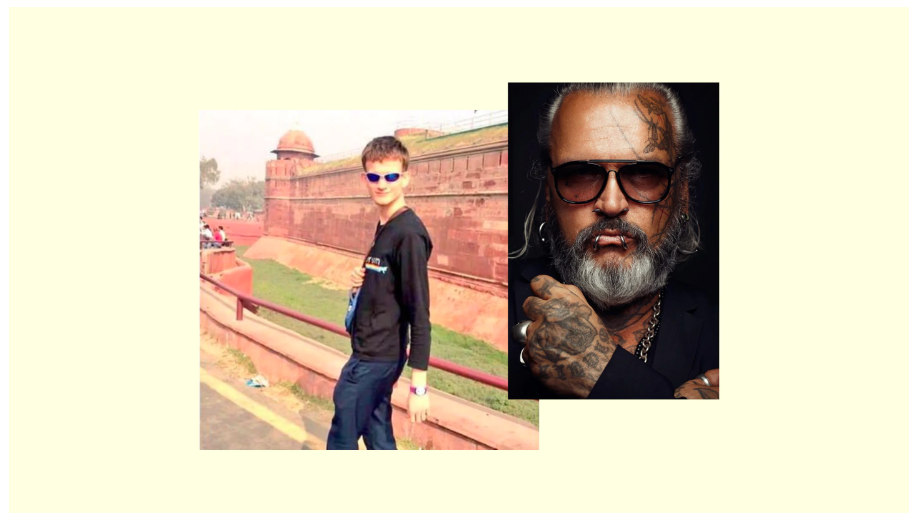
Economic capital is fast food. Social and cultural capital is slow food. While economic capital can be generated quickly from social capital (e.g., getting credit for your connections) and cultural capital (e.g., selling your knowledge for money), it is impossible to buy cultural and social capital through economic capital, or will have the opposite knot effect. Another example: I can use my money to buy a second-hand hoodie and yoga pants (objectified cultural capital) and dress myself up like Vitalik. However, that doesn't really turn me into Vitalik. Gaining his knowledge (cultural capital) and relationships (social capital), for me, took more than a lifetime. Buying cultural capital might even face a very bad situation: if the core ETH members see that I am just copying Vitalik's appearance, they will expose me as a liar.
Also, obviously, sending 1 BTC to a stranger doesn't make them your friend. You can't buy social capital. Even if you do succeed, the connection will not have the quality of friendship as we understand it.
The reward for social capital is in spending time, not money. You can buy a t-shirt from dAppcon, but you can only build social connections from it if you've been there. Personalized gifts are considered more valuable than just sending out Amazon gift certificates because of the extra time one person spends with the other.
The slow accumulation of cultural and social capital has a powerful effect: you can spend it multiple times. Money can only be spent once, instead social and cultural capital grows with each use. That's why, according to Bourdieu, multigenerational dynasties are built not on money but on relationships and culture.
Now that we've seen how the three types of capital drive social interaction, it's time to explore their role in Web3.
Capital in Crypto
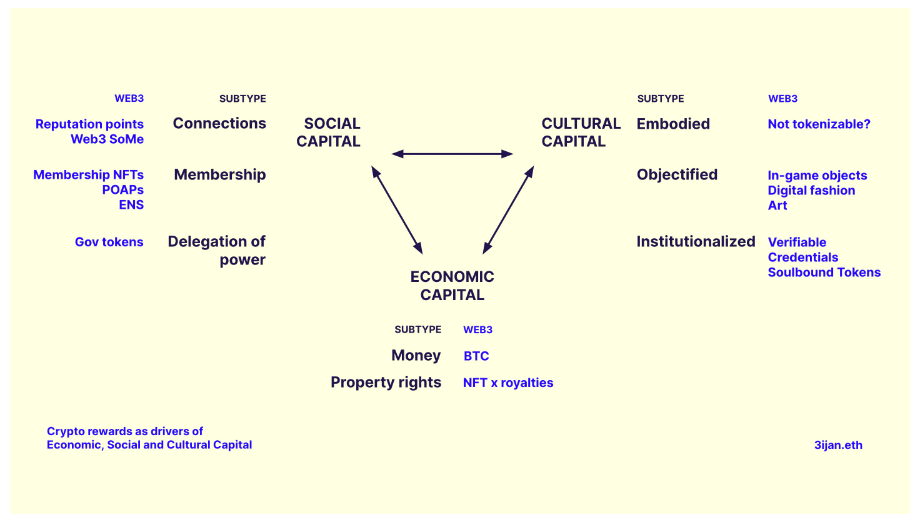
When we put these three capitals in crypto rewards, we can find that economic capital has been relatively mature, and we have just begun to develop the potential of social and cultural capital.
Economic Capital in Web3
Crypto is great for building economic capital. Starting with Bitcoin, it is the purest form of economic capital, and economic capital is the best paradigm for crypto development.
We can count ubiquitous utility tokens as economic capital. In order not to be classified as a security, Web3 projects are going to great lengths to argue that they are not distributing money to users. Brave browser claims its BAT token"Not a digital currency, but an application token". Talent network Braintrust sees its tokens less like money and more like credentials. Decentralized hedge fund Numer.ai distributes NMR to contributors. If Pierre Bourdieu leads the US Securities and Exchange Commission (SEC), life will be difficult for these projects. Even though these tokens are used to facilitate on-chain utility, at the same time they can be exchanged for fiat currency very quickly - thus, closer to economic capital.
Property rights are a subtype of economic capital encompassed by the world of NFTs, where protocols like Nina enable creators to earn lifetime royalties on secondary sales.
Social Capital in Web3
Let's take a look at social capital in Web3. Bourdieu explains social capital in terms of relationships, membership, and decentralization.
Crypto rewards that simulate or enhance closer connections with others are still in their infancy. Reputation scores on leaderboards have been a popular tool for describing crypto social hierarchy, but they are one-dimensional. Interesting experiments related to social connections include Lens, which allows users to have their own social graph, and Coordinape, a salary tool based on the points that group members give each other.
What makes these relationships worthwhile, however, are emotions, which are difficult to productize. While fostering friendship and gratitude is a great goal for a product, you can't mint emotion as a token -- or can you?
Membership is another subtype of social capital. Web3 provides tools for those who pay and earn memberships.
Starbucks and Nike recently launched on-chain loyalty programs to improve their customer experience. Other examples of how Web3 empowers membership include ENS domains.
While paid memberships may make sense where in-game financial gain is important, earned memberships are also growing in popularity. POAPs - which stand for Proof of Attendance at (Online) Events - are distributed to capture the moment to share with others. By holding POAP, one can become a member of the community.
Finally, social capital in the form of delegation is very important, especially during the DeFi summer. Crazy distribution of governance tokens through airdrops or liquidity mining projects to attract users. These tokens are not money, but the right to make decisions about the treasury or the protocol. Some projects, such as Compound, equip their governance with a form of delegation that enables the community to centralize decision-making power in the hands of a small number of well-informed decision makers.
Projects like Otterspace are working on solutions to decouple delegation from economic incentives in DAOs. Optimism is moving in a similar direction, separating its Token House from Citizen House. While Token House is made up of hundreds of thousands of addresses receiving airdropped OP tokens, Citizen House is an experiment to fund a public good managed by selected holders of non-transferable soul-bound tokens.
Cultural Capital in Web3
Embodimentd cultural capital cannot be tokenized. No one can do the exercise for you, no one can learn for you, and Web3 won't change that.
Objectified cultural capital, on the other hand, grows at a tremendous rate in Web3. NFTs are the premise of unique digital art, in-game items, and digital fashion. Cultural assets that can be purchased or earned will become more important as the Metaverse develops.
Finally, institutionalized cultural capital is early but will progress with the development of Verifiable Credentials (VC) and Soul-Bound Tokens (SBT). The latter ties the NFT to a specific wallet, giving it credit for the issuer. These decentralized credential models can be used to verify a user's credentials (such as a driver's license) and attest to achievements in games, protocols, or courses.
Web3 is catching up, not just economically, but socially and culturally rewarding. What does this mean for builders?
Strategy Summary
At the beginning of this article, we mentioned a typical problem faced by Web3 builders: my friend wants to use rewards to attract users for his DeFi protocol. From the above analysis, she can adopt these strategies:
decentralized power
After analysis, we can conclude: carefully choose the right reward for the right environment. Economic capital works fast, and you can use it to buy food. Social and cultural developments develop more slowly, but have long-term effects.
Are you building a DeFi protocol and want to reward users for recommending it? Then it is very meaningful to issue rewards based on economic value. At the end of the day, that's what users are for. At the same time, the integration of models such as leaderboards will open up a new dimension for users-in the past, users only came for money. “They come for the money and stay for the community,” Bourdieu didn’t say. But he should think so.
An interesting way to combine social incentives with economic incentives is the dual token system: Token 1 is reputation points that can be continuously accumulated but not spent. These are linked to the right to earn yield as Token 2, a liquid token that can be traded on the open market.
scarcity is king
If everyone has it, it's not worth having. All three types of capital share the principle that their value is a function of scarcity. If you’re offering monetary rewards without token economics designed for long-term value appreciation, then you’re on a classic pump and dump path.
The same goes for social and cultural capital. Don’t just hand out points—they should be the result of hard work, rewarding those who keep coming back and contributing. Are you designing reputation points? Make sure these points cannot be bought. Make sure you can't spend them either. Once you can buy reputation, it's worth nothing.
From transactional to long-term
Economic capital is transactional. It has to be, otherwise it is illiquid. However, if you have long-term goals, long-term incentives can be achieved through token release schedules, token lock-ups, or rewards through social and cultural capital, which are less transactional in nature. Economic capital is fast food. Social and cultural capital is slow food. Can you design rewards that build your users' social and cultural capital? This will give your community a stronger connection to your product. Cultural capital takes a multigenerational effort. In this financialized fast-paced crypto world, we can perhaps learn something from a watch brand (as weird as it sounds) - watch brand Patek Philippe's slogan:"No one can really own a Patek Philippe, you are just keeping it for the next generation". What durable cryptocurrency rewards can you give your users that will last for generations?