The Grayscale (GBTC) Effect: The Instigator of Institutional Bubbles and Collapses



Original title: "The Grayscale (GBTC) Effect》
Author: Ben Lilly
Original compilation:Original compilation:
Deep Tide TechFlow
We rearranged the story from two years ago, starting in 2020, which we call the "grayscale effect".
When we look back at these pictures, we find that 2020-2021 is the beginning of a bull market run, but at the same time, it also planted the seeds for the emergence of a bear market in 2022.
Today, the bear market continues.
Perhaps, crypto onlookers on Twitter and in the media are currently resignedly awaiting the eventual doomsday and hoping that it comes sooner rather than later. Because that Digital Currency Group (DCG) empire is collapsing itself... an empire with the now infamous Grayscale Bitcoin Trust...
And what these early clues are showing us is that we're coming full circle, that various catalysts from the past are now unraveling, and we're seeing the other side of the double-edged sword.
So today, let's take a deep dive into some of the recent scandals to make sense of what's happening today.
start of the bubble
Before we start, I want to talk about one thing.
I mentioned that we're going nowhere, and before anyone suggests that all the progress made two and a half years ago is now gone, I want to quickly dispel that malign thought.
This wasn't two and a half years ago, and what happened this year doesn't set the industry back three or four years.
Thinking in such a vicious way may hint at the origin of one's beliefs -- from speculation. In my opinion, this approach is not beneficial to the whole society. As we will see shortly, there are many downsides to this behavior.
So while the current atmosphere is sombre and reflective, let's not ignore the technological breakthroughs that are happening every week at a breakneck pace... this innovation is a fact. It is an inherent force in the industry and will not be pushed back a few years by speculation.
If anything, the rising energy in Githubs, forums, and eager teams is like a volcano ready to erupt. Nothing that stands in its way can slow its progress. And once this energy is released into the world, the most fertile soil will be born, making the future brighter.
Innovation and development in this industry is the freest force in any industry, and it is a force that stands out in freedom, truth, and self-sovereignty. These are truths that don't simply lose faith...and they are truths that today's failed headlines don't embody or mention.
So if "the purpose of conquest is to avoid doing the same things as the conquered"...let's look back and hopefully help us move forward and not let the mistakes of the past haunt us tomorrow. We didn't regress, we just understood the distance to the goal.
Act One - The Beginning
It started with the Summer of DeFi in 2020. Every crypto user stuck in the throes of on-chain transactions is starting to learn about yield farms, vaults, liquidity aggregation, synthetic tokens, yield tokens, and more.
Amid the hustle and bustle of these coins and 1,000%+ short-yield products, our in-house trading and alerting AI system has done a deep dive on unusual demand happening in the Bitcoin spot market.
This is a major alarm for us as spot demand pushes prices into new ranges. Derivatives push us to the highs and lows of the range. For anyone who recalls 2020, the fear of the March 2020 lows is seared into the minds of traders.
As we look back, we find it somewhat ironic that a new species in the form of yield tokens has emerged, allowing the largest whales in the ecosystem to roam around unnoticed…
These whales are what sparked the 18-month bull market.
And today, as the price pulls back close to where the market was 18 months ago, we realize that all the levers that started it all, are coming off the stage. This is the double-edged sword we mentioned earlier.
The person who starts the cycle is the same person who makes the headlines.
So, who and what am I referring to here?
Let's pull a tweet that caught our interest in the summer of 2020. It appealed to us more than any other at the time, simply because the bullishness likely had to do with what the AI was picking.
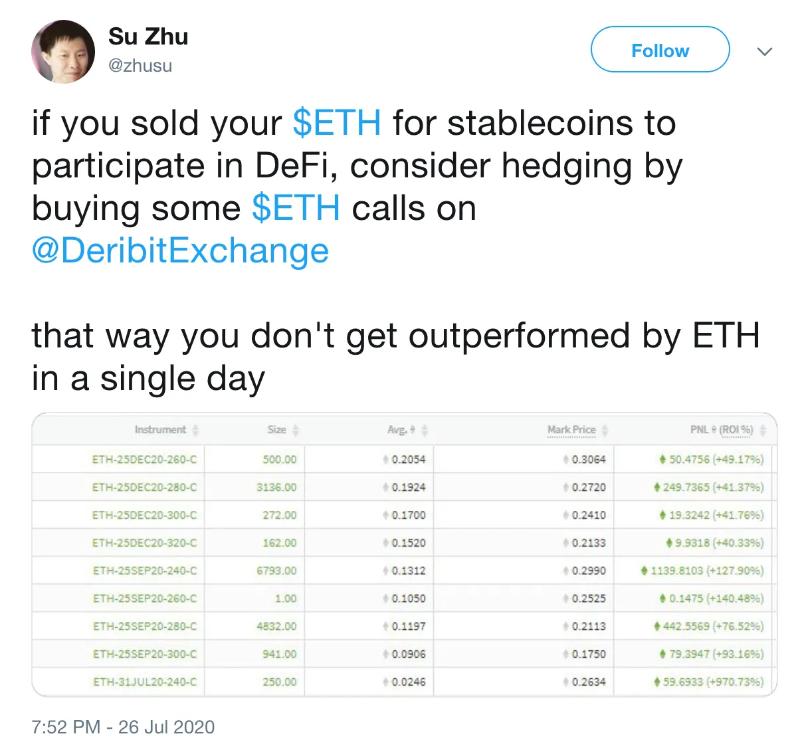
This is a now-deleted tweet from the head of 3 Arrows Capital (3 AC).
This is a slice of 3 AC on the books (possibly hedged) and they are adding to long positions. According to the picture, this screenshot of Zhu reflects that he opened a contract of approximately 2340 ETH. The total amount at the time was exactly $1 million.
That's probably a very small position for a multi-billion dollar hedge fund. But 3 AC wasn't a billion dollar hedge fund back then.
According to a passage in nymag's report, which cites 3 AC's annual report, "According to its annual report, Three Arrows' main fund returned more than 5,900 percent. By the end of the year, it managed more than $2.6 billion assets and liabilities of $1.9 billion.”
That translates to about $700 million in profits for 3 AC...it also means the two companies are gaining over 5,900% sometime in 2020, with about $11.5 million under management.
This makes the screenshot more reflective of an overstake based on belief.
As the fact that 3 AC is not interested in hedging has surfaced, this ETH position is an indicator of what 3 AC is going to do. We don't even know what BTC call options look like - that's a more liquid options market.
I think his BTC options position was much larger, as anyone who was trading on Deribit at the time can attest to the huge spread. For anyone establishing a seven-figure-plus position, it takes a considerable amount of time to fill, especially on the illiquid ETH options contracts.
That's why we also see so many contracts and expirations in the clip above.
Okay, so digging a little deeper into the location, we also know a few things that happened before that tweet.
First, 3 AC purchased over 21 million shares of the Grayscale Bitcoin Trust (GBTC). We know this thanks to a June 2, 2020 SEC filing.
Grayscale, an entity of the Digital Currency Group, has taken over the market, amassing a total of 536,000 BTC so far.
Their unique structure is what makes it possible. It's structured to essentially hoard bitcoins. BTC and USD (which are then used to buy BTC) flow in and cannot be withdrawn.
The way Grayscale achieves this one-way flow is the way they allocate shares. Accredited investors or "wealthy individuals" can sign up for private placements to receive shares.
These accredited investors can then provide Grayscale with BTC or USD. In exchange, Grayscale gave them shares of equal value. If each share equals 0.001 BTC (actually 0.00095085), then for every BTC handed over to Grayscale, accredited investors will receive 1000 GBTC (minus a small fee).
The problem is that private investors have to wait 6 months to sell GBTC on the market. This is where non-accredited retail investors speculate, the less wealthy buyers.
It might seem fair to trade stocks for BTC, but in reality, it's not. This is because GBTC almost always trades at a premium. Non-accredited investors or retail investors looking to invest purely in BTC in the stock market are not paying fair value.
Here's what I mean... recently GBTC closed at $28.25. Bitcoin closed at $22,830, according to the BraveNewCoin Liquidity Index. According to the Grayscale website, each GBTC share is equal to 0.00095085 BTC. This means that the fair value of GBTC is $21.71. There is a 30% premium to current prices simply because buyers are not rich. This 30% premium goes directly to accredited investors who hand over their BTC.
This strategy is how Grayscale created the trust, in which bitcoin basically enters the trust in a one-way flow. Which accredited investor who owns Bitcoin isn't interested in increasing his Bitcoin balance? It doesn't matter if the price is $5,000 or $20,000. As long as there is a premium, BTC will grow in value.
That's an almost risk-free return of 30% in six months and 69% in a year.
That's substantial, and natural economic pressures should bring that premium down to 0%. However, for some reason, we haven't seen that happen yet.
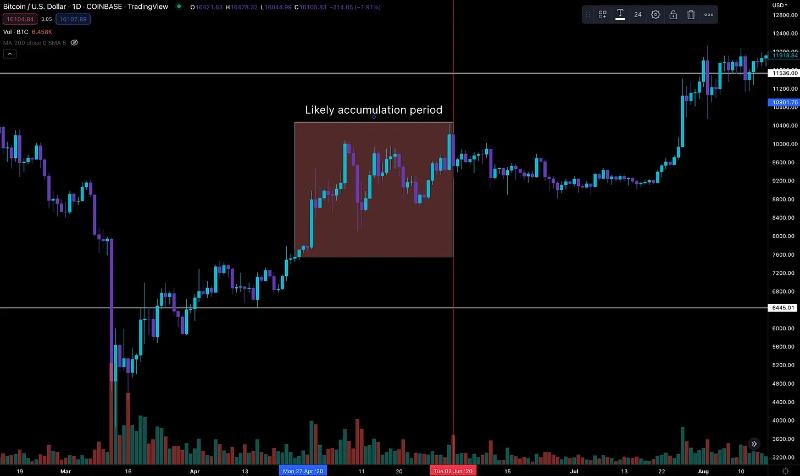
This means that 3 AC likely purchased bitcoins before filing on June 2. We can calculate the period shown below based on the approximately 30 days it took Su Zhu to tweet on 5 December 2020 and file his next disclosure on 31 December 2020. The time below is just over 30 days.
But keep in mind that Zhu holds some July ETH call options. They have a strike price of 240 and a cost of 0.0246 ETH per contract.
If these contracts were bought 1.5 months or more in advance, this means that the price of the contract needs to rise by 20% to 40%+ (estimated) in order to make money.
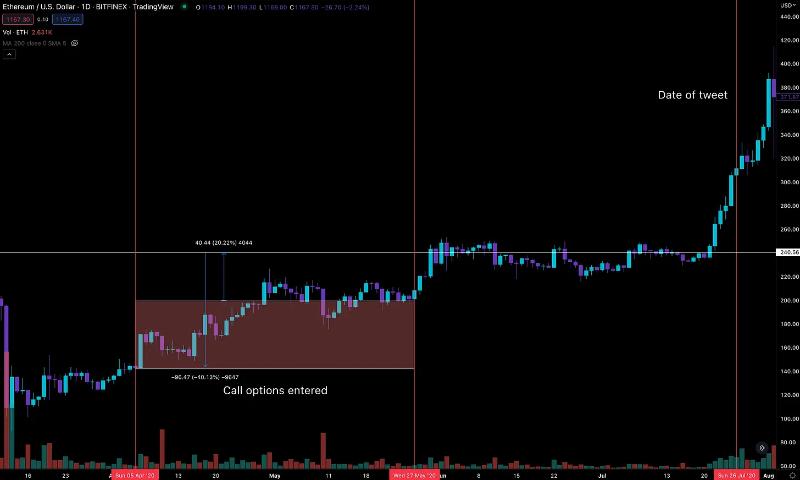
For now, we can assume that these positions were entered during this time frame.
The takeaway here is that there is a good chance that 3 AC bought call options on their BTC in the spot market before sending the tokens to Grayscale and filling out the SEC filing. This is logical since you can make a profit from your spot purchases, since 21 million shares (~1000 GBTC shares = 1 BTC) are roughly 21000 BTC.
That much Bitcoin was $150-200 million at the time, which meant it was a borrowed amount (from the lender Genesis) according to 3 AC's assets and liabilities.
Now, if we go one step further, we can time the timing even more...
Below is a screenshot of Grayscale's cumulative weekly inflow chart.<>This tells us that inflows could start as early as the week of May 11th. This puts us at the start of those two boxes in the previous candlestick. This also provides more support for the big move in late April and early May as it stems from 3 AC
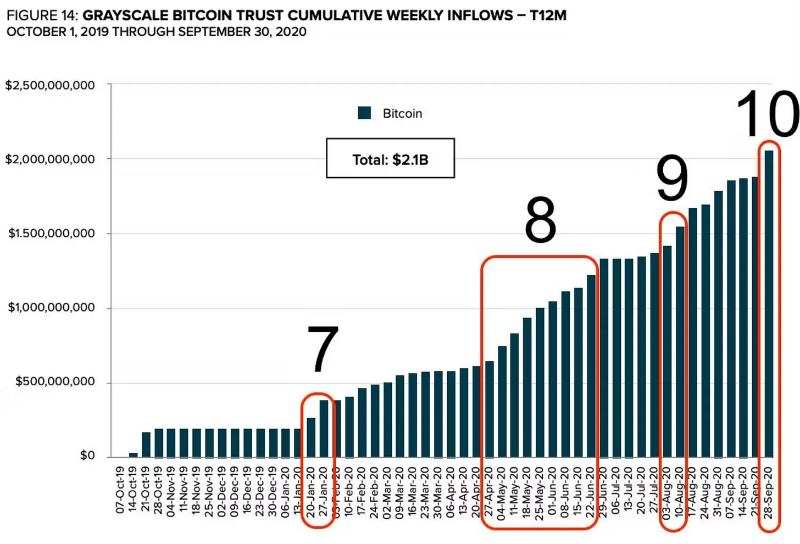
Grayscale dynamics.
This part basically sums up the first act of Su Zhu.
But it's interesting that in the first act, we can see Su Zhu showing fear in the directional bet. He wants to lock in a premium on GBTC, but fears it will disappear.
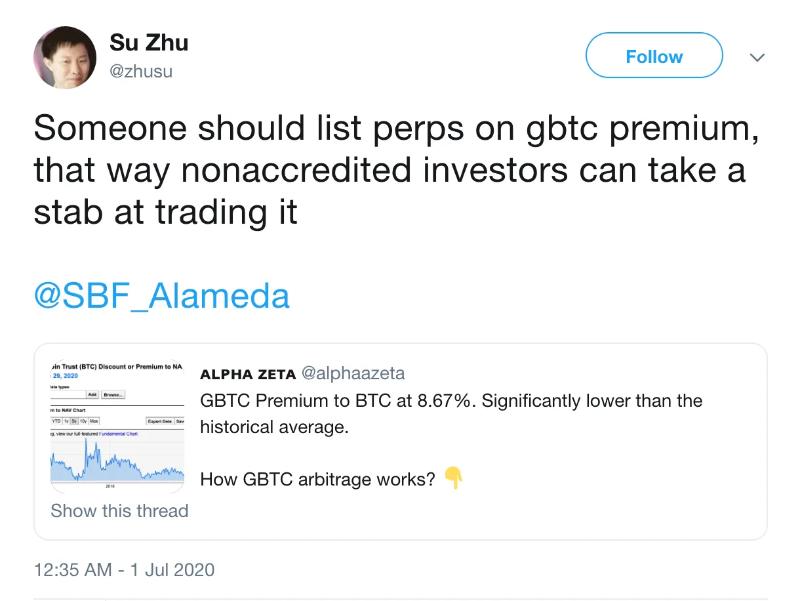
Here, he asks FTX's SBF to create a tool around Grayscale's GBTC Trust. We can only assume this is to allow 3 AC to exit the position in the trust without having to wait 6 months.
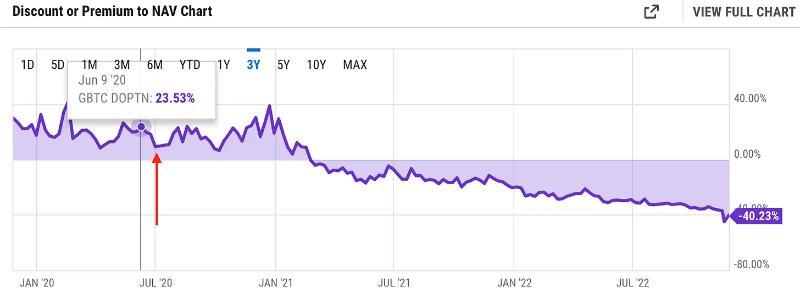
The tweet showed the unease caused by the timing. 3 AC filed with the SEC on June 2, and their underlying premium margin for the June period fell from around 23% to single digits.
While the premium is still there...it foreshadows the end.
Act Two - Increased Leverage
My initial theory was that 3 AC held their GBTC for at least six months and then sold.
This will mean that in December, 21 million GBTC will enter the market.
But thanks to some digging by Data Finnovation in this post, it seems my initial perception was wrong. This also looks consistent when we look at the GBTC chart and volume... 21 million shares volume doesn't seem to exist. After Genesis, the lending subsidiary of Grayscale's parent company, sold 21 million shares after lending Bitcoin...I very much doubt they are willing to create that kind of volatility.
on the contrary...
Why 3 AC did the opposite and added more leverage. After all, Bitcoin has gone up, and so has the premium... so taking your cash is fine here. We've heard stories of lenders who won't even do due diligence on 3 ACs.
So if 3 AC is going to be leveraged, the conversation could happen in late November or early December. The reason is that we can see Zhu growing more confident about what's to come.
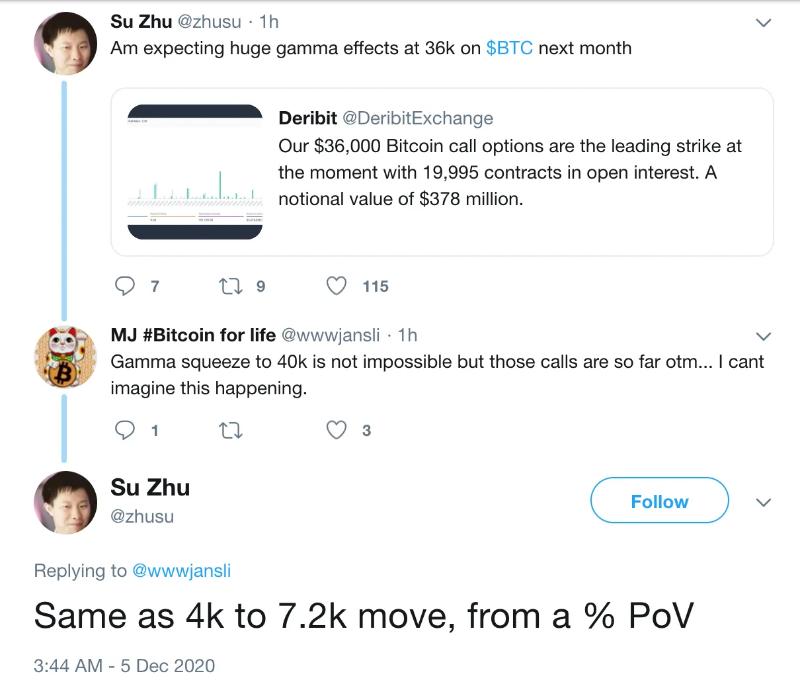
Below is a since-deleted tweet indicating that he believes a Gamma Squeeze is ready to happen by the end of the month. Remember, Zhu was holding a call option at the time.
And the fact that Su Zhu has so many forward-looking calls could suggest that the call to get 3 AC to continue raising leverage could actually happen in the summer of 2020.
So taking a step back and saying...
Su Zhu was confident on Dec. 5, 2020, stating that he expects Gamma to push BTC above $36,000. The price at the time was $18.6k, which meant it would take about four weeks for a 100% return. At the same time, BTC has yet to hit a new all-time high, which is once again an uphill task.
This confidence is consistent with a filing with the SEC on December 31, 2020, which stated that 3 AC held 38,888,888 shares of GBTC at the time.
This represents an increase of 17.8 million shares in 3 AC from June 2 to December 31, 2020.
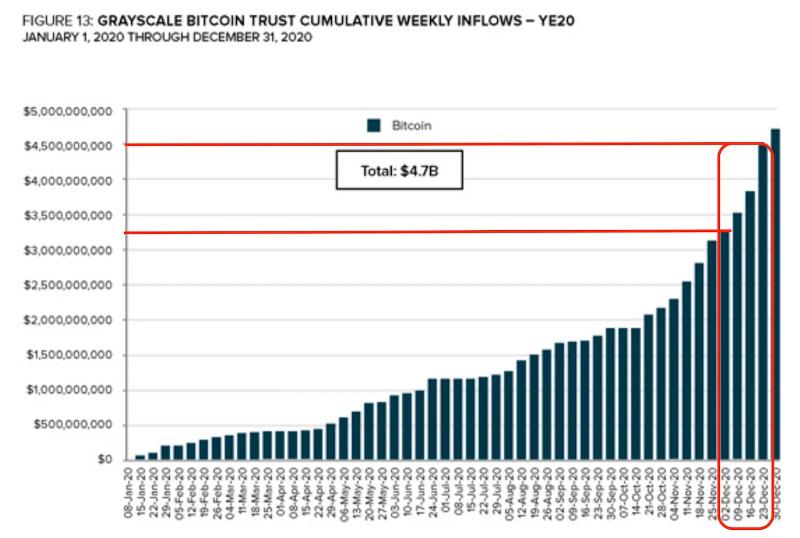
That's money flowing into trust funds, and there's a lot of room for 3 AC and others. And the biggest uptick in inflows happens just when the market is hot. If I had to guess, the biggest uptick came when 3 AC made a move to try the Gamma Squeeze it mentioned on Dec 5th.
And honestly, I wouldn't be surprised if the story of this bitcoin options trader who turned $638K into $4M in five weeks featured 3 ACs. This timing will again be a coincidence that cannot be ignored.
So it's the end of 2020, and 3 AC has $2.6 billion in assets and $1.9 billion in liabilities. With 38.8 million GBTC shares at around $32 each, we get about $1.25 billion, almost half of what they book.
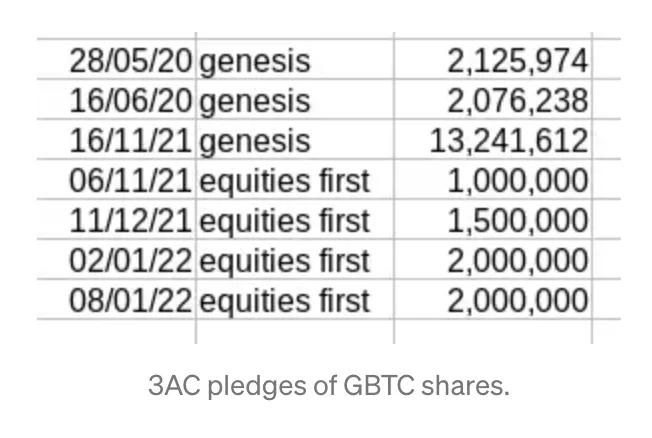
With around $700 million or so in profit earlier this year, we can assume 3 AC is surviving entirely on the grayscale effect. The whole market is going up. On trades that accounted for half of the 3 AC book, unhedged trades earned over 60x returns.
Given that 3 AC has $1.9 billion in liabilities on its books, we can assume they are also borrowing BTC for the Grayscale transactions we've been discussing so far.
Borrowing money from one DCG subsidiary to help another earn huge management fee income.
It's like allowing a lender to set up shop for home buyers in an upcoming neighborhood. None of these homebuyers actually want to live there. So the bank gives them money to buy a house...new homeowners have to wait six months for their house to be built.
Meanwhile, homebuilders make a few percent profit on all homes.
The key here is that there are no other home builders in the area...or in other words, there are no other ways to buy bitcoin in the area.
So to recap, the lender makes about 10% on the loan. Homebuilders make 2-3% profit on each home. Also, no homebuyer intends to actually live in the home.
This means that for the scheme to work, new buyers must enter the market and cannot buy from the original home builder.
How can this be done?
Act Three - The Narrative
In the first quarter of 2021, we started to see a shift in the narrative. To keep Grayscale's premium from going negative...more buyers are needed.
This means reaching out to the masses. The key here is that an individual cannot buy a home from a home builder (ie buy stock directly from Grayscale). They need to buy GBTC from the market.
This is a large number of retail investors.
And they can't attract users who are willing to learn the trading curve by using exchanges like Coinbase, Kraken, or Gemini.
This is the charm of the "Drop Gold" campaign. Originally launched in May 2019, it was just the demographic Graysacle needed to lure. What's more, if you do some searches on the internet, you'll find that late 2020 and early 2021 is when users outside of cryptocurrencies will accept this ad.
Then, to layer a narrative on top of the narrative, Zhu started his supercycle narrative in the first quarter, implying that people need to pay dearly for the cryptocurrency because it will only go up.
The hype is running full steam ahead.
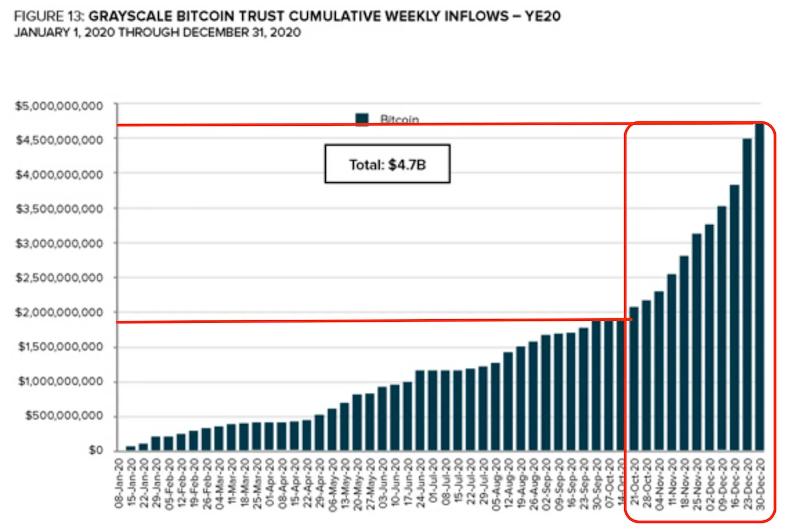
However, this is not enough. Grayscale saw more than $2.5 billion in inflows in the last 10 weeks of 2020.
It's ready to go on sale as soon as mid-April. These 10 weeks saw more capital than the entire previous 7 years. Read it again... During these 10 weeks, more capital went into the trust than in the previous 7 years.
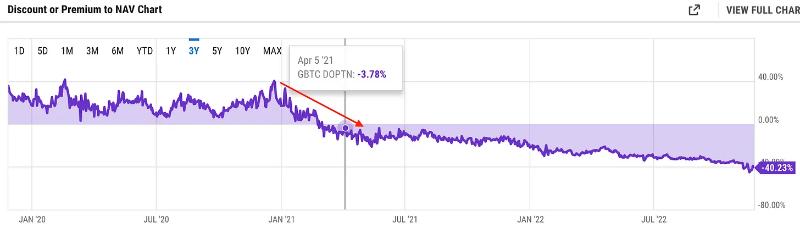
This period coincided with the trust's net asset value (NAV) turning negative. The inflows in August sent the share price below the level at which the trust could have redeemed it - had the trust allowed redemptions.
It's not just a nuisance...it's the real start of the plunge. Just when more than $2.5 billion of GBTC is ready to enter the market, how can Grayscale save its negative net worth?
Act Four - The End
On April 5, Grayscale went on to announce its intention to convert trust funds into ETFs. If successful, the equity will return to the standard value.
To return the trust to face value, Grayscale needs to sell BTC to the market. This means that if someone buys GBTC for less than their net asset value, they will make a profit.
This is the beginning of the end for the trust. When Bitcoin rallied in Q3 2021, NAV almost recovered...but NAV never turned positive again, and it was clear that the trust was getting weak.
Grayscale, DCG, Genesis, and 3 AC are all pigs in the trough. If life has taught me one lesson it is never to be a pig because pigs get slaughtered.
And that's exactly what's happening when the market starts to turn in 2022.
Regardless, that's why we're seeing Grayscale, Genesis, and DCG struggling right now. Barry Silbert has indeed done a lot of good things in this field.
But he and his massive entity became greedy. If we look closely, we may see that the Grayscale/DCG roots are connected to almost all the explosions in cryptocurrency. The industry is really that small.<> DCG <>Maybe he was good at the beginning, but now he is harmful to the industry. Don't worry about its demise. If we find Grayscale
I wouldn't be surprised if Genesis (and even BlockFi) perhaps more entities die.