Detailed explanation of NFT royalty reform: fighting, insider, where to go


Summary
first level title
Summary
The NFT market has entered a stage of fierce fighting under the current overall bear market. Recently, trading platforms represented by X2Y2 have successively launched the zero-royalty function. Regarding whether royalties should exist, all parties in the market have had heated discussions around this. This article mainly analyzes the royalty reform from three aspects: (1) the ingenious fermentation process of this incident; (2) the deep-seated reasons for Sudoswap and X2Y2 canceling the royalty; (3) the direction of the royalty reform. After analysis we came to the following conclusions:
●The main body of the debate on royalty reform is divided into four camps: ordinary users, trading markets, NFT collectors and project parties. Due to the current NFT market size is not large enough, the transaction rules are not clear, the quality of the project is uneven, and the demands of ordinary users are difficult to agree on. Regarding the cancellation of royalties, the four groups have their own opinions and debates endlessly, without forming a unified cognition .
●X2Y2 adopts "user-defined royalties" mainly because platforms similar to Sudoswap successively adopt zero royalties and integrate into the aggregator platform, which leads to the loss of their original advantages, which leads them to play the card of "cancellation of royalties". It can also increase transaction volume and attract new users in the environment of the NFT bear market.
●From the perspective of the direction and trend of the royalty reform, there are four main aspects: 1. For the development of PFP projects, the royalty reform may achieve a "soft landing", that is, a gradual transition from partial reliance on royalties to zero royalties; 2. The business of NFT The model will be more abundant, a large number of 2C 2B charging models will appear, and the high-quality supply of NFT will increase; 3. Paying royalties for art (1/1) projects will become the consensus of the industry; 4. Zero-royalty projects will form the foundation of the NFT market Long tail market.
first level title
1. Fermentation of royalty controversy
Recently, platforms such as X2Y2 have successively canceled royalties for creators. This incident has triggered intense attention and discussion in the NFT market. In fact, this incident originated from the battle for the share of the NFT market.
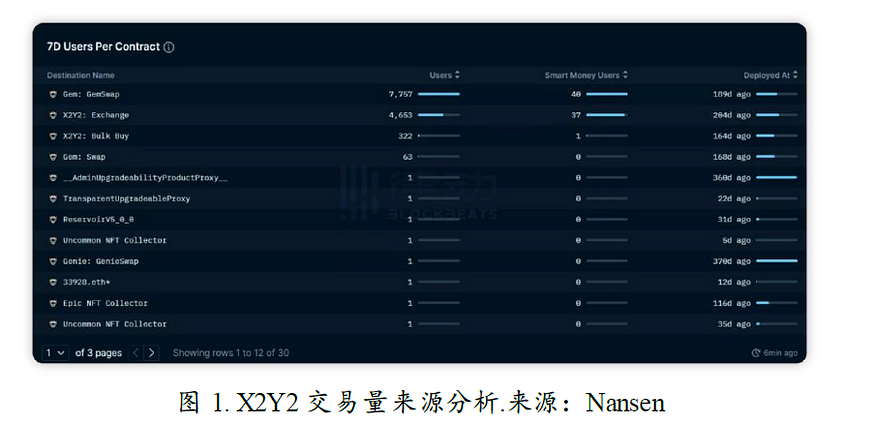
Before June 2022, various NFT transaction aggregators appeared on the market. The emergence of the aggregator variable smoothed out the information gap between pending orders on various trading platforms, enabling X2Y2 to gain a considerable market share with low transaction fees. According to nansen data, most of the current X2Y2 user transactions come from the NFT aggregator Gem. It is no exaggeration to say that the aggregator is the "handleman" to ensure the X2Y2 transaction volume.
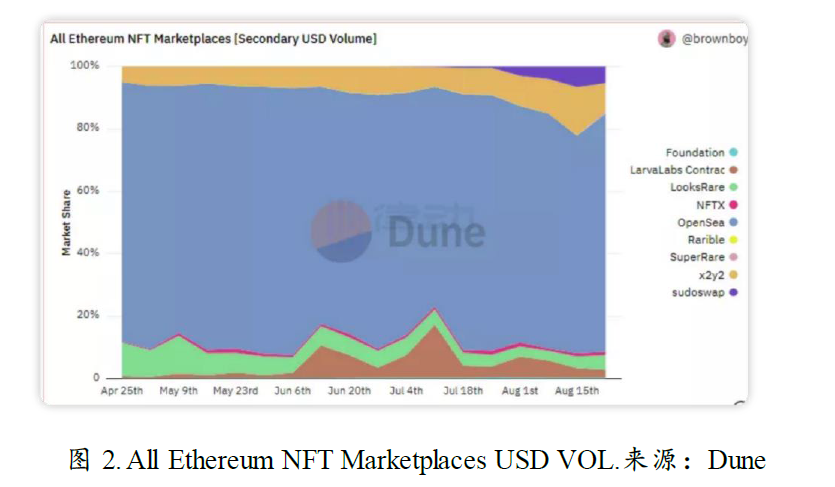
In July 2022, sudoswap went online and quickly seized the market by relying on low transaction fees and zero royalties. According to Dune data, sudoswap accounted for 5.3% of the total NFT trading volume in the third week of August 2022, x2y2 It is 8.7%. It can be seen that sudoswap has almost approached x2y2 in less than two months, seizing the share of x2y2.
In the early morning of August 26, 2022, sudoswap was quietly integrated into the gem trading platform, enabling the gem platform to have the function of purchasing NFT with 0 royalties. Many NFT collections (including blue-chip projects such as Azuki and Penguin) are hung on sudoswap instead of X2Y2. This "handle" of X2Y2 was slightly taken away by sudo.
This feature allows platform users to choose the royalties (100%, 50% or 0%) they want to pay for their contribution to the NFT project. When users choose to pay 50% or 0%, it means that half or all of the royalties will be is returned to the buyer.
The big V "Sister P" who followed NFT publicly opposed the cancellation of royalties on the Internet, and some project parties even threatened to cancel the follow-up airdrops and other benefits for users who purchased NFT from X2Y2. Supporters believe that the royalties "robbed" the profits that should have belonged to NFT traders, which are additional and unnecessary expenses. At the same time, royalties should not be paid to those project parties that are soft rug (soft run), if the project party If you don't do things, then you shouldn't continue to enjoy royalties. All of a sudden, the creator economy that originally created a win-win situation turned into a zero-sum game of life and death, and a fierce battle over NFT royalty reform triggered by the NFT market kicked off.
first level title
2. Analysis of the views of all parties in the royalty dispute
The author has observed the reaction of all parties in the market to this royalty reform. Generally speaking, it can be divided into four camps: ordinary NFT users, NFT trading markets (such as X2Y2, etc.), NFT KOL big V and project parties/artists. As far as trading platforms are concerned, almost all trading platforms support the cancellation of royalties or user-defined royalties. The cancellation of royalties on trading platforms is the same as the original intention of canceling transaction fees on FT trading platforms (various exchanges) recently. Attract more new users and increase transaction volume. On the contrary, project parties and artists think that zero royalties are a kind of retrogression, a kind of exploitation, and an insurmountable red line. They claim to be the guardians of the NFT ecology, and believe that the culture of supporting royalties is the same as tipping culture and must be followed.
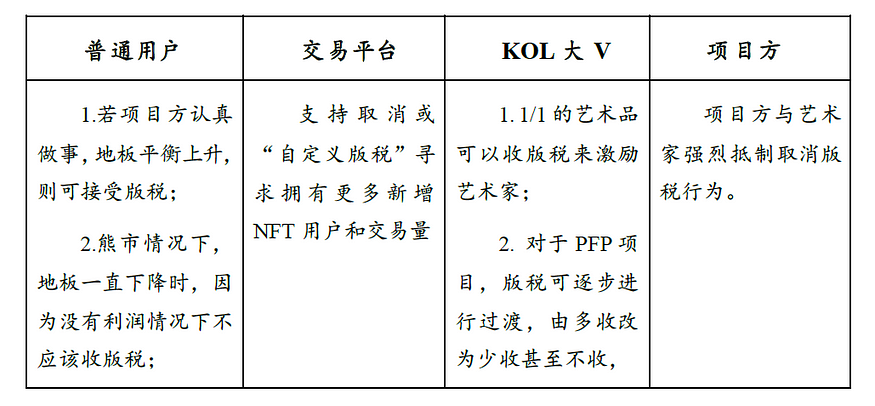
For KOL (NFT big V), its views are relatively dialectical. Some KOL groups suggest that the royalty reform can be carried out step by step, with a "soft landing". For example, for 1/1 of the works of art, it supports the collection of royalties to stimulate the creation of artists, and for other categories of projects, there are different royalties reform plans. (For details, please refer to Chapter 4.) However, some KOLs disagree. For example, Punk6529, an NFT collector, compares royalties to tips, and believes that tipping is a social practice and a reward for waiters.
first level title
3. The underlying reasons for SudoSwap and X2Y2 canceling royalties
secondary title

3.1 SudoSwap — Instigator or Grant?
From the information disclosed by @0xmons, we can see that sudoswap was originally an over-the-counter trading platform released in April last year. Users can customize the order expiration time and designate any or specific buyers for transactions. At the very beginning, its transactions were completely free of transaction fees and royalties. In the early days, the people who used sudoswap were mainly OTC buyers and sellers. Most of them negotiated the price outside the market, and then used the sudo platform to specify the order time and specific buyers, mainly playing the card of safe transactions. This is similar to some OTC security trading platforms in the FT field, whose market transaction volume is extremely small, which is almost negligible compared with Opensea and others. It can be seen that royalties did not exist on the sudo platform at the very beginning. It can be said that sudoswap is the "initiator" of zero royalties.
After the emergence of the market-making mechanism sudoAMM, the trading logic of the platform has changed. The liquidity of the platform is that users can freely choose a price range to improve capital efficiency. sudoAMM provides users with linear and joint (linear + exponential) curves to facilitate NFT transactions. In order to have higher matching efficiency and better price discovery functions, the AMM mechanism must have relatively small slippage. Zero royalties and extremely low transaction fees are important conditions for achieving low slippage. Examples are as follows:
Assuming that the market price of a BAYC is 100E, the royalty is 5%, and both parties can accept 1% slippage, then
◆ Buyer: Set the purchase price between 100*(1–1%) and 100*(1+1%), that is, 99E-101E;
◆Seller: Set the selling price at (1+5%)*100*(1–1%) to (1+5%)*100*(1+1%), that is, 103.9E- 106E
It can be seen that the existence of royalties caused a large deviation by using the upper and lower thresholds of buyers and sellers. Sudoswap did not add the function of collecting royalties after the launch of the AMM mechanism, which is also one of the main considerations for the efficient operation of the system.
Here is also a small episode, that is, before sudoswap was integrated into the gem platform in the early morning of the 26th, in fact, its insiders had discussed with the gem company many times before that, but the gem platform originally thought that sudoswap did not integrate royalties in its front end because Insufficient labor and technical reasons, but in fact it is not the case. At the same time, when sudo was integrated into gem, it also communicated with Opensea and got permission from Opensea (everyone knows that Gem was acquired by Opensea, and the real boss behind it is Opensea). In other words, the integration of sudo into gem is also supported by the big project Fangda Capital.
In summary, the reasons for the existence of zero royalties on the sudoswap platform are as follows:
Before the SudoAMM mechanism, it was an over-the-counter OTC project with a very small transaction volume. It was a project ignored by the market, and its zero royalties naturally did not attract the attention of the market;
It has obtained the permission and support of Opensea, a large project party and a large investor.
In short, Sudoswap, formerly known as the over-the-counter OTC trading market, had zero royalties at the beginning, and was the "initiator" of NFT's zero royalties. After the SudoAMM mechanism, in order to improve matching efficiency and reduce slippage, NFT transactions do not consider Royalty is a matter of course.
secondary title
3.2 X2Y2 — Down the Donkey and Borrow Flowers to Present Buddha
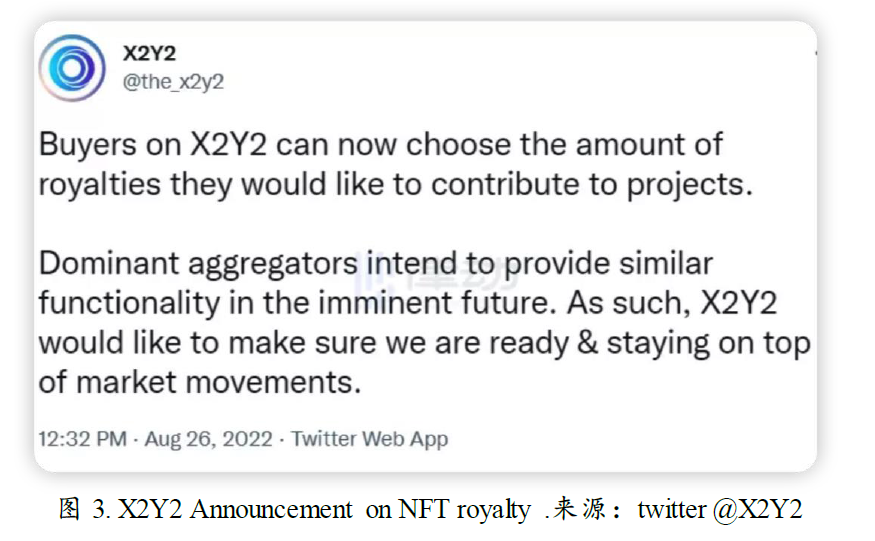
From the official tweet of X2Y2 at the end of August, we can see that there are two main reasons for the cancellation of royalties:
Serve users. That is to give users the right to choose how much royalty to give to the NFT project party;
Market fit. Claims that mainstream aggregators will offer similar functionality in the near future. So in order to ensure that X2Y2 can be prepared and grasp market trends.
In fact, we can know from the ferment process of the royalties incident in the first chapter that X2Y2 did not cancel the royalties in the early days. It was only at the end of August that this so-called "customized royalties" function was suddenly announced. Royalty abolished. The two reasons for X2Y2's official announcement are both morally high. One is to consider users, and the other is to cooperate with the market. In fact, in addition to the above two moral reasons, there are two hidden reasons that readers need to read. dig.
One is that after GEM integrated sudoswap, the floor price of a large number of popular projects (such as AZUKI, Penguin. See @GiancarloChaux's point of view in the picture below) was occupied by sudoswap, which greatly weakened the competitiveness of x2y2. The second is the bear market of NFT from June to August, and the transactions on major platforms are bleak. As a second-tier NFT trading platform, X2Y2 launched the so-called "user-defined function" at this time to seize a certain market share, and at the same time, there is a certain degree of hype hotspot. In short, thinking about the user is to say that it is borrowing flowers to offer Buddha, and following sudo to cater to the market is going downhill.
A summary is as follows:
2. The SudoAMM mechanism quickly squeezed X2Y2's market share in July and August with low transaction fees (0.5%, the same as the X2Y2 platform) and zero royalties;
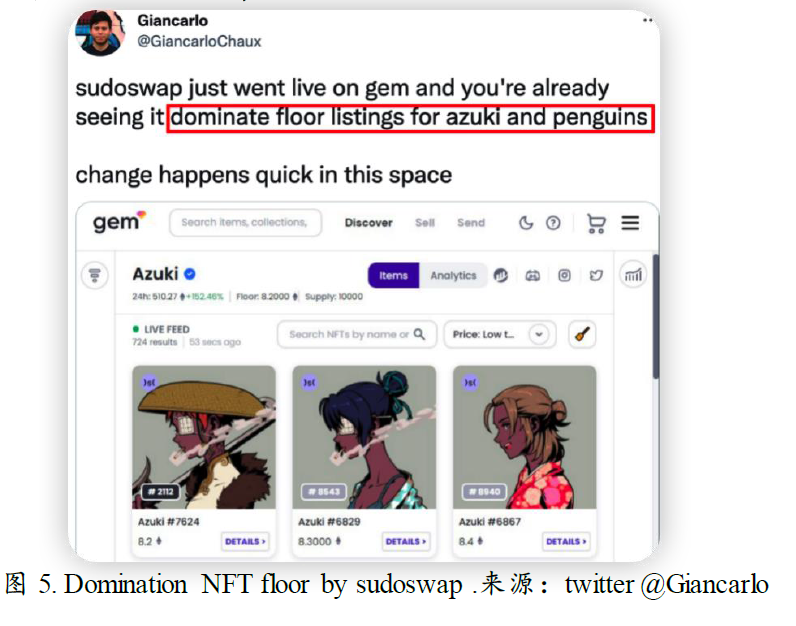
3. In this way, X2Y2 went downhill smoothly and launched the so-called custom royalty function "to meet market demand" within less than 10 hours after SUDO integration. It can not only improve the competitiveness in the bear market, but also have a certain spread effect, killing two birds with one stone.
first level title
4. Where does royalty reform go from here?
Judging from the context of the entire incident above and the games behind all parties, there seems to be an "impossible triangle" in the NFT market, which is the profit of NFT traders, the profit of NFT trading platforms, and the continuous incentives of creators/project parties , among the three, it is impossible to satisfy the demands of the three parties at the same time. Where will the NFT royalty reform go? Here are a few more discussed directions:
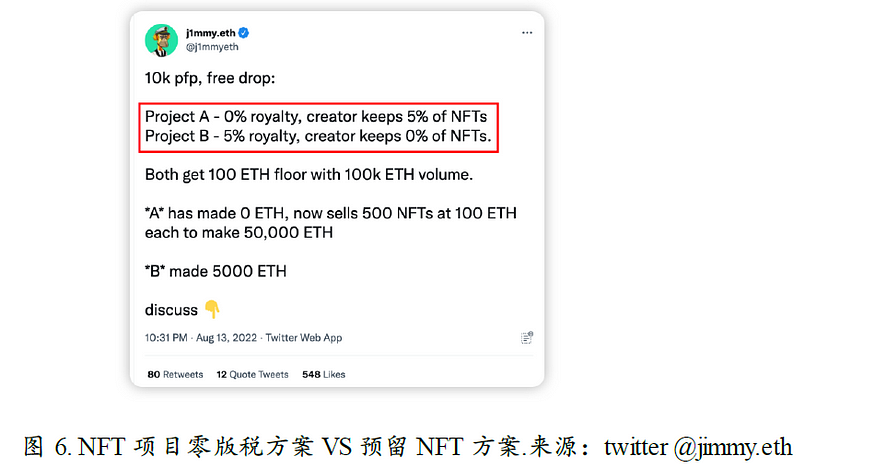
One is for the development of PFP projects. The royalty reform may develop in a direction from partial reliance on royalties to no reliance on royalties at all, that is, to achieve a "soft landing". Especially the PFP project of the 10K series. Because of PFP-type NFT projects, the issuer can first retain a part (such as 10%) of NFT, and then continue to empower the build to increase the value of NFT, which will make users and the project a win-win situation. For example, Project A and Project B in the figure below adopt two different schemes of 0 royalty + 5% NFT and 5% royalty + 0 NFT respectively.
Assuming that other external conditions are the same under the two schemes (such as the project party continues to build, empowers NFT, and has the same financial support in the early stage), under the royalty-free project, we see that the project party’s income is 50K ETH, which is greater than 5K ETH under the condition of collecting royalties. Therefore, the PFP project may try to transition from a "small royalty + partial NFT" scheme to a completely zero-royalty scheme.
The second is that for art 1/1 projects, which have condensed a lot of effort and energy of the artist, it is understandable to pay royalties for the NFT to support the artist's creation.
The third is for tool NFTs, which are essentially consumer goods rather than collectibles. The amount of royalties is small and will be gradually replaced by subscription fees or buyout fees, and the business model will be changed. Since the NFT floor price of tools is quite low and the quantity is also small (such as an NFT analysis platform OG Pass card), even if the project party retains a part of the NFT, its income cannot cover the cost of its build, and the chance of launching a new project is small . The share of tool NFT royalties is almost negligible and turned to charging users for subscription fees. For example, some Pass cards are charged annually and can be renewed upon expiration.
In general, the author believes that the problem of royalties should not be one-size-fits-all. The current step of NFT royalty reform may be a watershed for the NFT business model from rough to fine. The future development trend has the following relatively clear directions:
3. The content of the report is for reference only, and the conclusions and opinions in the report do not constitute any investment advice on relevant digital assets. Huobi Blockchain Research Institute shall not be liable for any losses arising from the use of the contents of this report, unless expressly stipulated by laws and regulations. Readers should not make investment decisions solely based on this report, nor should they lose the ability to make independent judgments based on this report.
About Huobi Research
Huobi Blockchain Application Research Institute (referred to as "Huobi Research Institute") was established in April 2016. Since March 2018, it has been committed to comprehensively expanding the research and exploration of various fields of blockchain, with a view to pan-blockchain As the research object, the research objectives are to accelerate the research and development of blockchain technology, promote the application of blockchain industry, and promote the ecological optimization of blockchain industry. The main research contents include industry trends, technical paths, application innovation, Pattern Exploration, etc. In line with the principles of public welfare, rigor, and innovation, Huobi Research Institute will carry out extensive and in-depth cooperation with governments, enterprises, universities and other institutions through various forms, and build a research platform covering the complete industrial chain of the blockchain. Industry professionals provide a solid theoretical foundation and trend judgment to promote the healthy and sustainable development of the entire blockchain industry.
contact us:
Consulting email: research@huobi.com
Official website:https://research.huobi.com/
Twitter: Huobi_Research
https://twitter.com/Huobi_Research
Medium: Huobi Research
https://medium.com/huobi-research
Telegram: Huobi Research
https://t.me/HuobiResearchOfficial
disclaimer
1. Huobi Blockchain Research Institute does not have any relationship with the projects or other third parties involved in this report that may affect the objectivity, independence, and impartiality of the report.
2. The materials and data cited in this report are all from compliant channels. The sources of the materials and data are considered reliable by Huobi Blockchain Research Institute, and necessary verifications have been carried out for their authenticity, accuracy and completeness , but Huobi Blockchain Research Institute does not make any guarantees about its authenticity, accuracy or completeness.
3. The content of the report is for reference only, and the conclusions and opinions in the report do not constitute any investment advice on relevant digital assets. Huobi Blockchain Research Institute shall not be liable for any losses arising from the use of the contents of this report, unless expressly stipulated by laws and regulations. Readers should not make investment decisions solely based on this report, nor should they lose the ability to make independent judgments based on this report.
4. The information, opinions and speculations contained in this report only reflect the judgment of the researchers on the date of finalizing this report. In the future, based on industry changes and updates of data information, there is a possibility of updating opinions and judgments.
5. The copyright of this report is only owned by Huobi Blockchain Research Institute. If you want to quote the content of this report, please indicate the source. Please let me know in advance if you need to quote a lot, and use it within the scope of permission. Under no circumstances shall any quotation, abridgement and modification contrary to the original intention be made to this report.