






In-depth interpretation of DID: Web3 enters the next stage of middleware


Original author: Calvin, Taihe Researcher
In 1807, after the defeat of the Danish Navy in Copenhagen, 90,000 oak trees were planted in order to rebuild the Navy and make up for the losses.
In 2007, the Danish Nature Agency, the successor to the Royal Forestry Commissioner of Denmark, informed the Danish Ministry of Defense that 90,000 oak trees were ready for the rebuilding of the Navy.
The world is always changing faster than we expect.
In 1807, after the defeat of the Danish navy in Copenhagen, 90,000 oak trees were planted in order to rebuild the navy and supplement the losses.
In 2007, the Danish Nature Agency, the successor to the Royal Forestry Service, informed the Danish Ministry of Defense that 90,000 oak trees were ready to rebuild the navy.
The world is always changing faster than we expect.
During the last round of DeFi summer, with the speculative upsurge of liquidity mining, Defi was very hot. At the peak, some people even asked "How can the DeFi protocol withstand the influx of millions of users?"
In hindsight, the question seemed simplistic and naive. The fundamental reason is that finance always belongs to the underlying facilities, and those who really care about and participate in it belong to a small number of people in the world, perhaps only tens of thousands of people.
The last round of Defi summer has already verified this problem. Most of the participants are "encrypted natives". Although there is a large influx of funds, they mainly come from funds and giants, not common C-end users.
In general, DeFi belongs to infrastructure. Even if speculative factors are taken into account, the number of people interested in it is by no means the majority. This means that expanding the boundaries of the blockchain with DeFi as the ecological core will one day Reach the limit.
DeFi still has a threshold, and it will not be directly oriented to users in the future, because our on-chain activities have been completely dependent on "enthusiasts" since 2018. But ordinary users are more likely to interact with DeFi through mobile wallets as infrastructure in the future rather than directly.
DeFi will continue to shine, but it will be used as an infrastructure, as the "root" of this big tree. In the future, it will depend on applications, social networking and entertainment to expand Web3 players and conquer the world.
Under the assumption of this conjecture, DID, as an essential component of social and entertainment, will also become a middleware for large-scale applications, a bit like Chainlink in the previous stage for Defi.
This article only talks about two things, the current status of DID development and the conjecture of future development.
Current status of DID (original short ID)
The concept of the macro DID is very broad: it includes the explicit tags formed by the collection of all chains, and in the future it will even include off-chain identity verification on-chain, forming on-chain identities, etc.
At present, we have reduced the long public key to a human-readable address name, which is also the most superficial thing of DID, but it carries the things of DID entrance; the threshold is very low but the ecological card position is very important:
The ETH ecology has ENS, with a registration volume of about 2 million;
The Solana ecosystem has Bonfida, with about 200,000 registrations;
Avalanche has Avvy Domains with about 10,000 registrations;
Polkadot has Polkadot Name System (PNS), with a registration volume of about 15,000;
ICP has ICNS and IC Naming;
BSC has a SPACE ID;
FLOW has flowns:
Cosmos has EVNS, and all cosmos public chains may use this domain name system.
The cross-chain DID domain name project also includes:
.bit, in addition to ETH, supports polygon, TRON, BSC, etc.;
Unipass, the project update is obviously very old, and it is still on the way to support Terra.
The homogeneity of this type of project is very serious. It is essentially a ledger system between short domain names and public keys. There is no technical content but the ecological card position is very important.
SpruceID
Expansion of auxiliary domain names, such as SpruceID, which helps web3 users log in to web2 websites directly with on-chain identities. This project was led by a16z. At that time, ENS and the ETH Foundation made a tender to uniformly use ENS addresses to log in to web2 websites, and set a The protocol standard, that is, Spruce won the bid, and has a good relationship with ENS, and drafted the ETH DID protocol together.
Ceramic
DID also has a key component called the data layer.
We have talked about web3 before, one of the most important characteristics is that the protocol layer does not own data, and the data is collected and fused here by the user. DID can even be said to be an information bridge between various protocol layers.
From the Defi composability brought about by the BTC asset itself, we can understand the data composability after the data is owned by itself.
Compared with traditional finance, DeFi does not require permission and has no entry threshold. Assets can be transferred between multiple platforms at the same time. The platform does not touch user assets, and user assets can be transferred between different platforms. For example, deposit certificates can be used for re-pledging.
A fat asset layer and a thin platform layer are formed, and the platform layers can combine network effects with each other.
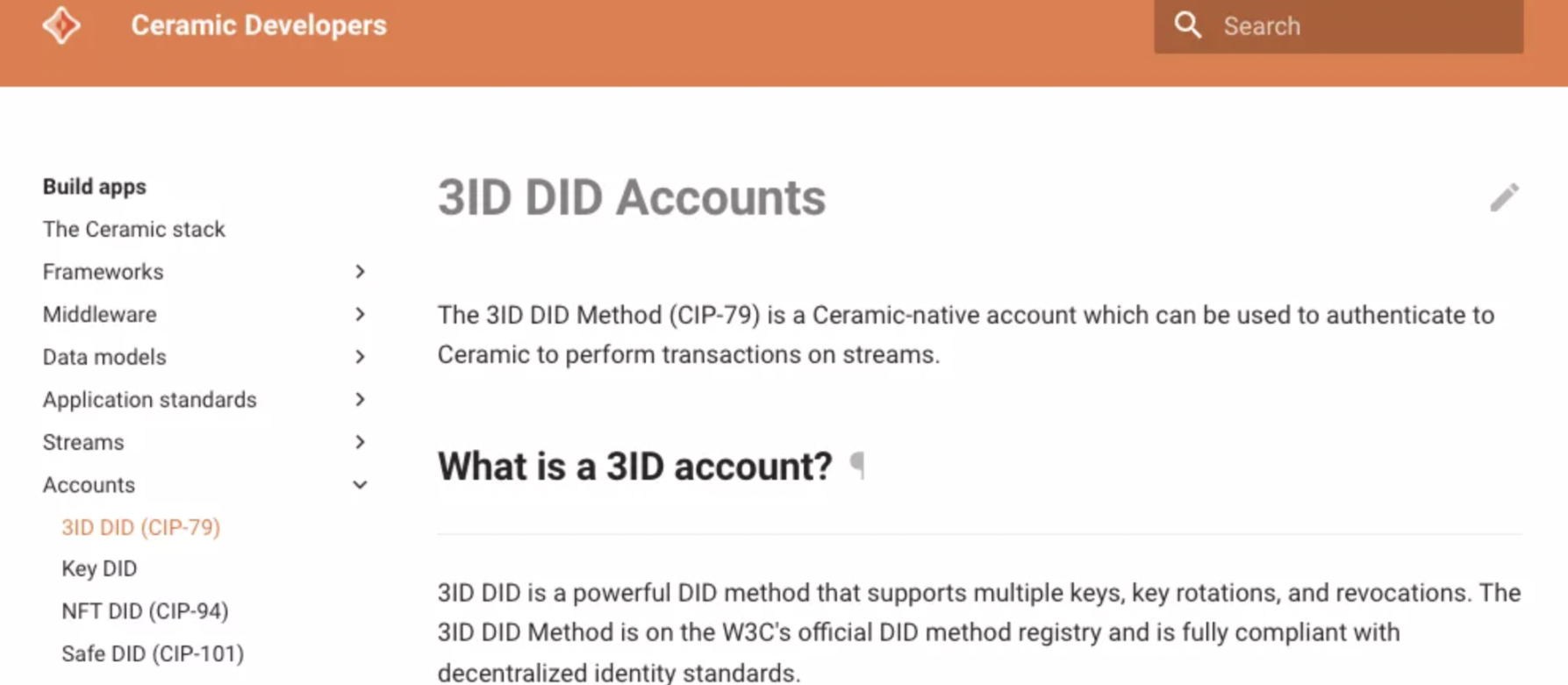
Then the adhesive of the network effect formed by DID here needs to have a bearing place, which is Ceramic, where the data from each application is standardized.
So Ceramic can be said to be a data protocol specially designed for DID.
At present, many DID and Web3.0 social platform projects have been developed on Ceramic, such as CyberConnect, Web3.0 Twitter's Orbis, instant messaging platform The Convo Space, etc.
Tabbed DID
What Project Galaxy (now renamed GALXE) wants to do is to use the user's information on the chain as an information anchor. For example, if AAVE borrows more than a certain amount, it will issue a "badge", or label it; Uni transactions reach a certain amount. A "badge" is issued and labeled.
The advantage of going this way is that this person is covered by labels, and it is easy to portray the image, so that other applications will give users a thick line, and airdrops are at least more accurate than they are now.
We can see that different infrastructures are solving the problem of user identity portraits from various directions. The data represented by GRT is fully crawled (coarse), and then curators are asked to create data sets and then use them for applications, but everyone It is obviously unrealistic to hand over all the data to the curator for display.
Ceramic is the representative of classifying and modularizing the data of each application, and automatically (because the data model is unified) to make user data portraits, which is convenient for calling between different applications.
The representative application of Galxe is to use NFT to tag users, draw a thick line, so that users can be easily classified and roughly screened.
DID future development imagination - development history
According to the situation of various DID projects or self-proclaimed DID track projects, the author can see that DID is still in the exploratory stage, and is still in the early stages of development. Even in the form of web3, DID is a surface entrance or an underlying infrastructure. Each is different.
But one thing has become more and more clear in the research. DID is very likely to be the entry component of Web3. Referring to the history of the development of the Internet, it is a game in which bubbles burst and then survive. After each cycle, they can survive. It must be the last survivor, and the market will naturally concentrate the traffic.
Just like a search engine in the Web2 era, DID will become an entry-level application in Web 3.
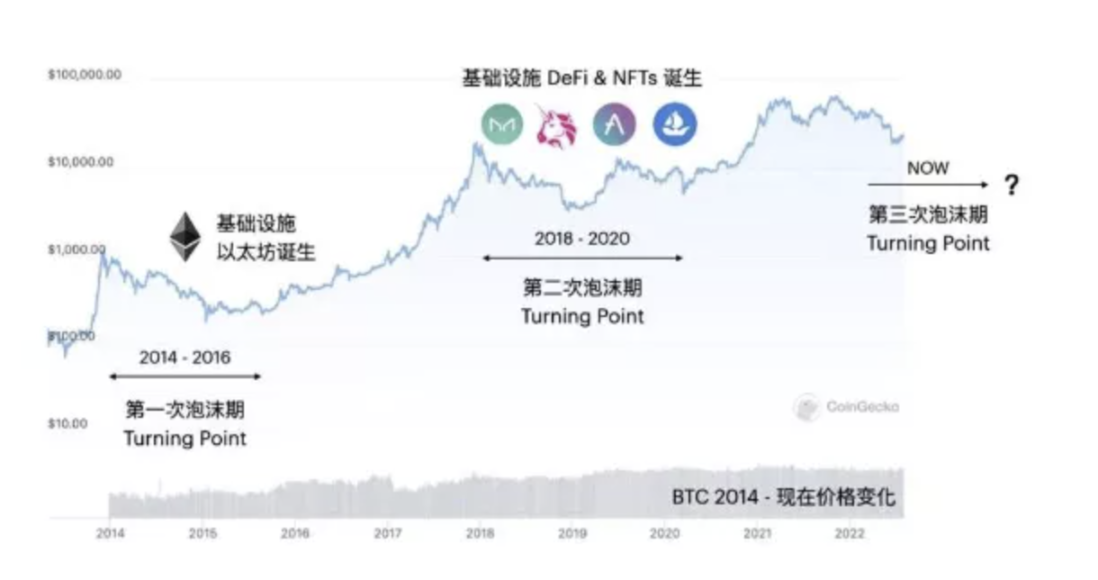
In the future, everyone will have a DID, which can pass through the entire Web3, and even with the development of DID, there will be regional DIDs, such as game DID for games, and social DID for social interaction.
In the future, a much more powerful application than the current wallet will appear on the DID track to manage your own on-chain identity, on-chain activities, and even on-chain assets.
The application will be connected with all the infrastructure on the chain, and even become a bridge from web2 to Web3, a bit like Chainlink for DeFi.
Let's take a look at Chainlink first. What he does is just an oracle machine, but based on the continuous extension of basic services, it touches multiple sectors of current blockchain applications.
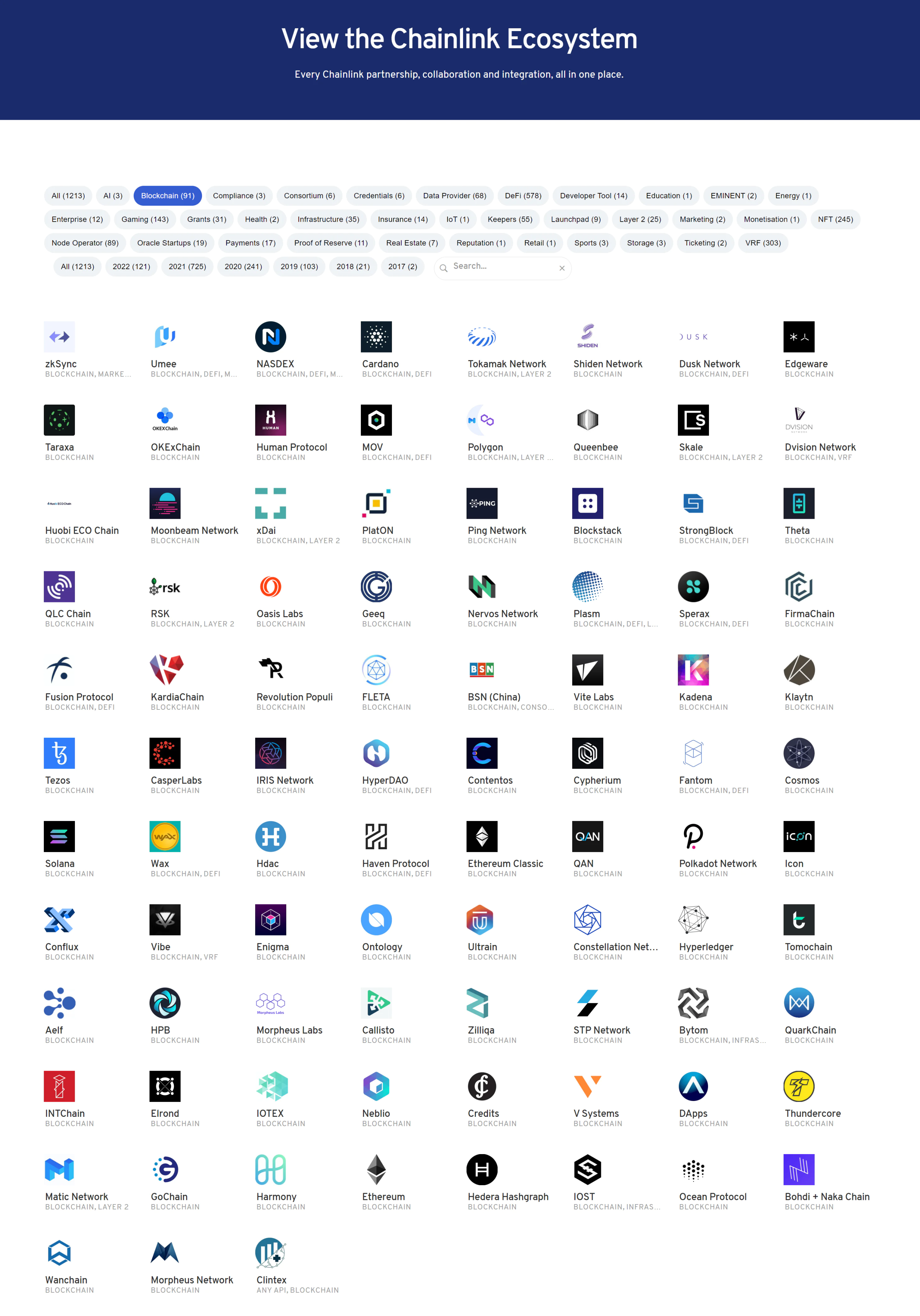
As of now, Chainlink has provided services for 1213 projects, including 578 DeFi projects, 143 game projects and 91 public chain projects.
The initial service provided by Chainlink is only to help data that cannot be obtained on the chain. Although smart contracts allow trusted transactions without a third party, making transactions traceable and irreversible, they cannot be linked to data outside the blockchain. A direct connection occurs (such as the acquisition and call of external data, etc.), so an external Turing machine is required to write the data into the blockchain or distributed ledger.
It acts as a bridge between the data source API interface, so as to realize the connection between the blockchain interface and the external data API interface, and this Turing machine is the oracle machine (Oracle).
With the expansion and prosperity of this blockchain application, Chainlink has developed multiple services from the original oracle service, such as generating random numbers for games and NFT applications; providing quotations for NFT floor prices; off-chain calculations, fair sorting, There are even cross-chain services.
Since there are a large number of smart contract use cases that require access to oracles, deploying Chainlink to new blockchain environments will provide on-chain developers with the critical infrastructure needed to develop applications.
In 2021, the blockchain also experienced the spillover effect of ETH, and multiple public chains began to develop their own ecology. At this time, an infrastructure that can provide secure data sources on the chain is needed to attract mature Defi protocols, such as Aave\xDollar Waiting for deployment on it, Chainlink relied on its position as the leading oracle machine to be even more sought after during this period. The requirements for the safety and reliability of the oracle machine made Chainlink's "Matthew Effect" continue to expand.
Chainlink is connected to many top L1 blockchains and L2 scaling solutions, including Arbitrum, Avalanche, BNB Chain, Ethereum, Fantom, Harmony, Heco, Moonriver, Optimism, Polygon, Starkware, and xDai.
Will DID, which is closely related to data, replicate the old way of Chainlink? It seems that the two are very similar, both are simple but basic on-chain data services, with high requirements for security and reliability, and traffic tends to gather at the head.
Although DID is also a kind of data service, the path it solves is completely different from that of Chainlink. Currently, the on-chain data of the blockchain is based on the non-tamperable property of the blockchain. To prove that wallet address A has indeed transferred money to wallet address B, you only need to check the corresponding information on the chain, and do not need a certain application or institution to issue a certificate.
However, this kind of credential-free trust data has limitations for identity information. The establishment of identity information depends on the institution that issues the identity.
Based on the management and transmission of user identity information, DID is an essential component for users to process their own activities on the chain. It can be divided into DID user information collection and DID user identity distribution.
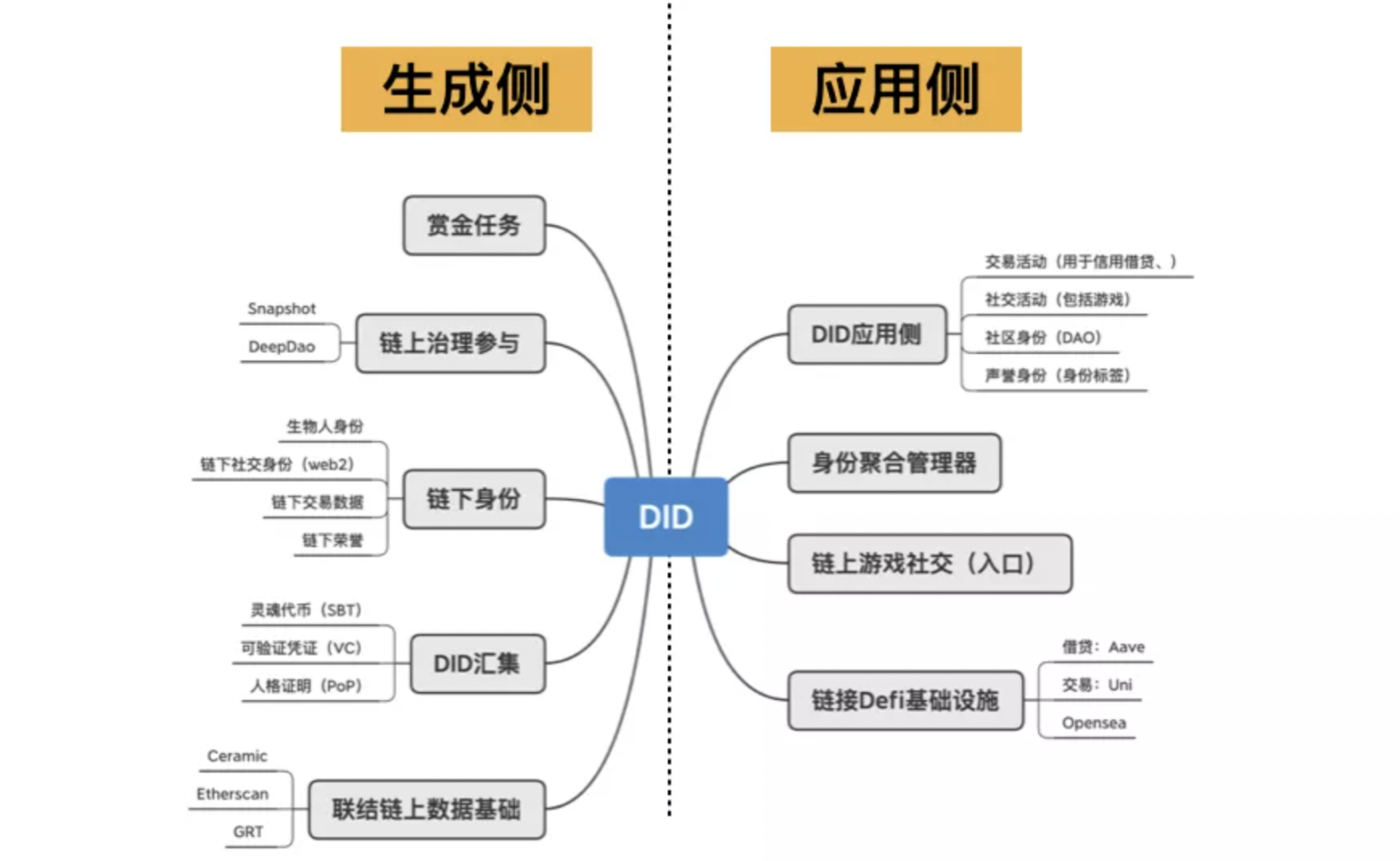
Since DID controls the key for users to enter each sector, it is very easy to form a super application of the ecological hub. The popularization of AA technology and L2 technology means that the evolution direction of the blockchain has gradually shifted from focusing on "infrastructure" to looking for " super app".
Because the "super application" bundled with previous technical limitations is likely to explode in the next stage, the application will inherit multiple identity management protocols, as well as the basic DeFi protocol, etc., and users can achieve high-frequency on-chain operations within this application , trading tokens, trading NFTs, publishing news updates, displaying relationship graphs and user portraits, etc.
DID is very likely to become the entrance of web 3 in the form of "smart contract account". At present, we regard "Metamask" as the entrance of web 3, which is completely insufficient in demand. After the influx of low-threshold people, we need a A comprehensive "entrance", which is similar to Google in the web2 era.
However, DID still has many problems that need to be solved urgently. For example, if DID gathers all the information of a person, then data privacy and security are particularly important. Will there be large-scale data leakage and threats; currently, the identities issued by various protocols have no Uniformity, there is no uniformity in the behavior on the chain, it is difficult to achieve large-scale identity management; the speculative nature of the current social entertainment and other applications on the chain is constantly weakening, and the loss of personnel represents the disappearance of the soil of DID's continuous trial and error.
Original link





