






One article sorts out the nine major directions and representative projects of Web3 identity


Author: Kerman Kohli
Original compilation: aididiaojp.eth, Foresight News
Author: Kerman Kohli
Original compilation: aididiaojp.eth, Foresight News
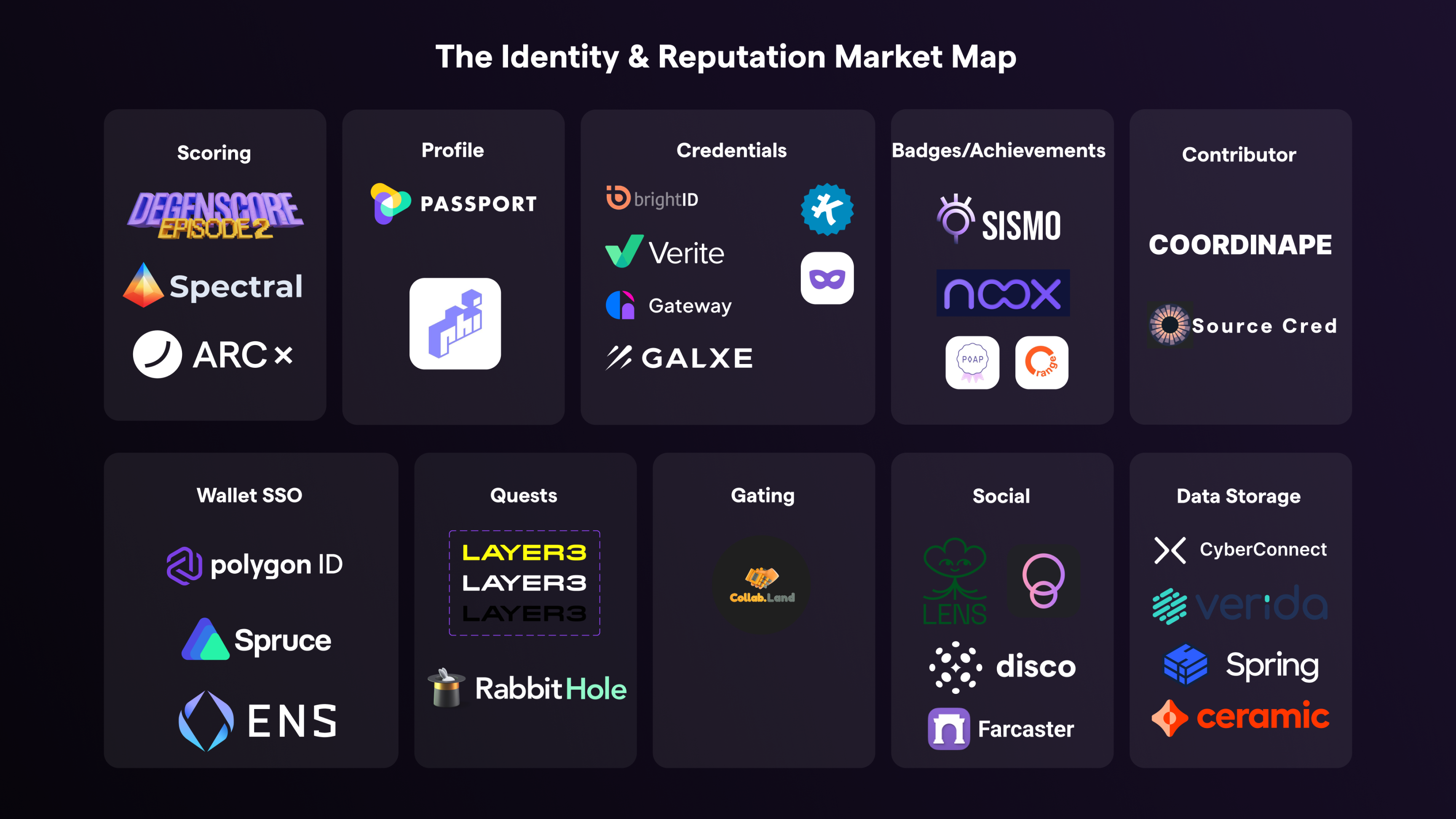
This article lists the different domains related to on-chain identity and outlines representative projects in each domain.
badge
On-chain badges are the most common category, tokens or NFTs earned by completing on-chain or off-chain tasks. The following startups fall into this category:
Sismo is a modular proof protocol featuring decentralization, privacy, and ease of use. It issues proof badges in the form of non-transferable tokens or soul-bound tokens, and the protocol runs on Polygon.
POAP is a protocol for preserving memories as digital records, minted as NFT tokens on the blockchain according to the ERC-721 standard.
Orange Protocol is a reputation and trust casting protocol that aggregates data and Web3 reputation models to generate systematic proof of reputation in the form of verifiable credentials and NFTs.
Noox is a minting platform that can mint on-chain achievements as soul-bound NFTs.
proof on chain
In contrast to on-chain badges, on-chain proofs typically require a third-party entity to verify the authenticity of the information. Anyone can prove the authenticity of on-chain identities through KYC details, such as a certified software engineer. There is a lot to like in the certification space, and each startup tries to approach it from a different angle:
Galxe is a Web3 credential data network that enables brands and developers to participate in the community and build powerful products in Web3.
BrightID is a decentralized open-source social identity network that allows people to prove the authenticity of their personal accounts to applications.
Gateway is a Web3 credential network that creates proof of a user's work and abilities and builds a Web3 on-chain resume.
Zorro is a Web3 citizenship system that helps users authenticate to gain DAO voting rights and other benefits.
Verite is a protocol and open-source software built with a data model that links identity proofs to crypto-financial experiences.
Krebit is a reputation scoring platform that provides fully decentralized, community-validated on-chain credentials.
Personal profile
Gitcoin Paspport is a digital ID that uses verifiable credentials to confirm identity from the Internet without storing personally identifiable information.
social contact
Phi is able to visualize on-chain identities and build metaverse digital identity systems based on common web3 facilities such as ENS domain names or wallet activity.
social contact
Perhaps one of the most popular categories in recent months is social, which is a social media network or platform based on a person's address. The deplatforming of creators has prompted many to rethink Web2 social networking. It's still a small category right now, but one that's worth looking forward to.
Lens Protocol is a composable decentralized social graph for creators.
Farcaster is an open decentralized social network that supports multiple clients.
Orbis is a set of social data models that combine with a decentralized infrastructure, featuring an advanced SDK and flexible modules to provide a fully composable social experience.
Disco is a profile system and data backpack that exposes profiles in social media accounts and Web3 credentials.
sign in
Replacing internet login processes like email logins or password registrations is probably one of the biggest contributions the crypto industry has made in changing the fundamental structure of the internet. Startups in these categories help improve the user experience of single sign-on authentication and the infrastructure around it.
Spruce is a decentralized identity toolkit consisting of DIDkit, Rabase, Keylink and Credible, which supports signing, sharing and verifying trusted information.
ENS is a distributed, open and scalable domain name system based on the Ethereum blockchain.
PolygonID is a blockchain-native identity system with programmable privacy, providing on-chain verification and permissionless proofs.
On-chain evaluation and tracking
On-chain evaluation and tracking is a category that is technically harder to implement, but also expands the design space for application types. On-chain evaluation and tracking is the continuous computation of large data sets to evaluate scores or properties for users about their wallets. This category is dynamic and has more use cases than the static badges and achievements. On-chain tracking can understand where your users come from and how valuable they are to you.
Degen Score is a scoring protocol that scores users based on their on-chain history.
Tasks and User Acquisition
Spectral is a credit scoring protocol that uses on-chain transaction data to calculate your credit score.
Tasks and User Acquisition
Layer3 is a protocol that hosts tasks in the form of bounties for Web3 tasks such as sending tokens on a polygon, or even lending.
contributor
Rabbit Hole is an on-chain achievement system that rewards you for completing Web3 tasks. The project will publish tasks on the platform, but cooperate with Rabbit Hole to distribute its tokens to users who have proven their value.
contributor
Coordinape is a scalable and permissionless platform built for DAOs for decentralized reward distribution.
store
Source Cred is a DAO or open source community governance tool that measures and rewards value creation.
store
Due to the diversity of information available, storage is a key component around data sovereignty and decentralization. It is also technically very challenging because it combines the consensus problem with a larger dataset. There are currently several teams actively working on some workarounds.
Cyber Connect is a decentralized social graph protocol that returns data ownership to users and helps developers build web3 social applications.
Verida is a multi-chain protocol for interoperable database storage and messaging built on decentralized identity, where personal data is owned and controlled by users.
summary
This article outlines each category of on-chain identity and reputation and represents projects, a dynamic space with many teams and protocols working on many different problems.


