Weekly Brief: Storage technology is penetrating, dynamic data processing and storage



first level title
Storage technology is penetrating: dynamic data processing and storage
The explosion of various Web3 applications is greatly increasing the demand for decentralized storage.
Web3 emphasizes data, social interaction, identity, etc., and builds a general storage layer and a general structure layer. How decentralized storage can be integrated and penetrated into various application scenarios and DApps will be an important focus of the storage track.
However, putting all content into Web3 native programs usually requires high cost and complex design; under this storage logic, NFT projects usually use storage providers such as IPFS to ensure that their metadata is open, accessible, but immutable. "Immutable" leads to limited experience, because metadata itself cannot be "mutated", and it is not easy to query or combine.
Infrastructure and protocols capable of dynamic data processing are addressing such problems.
Since the development of the storage track, many types of storage and computing solutions have emerged to adapt to different application scenarios. Decentralized storage can be roughly divided into two modes: static storage and dynamic storage. Pure static solutions can be regarded as early Filecoin, Arweave protocols, etc., and pure dynamic solutions such as Dfinity.
Cold storage corresponds to static data, such as videos, pictures, or documents; but for hot storage of dynamic data, such as games, dynamic web pages, etc., the advantages of decentralized storage technology have not emerged.
In practical applications, a person's reputation score, social graph, game play, etc. all need to be updated and called at any time. The outbreak of NFT, GameFi and other upsurges in the last cycle has triggered a further expansion of the market's demand for dynamic storage.
Taking the NFT field as an example, NFTs for sale may choose static storage first, while interactive ones may choose dynamic storage solutions; GameFi is another typical scenario that requires dynamic storage. Layer, storage redundancy layer considerations, put in a variety of storage solutions.
From infrastructure to middleware, some representative projects shed light:
Subspace:
secondary title
Subspace Network is an open, scalable, Layer0-based storage and computing network that is fully interoperable with Layer1. It is designed to achieve Internet-scale, scalable on-chain storage and computing, supporting thousands of shards, millions of transactions per second, and storing EB-level data on the chain.
Subspace draws on the PoC (Proof of Capacity) mechanism and the PoA (Proof of Access) consensus mechanism and innovates it. Through the PoAS (Proof of Archival Storage) consensus mechanism to encourage miners to cooperate with each other to store historical block data, Subspace sets up Storage Farmers and Staked Executors two structures:
Storage Famers are responsible for storing data, confirming content, and operating based on Layer 1;
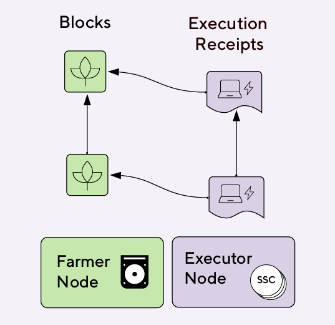
Staked Executors are responsible for computing and undertaking light node tasks. Runs on Layer2 layer.
The network provides low-cost, permanent, and scalable decentralized storage through the above mechanisms. Among them, Executors have computing and state management capabilities, and can perform hot storage (dynamic storage) to realize more advanced functions of the database and provide a general data layer for DApp.
Subspace can provide infrastructure for specific application scenarios such as archival storage, computing storage, data availability, and cross-chain in the Web3 ecosystem.
Ceramic
secondary title
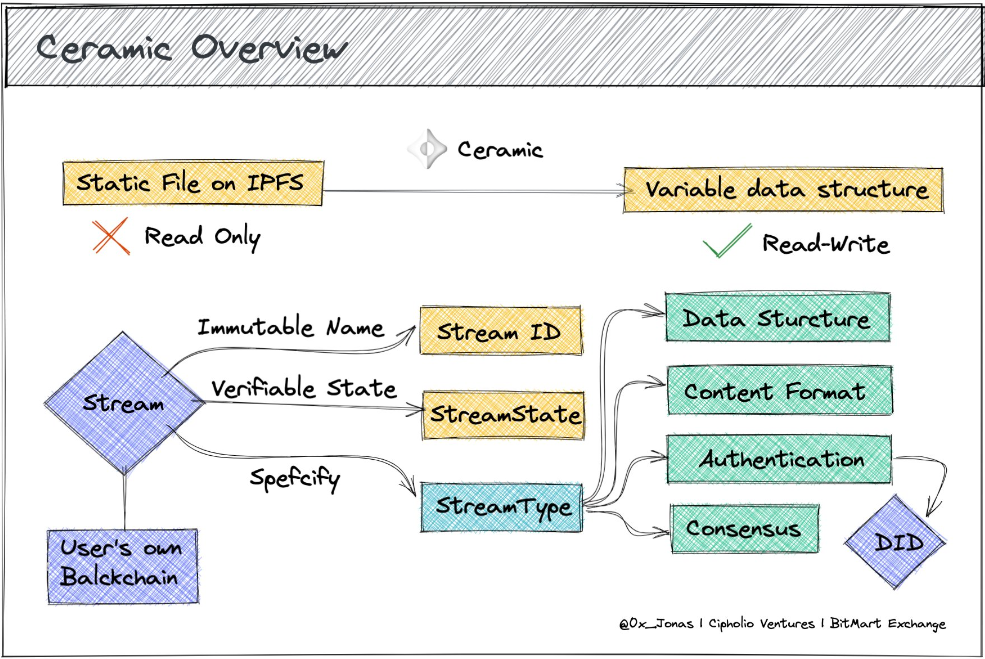
Ceramic Network is developed based on IPFS and aims to provide computation, state transition and consensus synchronization for all types of data structures stored on the decentralized network. Ceramic's dataflow process enables developers to build Dapps based on dynamic information without a trusted database server.
At the same time, Ceramic also provides an embedded authentication mechanism and a cross-chain identity protocol.
Tableland
secondary title
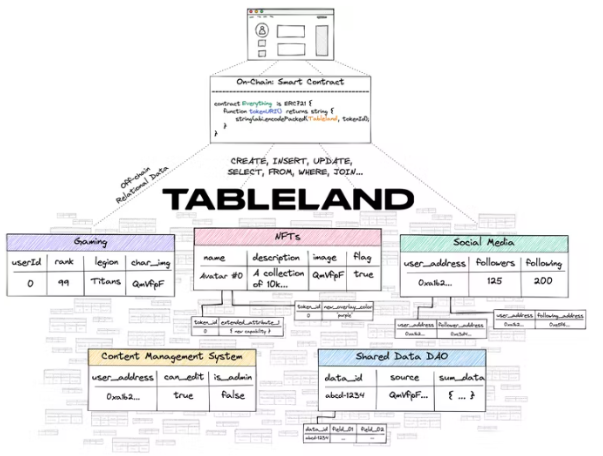
Tableland has built a decentralized structured relational data protocol (decentralized protocol for structured relational data) to better support the dynamic changes (mutable metadata) of structured data in Web3 applications (game / NFT / DAO).
Tableland is designed as a middle layer to call the decentralized database, so that the source data can be changed (mutatable), structured query (simple as SQL) and combined (composable with other tables on Tableland), while reducing the three aspects threshold. Through Tableland, metadata can be modified, access control can be used if required, can also be queried using the more familiar SQL, and can be combined with other tables on Tableland.
first level title
Primary market investment dynamics
Primary market investment dynamics
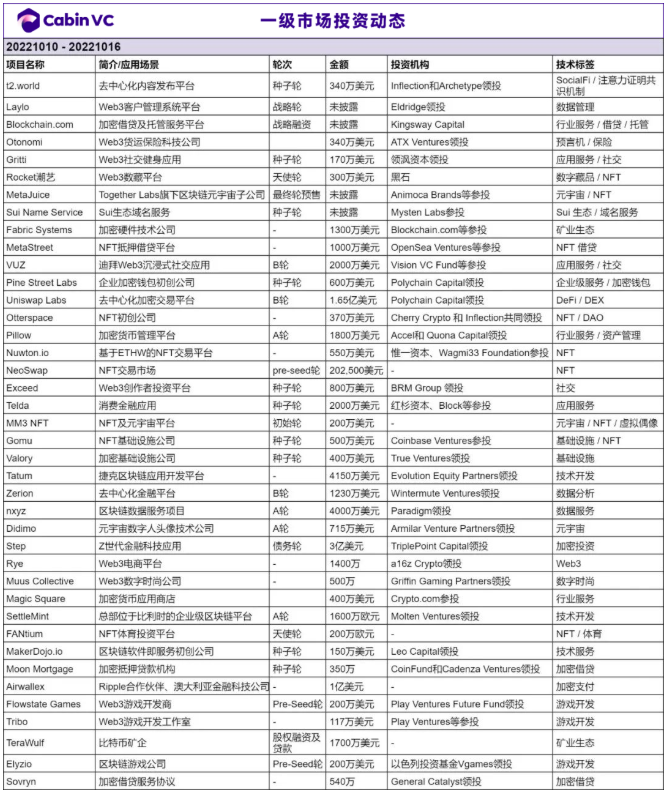
There were more than 40 financing events in the industry announced last week, and the total disclosed financing exceeded US$848.42 million. Last week, the fields with a large number of investments included infrastructure, security services, and data analysis platforms, with 9 financing incidents. There were 8 rounds of financing in the NFT and metaverse fields, and the heat was heating up. Chain Game Track announced 4 financings, focusing on game development. Among them, mobile game developer Homa completed a US$100 million Series B financing, led by Quadrille Capital and Headline.