






Magic Eden supports zero royalties, what does it mean for the Solana NFT ecosystem?


This article comes from diamondappThis article comes from

Solana , the original author: nader & Andrew Hayward, compiled by Odaily translator Katie Koo.
NFT marketplace Magic Eden recently announced that it will no longer support Solana’s NFT royalties. The move may come under recent pressure, as other "zero-royalty" competitors have taken away Magic Eden's market share.
Why does Magic Eden do this? Perhaps the more critical question is, why does Magic Eden have to do this? Let's analyze what choosing "Zero Royalty" means for the Solana ecosystem.
secondary title
Why "Zero Royalty" is not a good option?
The first thing to figure out is who benefits the royalties in NFT transactions. For most artists, royalties are the main way they make money from NFT collectibles.
The current NFT market situation is not good for artists. Anyone who started an NFT collectible line on Solana is now without a major source of income. Those who launched "mint-free" collections in the hope that royalties would cover their losses were particularly affected.
secondary title
Why would Magic Eden do this?Actually Magic Eden doesn't have much choice in this matter.When an artist mints an NFT on Magic Eden, there's nothing stopping other lower-tier marketplaces from allowing buyers to transact without royalties (sounds like vicious competition).
This is because NFT royalties on Solana are not enforced at the protocol level, as we explain in the next section.
For example, suppose you create an NFT series on Magic Eden and configure a 15% royalty. Let's say 10,000 people mint your NFT, which means the NFT is distributed to their Solana wallets. All of these buyers now have a choice: they can sell their NFTs on Magic Eden, which will charge an additional 15% royalty, or they can also issue them on other lower-level NFT marketplaces, which will completely ignore royalties.
But since the Solana NFT ecosystem is more competitive than the Ethereum NFT ecosystem, sellers seem eager to list on other platforms, forcing Magic Eden to believe it can't remain competitive unless it also ignores artists' royalties. Competition will lead to a decrease in the quality of NFTs (artistic aspects) across the ecosystem.
secondary title
Why is this a problem for the Solana ecosystem?
As discussed in the previous section, royalties cannot be sustained by Magic Eden, nor is it possible for any Solana NFT marketplace to sustain royalties. Because any marketplace that insists on royalties will immediately see their product move to another platform that ignores them.
This is largely due to Solana not enforcing royalties at the protocol level. In particular, if NFT auctions were hosted on-chain, rather than being run off-chain by each individual NFT marketplace as they are today, then fees could be enforced programmatically at the end of each auction.
Say you're a buyer of an NFT with a programmatically enforced on-chain commission of 15%. You can sell your NFT on-chain and each NFT marketplace will pick it up and list it, or you can choose to list it on a single market without on-chain broadcasting. If you put it on-chain, you get the real benefit of being automatically listed on all NFT marketplaces in the ecosystem. So more buyers are likely to choose it, even though it generates royalties.
Simply put, if Solana puts NFT auctions on-chain, it can enforce royalties programmatically at the protocol level, which prevents the "price war" playing field that NFT marketplaces like Magic Eden currently find themselves in.
secondary title
Why didn't Solana implement on-chain NFT auctions and royalties?
We refer to Solana as a finite-state blockchain, which means it is not designed to handle use cases that generate large amounts of data. For example, if all you want to do is transfer money back and forth, then you never need to store more than two account balances, and Solana can do that too.
However, if you want to sell something, accept a bid, cancel a bid, etc., each transaction generates new data that must be stored. This will significantly increase the cost per operation on Solana, from almost nothing to $0.27 per operation. What's more, you need to iterate over that data a lot to perform matching and things like that, and Solana isn't a good fit for that either.In other words, an NFT auction is an infinite state application where the data that needs to be stored and indexed grows infinitely with each transaction.So one explanation is that Solana eschewed this "zero-royalty" option because it was beyond its technical scope.
After all, if you have a thriving DeFi ecosystem, why risk disrupting it with an NFT experiment?
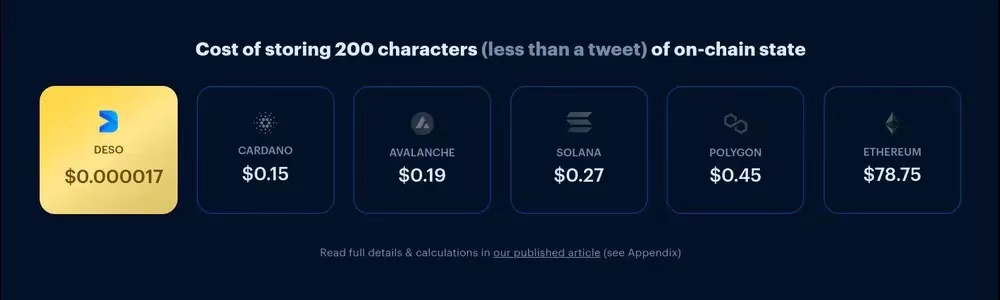
The graph below shows the cost of storing 200 characters of data for different blockchains:
The problem with this strategy is that while it does attract more talent to start building in the short term, it almost completely hurts the long term. You are destined to fall into one of two situations: either NFTs are completely concentrated in the hands of a single platform, as happened with Ethereum and OpenSea; capabilities, such as royalties.
secondary title
The Future of NFT Creators
secondary title
Reference reading:
Reference reading:


