The founder of Bankless talks to the Cosmos community OG: A comprehensive analysis of the core theory of Cosmos


Recently, the two co-founders of Bankless, Ryan Sean Adams and David Hoffman, and two OG Sunny Aggarwal and Zaki Manian from the Cosmos community started a conversation about the theory of Cosmos. In my opinion, this podcast is very interesting Yes, the two parties in the dialogue represented the Ethereum community and the Cosmos community respectively, and demonstrated the differences between the two ecologies.
In this podcast, they focus on the following topics:
The Core Theory of Cosmos
Ethereum VS Cosmos
Thoughts on monetary premium
Osmosis and the Liquidity Premium
Cosmos Ecological Stablecoin
L2 VS Cosmos
Cosmos VS Polkadot (Pokadot)
MEV Problems and Solutions
ATOM 2.0
Mesh & Interchain Security
The future of the universe
Since this podcast is about 2 hours long, a full transcript would be lengthy, so I've only drilled down some of the main points.
1. The core theory of Cosmos
According to Sunny Aggarwal's explanation, the Cosmos community believes that the future of the blockchain will not be dominated by a few blockchains, but that there will be a variety of blockchains, most of which belong to the application chain, just like the reality The world will not have one final settlement layer, the same is true in the blockchain world, we will have many settlement layers, each blockchain will be a settlement layer for its native assets, which gives them sovereignty, while Rollup or other systems will It does not have the sovereignty of the main chain. Generally speaking, the core theory of Cosmos is not to try to build a world computer like Ethereum, but to build various community computers and interconnect these computers.
Zaki Manian added that the emergence of Cosmos is to kill the fat protocol theory, and the core of the fat protocol theory is that the token of the underlying protocol of the blockchain will capture the value of the application built on it, and the protocol with network effects token will be the most valuable. On the contrary, the core theory of Cosmos believes that the layer that captures value should be the application layer, which is the layer closest to the user. Therefore, Cosmos has established some technology stacks to help developers build the best possible application layer.
2. Ethereum VS Cosmos
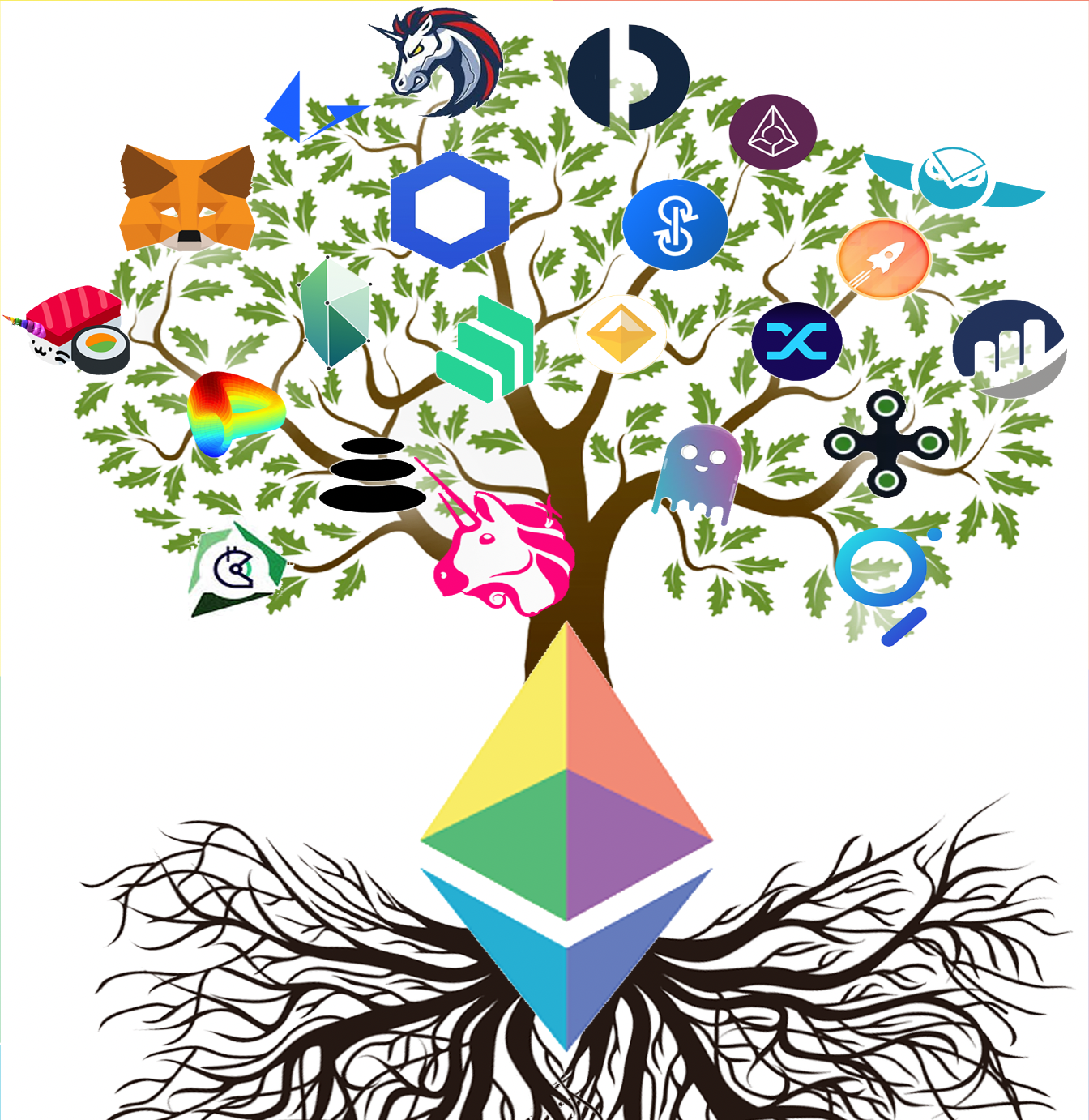
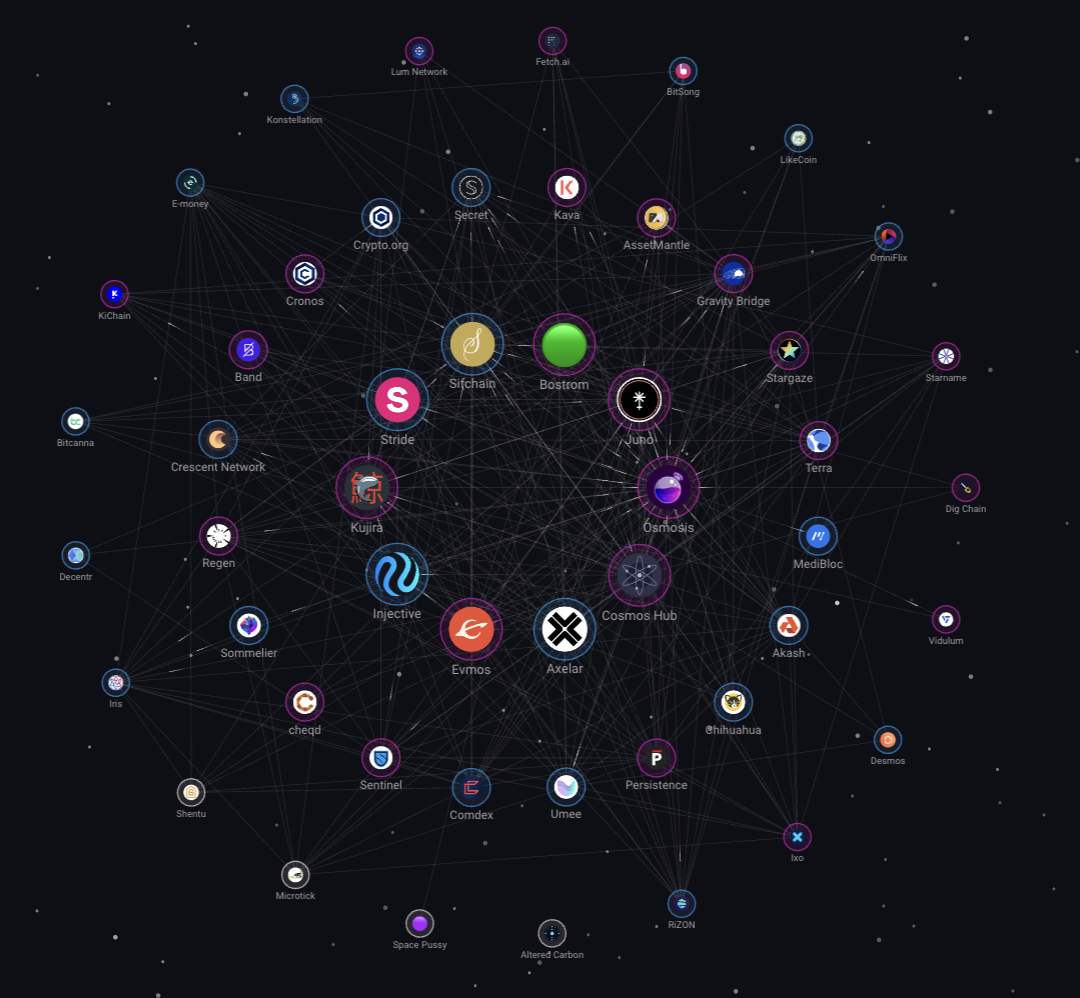
David Hoffman and Zaki Manian explained the ecological differences between Ethereum and Cosmos with biology.
David Hoffman :image description
(Image via David Hoffman)
Zaki Manian:image description
(picture from: mapofzones)
Note: When explaining the two-way mesh security (Mesh security) model, Sunny Aggarwal uses the real world NATO (NATO) example to illustrate, that is, each member state has its own sovereignty and governance system, and does not interfere with other members China's politics, but it has a mesh security system.
3. The trade-off of monetary premium
Ryan Sean Adams :The Cosmos ecological chain sacrifices the monetary premium, especially the design of the Cosmos hub avoids obtaining the monetary premium, while the Ethereum community attaches great importance to the monetary premium and regards it as a security protection force, while the previous fat protocol theory, now It also slowly turned into a fat money theory.
The key to this thinking is that if you can create a monetary premium on the base layer asset, then you get security for free, and therefore against competing Layer 1s.
Sunny Aggarwal :The Cosmos ecology is actually a hidden branch of Bitcoin maxis. We want to build an application layer for Bitcoin. In my opinion, Bitcoin is an application chain, and the entire Cosmos ecology is to build various application layers for Bitcoin. , and connect Bitcoin and the Cosmos ecology through a protocol called Babylon, and use the Bitcoin network to provide security for the Cosmos ecology and any PoS chain (to solve problems such as long-range attacks). In this regard, Bitcoin will It is the beneficiary of the monetary premium of the Cosmos ecology.
The mesh security (Mesh security) model design in the Cosmos ecosystem is a non-rent-seeking way to obtain free economic security.
Ryan Sean Adams:After connecting Bitcoin to the Cosmos ecosystem, it is necessary to trust the verifier of the application chain, thus losing the security of the original Bitcoin network, which is a challenge for the currency premium.
Sunny Aggarwal:Building a secure bridge between Bitcoin and the Cosmos ecosystem is the current focus. We are also trying to help jeremy rubin improve things like OP_CTV so that cross-chain bridges can be as trustless as IBC. Also, regarding mesh security, gold (bitcoin) has the largest monetary premium, its single market cap is the highest, and the combined market capitalization of the top 10 companies in the world exceeds gold, so in my opinion, economic security does not need Not from a monetary premium, but from productive assets.
4. Osmosis and liquidity premium
David Hoffman:Regarding the mesh security (Mesh security) model design, what can prevent one of the Cosmos chains from becoming the core of the entire network, and then gaining network effects and liquidity premiums (liquidity premium), thus deviating from the goals of the mycelium network (eg, currently Osmosis is the liquidity center of the entire Cosmos ecosystem).
Sunny Aggarwal :As a communication protocol, IBC allows each Cosmos chain to communicate with each other, and Osmosis, as an early successful application chain, is currently the activity and liquidity center of the entire ecology, but there will be more successful application chains in the future, and they will also It will become the center of various application fields, thereby forming a mesh network, and the mesh security model enables the application chains of the entire ecology to cooperate with each other, preventing a single application chain from becoming a security center.
David Hoffman :The current liquidity of OSMO tokens in the entire Cosmos ecosystem may be the best, so it will start to become the currency of the Cosmos ecosystem, while Uniswap’s UNI has not done so (it has not become a currency premium asset), is this true? Would make Osmosis's liquidity premium too high, thus undermining the vision of the mesh network.
Sunny Aggarwal :Currently the OSMO token is the pairing asset for most pools, but I actually don't think that's going to be an ongoing thing as we're moving towards a more centralized liquidity and order book system where stablecoins will be more Become a basic matching asset, rather than a fluctuating OSMO, and we are connecting more ecology and introducing different assets.
5. Cosmos Ecological Stablecoin
Ryan Sean Adams :The Cosmos ecosystem is introducing stable currency assets. For example, Circle recently announced that it will launch native USDC in the Cosmos ecosystem. What do you think of this development?
Zaki Manian:I think one of the biggest differences between Ethereum and the Cosmos ecosystem is that most of the core developers in the Cosmos ecosystem are also working on applications, while the core developers of the Ethereum ecosystem focus on the underlying blockchain. At the conference, you can see that the core developer community and the application developer community are two different groups of people, so my own agoric project has a stable currency, and I am also working on the USDC chain, which is the USDC general asset issuance chain. I helped to facilitate this, which makes the whole system into a network instead of a center, because we all have our own applications and our own economic incentives. Now, USDC passes through a consumer chain in the Cosmos ecology ( consumer chain), and then connected to the entire ecology through the IBC communication protocol, any member chain in the ecology can obtain the original USDC stable currency without paying rent.
Ryan Sean Adams:I think this makes a lot of sense, I like the idea of USDC on Cosmos better than Bitcoin, because USDC itself is a centralized dollar IOU, it doesn't want to provide sovereign-level security, it's not an encryption native assets, so it seems reasonable to put it into the Cosmos ecosystem, because it will not really sacrifice any monetary sovereignty.
6. L2 VS Cosmos
Ryan Sean Adams :Regarding the multi-chain future, there are currently two theories, one is the Ethereum-style vision, and the other is the Cosmos-style vision. I am not sure whether these two visions will coexist at the same time. I will first propose the Ethereum that I am familiar with. The vision is that in the future, various application chains will be built on each L2 in the form of L3, and use Ethereum L1 as a source of security. This does not require the establishment of its own validator set to enjoy the economic security of Ethereum .
Sunny Aggarwal:In my opinion, this is a model of empires and colonies, and what Cosmos builds is a sovereign system.
Zaki Manian:Of course, this is a very meme statement. As early as 2014, early participants in the Cosmos ecosystem were trying to persuade the Ethereum ecosystem to turn to the vision of Cosmos, but developers paid more attention to infrastructure such as sharding. The entire ecological development has only now begun to pay attention to the application layer. From a technical point of view, the blockchain can be roughly divided into three parts: the execution environment, the data availability system, and the bridge system, while Ethereum is trying to build an overall system. proofs, zero-knowledge proofs, then provide a data availability layer called danksharding, and finally connect all the execution environments.
The vision of Cosmos is to provide an IBC cross-chain communication protocol, and then you can go anywhere you want. For example, Celestia is also part of the Cosmos ecosystem in a sense. It is a data availability (DA) The application chain, and then through it can also establish a rollup type of ecosystem, we provide a toolkit that allows developers to build an execution environment.
Therefore, one of the biggest differences between Ethereum and Cosmos ecology is that most of the execution environment toolkits of Ethereum ecology are not free, which is one of the important reasons why dydx left Ethereum and migrated to Cosmos ecology, because the latter is What is provided for free is a public good that is available to all.
Sunny Aggarwal :Compound once tried to launch an application chain in the Polkadot ecosystem. They chose the substrate architecture, and then spent a year to do it, but finally chose to give up. Then Robert Leshner said that if they choose the Cosmos SDK architecture, the result may be Better yet, from an app builder's perspective, building with the Cosmos SDK architecture will be faster. The Ethereum ecosystem pays more attention to cutting-edge underlying technologies, such as zero-knowledge proofs, but their implementation will be slower, while Cosmos pays more attention to higher-level things, such as state machines, etc. We pay more attention to the chain-to-chain. Composability, as well as the user experience and functions of the application chain, and then adding things about fraud proofs and validity proofs in the future, this is a trade-off.
7. Cosmos VS Polkadot (Pokadot)
Ryan Sean Adams :Back in 2017-2018, there were two interoperability-focused projects on the market, namely Cosmos and Polkadot (Polkadot). You also talked about Compound’s attempt to launch an application chain in the Polkadot ecosystem, but In the end, I chose to give up. Do you think that Cosmos has won the competition between the two ecologies?
Zaki Manian :From the perspective of market value, DOT is currently leading, and USDC will first launch native assets in the Polkadot (Polkadot) ecology, but Polkadot (Polkadot) does not have an application that can undertake 1 billion USDC in a short period of time, while Cosmos has dydx can do that, and that's what happens when you bring the best apps into your ecosystem.
Ryan Sean Adams :Polkadot seems to have adopted a strategy between Ethereum and Cosmos. It does not provide smart contract functions, but is only responsible for the consensus of the entire network, providing shared security for the entire ecology, while Cosmos is Adopting a model without a ruler, from this perspective, Ethereum is one extreme of the Crypto ecology, while Cosmos is the other extreme, which are two parallel ideas (no intersection).
(Note: This statement reminds me of Vitalik's "concave-convex" theory. He believes that in some decisions (such as technical direction), it is more reasonable to adopt convex decision-making, and the compromise method may bring unnecessary complexity.)
8. MEV Problems and Solutions
David Hoffman:Speaking of Lisk, Dan elitzer recently wrote a great article about Uniswap, which mentions that only about 1/3 of the economic value is captured by liquidity providers (LPs), and 1/3 is consumed in In terms of gas fees, the remaining 1/3 is leaked to MEV in the form of front-running transactions. That is to say, using Uniswap, you will leak a lot of economic value. Can you talk about how Lisk solves some of these MEV problems from a Cosmos perspective?
Sunny Aggarwal:This is what we are doing at Osmosis, we take the threshold encryption transaction memory pool (mempool) approach, this can eliminate bad MEV fetches, such as sandwich transactions, because in the case of a public transaction mempool, someone will read all Transactions submitted by others, and copy this strategy, and then achieve arbitrage through front-running transactions, this is the problem caused by the disclosure of transaction storage pools. Of course, there are some good MEVs, which are not value extraction, such as the price difference between Osmosis and other centralized exchanges, which is good MEV arbitrage. In addition, the mars protocol will launch a lending platform on Osmosis in the future, so triggering liquidation will also be an opportunity for MEV arbitrage. These are good MEVs, so our strategy is to eliminate bad MEVs and then implement good MEVs ( via on-chain bots that run autonomously) and distribute the profits earned therefrom to OSMO stakers.
9. ATOM 2.0
Ryan Sean Adams :We talked a lot about the theory of the universe, let's talk about the recently released ATOM 2.0 white paper, which talked about economic changes.
Zaki Manian:We have the application chain theory, so what is the application of the Cosmos hub itself? It does not seem to have any application. After long-term discussions, we feel that to make ATOM a better ecological asset, we need to create an application for it. Therefore, we have seen changes in the economic model. It does not Another index inflation token, we make it more similar to a monetary asset.
10. Mesh Security & Interchain Security
Ryan Sean Adams :Regarding the application of the Cosmos hub itself, it should be called "interchain security". In fact, does it mean that the validators of the Cosmos hub help verify other application chains and provide them with security?
Zaki Manian:There are two models around security sharing, one is called "interchain security" and the other is called mesh security, there are some application chains, which have high value Users, such as USDC, but they don’t want to think about the token economy. This type of application has a high incentive to become a consumer chain (consumer chain), lease the validator of the Cosmos hub, and provide for the Cosmos hub and the entire ecology Value, another scenario that has a high demand for inter-chain security is application chains that are very sensitive to security, such as liquid staking, and these application chains will also have high demand for access to the Cosmos hub.
Sunny Aggarwal:Regarding the vision of mesh security (mesh security), historically, credible neutrality (credible neutrality) is very important. For example, Switzerland, the richest country in the world, is because of neutrality. I initially thought that the role of the Cosmos hub is A trusted and neutral system that rents out security and earns revenue, and this is a role I think the Cosmos hub will play in this vision of mesh security.
David Hoffman:Is the idea of inter-chain security here in the initial stage, and with the occurrence of application chain product market fit, the value has also been improved, then they can afford the security burden at this time, and then they can switch to this trusted neutrality Army system (mesh security)?
Zaki Manian:What I think is unique about our shared security vision is that we designed the whole system to be seamlessly upgradeable, like the standard application upgrade process we use in cosmos, you can add interchain security and then don't have to Too much technical burden, or you can choose to leave interchain security, we want to make sure this is a diverse ecosystem.
11. The Future of Cosmos
Ryan Sean Adams :In the next 5-10 years, what do you think Cosmos will be like, and what will the entire Crypto ecosystem be like?
Zaki Manian:My expectation is that when the vision is realized, most people who use cryptocurrencies will not know what they are using, whether it is something in Cosmos, or something in Ethereum, or something in Solana, the entire market will not have Attack or front-running, but a real digital market, I don't care about other things, I just hope that the tools we build for cosmos can be an important part of reaching this goal, and I also think Ethereum plays a very important role in the whole vision part. So if we can succeed, we will have an open source digital market that provides economic collaboration for the entire human race. This is the utopia I envision.
Sunny Aggarwal:As I mentioned before, I really like the organic Hayek system, maybe last month or two weeks ago, over 50% of the market capitalization of the crypto market was backed by the PoS system, which is great, but I now Thinking about the next thing, I think we can achieve something better than Proof of Stake (PoS), I really believe that we can build a consensus protocol based on network trust, which is more decentralized than Proof of Stake (PoS) , I don't know, I just want to keep tearing down centralized systems and building more organic mesh systems.