






How Blockchain and Oracles Can Accelerate the IoT Economy


The Internet continues to develop rapidly and never stops. In the past two decades, the connectivity of the Internet has achieved unprecedented improvement. People all over the world have enjoyed the benefits of high-speed communication, participated in various Internet public forums, communicated and interacted with billions of netizens, and could Internal electronic transfer. So what's next for the Internet?
Many predict that the next phase of development will focus on connected devices, often referred to as the "Era of the Internet of Things." At present, many electrical devices have been connected to the Internet or are currently connected to the Internet. These devices can send and receive data through machine-to-machine communication and perform programmed operations automatically without manual intervention.
first level title
IoT overview
secondary title
Sensing device
secondary title
General Equipment
secondary title
Back-end data storage and processing
Back-end data storage and processing include data, web server and data analysis platform. This module is steadily expanding the functionality of IoT devices and enabling large-scale connectivity between devices. These platforms store data generated by IoT devices, generate insights based on the data, make devices smarter, and transmit relevant data and insights to various stakeholders in an easy-to-read form.
Building an automated world with the Internet of Things
At present, people have begun to combine sensing devices, general-purpose devices, and back-end data storage and processing platforms to fully realize automation functions.
For example, using advanced equipment to select from harvested tomatoesunripe green tomatoes. Sorting equipment (general equipment) uses optics (sensors) and computer software (data processing) to sort out unripe green tomatoes with great accuracy. The entire process requires no human intervention, a job that used to require a lot of human effort.
At present, such application scenarios are usually closed. Tomato sorting equipment can work together with automatic packaging equipment to sort tomatoes by weight and pack them for delivery. The packed tomatoes can be automatically sorted into different boxes and shipped to different locations. Each device is connected through the Internet and coordinated by the back-end system to trigger operations based on specific supply chain processes. At present, IoT application scenarios can only do this at most. However, the real challenge is whether to continue the automated process when the goods leave the factory and ownership passes to the next stakeholder in the supply chain.
first level title
The current bottleneck of the IoT ecosystem
secondary title
Building consensus on IoT data insights
In many cases, shared systems of all kinds are unable to efficiently reach a consensus on data and insights, thus under-utilizing the full value of IoT devices.
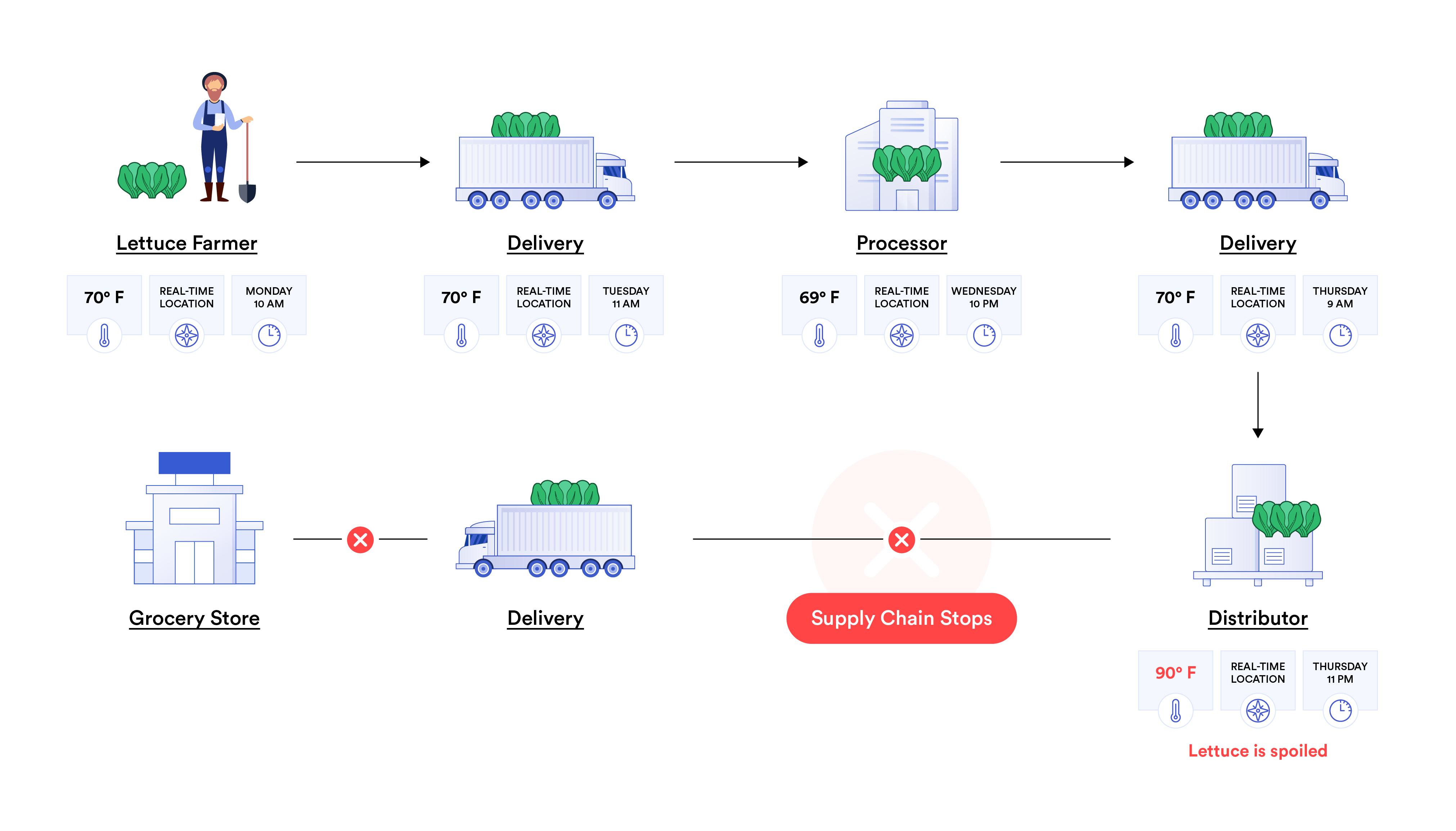
For example, a farmer in California planted a lettuce field. He sells the lettuce he grows to small supermarkets across the United States. However, this supply chain from farmer to consumer consists of multiple links - lettuce needs to go from farmer to processing plant to distributor to small supermarket before finally reaching the consumer. In every link, lettuce may spoil due to poor storage.
image description
text
secondary title
Auto Expand Billing
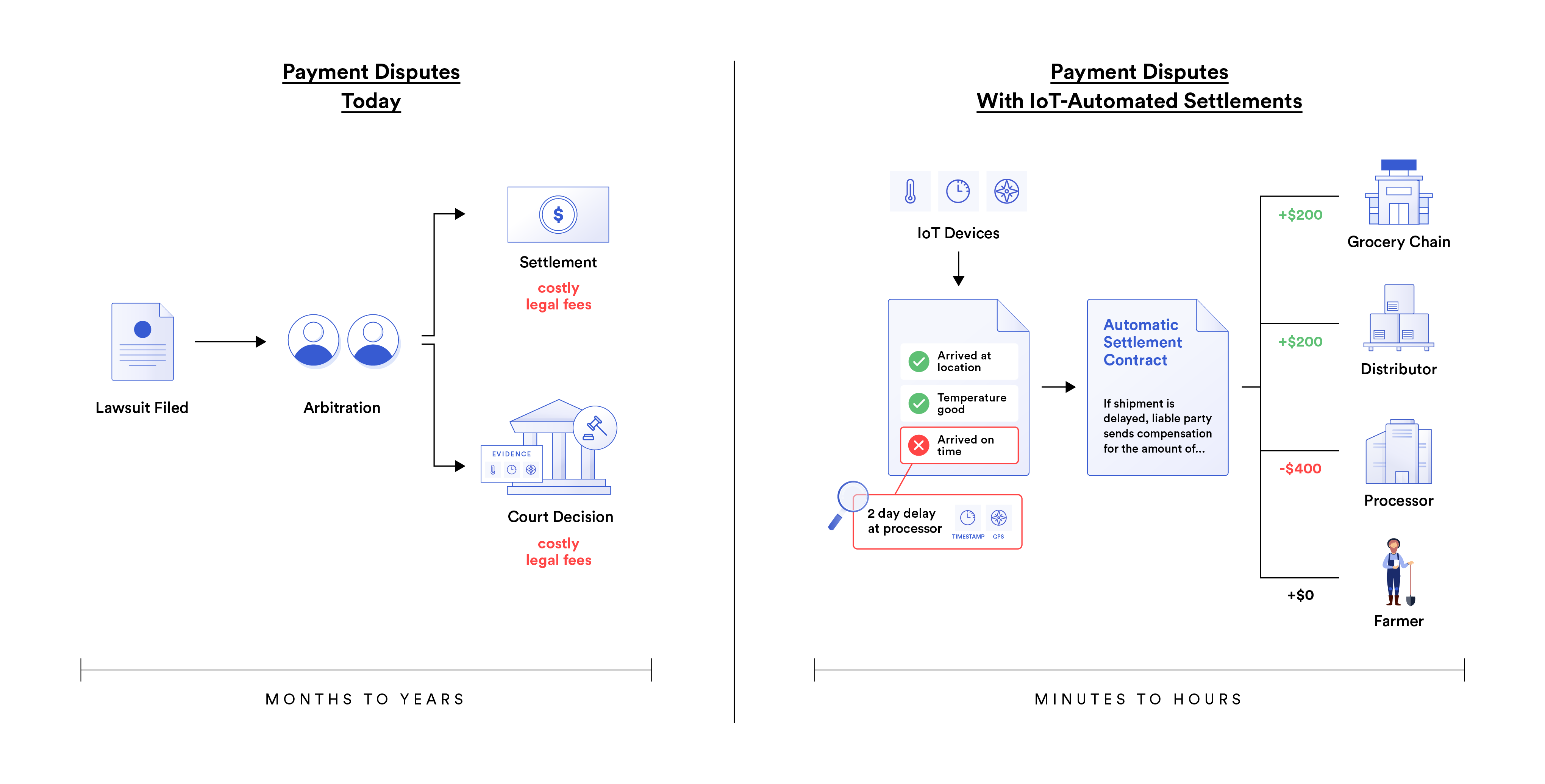
To give full play to the value of the Internet of Things, another function must be realized, which is automatic settlement among multiple stakeholders.
For example, local farmers do not have as many resources and funds as processing plants, distributors and supermarket chains. These big businesses can afford lengthy disputes and late payments, but farmers cannot. This asymmetry exists in many supply chains and business processes.
image description
secondary title
Eliminate bottlenecks
An easy way to think about how to remove these bottlenecks is to imagine what it would be like to fill in the two missing pieces of the puzzle (data consensus and automatic computation). Going back to the California farmer example, temperature sensors, GPS devices, and smart cameras can now be used to determine when, where, and why lettuce is spoiling. However, if these two pieces of the puzzle are completed, the transparency of the data can be guaranteed, and the data can be stamped with a time stamp. All stakeholders can obtain the data in real time, and the data cannot be tampered with. This will lay a key foundation for data consensus .
If it is found that the lettuce is broken during the storage process, the stakeholders responsible for the storage can be held accountable, and the affected parties can be compensated through the automatic settlement system. The entire process is written into the underlying code of the system , executed automatically. No one, including responsible parties, can stop this process: all operations in the process are immutable, with verifiable data as a shared source of truth. The future prospects of this automatic settlement system based on real-time data are unlimited, and the key lies in the data granularity, accuracy and automation level of IoT devices.
secondary title
The two missing pieces of the puzzle are smart contracts and oracles
Building data consensus and automated settlement systems for IoT devices is not an easy task. In order to create a truly robust system, data needs to be decentralized at every link to fully protect the value in the process and the interests of the parties involved.
smart contract
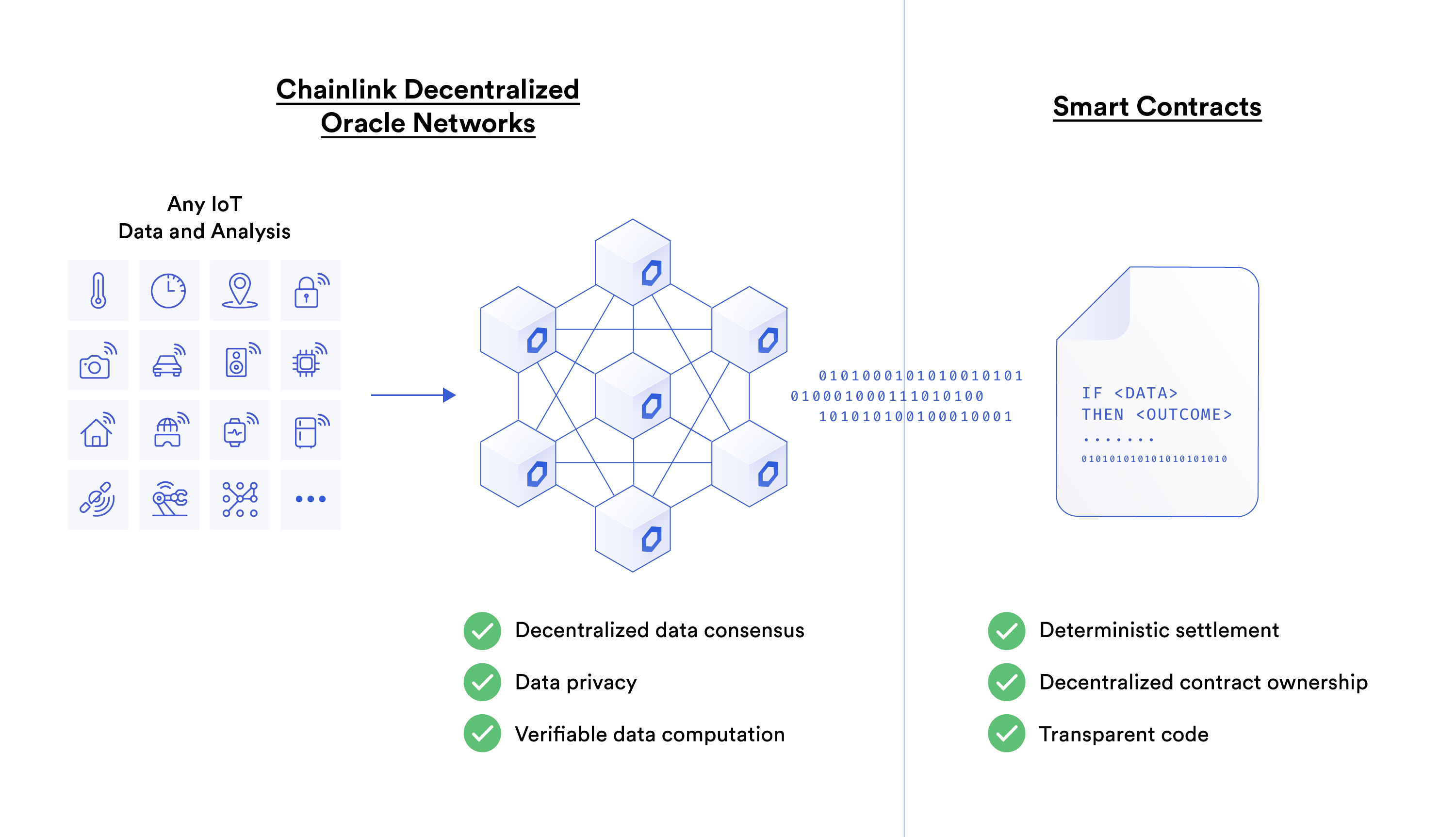
smart contractBased on block chain development, it is an automated code that cannot be tampered with. It ensures that the process is executed seamlessly according to the if/then logic, so it is the first missing piece of the puzzle. If the lettuce spoils in the processing plant's warehouse, a predefined amount is automatically deducted from the processing plant's bank account and transferred to the farmer as compensation. If the car reaches its destination, the fare is automatically debited from the passenger's bank account. Once everyone has reached an agreement, neither party can change or stop these immutable pre-programmed contracts. These types of smart contracts provide the foundation for building multi-party IoT systems.
However, the blockchain and smart contracts on the chainitself cannot be compared withExternal world interaction, which includes IoT data and data processing systems. This prevents us from integrating deterministic automated settlement functions into multi-party systems based on IoT data and insights.
image description
secondary title
Fully realize the value of smart contracts by using oracles
Chainlinkis an industry-standard protocol that connects smart contracts to the outside world. Chainlink can securely and reliably connect smart contracts to off-chain data and computing resources, provide critical trust-minimizing services, and fully realize the potential of IoT technology.
interactinteract。
The decentralized oracle network (DON) can transmit, process and calculate data in a way that minimizes trust, and ultimately create an automated world.
data transmission--The Chainlink oracle network can be connected to a single IoT device, or multiple IoT devices to minimize the risk of hardware centralization, and can also be connected to the back-end platform, so it is a secure middleware that can be reliable, timely and Securely transmit data to the chain.
Data processing and operation——Chainlink's decentralized oracle network is constantly iterating to better provide trust-minimized guarantees for computing. That is to say, when it is necessary to analyze raw IoT data and automatically settle in smart contracts, Chainlink’s decentralized oracle network can not only verify IoT data, but also perform verifiable computing tasks to ensure the accuracy of results .
Data Privacy -One of the features currently being developed on the Chainlink network is to take advantage ofDECOZero-knowledge proof technology to verify data without revealing data privacy. Companies can use this technology to prove that a certain attribute of the data (such as the temperature of the lettuce is below 21 degrees Celsius) is real without revealing the underlying data.
image description
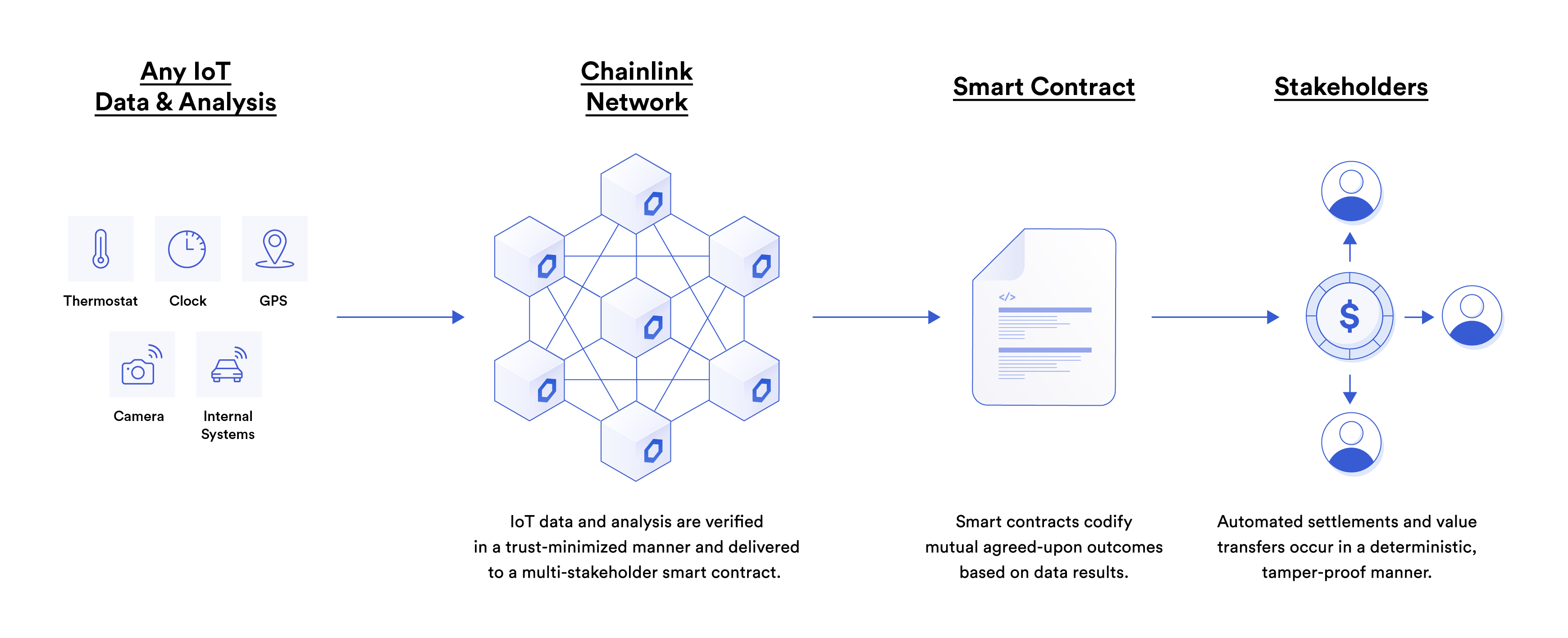
With IoT devices and data, Chainlink's decentralized oracle network, and smart contracts, multi-party agreements can be perfectly implemented.
Let's continue the example of the lettuce supply chain just now to understand the logic behind it more intuitively. We can customize a Chainlink decentralized oracle network, in which all nodes can independently monitor the IoT devices in each link of the supply chain, trigger smart contract execution when the lettuce is broken, and attach time stamp, temperature and location information .
Chainlink nodes are economically incentivized to respond honestly, and only when a custom consensus criterion is met (e.g., more than 80% of nodes return the same value and conclusion), the data is transmitted to the smart contract and triggers a value transfer (ie: responsibility parties to pay the respective operating costs of each stakeholder). If the existing supply chain already uses a third-party platform for data analysis, this platform can also be integrated into the smart contract and minimize trust. In addition, Chainlink nodes can directly connect to IoT devices one-to-one, or through servers. In this way, further customization can be realized at the node level, and a more secure decentralized oracle network can be better created.
first level title
The ultimate vision of the Internet of Things
Devices are getting smarter. Whether it is the performance of the hardware itself, the granularity of the data collected by the sensing device, or the ability of machine learning and artificial intelligence to make autonomous decisions, these technological advances are making the automated world closer and closer to us.
We can imagine that one day, traditional legal contracts can be combined with smart contracts to trigger execution based entirely on data. The real estate smart contract can use IoT devices to record the damage of the rental house, automatically deduct money from the deposit, and make an appointment for a repairman to come to repair. AI cameras can determine who is responsible and trigger after a car accidentblockchain insuranceClaims are automatically settled between the company and the insured, and then an unmanned tow truck is dispatched to tow the car in for repairs. Smart watches that protect privacy can pay for users' medical data, monitor the usage scenarios and flow of these data, and make outpatient appointments when necessary.
For IoT devices and data to reach their full potential, they must be able to automatically make decisions based on objective sources of truth and sophisticated data analysis models. Both the equipment and the system must be executed in full accordance with the procedures. The key here is to create devices and systems that are truly immutable, immune to manipulation by any single stakeholder, and able to fairly perform operations and transfer value based on a shared encrypted source of truth.


