Japan's official new thinking on the development of Web3


Compilation of the original text: Alpha Rabbit Research Notes
Compilation of the original text: Alpha Rabbit Research Notes
This article is a policy report on Web3 (Web3.0) released by the Japanese Ministry of Economy, Trade and Industry (METI) on May 19 this year. The main background of the report is that under the current complicated economic situation, some new directions of economic and industrial policies are put forward, as well as some Japanese official thinking on Web3. Considering (Japan’s) geographical and resource constraints, it is necessary to develop a A whole new area of growth that is not constrained by geography or resources, so it will start to focus on Web 3.0 (Web3); because it is not constrained by geography or resource constraints, it may become a new growth area in cyberspace. We read this report as an international trend, and we must look at these phenomena based on the principle of objective dialectics.
theme
theme
secondary title
file location
file location
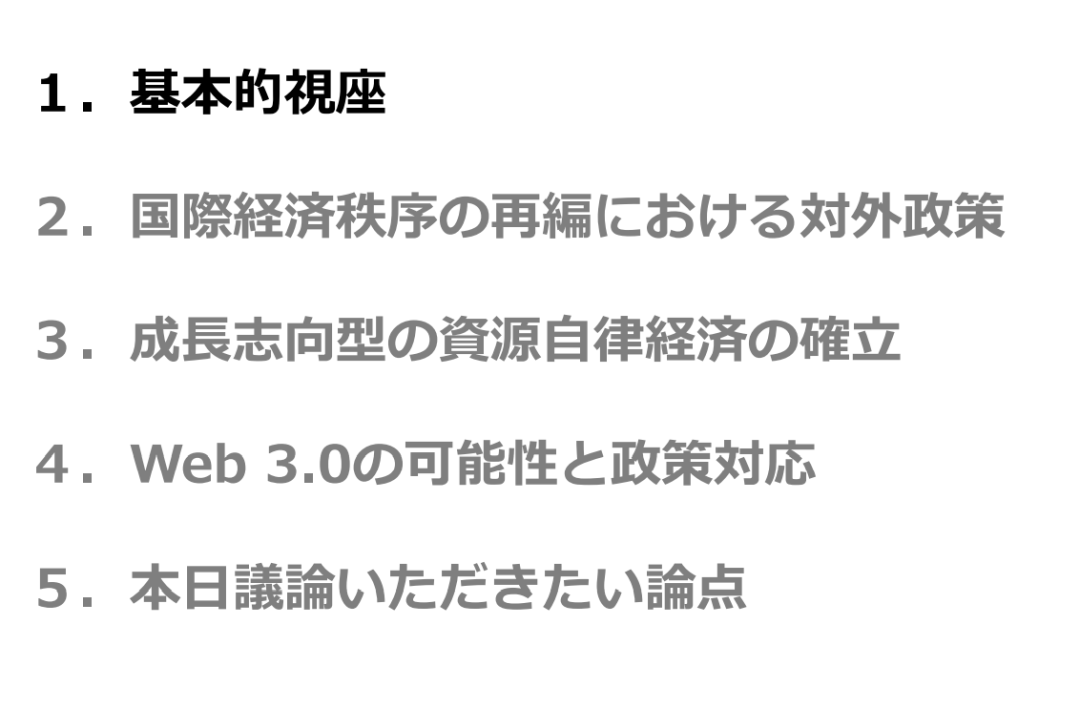
According to the discussion at last year's industrial structure committee meeting, the subcommittee has been discussing new economic and industrial policies in the past year.
Recent trends/thoughts include:
①The international situation has had a new impact on the international economic order. It is necessary to clarify what role Japan should play in the new international situation?
②The supply chain problems caused by the new crown virus need to strictly prevent the risk of interruption of the supply of all commodities and resources, and strengthen economic construction.
③ (Considering Japan's) geographical and resource constraints, a whole new growth area that is not limited by geography or resources needs to be developed in cyberspace. Attention is currently being paid to Web 3.0 (Web3) as it is not constrained by geography or resource constraints and may become a new growth area in cyberspace, these changes are ushering in a new period that will have the potential to transform the existing economy order.
secondary title
main frame
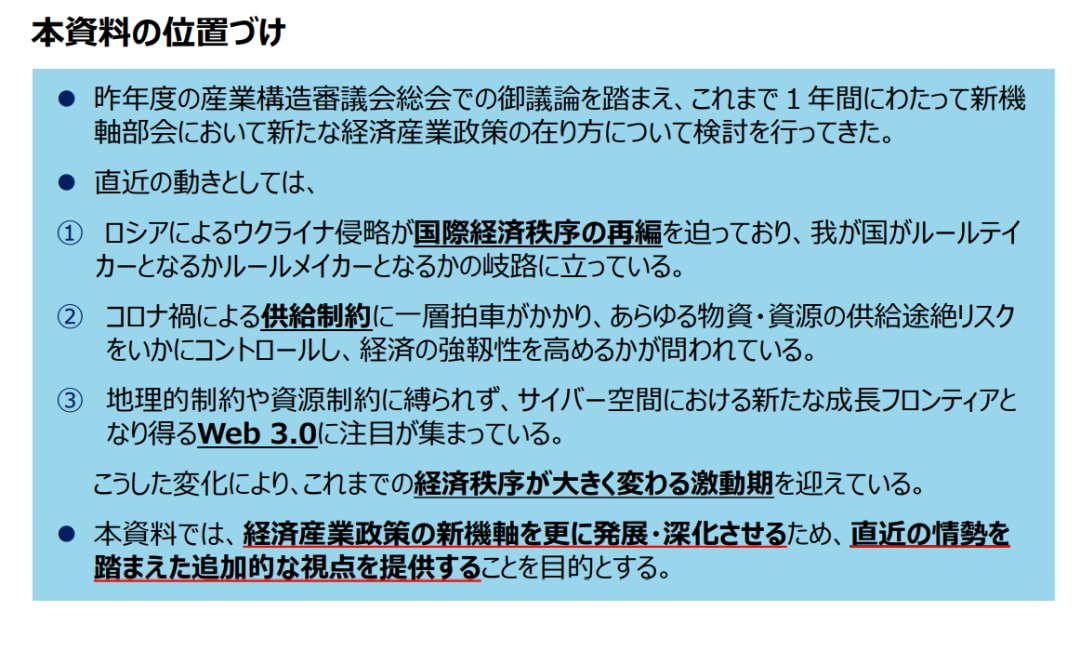
Main frame:
1. Basic point of view
2. Foreign policy in the restructuring of the international economic order
3. Build a growth-oriented resource-independent economy
4. Potential and Policies of Web 3.0
5. Questions to discuss
The world situation after the financial crisis:
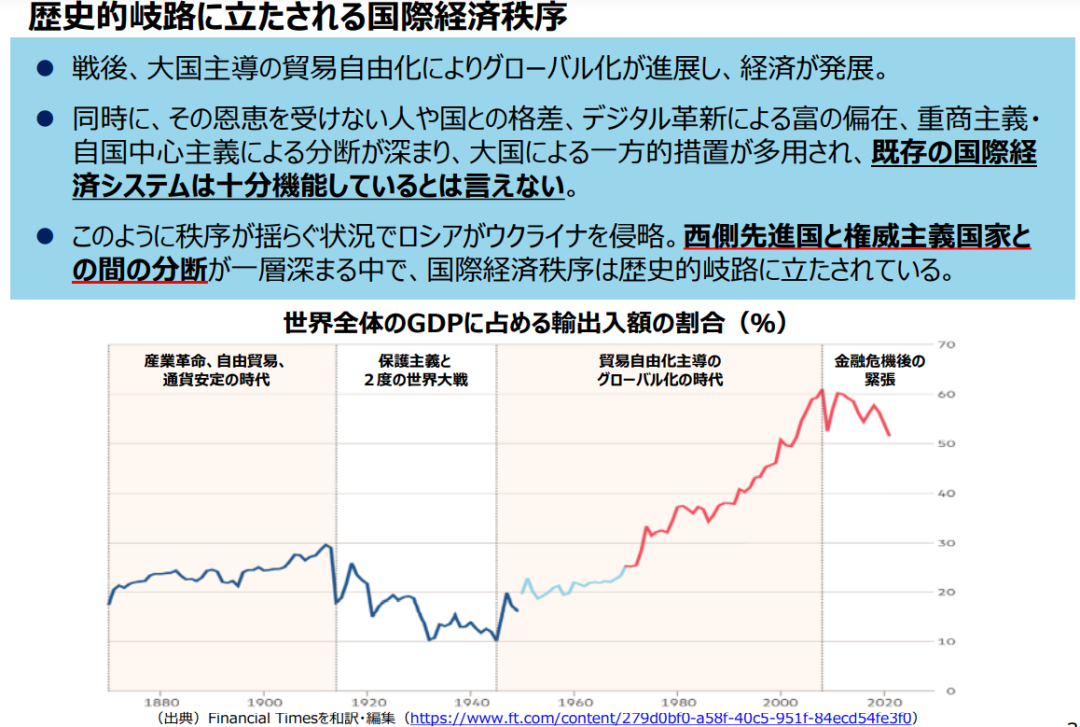
After the war, globalization and the economy were fully developed through the liberalization of trade led by the great powers.
However, the gap is also prominent. The unequal distribution of wealth caused by digital innovation and the spread of centralization ideology have deepened the division, and the advantages of the existing international economic system have not been fully utilized. Combined with geopolitical turmoil, we believe that the international economic order is at a historical crossroads.
Japanese official views on the field of Web3.0 (Web3)
What is Web 3.0 (Web3)
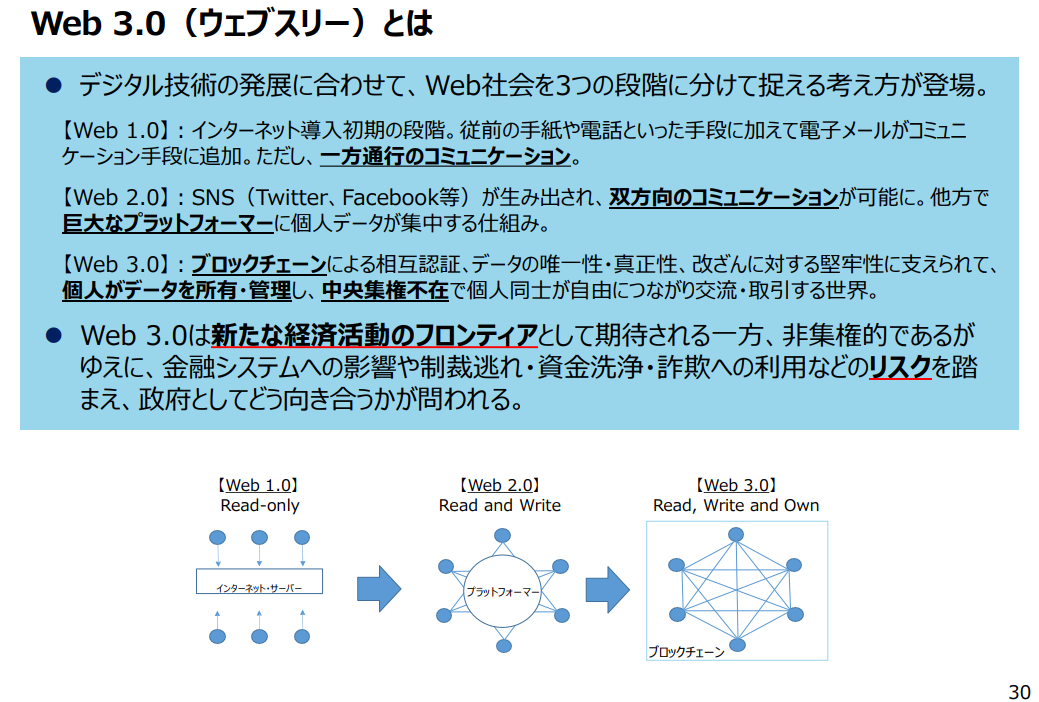
With the development of digital technology and technology, the idea of dividing the Internet society into three stages has emerged:
Web 1.0: In the early days of the Internet, e-mail was used as a means of communication in addition to conventional means of communication such as letters and telephone calls. However, this is an Internet of one-way communication (read-only);
Web 2.0: The birth of social networking services (Twitter, Facebook, etc.), making two-way (readable and writable) communication possible; on the other hand, in the Web 2.0 era, personal data is concentrated in the hands of giant technology platforms;
Web 3.0 (Web3): A new world where everyone can own and manage their own data. It has the characteristics of verifiability, data uniqueness, and authenticity. It prevents tampering through the blockchain and is robust (very strong, not easy) destroyed), and individual users can freely connect, interact and transact in a decentralized manner.
Web 3.0 promises to be the frontier of new economic activity, but because it is decentralized, it raises questions about how regulators will respond to the risks: for example, what will be the impact on the financial system? How to deal with money laundering and fraudulent nature?
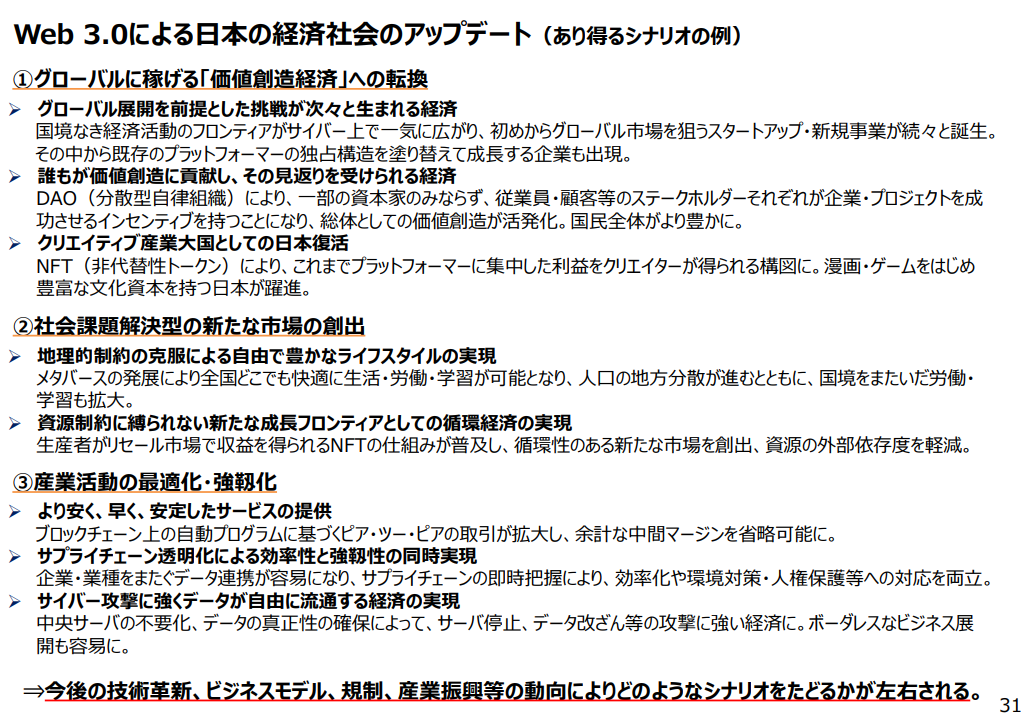
The document proposes the idea of empowering the economy and society through Web 3.0:
Web3 represents economic activities that transcend national borders. Start-up companies that are rapidly growing on the Internet and positioning services in the global market will be born one after another in the Web3 field and continue to grow. This will change the monopoly structure of existing platform providers. Through Web3, everyone can contribute to value creation and get rewarded.
DAO (Decentralized Autonomous Organization), which includes various stakeholders, which can be motivated to make the organizational model and project successful. Such a model will make value creation a whole, so everyone will be more active, and this model may make the entire country richer.
Japan, as a country with obvious advantages in cultural and creative industries, NFT can benefit creators (previously profits were concentrated on platform operators), and at the same time, rich cultural capital (including comics and games, can make breakthroughs) (1) turn to Profitable worldwide"value creation economy"(2) Industrial activities can bring series optimization and flexibility
Cheaper, faster, more stable services: Peer-to-peer transactions based on blockchain automation procedures can eliminate unnecessary middlemen.
Achieving a balance between efficiency and resilience through supply chain transparency: Promoting cross-company and intra-industry data connectivity and real-time understanding of the supply chain can not only improve efficiency, but also empower environmental protection and other fields.
Ensuring data authenticity: Ensuring data authenticity and enabling a resilient economy by reducing reliance on central servers—for example, preventing sudden server outages and data falsification. The development of the metaverse may allow people to live, work and study comfortably anywhere in the country, and the expansion of the population to the local and cross-border work and study will also increase, realizing a circular economy, as a new country that is not constrained by its own resources. growth area.
secondary title
Layout/trend of Web 3.0 in major countries and regions
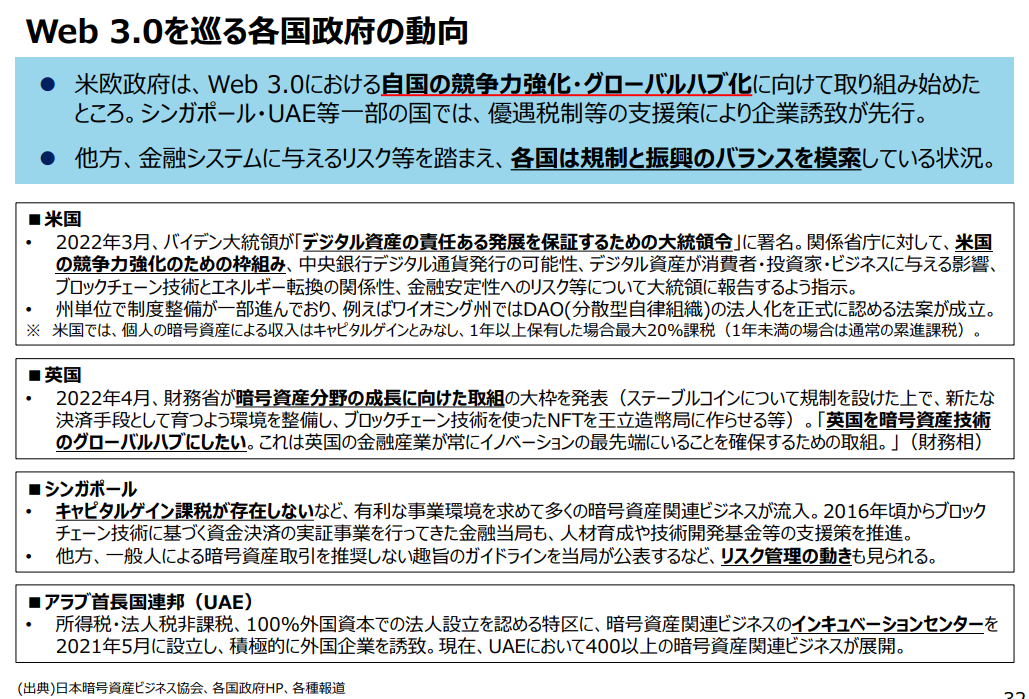
On the one hand, the United States and European officials are starting to make efforts in the field of Web3, hoping that their countries will become more competitive in Web 3.0, and even become a global center; some countries, such as Singapore and the United Arab Emirates, are taking the lead in passing preferential taxation and other support measures to attract companies.
USA
USA
In March 2022, Biden signed a presidential decree to ensure the prudent development of digital assets, which provided relevant agencies with a highly competitive development framework in the United States, explored how to issue central bank digital currency, and the impact of digital assets on The impact on consumers, investors and businesses, as well as the relationship between blockchain technology and energy transition, also takes into account risks related to financial stability.
Each US state has a different system: Wyoming, for example, has passed a bill officially allowing DAOs (Decentralized Autonomous Organizations) to become legal entities.
U.K.
U.K.
Singapore
Singapore
Many companies related to encrypted assets have entered Singapore to seek a favorable business environment (Singapore's tax policy is relatively friendly). However, the Monetary Authority of Singapore also has some measures in terms of risk management for the encrypted industry. Guidelines for the general public (retail investors) to trade cryptoassets.
United Arab Emirates (UAE)
secondary title
Policy Discussions Around Web 3.0 (Web3)
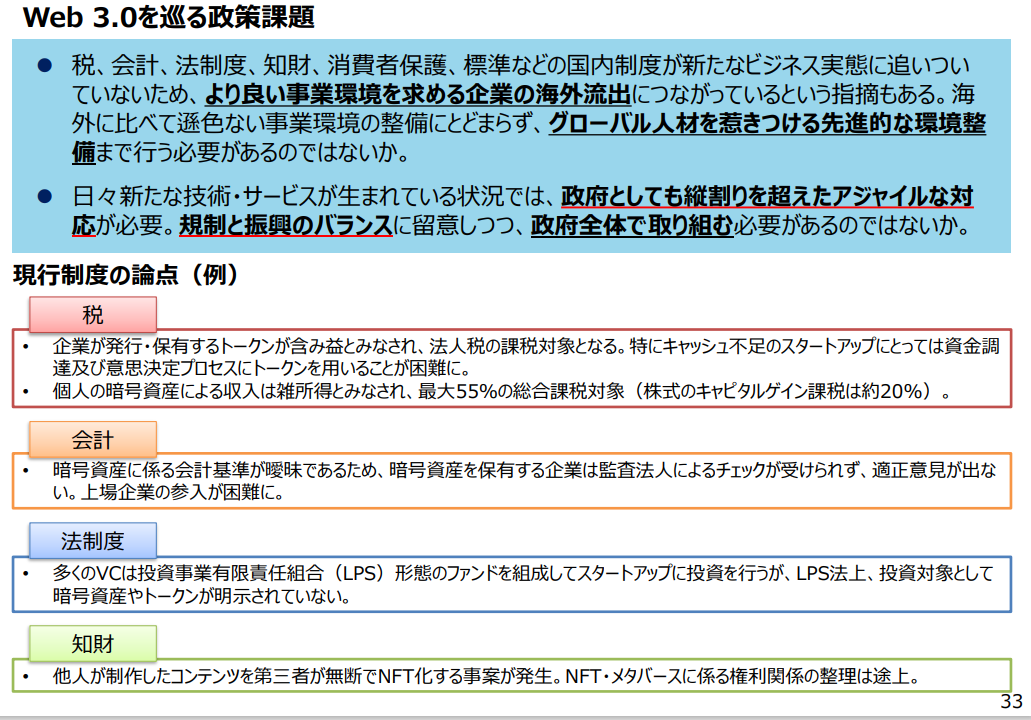
Domestic systems, such as taxation, accounting, legal systems, intellectual property, consumer protection and standards, need to keep up with the latest business developments. Some legal systems such as intellectual property rights, consumer protection, and standards have not kept up with the new business status quo. Some companies will go to other countries and regions to seek a better business environment, and need to create an advanced environment that can attract global talents.
Balance regulation and innovation. Emerging technologies and services are emerging every day, and it is necessary to respond in a flexible manner and pay attention to the balance between regulation and innovation.
Taxation: Tokens issued by companies as the main body will be considered as unrealized profits and need to pay corporate tax. For capital-strapped start-ups, tokens can be used for funding and decision-making processes.
Income from personal crypto assets is subject to general income tax of up to 55% (capital gains tax on stocks is about 20%)