






2022 Overseas NFT and Metaverse Platform Governance Research Blue Book


Original Author: Zhang Yanlai, Ye Danni
Table of contents
Table of contents
1. Platform type and secondary market
2. Platform openness and compatibility
3. Qualification
(1) European Union
(2) United States
4. Payment method
(1) Traditional non-encrypted payment (credit card, third-party payment)
(2) Blockchain and cryptocurrency
(3) Encrypted Wallet
(4) Cryptocurrency exchanges
5. IP review and access
(1) Subsequent review
(2) Prior review
(3) Issuer access
6. Identity Verification KYC
7. Anti-Money Laundering AWL
8. Anti-fraud
9. Expenses: Fuel fees, commissions and others
(1) Gas Fee
(2) Commission
(3) Credit card handling fee
(4) Taxes and fees
10. Royalty and cross-platform
the case
Chinese IP Overseas Issuance of NFT Cases
IP class
Celebrity tide brand
Grassroots
Cases of adding traditional games to NFT gameplay
MakersPlace
Rarible
SuperRare
OpenSea
Decentraland
Legal Analysis of Domestic Enterprises Purchasing Overseas Blue Chip NFTs
timeline
The core benefits of Boring Ape to buyers
Reference and bottleneck breakthrough of domestic NFT
Special Compliance Issues
Metaverse Digital Asset Type
Decentraland's "Dual Governance" Architecture and User Asset Confirmation
first level title
summary
1. Platform type and secondary market
Overseas NFT websites can be divided into two categories: NFT project websites and NFT platforms.
Well-known overseas projects generally have dedicated project websites. According to the function of the project website, it is divided into the following categories:
1. Display project websites: Some project websites only have the function of introduction, and the specific issuance will generally rely on the NFT platform that supports the issuance. At present, there are few independent display websites. If there is only a need for display, the project party will generally choose to introduce new projects on Twitter and other platforms.
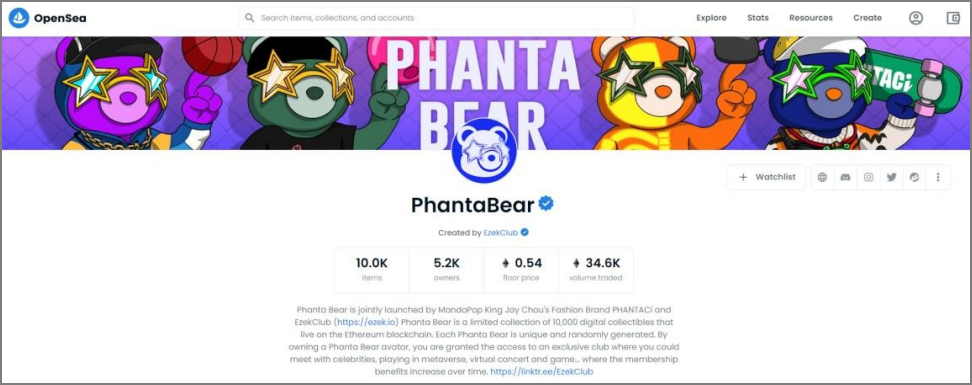
2. Issuing project websites: Some project websites can bind encrypted wallets to complete the issuance. There are generally two ways of issuance: airdrop (equivalent to free issuance) and issuance at an issue price. For NFTs on the public chain, whether it is an airdrop or a paid purchase, you generally need to pay a casting fee (that is, the Gas fee consumed by Mint NFT). After the issuance of this type of project platform is completed, only the display function remains, and subsequent transactions need to be completed in other secondary markets. For example, after the official website of Phanta Bear (commonly known as Jaylen Bear) is released, there are only introductory materials left on the official website, and subsequent transactions need to go to OpenSea.
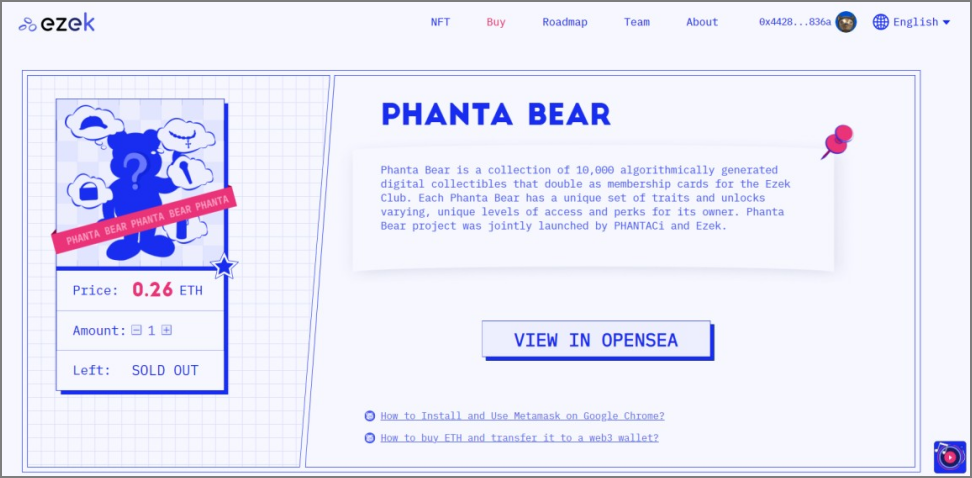
image description
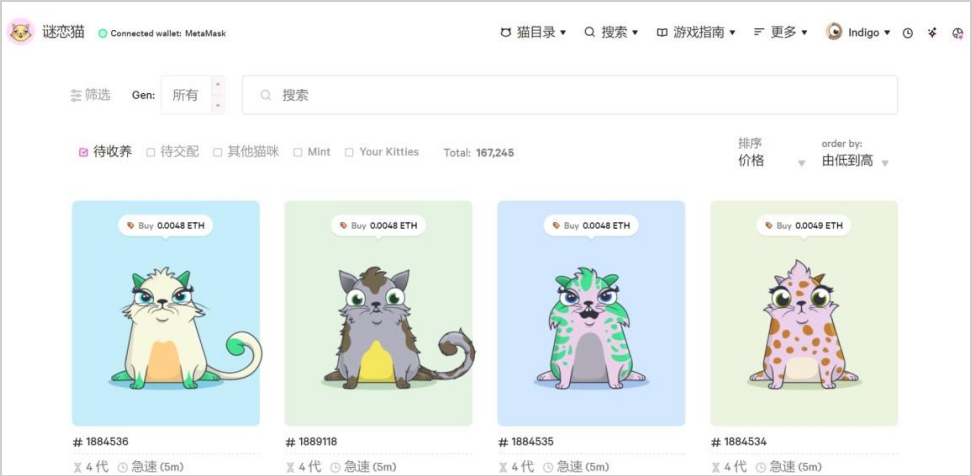
The official website of the CryptoKitties project provides a secondary market and supports games such as breeding
first level title
2. Platform openness and compatibility
Most of the NFT platforms represented by OpenSea are open. Generally, there are no restrictions on NFT withdrawals to encrypted wallets, or display and trading on other platforms. NFTs in encrypted wallets or on the same blockchain from other platforms can also be put on the shelves sell. In the past, some relatively closed platforms (such as NBA Top shot Marketplace) also gradually supported withdrawals to encrypted wallets.
first level title
secondary title
(1) European Union
secondary title
(2) United States
The U.S. federal government and states have qualification requirements for cryptocurrency exchanges and cryptocurrency issuers: at the federal level, they need to register with FinCEN as MSB (Money Services Business), and comply with the Bank Secrecy Act and anti-money laundering and anti-terrorist financing requirements; At the state level, it is necessary to apply for MTL licenses (Money Transmitter Licensing) from each state for state-level compliance, and selective applications can be made according to needs.
NFT may have the risk of being recognized as a security by the US Securities and Exchange Commission (SEC). Although the SEC has not yet initiated a lawsuit against an NFT project, there have been allegations of illegal securities transactions filed by ordinary investors against the issuer of the NBA Top Shot card. On May 12, 2021, the plaintiff initiated a class action lawsuit, claiming that Dapper Labs was not registered with the SEC, illegally issued and sold NFT securities, and demanded compensation from the defendant for its losses and attorney fees.
first level title
4. Payment method
secondary title
(1) Traditional non-encrypted payment (credit card, third-party payment)
secondary title
(2) Blockchain and cryptocurrency
Overseas NFT platforms generally support one or several blockchains and corresponding tokens (cryptocurrency) for transactions. Different cryptocurrencies on the same blockchain can be freely exchanged in tools such as exchanges and encrypted wallets according to real-time exchange rates, and cryptocurrencies on different blockchains can generally be exchanged through the cross-chain function.
In addition to supporting the Ethereum network, OpenSea currently also supports the Polygon network, the side chain of the Ethereum. The native token of Ethereum is ETH, the native token of Polygon is Matic, and the token WETH on Polygon is interchangeable with ETH.
In addition to Ethereum and Polygon, Rarible also supports Flow and Tezos public chains. Rarible issued the governance token RARI. Decentraland supports Ethereum and its side chain Polygon, and the token issued by the project is MANA.
secondary title
(3) Encrypted Wallet
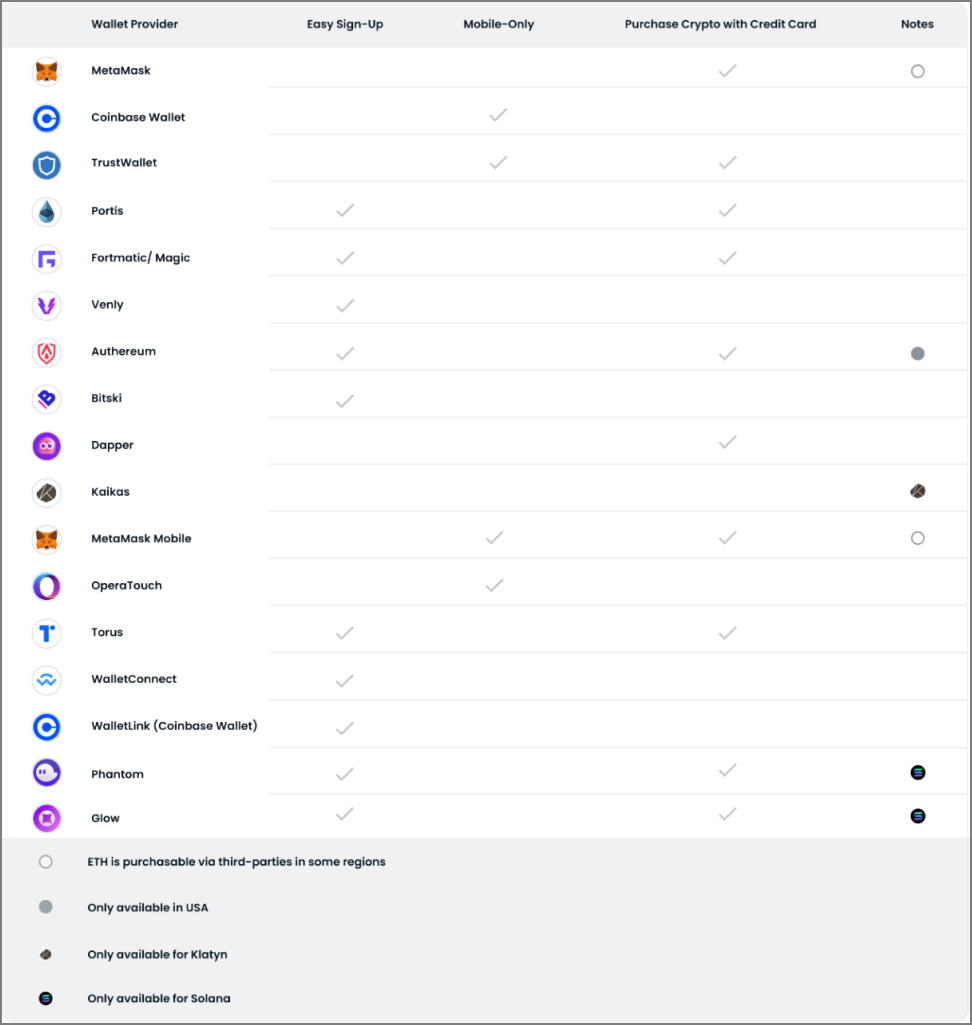
Crypto Wallets include software wallets (hot wallets) and hardware wallets (cold wallets). Common software wallets include MetaMask, Rainbow or Coinbase Wallet. Common hardware wallets include Ledger and Trezor.
Overseas NFT platforms generally support one or several software wallets, the most common being MetaMask. Software wallets generally have the function of withdrawing cash to hardware wallets.
secondary title
(4) Cryptocurrency exchanges
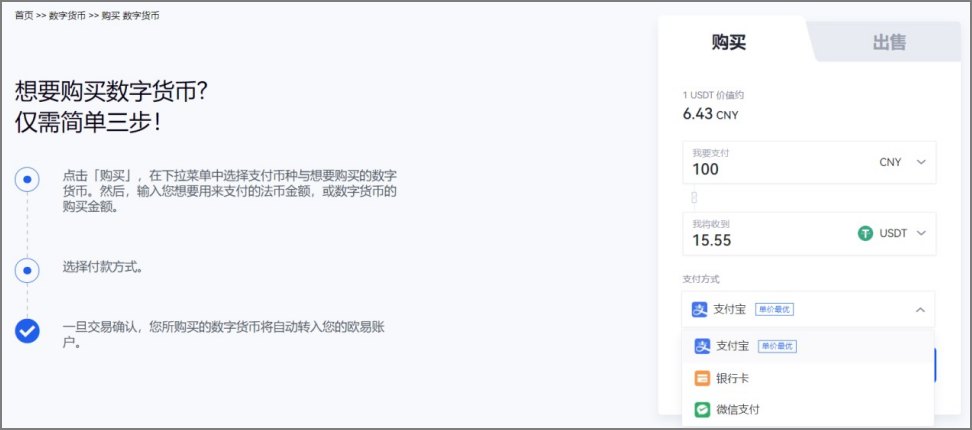
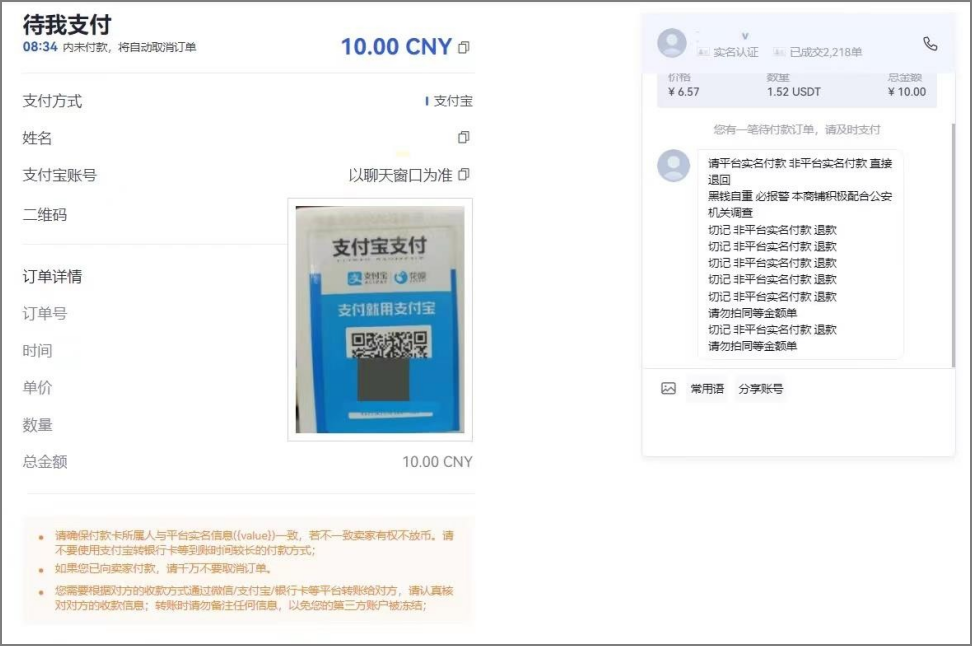
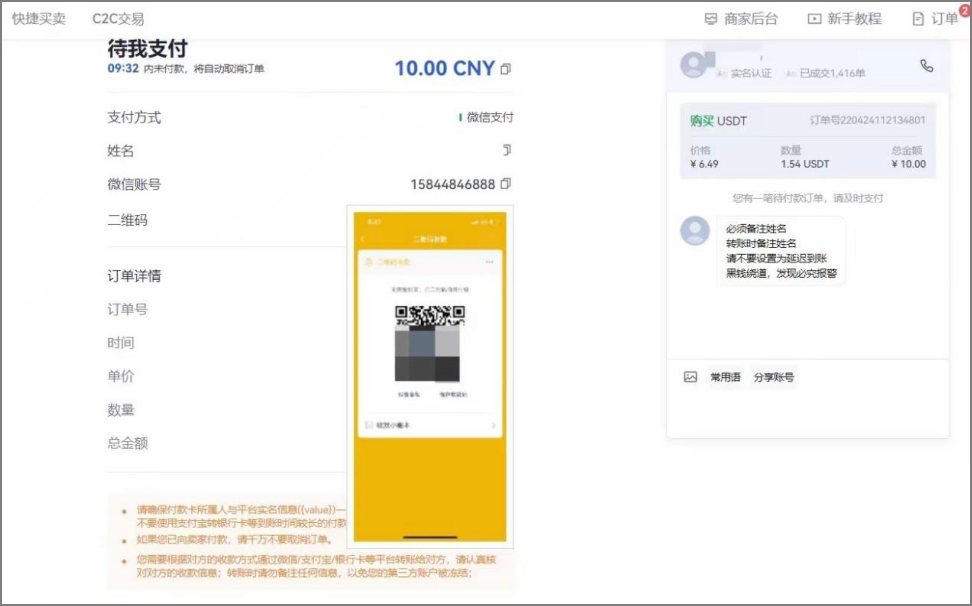
The conversion between legal currency and cryptocurrency needs to go through cryptocurrency exchanges (such as Coinbase, Binance, FTX). Users can purchase cryptocurrencies on cryptocurrency exchanges, and some regions support direct credit card purchases (may include handling fees).
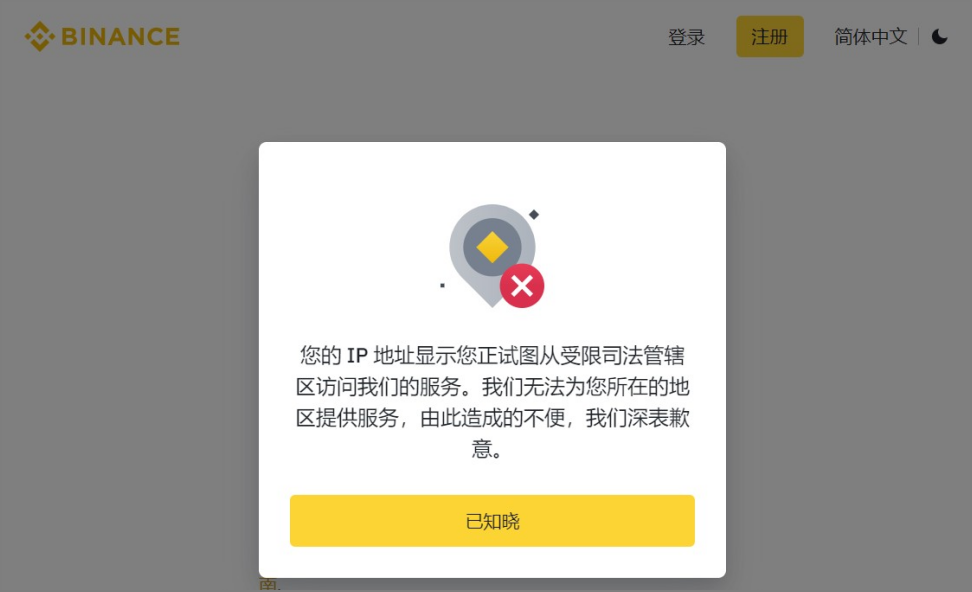
At present, due to regulatory reasons, most cryptocurrency exchanges do not support opening up to Chinese users.
first level title
secondary title
(1) Subsequent review
Platforms such as OpenSea do not have IP review, but generally provide reporting channels for pirated works.
secondary title
(2) Prior review
image description

secondary title
(3) Issuer access
first level title
6. Identity Verification KYC
At present, overseas NFT platforms have no mandatory KYC requirements.
In May 2021, the U.S. Department of the Treasury officially issued a message requiring that encrypted digital currency transactions exceeding $10,000 in the U.S. need to be reported to the U.S. Internal Revenue Service (IRS). Due to anti-money laundering requirements, future NFT transactions may require KYC.
image description
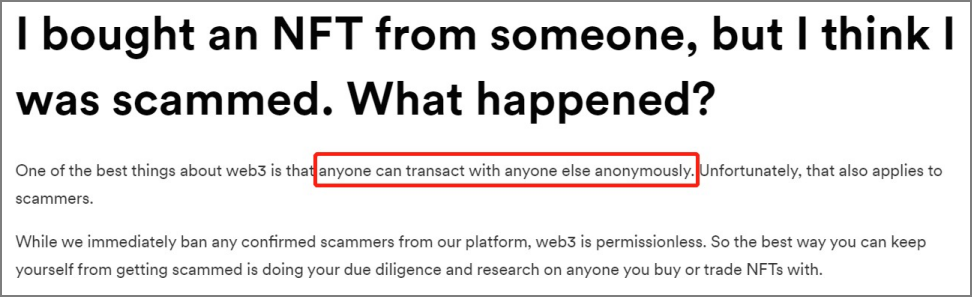
A platform says web3 transactions are anonymous
first level title
7. Anti-Money Laundering AWL
In May 2021, the U.S. Department of the Treasury officially issued a message requiring that encrypted digital currency transactions exceeding $10,000 in the U.S. need to be reported to the U.S. Internal Revenue Service (IRS).
first level title
8. Anti-fraud
According to Article 6 of EU MiCA:
First, marketing communication should be identifiable, that is, the public can recognize that the service provider's information delivery is marketing encrypted assets. The marketing of NFT does not require the prior approval of the competent authority, but the start of marketing activities must be notified to the competent authority at least 20 working days in advance. The notice should state when the cryptoasset was issued or when it entered the trading platform.
first level title
secondary title
(1) Gas Fee
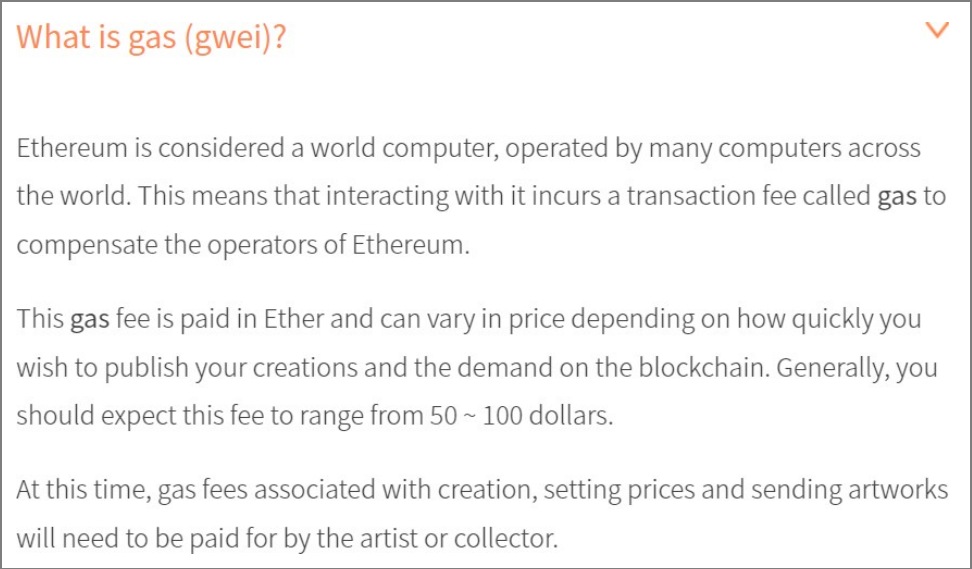
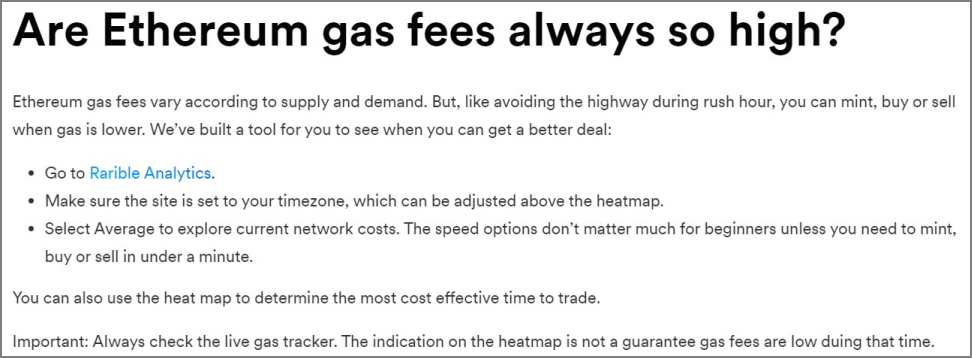
The concept of Gas first appeared in Ethereum. In the Ethereum network, whether it is a transfer transaction or executing a smart contract, it needs to consume the computing or storage resources of the entire network. The consumption of these resources is called Gas. Gas Fee is also commonly used in other public chains. The following uses Ethereum as an example to explain. The essence of Gas Fee is the fee paid to blockchain nodes for bookkeeping.
Regardless of the market in which the transaction is made, as long as it is recorded on the same chain, the actual Gas Fee is determined based on the current Gas Price. That is to say, no matter which NFT platform is used for transactions, as long as they are all carried out on Ethereum, the Gas Fee depends on the current Gas Price (unit: gwei5) on Ethereum. The bid may wait for a long time to be executed or even unable to be executed. The Gas Price of the final transaction multiplied by the specific Gas required for the operation (the Gas required for the basic transaction is 21,000) is the Gas Fee actually paid for this transaction.
image description
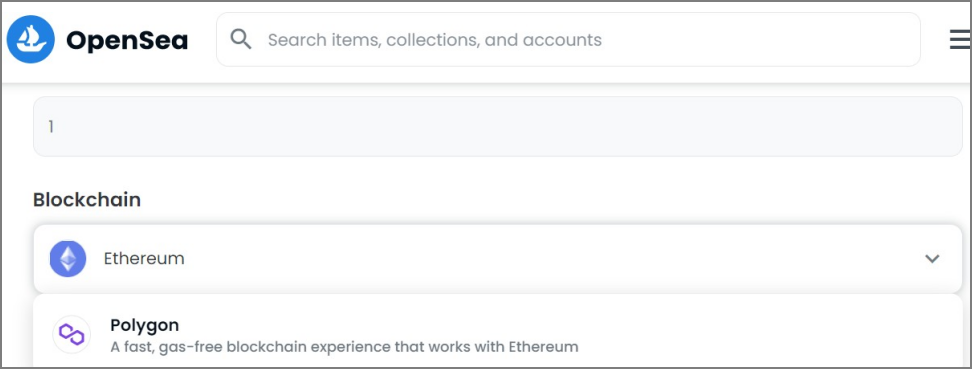
image description
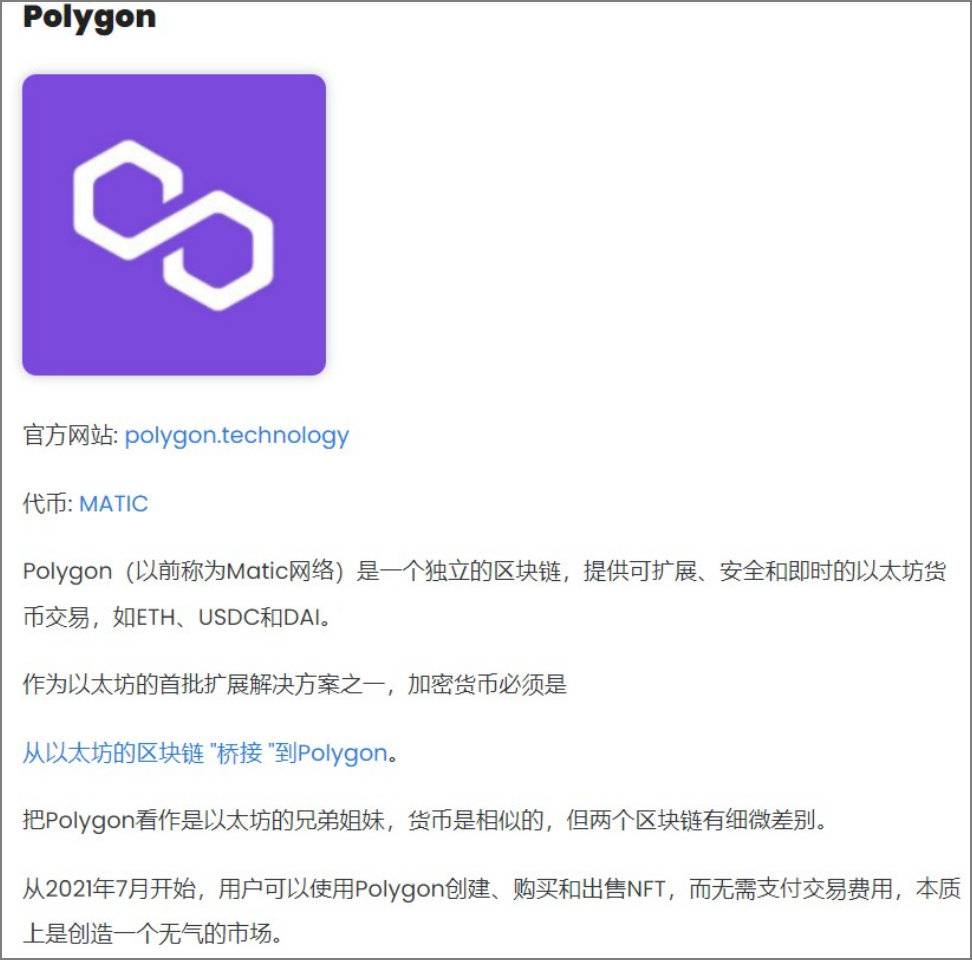
image description
secondary title
(2) Commission
secondary title
(3) Credit card handling fee
secondary title
(4) Taxes and fees
first level title
10. Royalty and cross-platform
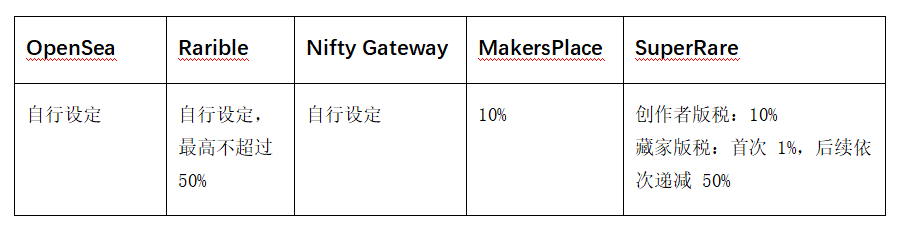
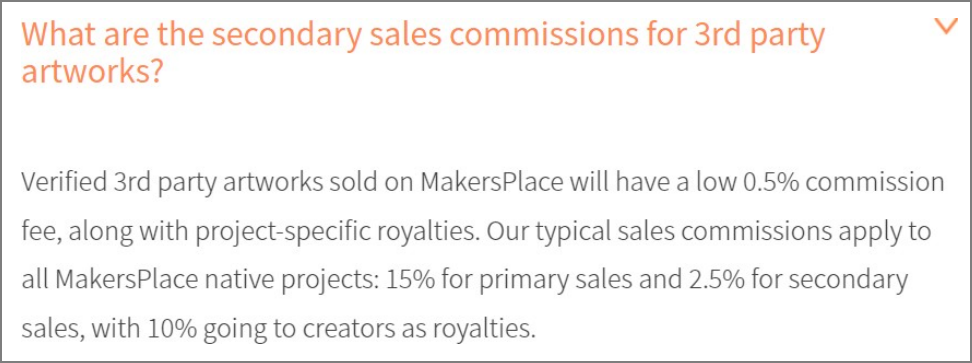
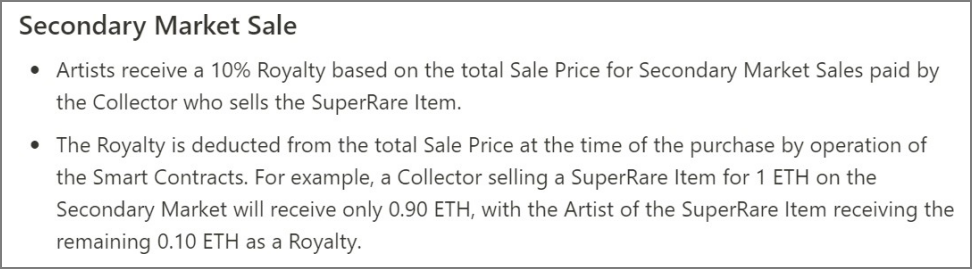
Royalty is also known as the right to repeated income. NFT-related standards allow creators to retain a certain percentage of income rights for subsequent transactions of NFT. Most NFT platforms support royalties, OpenSea, Rarible, Nifty Gateway support self-setting, MakersPlace, SuperRare adopt fixed royalties, and NFTs in chain games generally have no royalties. SuperRare also provides collector royalties to encourage collectors to purchase works of artists with higher market value.
secondary title
the case
Chinese IP Overseas Issuance of NFT Cases
IP class
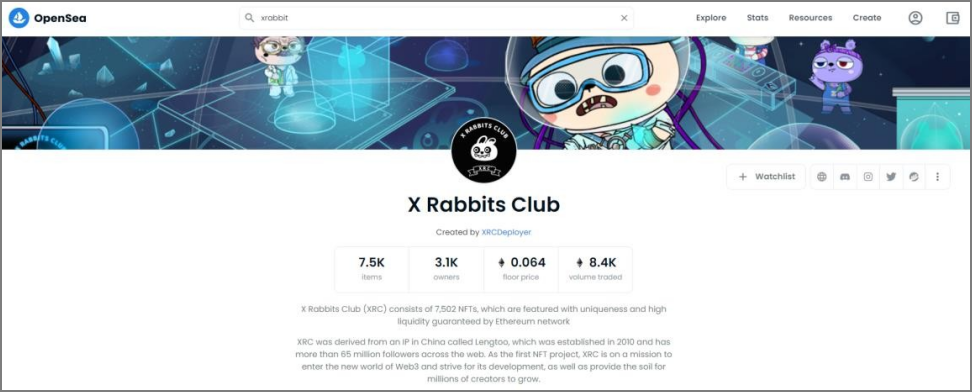
Lengtu, domestic IP, founder Yi Shuihan
Ali, domestic IP
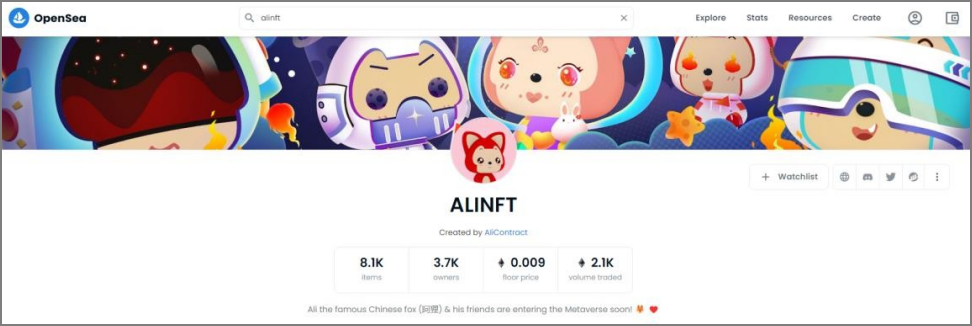
Celebrity tide brand
Phanta Bear, commonly known as Jay Chou, is endorsed by Jay Chou, but his studio explained that the project has nothing to do with Jay Chou, the project is EzekClub, and its founder is said to be Liu Genghong.
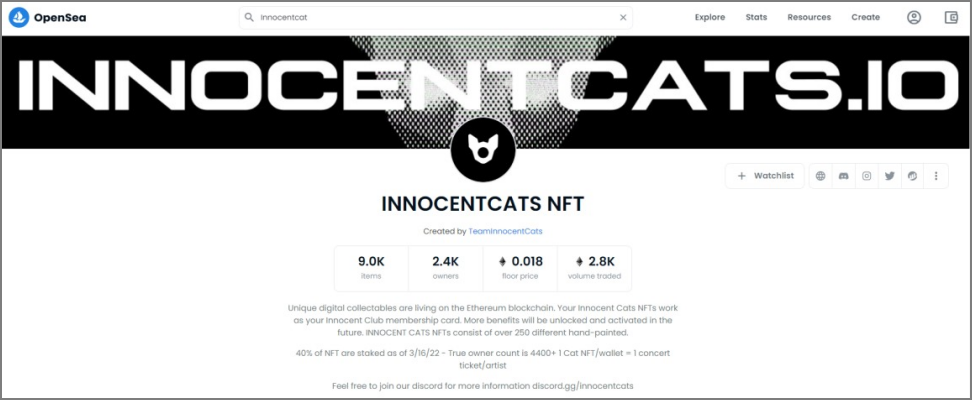
Innocentcat, commonly known as Pan cat, is endorsed by Wilber Pan, and the project code is similar to that of Jay Cub.
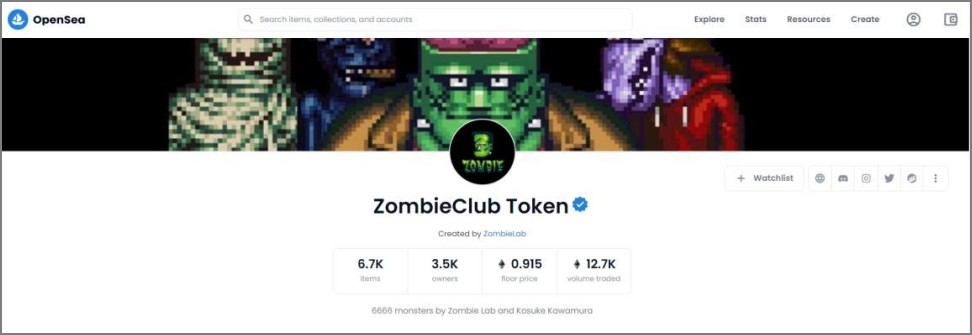
Zombieclub, endorsement by Shawn Yue
Grassroots
secondary title
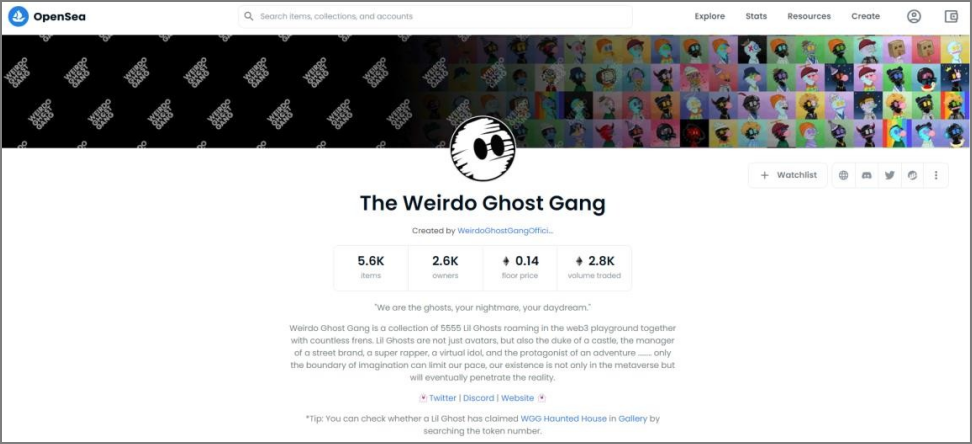
Cases of adding traditional games to NFT gameplay
Ubisoft (Unisoft) launched Unisoft Quartz, a game platform that supports NFT.
Ubisoft introduced NFT item skins (Tezos public chain) in the traditional game "Ghost Recon: Breakpoint" in December 2021. NFTs were released through airdrops. This plan aroused massive (96) opposition from players. Ubisoft dropped the project 4 months after its introduction. At present, Ubisoft plans to launch NFT in new games, participating in the pet game Dogami, and the robot game Rebel bots.
MakersPlace
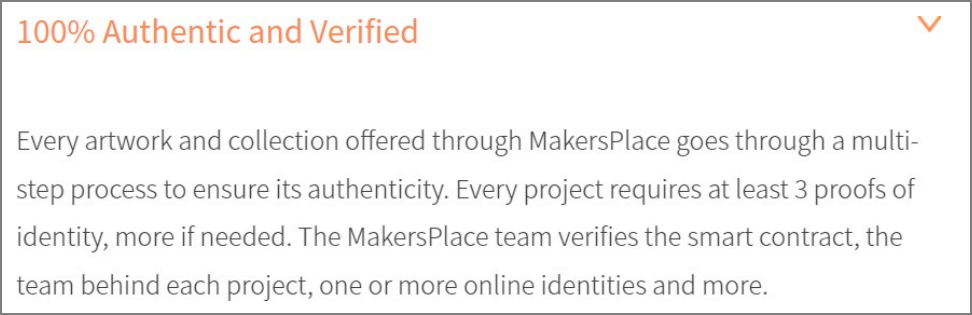
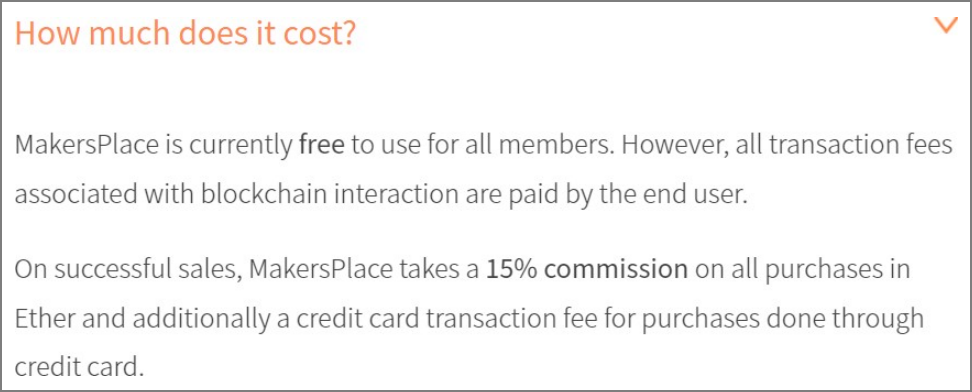
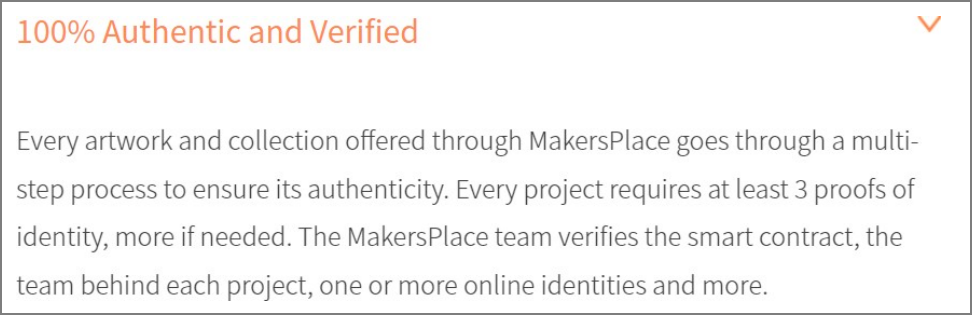
MakersPlace is an established encrypted art platform. The platform covers a variety of digital creations, and mainly promotes limited edition NFTs. The threshold is high, mainly famous artists, and an invitation system is implemented.
https://makersplace.com/faq/
Gas fee, commission
Authentication
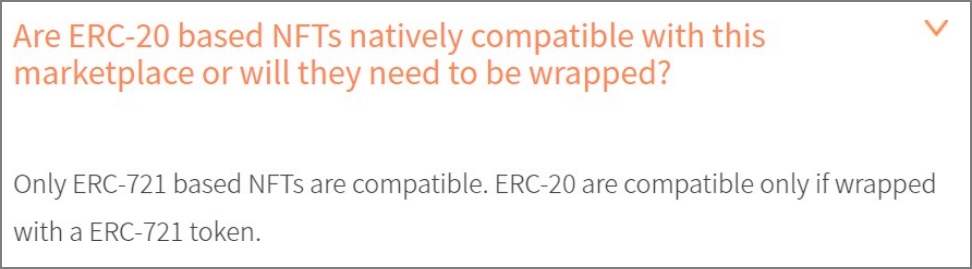
cross-platform compatibility
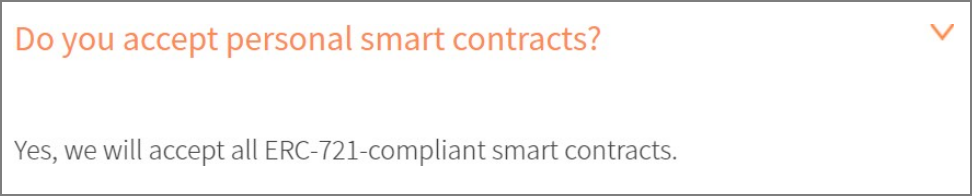
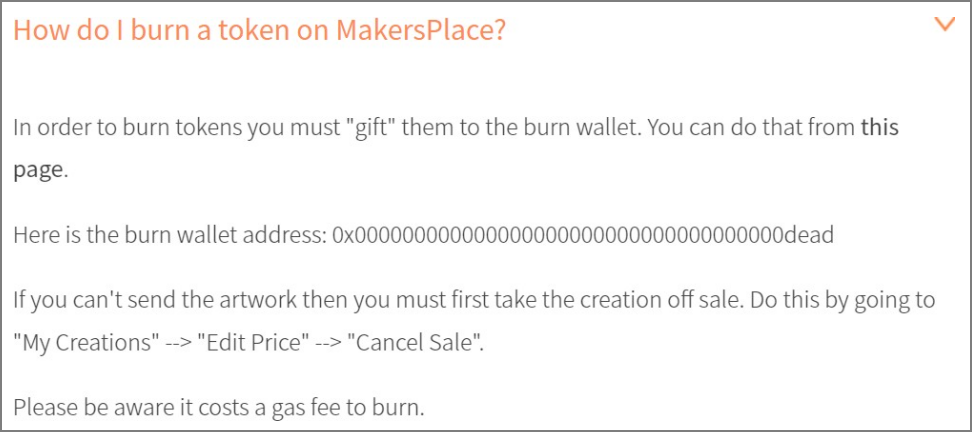
Destroy NFTs
Rarible
Rarible is a comprehensive NFT issuance and trading platform built on Ethereum, creating and selling digital collections protected by blockchain. The platform is an open-source, non-custodial platform for users to mint, sell and create collectibles. Rarible supports Ethereum ERC721, ERC155 standard encrypted artwork, game props, domain name services and other types of NFT transactions. The platform is integrated with OpenSea and supports cross-platform management.
Any user can enter Rarible, create and distribute their own artwork NFT. The platform supports fixed-price transactions and auction transactions. The platform issued the governance token RARI in 2020 to encourage users to participate in token governance and review of works.
https://rarible.com/how-it-works
Ethereum Gas Fee rate problem
The creator can choose to have the gas fee borne by the buyer
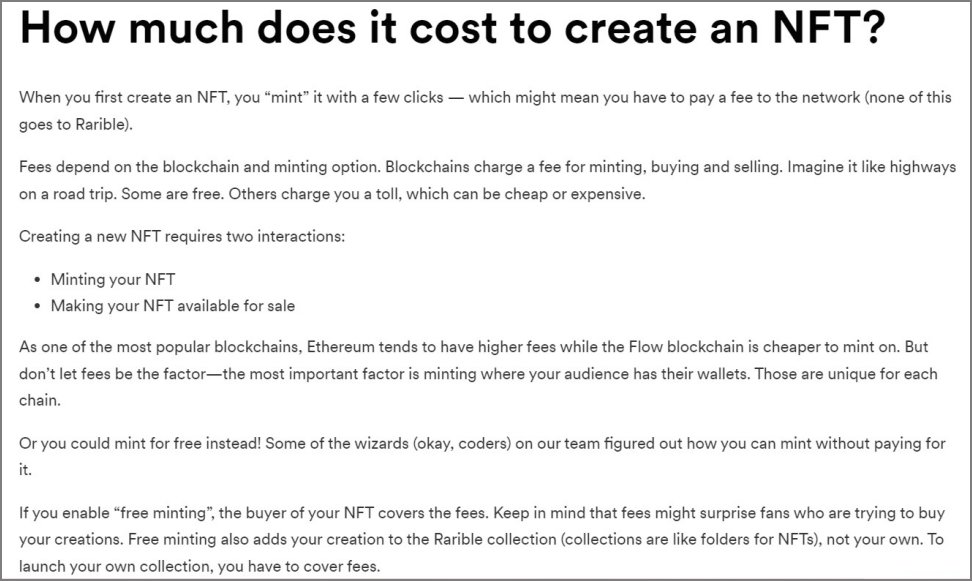
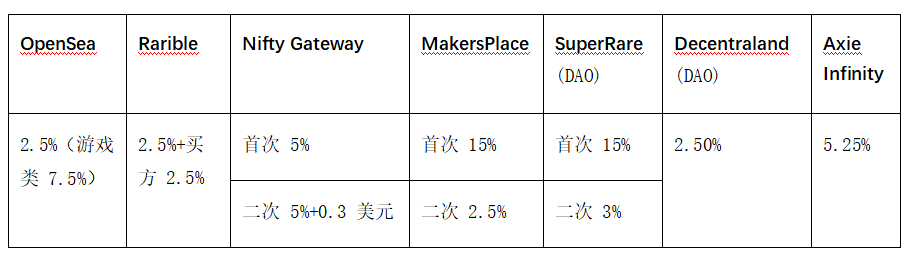
The commission is 2.5 for the seller and 2.5 for the buyer

Rarible says it will take down all pirated content

SuperRare
SuperRare has strict review standards for artists. If artists want to enter SuperRare, they need to apply to the platform. Only the original creators who have passed the review can sell NFT, and they cannot be tokenized elsewhere on the Internet.
https://www.notion.so/SuperRare-Terms-of-Service-075a82773af34aab99dde323f5aa044e
Commission (charged by DAO)
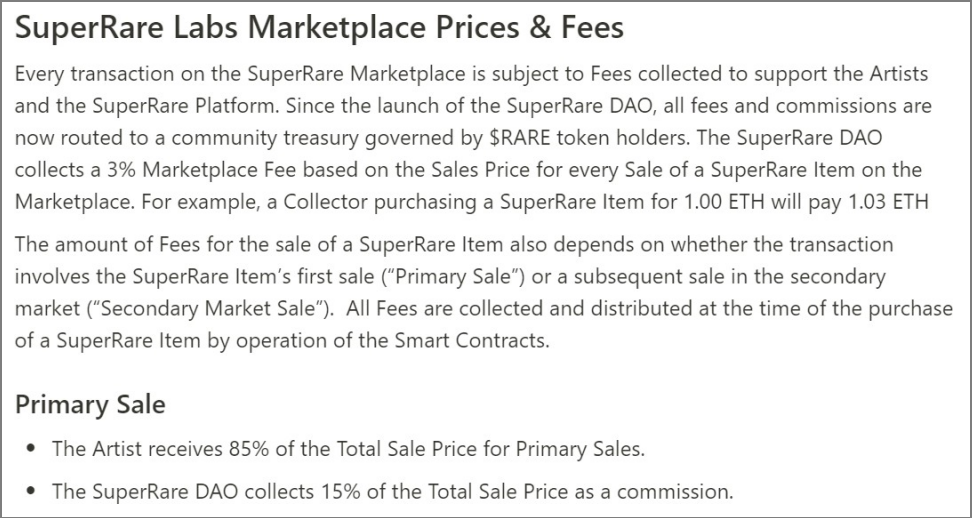
Creator Royalty and Collector Royalty
OpenSea
image description
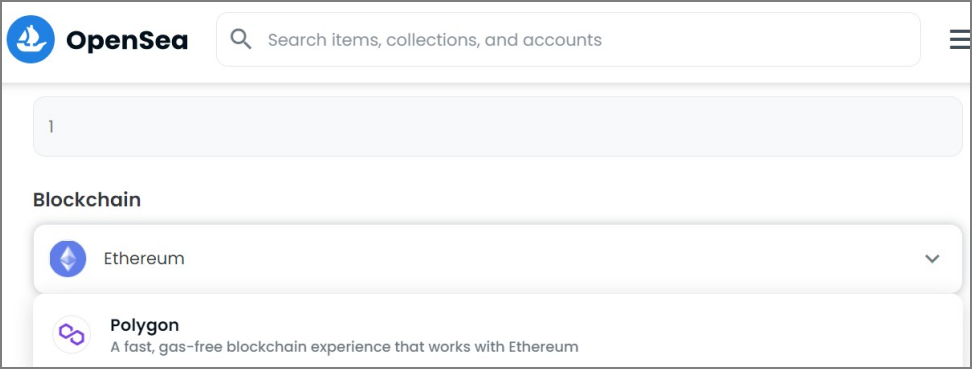
image description
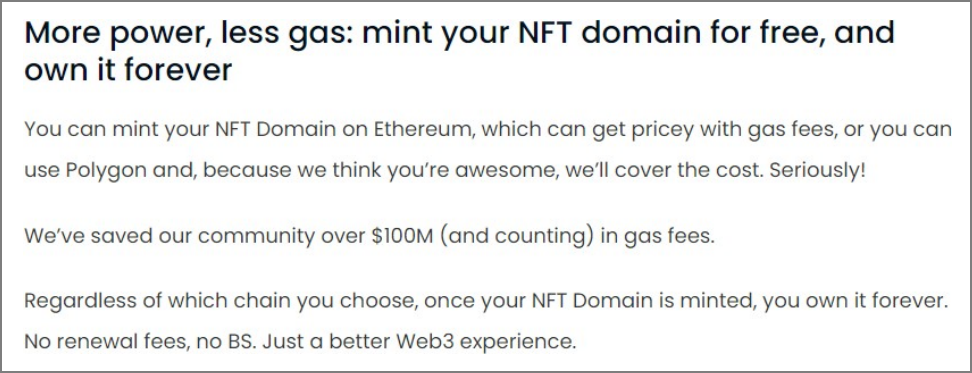
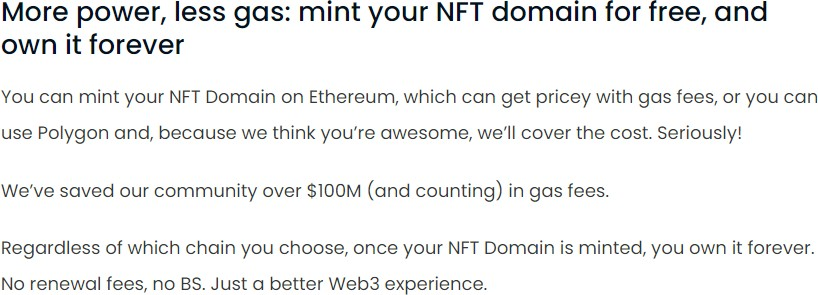
OpenSea said to bear the Gas fee on the Polygon network
Decentraland
Decentraland is a chain game, in which the virtual land is NFT.https://decentraland.org/terms/
Gas Fee

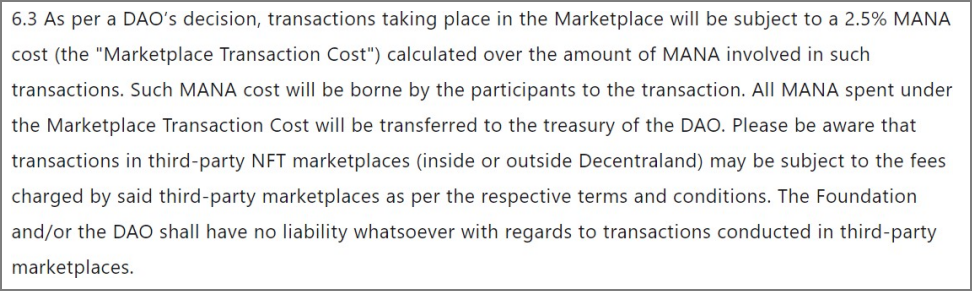
Commission (charged by DAO)
first level title
secondary title
timeline
On April 11, 2022, Li Ning China purchased Bored Ape Yacht Club#4102 and became a member of the Bored Ape Yacht Club family. BAYC with the number #4102 will serve as the manager of China Lining's "Boring Ape Trend Sports Club". For this reason, Li Ning not only specially created the image of a boring ape wearing Li Ning's classic award-winning clothes, but also created a series of clothing items. On the evening of April 24th, China Lining released the [China Lining Boring Ape Trend Sports Club] series of clothing through Weibo.
On April 29, Greenland Group's "Greenland G Youzun Club" official account issued a document stating that Greenland Group has officially purchased BAYC #8302 and used it as an NFT image of its digital strategy. Greenland Group said that in the future, Greenland G-World will be built, through VR and AR technologies, to connect virtual and reality, and realize the interoperability of online and offline scenes. Greenland also stated that it will share the NFT image of Boring Ape with the supporters of Greenland Group, so that everyone can have their first digital collection through Greenland G-World, and also witness the progress of Greenland Gold Chuang and Greenland Group's digitalization process. start up.
Only one day later, on April 30th, Beeasy, a company listed on the Science and Technology Innovation Board for health and smart hardware, also announced the official purchase of Boring Ape BAYC series #1365, following Li Ning’s purchase of Boring Ape #4102 and Greenland Group’s purchase of New member of the Boring Ape Yacht Club family after Boring Ape #8302.
This series of actions can be said to have once again ignited the enthusiasm of domestic companies for overseas blue-chip NFTs (simply understood as high-quality, high-premium NFTs). to follow from
Do joint operation and promotion of your own products.
secondary title
The core benefits of Boring Ape to buyers
The price of Boring Ape has reached the level of more than 2 million RMB. Such a high unit price has not yet appeared in China. The IP that is comparable to it abroad is Cryptopunks, and the price is much higher than Boring Ape. However, in the follow-up operation process Among them, the market acceptance of Boring Ape has gradually surpassed that of Cryptopunks. One of the very important reasons is that the scope of rights and interests that Boring Ape opens to buyers is much larger than that of Cryptopunks.
1. Bind the NFT of "Commercial Authorization"
We can first take a look at the terms of ownership published on the official website of Boring Ape:
In article iii of the clause, we can clearly see the content of "commercial use", which is independent of the scope of article ii "personal use", which is what we are most familiar with in the sense of using NFT as a collection "use, copy, display" rights, and section iii extends to commercial use on this basis, including the use of the Boring Ape image for the production and sale of goods with the Boring Ape image purchased, for more clarity Questions, specific examples are also given in the articles: T-shirts, etc. And this kind of commercial use is on a global scale, which makes domestic buyers spend millions to buy boring apes not only for collection, but also for the development of commercial derivatives, and Li Ning, Greenland and Beiyi already have A mature product system can easily follow the popularity of Boring Monkey and bind it to products and services, adding value to products, so as to gain stronger competitiveness in the market.
In contrast, Cryptopunks does not open such commercial terms, which greatly limits the buyer's subsequent commercial development. This is the key reason why the boring ape catches up from behind. Of course, according to public media reports, in March 2022, Yuga Labs, as the parent company of Boring Ape, acquired CryptoPunks, and then plans to transfer CryptoPunks’ intellectual property, commercial and exclusive licensing rights to various For NFT holders, the "binding commercial authorization" will also apply to CryptoPunks at that time.
2. The traffic rights behind social and community
The holders of Boring Ape not only buy the ability to develop commercial derivatives, but also the social and community attributes carried by Boring Ape are also valued by buyers. First of all, having a Boring Ape is an important identity in itself, and having a Boring Ape’s avatar means entering a brand new social field, which is a manifestation of wealth, identity and a certain trend concept to the outside world. A large number of buyers represented by celebrities The family quickly formed a new social circle using the boring ape as social currency.
In addition, BAYC holders can use the community to form various interactions and cooperation, develop more and more gameplays, regroup their fans and private domain traffic, and even break the circle to complete the accumulation of more traffic. A typical case is that the creators of BAYC united with "10:22PM" to announce the establishment of KINGSHIP, an idol group consisting of a mutant ape and three boring ape characters, including the rare golden-haired ape and rambo ape. With KINGSHIP, "10:22PM" will release music, NFTs, community events, and Metaverse experiences, and kickstart the engagement of a new generation of artists, fans, and communities. This kind of gameplay is becoming more and more common in the Boring Ape Club, giving the holder a huge room for imagination.
3. Metaverse Empowerment
If the rights and interests of the first two modules still mainly rely on NFT holders to develop application scenarios, then a recent announcement by the founding team of Boring Ape can be said to have strengthened the market's recognition of Boring Ape's commercial value.
The news dates back to March 23, Beijing time, when Yuga Labs, the founding company of "Boring Ape", announced that it had raised US$450 million (about 2.8 billion yuan) at a valuation of US$4 billion (about 25.5 billion yuan). Use this funding to build a media empire around NFTs, starting with games and your own Metaverse project. The Metaverse project, called "Otherside," is an MMORPG (massively multiplayer online role-playing game) that aims to connect the wider NFT universe and create an "interoperable world."
In fact, Otherside is a metaverse game world that aggregates various NFT projects, including the well-known CryptoPunks, Meebits, Cool Cats, etc., and of course the "Ape" series of NFTs independently launched by Yuga Labs.
On April 30, Yuga Labs announced that it will launch a new NFT specially designed for the game - "Otherdeed". Otherdeeds will be sold to the public and will also be available to existing Boring Ape BAYC and Mutant Ape MAYC owners.
This action actually created a brand new "Metaverse Space" for Boring Ape, and in this space there are not only Boring Ape, but also other popular IPs and virtual plots, all of which mean that huge traffic will It will be injected into this virtual world, which is undoubtedly an unprecedented "empowerment" for the buyer as the holder. It is a bit like we bought an inconspicuous house in the real world. The plan is to build the city's core CBD.
secondary title
Reference and bottleneck breakthrough of domestic NFT
The author has written two articles before, one titled "New Opportunities and New Challenges Brought by Digital Collections to the Copyright Industry" published in "China Press, Publishing, Radio and Television News", which pointed out: NFT technology brings new opportunities in the field of copyright It is by no means limited to digital collections. After all, "collection" represents "closed", and the real value of copyright lies in "use". Therefore, from the perspective of creating greater market value, NFT must not be limited to collections, but should become a part of the digital economy, The new engine of the copyright economy. Another article ""Remove the reality" or "go to the virtual": the future of NFT digital copyright and the three-point compliance consensus" analyzed the application scenarios of NFT from two completely different directions. Seek derivatives development and application in the real world; one is to "go to the virtual world" to find application scenarios in the virtual world. Metaverse".
It now appears that a series of business operations of Boring Ape fully confirm the above point of view, which also provides a very favorable reference for the domestic NFT industry. We should firmly grasp the two main lines of "going real" - grafting with physical goods and services and "going virtual" - finding application scenarios in the virtual world. At this point, the domestic NFT industry is not too far behind. More and more NFT platforms and issuers have begun to support the issuance of NFT with copyright binding, and some platforms have actively linked the supply of physical goods into the platform to facilitate the faster development of NFT derivatives by NFT holders.
There are also some domestic NFT platforms that have begun to lay out the Metaverse, or cooperate with existing Metaverse platforms to expand the NFT collections on the platform into props and facilities on the Metaverse platform. Some game companies have begun to consider using existing game props NFTization and support for transactions are all beneficial attempts to "remove reality" and "go virtual". I believe that as NFT can find more and more application scenarios, it will inevitably provide sufficient value support at the price level.
secondary title
Special Compliance Issues
1. Whether domestic companies can purchase and whether the purchased rights can be legally recognized
Seeing the news that these domestic companies have repeatedly sold overseas NFT assets, the first reaction of many people is: can they buy it? After all, the vast majority of these assets are to be traded through virtual currencies such as Ethereum. The country obviously does not support the circulation of virtual currencies as currencies, and financial institutions are also prohibited from providing various supports for them as currency circulation. Relevant documents include "About Prevention Notice on Risks of Bitcoin", "Announcement on Preventing Risks of Token Issuance and Financing", "Risk Warning on Preventing Illegal Fundraising in the Name of "Virtual Currency" and "Blockchain"", "Notice on Preventing the Risk of Hype in Virtual Currency Transactions" "Announcement", "Notice on Further Preventing and Dealing with Hype Risks in Virtual Currency Transactions", the regulatory focus of these documents is still to exclude the financial "currency" attribute of virtual currency, but if it is purchased and held as a virtual commodity or virtual property Otherwise,
On May 5, 2022, the official WeChat account of Shanghai Higher People's Court "Pujiang Tianping" released a case about Bitcoin. It has formed a unified opinion on the legal positioning of virtual property and identified it as virtual property”, and pointed out: “In judicial practice, the courts do not make a direct judgment on the legal nature of virtual property based on the attitude of judicial pragmatism. Because it has certain economic value, It conforms to the attribute of property, so it is protected by legal rules of property rights.”
Therefore, it is forbidden to circulate as currency in administrative supervision, and it is accepted as virtual property in judicial practice. Virtual currency is currently such an embarrassing existence in a "parallel universe" in China.
Going back to the issue of purchasing overseas NFT assets, this kind of transaction must take place on an overseas platform, so it is difficult to say that domestic supervision and justice can be governed. In addition, if Bitcoin can be used as virtual property, then the NFT assets obtained from such overseas transactions It is also an acceptable virtual property in my country's "Civil Code". This of course refers to the perspective of using NFT as a digital collection. In addition, Boring Ape is also bound to other rights and interests such as copyright. In fact, it can still be obtained under the legal framework of our country.
It is recognized that copyright is very simple. my country's "Copyright Law" is compatible with the "Berne Convention". Of course, the works of these foreign rights holders can obtain copyright protection in my country, and the relevant authorizations are also legally effective. Other derivative rights and participation opportunities in Metaverse can be adjusted through the creditor's rights rules in the contract law. Therefore, the author believes that it is feasible for domestic enterprises to purchase overseas NFT assets in the legal framework.
2. Equity cut after the secondary transaction
One of the challenges faced by NFTs bound to various derivative rights is the transfer of rights after transactions in the secondary market. After all, this kind of NFT is not as clear as a pure collection NFT. If Li Ning bought a lot of derivative products, After that, Li Ning sold the NFT again, which legally means that Li Ning should transfer the commercial authorization obtained from the Boring Ape right holder. In this way, it should also stop the commercial use of the NFT work at the same time. The used parts (co-branded products that have already been produced, etc.) can continue to circulate, but subsequent new derivatives cannot be produced again, and applications such as "image ambassadors" also need to be stopped.
In practice, such operations are not necessarily clearly visible. If the backhand finds that the fronthand is still using it, whether it is possible to initiate rights protection or must rely on the rights holder of Boring Monkey to do so. I have not seen relevant information on public channels. Terms. From the perspective of our country's legal regulations, I am afraid that we must first find out whether the commercial licensing terms of Boring Ape are "exclusive use rights" or "non-exclusive use rights". We cannot see a clear explanation from Boring Ape's licensing terms. But judging from the distribution model of Boring Ape Unique Edition, it is obvious that it should be more inclined to "exclusive use" which is more in line with the transaction logic of NFT. Of course, the words cannot be too absolute. There are similar NFT projects in China. Although the same commercial authorization is stipulated in the terms, it also points out that the issuer can put it into commercial use by itself, but part of the commercial proceeds will be exchanged with NFT holders. Distribution, so there will be some ambiguity on this issue. The author thinks that instead of leaving it to the court to make a breakthrough determination, it is better for the issuer to improve the terms and directly grant the holder the right to protect their rights.
In fact, there will be another problem here, that is, it is not the former owner who is more likely to infringe on the NFT works, but other third parties who directly plagiarize and use them without authorization. The first case of NFT infringement represented by the author is a typical one. Cases, whether domestic or foreign, direct plagiarism and infringement of NFTs have become very common and are intensifying. In this case, if we all hope that the issuer will come forward to protect the rights, I am afraid it will be powerless, and from an economic point of view, the motivation of the holders to protect their rights is much higher than that of the issuer, so in the subsequent NFT issuance terms, it should be It is very necessary to add rights protection and authorization clauses. The objects of rights protection include both the former holder and other infringing third parties.
3. Further exercise of rights and interests with the help of DAO
NFT is not a digital work or a digital asset itself, but represents the rights and interests certificate of the former, but the rights and interests certificate in the web3.0 era is not only NFT. Other certificates of rights and interests other than NFT are required. Still taking Boring Ape as an example, Yuga Labs will launch an Ethereum-based Boring Ape cryptocurrency in 2022——ApeCoin, which can be used to reward NFT holders and be used for Governance in ApeDAO
(APE will allow ApeCoin DAO members to make decisions on ecosystem fund allocation, governance rules, projects, partnerships, etc.), so tokens are not only used as virtual currency, but also can become community members. Virtual plots can also acquire community DAO membership.
first level title
Metaverse Digital Asset Type
Metaverse is not simply a digital image of the physical world, but has its own unique economic system. With the help of new technologies and new platforms, users can create material civilization to a greater extent, but these material civilizations are all based on digital. Yes, so it is necessary for us to study what types of digital assets exist in the metaverse and how their corresponding ownership is divided.
From the perspective of the existing metaverse, we can simply divide the digital assets in the metaverse into the following categories:
Digital real estate: the most typical is the virtual land in Metaverse platforms such as Decentraland and Sandbox. Not long ago, a piece of land on Sandbox was sold for US$4.3 million, setting a new transaction record for Metaverse real estate. The well-known singer JJ Lin also announced on Twitter that he bought three pieces of virtual land in Decentraland, with a total value of about 782,000 yuan. In fact, this kind of plot is the same as the displayed real estate, both of which are sufficiently scarce, and are necessary places for human social activities, so they are a typical digital asset.
Digital image: The digital image is a passport for people to enter the metaverse. At present, many metaverse platforms are still stuck in simple face pinching. With the continuous maturity of technology, more and more refined digital images will inevitably become the mainstream. At that time, people will no longer be affected by it. The limitation of one's own physical image allows oneself to carry out activities in an ideal form and more than one "clone" in the metaverse, and with the social activities of "digital people", it will inevitably form a digital IP, and even form a digital IP with other digital people. Ethical relationship, so that the digital image is no longer just an avatar symbol in the traditional Internet, but a carrier that can independently carry the value of personal brand and virtual social relationship, so digital image is also a typical type of digital assets.
Digital works: Refers to the content assets with cultural and artistic attributes in the metaverse, such as the current very popular digital collections, whose main value lies in aesthetics and collection, and some digital buildings, digital exhibitions, and digital concerts with aesthetic significance Activities, etc. are digital works because of their aesthetic function.
Digital items: Compared with digital works, digital items have more tool attributes, which can also be called "digital props". Digital real estate, digital offices, digital clothing, digital goods, and more on .
Digital human behavior data: This is somewhat similar to personal information in the real world, especially behavior track information. The various behaviors of users in the Metaverse should be recorded by the system, and then automatically interact with the behavior carrier—the digital human through algorithms, such as placing advertisements, matching friends, etc. These data resources are crucial. If the digital image is the metaverse The external performance of the users in the Metaverse, then the behavior data is the inner essence of the Metaverse users. It can even be said that there are no people in the Metaverse, only the data aggregates composed of behavior data.
Digital currency: This is easy to understand, just like currencies in the real world, most metaverses issue their own currencies (such as Decentraland's MANA currency and SandBox's SAND currency), this model is in my country's current legal framework It is also feasible to download, because there is no essential difference with game coins, points, etc. And many foreign metaverse platforms will anchor the platform currency with tokens such as Bitcoin and Ethereum, which may not be possible in China at present. Digital currency acts as a general equivalent in the Metaverse, and the platform usually controls currency issuance through algorithms, etc., so that it matches the overall asset value in the Metaverse. This is why holding digital currency itself represents Hold digital assets.
NFT digital pass: It can be concluded that the Metaverse is absolutely inseparable from NFT. Unlike digital currency, NFT, as a non-homogeneous pass, should not be regarded as a digital asset in essence, but a digital asset. The function of the equity certificate is to confirm the digital asset itself (through the asset chain) and record the scope of equity. Only after the equity is confirmed can transactions and circulation be carried out. This is the basic logic of economics. But after all, NFT can refer to the virtual assets held, so it can also be regarded as a type of virtual assets for research.
After roughly categorizing digital assets, the next question is to confirm their ownership. The most popular way of traditional Internet platforms is to define digital assets as a kind of debt, which is a service debt established between users and platforms through platform service agreements. Such operations are reasonable, after all, platform services depend on the platform itself The service capability, once given absolute rights and interests, may lead to excessive pressure on the platform.
But entering the metaverse era, one of its biggest features is that the user's autonomous behavior ability is greatly improved compared with the traditional Internet, especially the bottom layer of the metaverse is built on the basis of decentralized blockchain technology, which makes the creation The assets issued can be permanently stored on the chain, and even the governance of the platform is also decentralized, a new way of human organization collaboration
first level title
Decentraland's "Dual Governance" Architecture and User Asset Confirmation
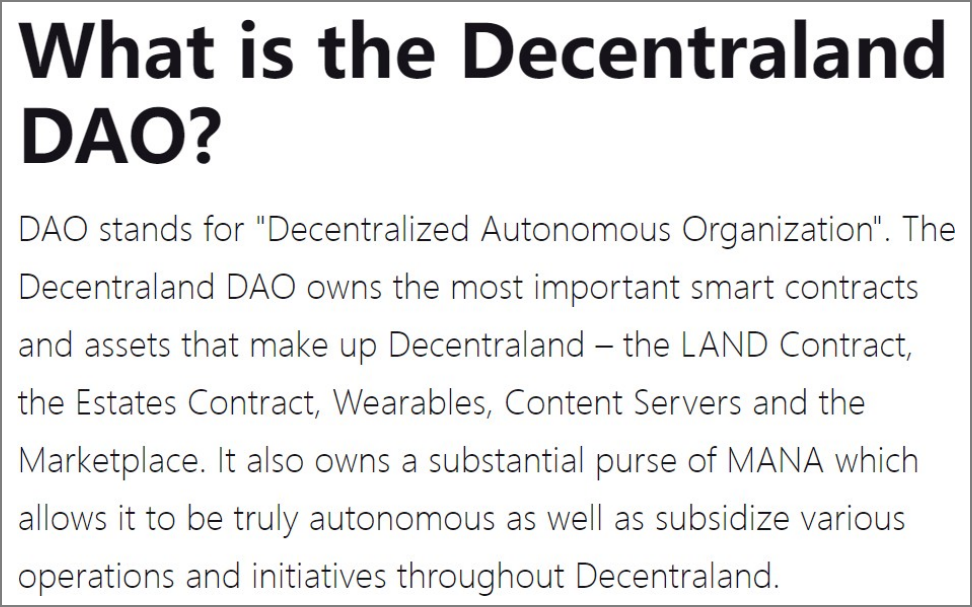
In this way, the Metaverse has created conditions for the redefinition of the ownership of virtual asset property rights, both in terms of creativity and governance. We use an intuitive example to analyze it. Decentraland is one of the most well-known virtual real estate Metaverse platforms. First, in terms of platform governance model, Decentraland operates in a decentralized manner through the cooperation of the two major structures of the foundation and the DAO.
Decentraland DAO is a tool for organizing and implementing collective decision-making on the chain, responsible for controlling the update, maintenance and upgrade of core smart contracts (such as whether market transaction fees need to be changed, whether platform currency MANA holders are rewarded for participating in governance and maintaining the network, etc. ). Additionally, the Decentraland DAO also owns key assets, including Decentraland's public roads and squares.
The Decentraland Foundation is responsible for holding Decentraland intellectual property, trademarks, web domain names, open source code libraries, social media accounts, and all other assets that the DAO cannot own due to lack of legal support.
After understanding the background of the above governance structure, we pay attention to Article 12.4 of the Decentraland Platform Terms (https://decentraland.org/terms/): “Ownership and management of LAND, Non-fungibletokens (NTFs) and Contentcreatedbyusers” (lots, NFTs, and user-created content ownership and management) clarifies the ownership of the rights and interests of the three types of virtual assets on the Decentraland platform, virtual land, NFT, and user-created content. in:
LAND: All title and ownership rights over each piece of LAND lies with its owner. Each LAND owner decides the Content to be included in the LAND and may impose its own terms and conditions and policies. In the case of Districts, the relationship between the District and District participants - in any capacity - is exclusively governed by the applicable plan approved by each community. You are advised to review any such terms, conditions and policies before entering into transactions in any LAND. The Foundation does not control the Content of each LAND parcel and does not assume any liability or obligation in connection thereto.AllContentuploadedtoLANDmustcomplywiththeContentPolicy.TheFoundation holds the Intellectual Property Rights over the LAND smart contract but does not have any Intellectual Property RIght over the Content introduced by eachuser.
Regarding virtual real estate, the terms clearly state that the Decentraland Foundation does not control any land, and does not enjoy any intellectual property rights to the content assets produced by users. The ownership of each land belongs to its land owner user, and each land owner Decide what is included in the parcel and can enforce your own terms and conditions and policies. If the corresponding land is to be traded, the trader needs to understand the various terms and restrictions attached to the land.
NFTs: All title, ownership and Intellectual Property Rights over NFTs, including without limitation, Wearables, belong to the creator of the NFT. Transactions for the sale of NFT
through the Marketplace will convey said title, ownership and Intellectual Property Rights to the purchaser. To the fullest extent possible, the creator will waive any moral rights over the NFTsupontransfertothirdparties.NeithertheFoundationnortheDAOhaveanyIntellectual Property Rights over NFTs created by users. All NFTs must comply with the ContentPolicy.
Regarding NFT, the terms stipulate that all ownership and intellectual property rights of NFT belong to the creator of NFT. A transaction to sell an NFT through the marketplace will transfer the aforementioned ownership and intellectual property rights to the buyer. To the greatest extent possible, the creator will waive any moral rights to the NFT upon transfer to a third party. Neither the foundation nor the DAO has any intellectual property rights over the NFTs created by users, and of course, all NFTs must abide by the content policy.
Content:Alltitle,ownershipandIntellectualPropertyRightsovertheContentcreatedbyusers belongs to the users who created said Content. Neither the Foundation nor the DAO have any Intellectual Property Rights over the user’s Content. The creator of the Content may impose its own terms, conditions and licences for access and use of said Content. You are advisedtoreviewanysuchterms,conditionsandpoliciesbeforeaccessinganysuchContent. All Content must comply with the ContentPolicy.
Regarding user-generated content, the terms stipulate that the ownership and intellectual property rights of user-created content belong to the user who created the content. Neither the Foundation nor the DAO has any intellectual property rights over user content. Creators of content may impose their own terms, conditions and licenses for accessing and using said content. You are advised to review any such terms, conditions and policies before accessing any such content. All content must comply with the content policy.
first level title
SandBox's governance model and asset ownership
Judging from the current SandBox public information, the platform has no organizational structure for launching a DAO, but some media reports that SandBox has a clear statement and plan for realizing platform governance through DAO. The current SandBox is still a governance model in which the platform holder TSB and users directly "dialogue", and TSB has relatively strong control over the content and assets generated by users on the SandBox platform, requiring that no "identical" content and assets appear, and TSB The right not to accept "defective" assets. Therefore, at least at this stage, SandBox's "centralized" governance is stronger than that of decentraland.
At the level of virtual property ownership, according to "TheSandboxTermsOfUse" (Sandbox terms of use, https://www.sandbox.game/en/terms-of-use/) "OWNERSHIPOFTSBCONTENT" chapter takes the lead in clearly separating the ownership of TSB platform content and user-created content:
ByusingtheServices,youwillencounter“TSBContent”,whichincludesalloftheimages,text, information, data, audio, video, graphics and other material included on, or otherwise made available through the Services, excluding your Assets and/or Games. Except as otherwise set forth in these Terms, we do not claim ownership over your Assets and/orGames.
According to the above provisions, the platform has all rights and interests in the content created in the process of providing services, but these contents do not include assets or games (our Assets and/or Games) in which users have rights:
In the chapter "OWNERSHIP OF ASSETS AND GAMES", it is more clearly stipulated that the user is the owner of the assets and games, and TSB does not claim any ownership of the user's assets and games:
DuringtheoperationoftheServices,youmayuploadcertainAssetsandGamesthatyouhave createdtoTheSandboxinaccordancewiththeseTerms.Exceptasotherwisesetforthinthese Terms, you remain the owner of your Assets and Games at all times, and TSB does not claim any ownership rights in your Assets andGames.
summary
You may make your Assets and Games available for purchase in The Sandbox. Each Asset is a non-fungible token (a “NFT”) on the blockchain. When you upload an Asset and make it availableforsaleinTheSandboxmarketplace,youretainownershipofallintellectualproperty rights associated with such Asset but you agree to make a certain number of the Assets availableforsaleasNFTs.EnduserswhopurchasetheAssetownthatunderlying,purchased NFT completely and have the right to sell, trade, donate, give away, transfer, or otherwise dispose of the NFT as they see fit; provided, however, that each Asset will be tokenized so that it will have provable scarcity and proof ofownership.
summary
It is not difficult to find that the two major platforms, Decentraland and Sandbox, have reached a high degree of consensus on the two levels that the property rights of virtual assets belong to users, and that assets are “tokenized” and put into free transactions after confirmation of rights. In terms of decentralized governance , Decentraland seems to be one step ahead, launching a DAO organization parallel to the platform holder foundation. I believe Sandbox will follow up soon, and finally achieve a high degree of unification from governance structure to asset ownership and transaction models.
It should be noted that my country's "Civil Code" has recognized virtual property, which is consistent with the fact that the Decentraland platform grants all rights and interests of virtual assets to users. As a non-homogeneous pass, NFT is used to prove rights rather than tokens It is legally feasible to use online, so it can be said that Metaverse has achieved the convergence and unity of online and offline rules at the level of virtual assets and transactions. The decentralized platform autonomy model of DAO also has solid legal support at the level of the "Contract Law". Therefore, the representative metaverse governance model of the Decentraland platform can be completely inherited to the domestic metaverse platform.
It’s just that some details, such as the design of platform tokens and cross-chain transactions, need to match my country’s current special legal and policy environment.


