Under the change of expansion paradigm, the two types of chain games parted ways



This article comes fromDialecticThis article comes from

, the original author aaaaaaaaaa, compiled by Odaily Shiwen.
The game industry is slowly realizing that blockchain technology can greatly change the game landscape and benefit players.
However, blockchain technology is being constrained by the bottleneck of scalability, and it is necessary to increase computing bandwidth while ensuring decentralization and not increasing verification costs.
At the same time, the blockchain needs to charge users a monetary fee proportional to node verification. Therefore, the computational cost of chain games is quite high. Developers are forced to write code around these constraints, which prevents them from expressing the true potential of on-chain applications.
Fortunately, when Optimistic Rollups and Zk-Rollups appeared, the scalability paradigm of blockchain games changed.
Calculations are run off-chain by high-end machines (provers), while fraud proofs (Op) or validity proofs (Zk) are issued on the settlement chain, which can guarantee the integrity of the calculations.
In this way, network nodes can verify additional proofs faster and cheaper, enabling complex calculations such as game animations at low cost.
For example, the Starknet virtual machine powered by Cairo unlocks this potential because their native programming language is not bound by the EVM.
Thanks to these Rollups, it is possible to increase computational complexity and throughput exponentially while keeping the verification cost linear (or even lower). This is a paradigm shift in blockchain scaling.Speaking of the game scenario, it is not economically feasible to run every unit of the game on a single blockchain, and it will be the same in the future. This is why most blockchain games released in the past few years are hybrids: their stacks have only a few components on-chain, while the core of their game logic runs off-chain on dedicated servers. We call this series of blockchain games。
Weak on-chain games
Axie Infinity, Crabada, and The Sandbox, among others, fall into this category.On the other hand, through off-chain expansion, developers can provide more computing resources at a low cost. Therefore, the logic of the game can eventually be deployed on the chain as a smart contract. We call this series of games the。
Strong on-chain games
In this article, we will explore the advantages and disadvantages of these two categories of blockchain games.
Weak on-chain games
Advantage
Advantage
extend more directly
good user experience
low latency
low latency
Fast bug fix process
Easily ban cheaters
vulnerable
top-down development
closed source
ownership
ownership
non-persistent
non-persistent
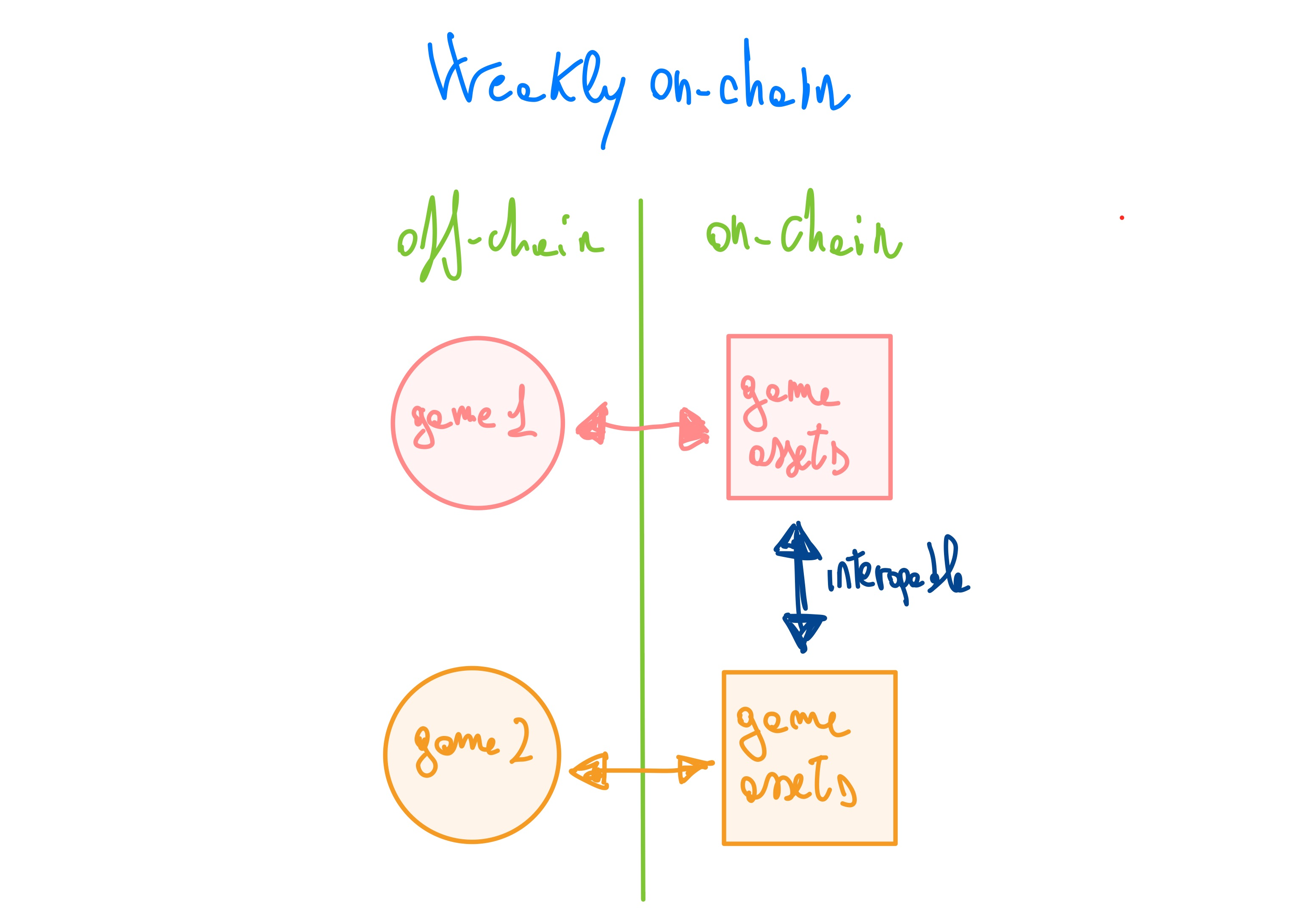
Weak on-chain games are easier to scale because they keep most of their stack off-chain. The game part on the chain is usually in-game assets and in-game tokens represented by NFT, which can be freely traded and transferred in an open and permissionless market. So the game happens off-chain, and the economic settlement is done on-chain.
On the plus side, the user experience is very similar to traditional gaming, and latency isn't an issue given the game's client-server connection type. Any updates can be rolled out without a hitch. Because game access is closed, game publishers can ban players who violate the terms of service.
Advantage
Advantage
open source
open source
bottom-up development
customer abstraction
trust minimization
trust minimization
License-free
vulnerable
user experience
user experience
Players may be exposed to backtracking and other forms of MEV
Delay
Bug fixes may require social coordination
robot
robot
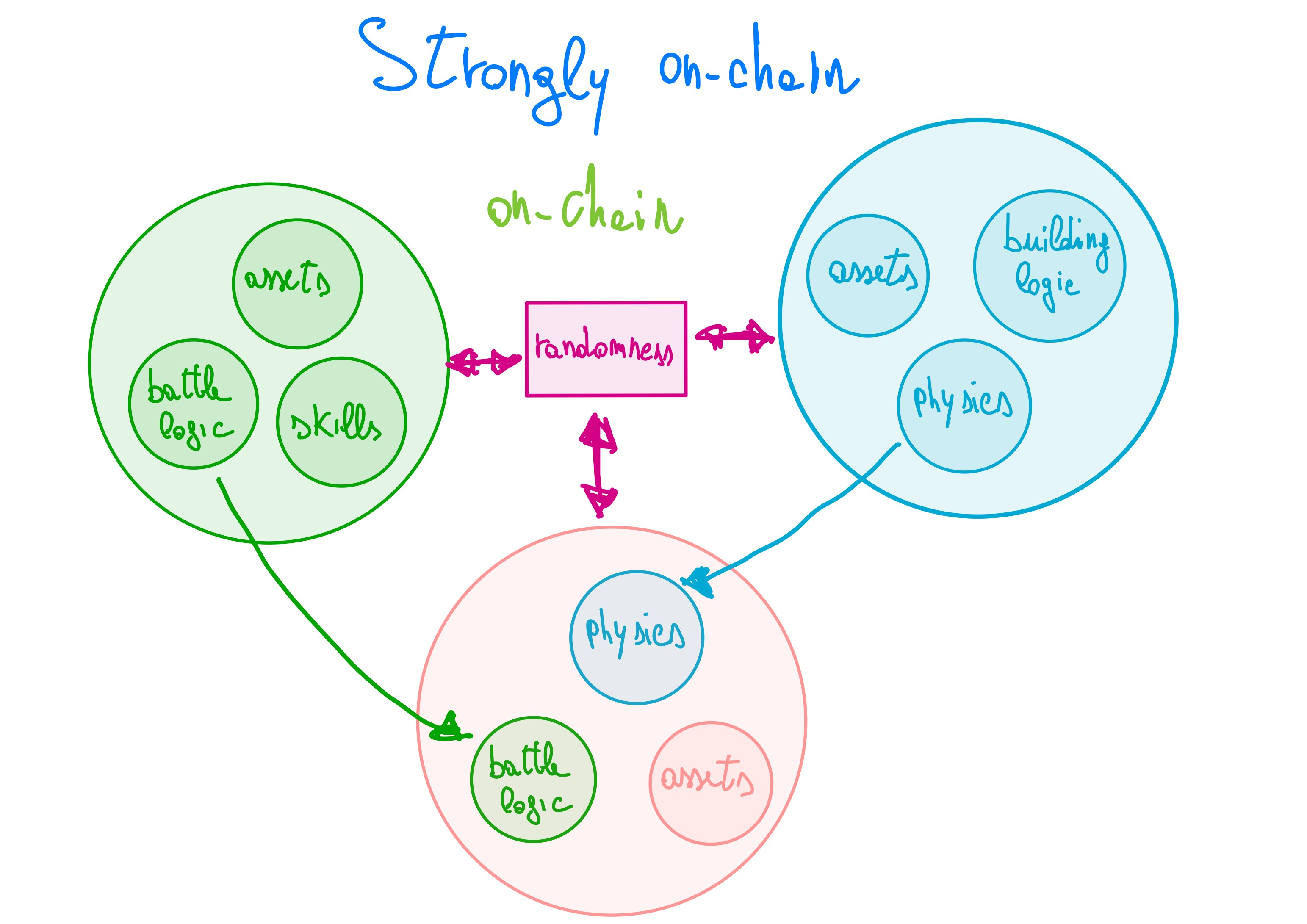
With strong on-chain play, developers can leverage components on any public chain, such as:
physics engine
On-chain VRF primitives for capturing randomness
NTF representing the skill tree, portable to any mod of the game
Mission contracts, anyone can deploy and import their missions in game
Every game component is composable and interoperable, and infinitely replicable.
This sets the stage for endless and powerful bottom-up collaboration. MatchboxDAO is an obvious example.
Let's now look at some of the weaknesses and future challenges of strong on-chain gaming.
secondary title
UI/UX
In games on a strong chain, every state change of the game contract needs to be registered on the chain. Therefore, users need to sign a transaction for every action they perform in the game. This solution is not feasible for high-speed games such as RTS.Account Abstraction (AA) is a clear improvement over Ethereum's account model, and Rollups such as Starknet and Optimism are implementing it.
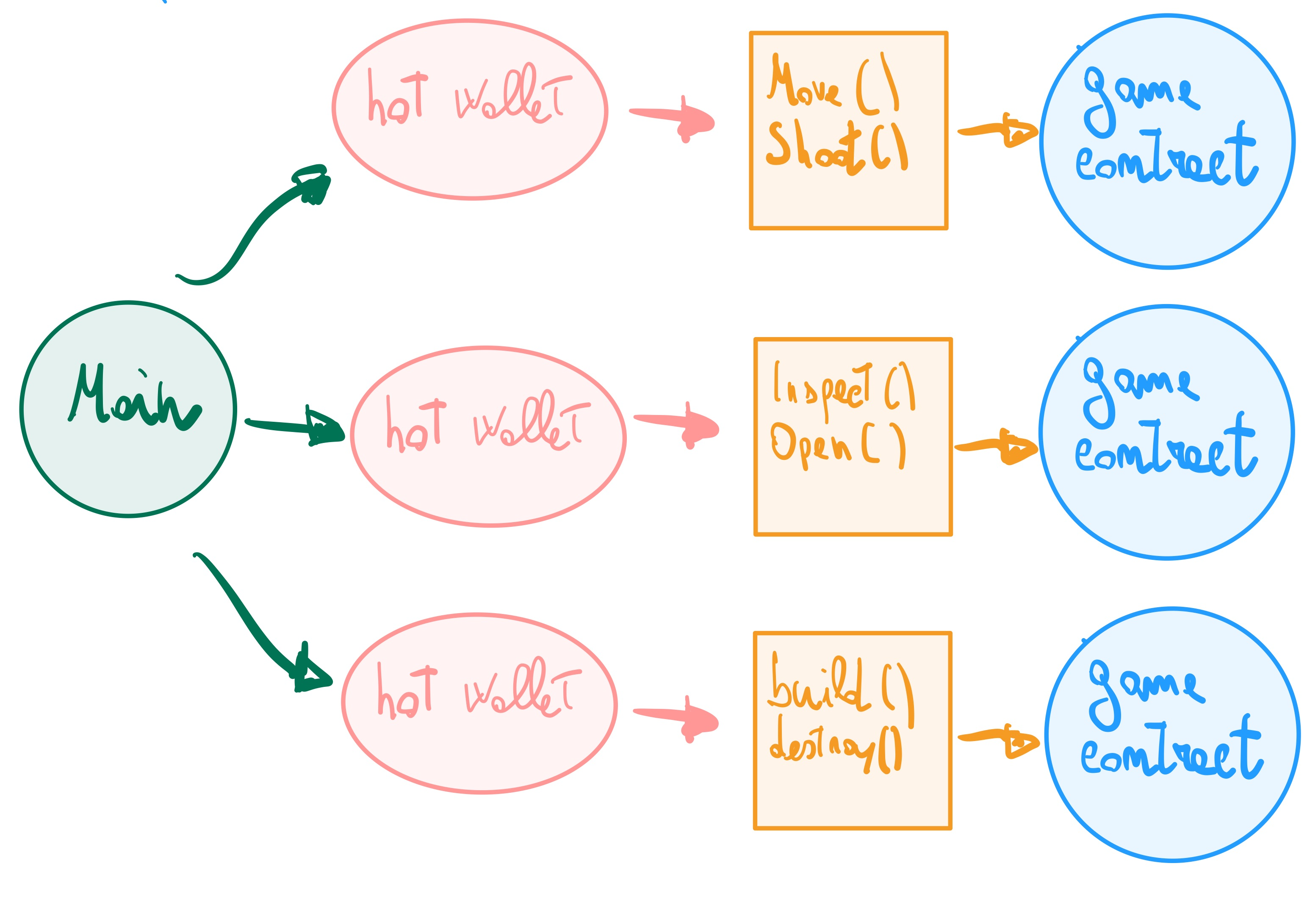 With AA, each externally owned account is a smart contract, allowing the deployment of powerful, secure and highly customizable smart wallets.
This smart wallet saves users from having to sign transactions for every in-game action, while maintaining strong security on the main wallet.
Backtracking and gaMEV
For example, consider a fighting game where Player1 submits transactions related to actions on the mempool, such as high kicks. Meanwhile, Player2 is monitoring the mempool for all transactions from Player1. Once the transaction is submitted, Player2 can predict the opponent's next move and perfectly counterattack the opponent.
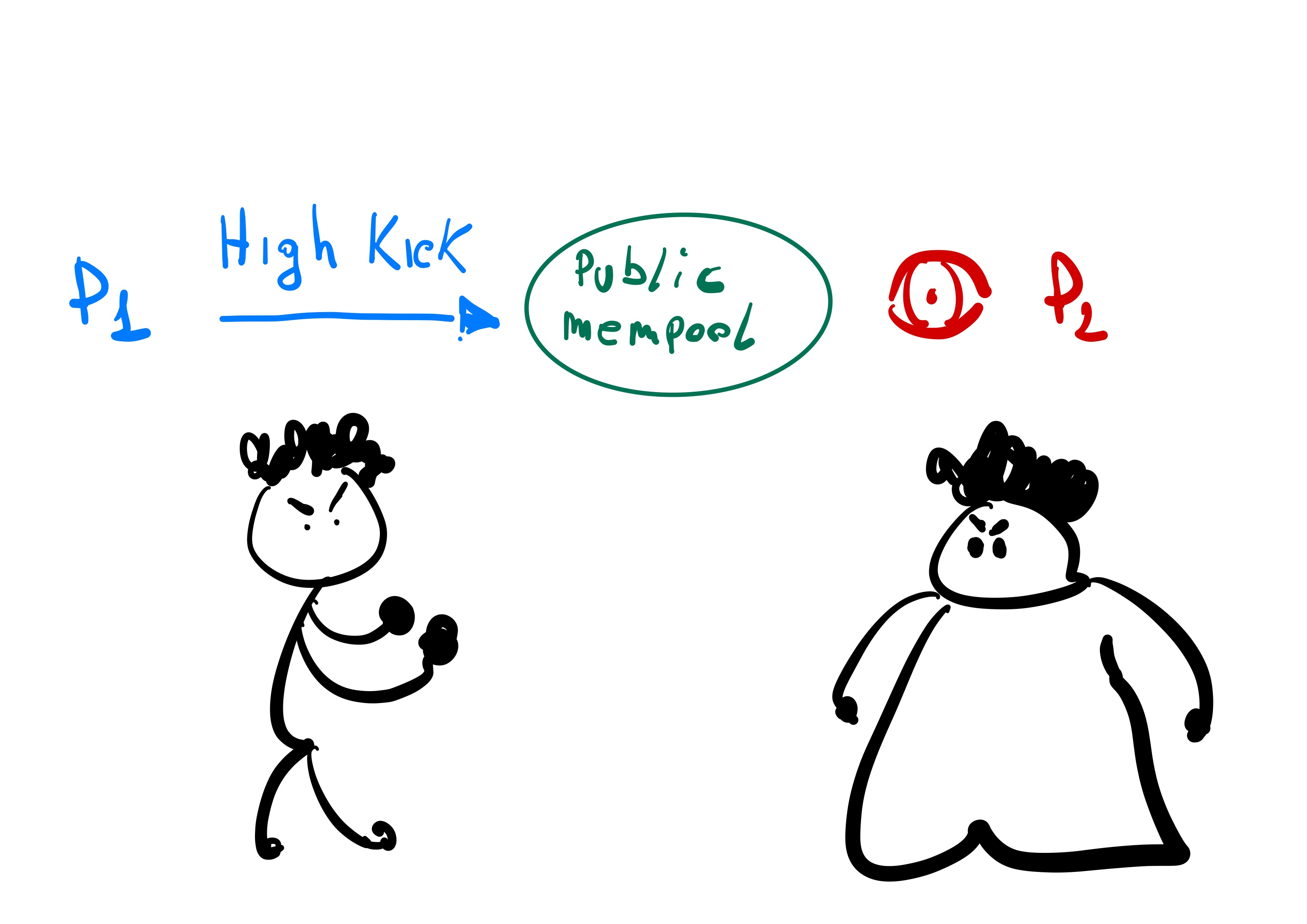
Player1 submits the High-Kick action to the common memory pool. Player2 is listening to the memory pool
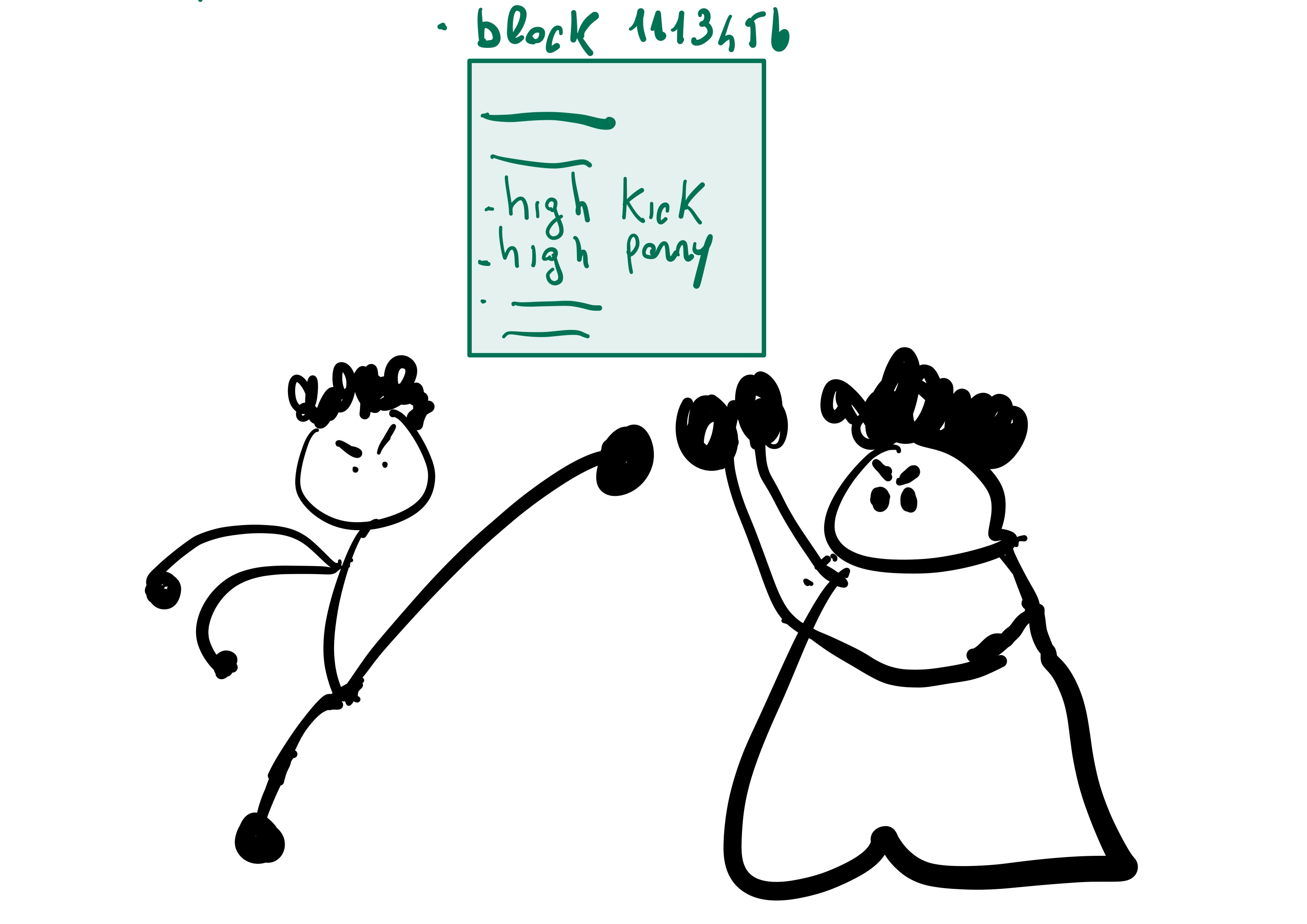
image description
Player2 counters Player1's High-Kick with their High-ParryThe solutions to such problems are:
Prevent backtracking or pre-judgment by encrypting player behavior or sending transactions through private memory pools.
secondary title
information hiding
information hiding
Most competitive games rely on some degree of hidden information.
However, public blockchains store all information in a clear and readable form, accessible to anyone in the world who has access to a node. This allows any observer to take advantage of other players by reading the information stored on the smart contract.
Imagine that in a real-time strategy game, players fight against each other by forming war troops with different attributes. Each user can only see part of the game map due to limited vision. Seeing your opponent's combat tactics in action is a competitive advantage. The blockchain technology can spy on the opponent's combat methods by reading the smart contract, so as to adjust its own strategy.
When information that should be kept private is made public on the game contract, there is an asymmetry between those who can read the storage fields and those who cannot. Since blockchain games often come with monetary rewards, this exploitation process is even more serious.Asynchronous turn-based games may implement a submit-reveal scheme.
Players can publish their actions in a decentralized manner without revealing their underlying intent.Another solution is to utilize zero-knowledge proofs.
Dark Forest is a fully on-chain MMO, the first to use zkSNARKs to protect the privacy of in-game information. In DF, players can conquer planets in the universe. However, they are not required to submit the coordinates of the planets they conquer. Instead, submit hashed coordinates and a locally generated zk-proof. Similarly, whenever they want to move from A Odaily to B Odaily, they need to provide the hash value of the two Odaily coordinates plus the corresponding zk-proof. Only the player knows the coordinates and state transitions because they are stored locally. Every external user will only see the hash and zk-proof.
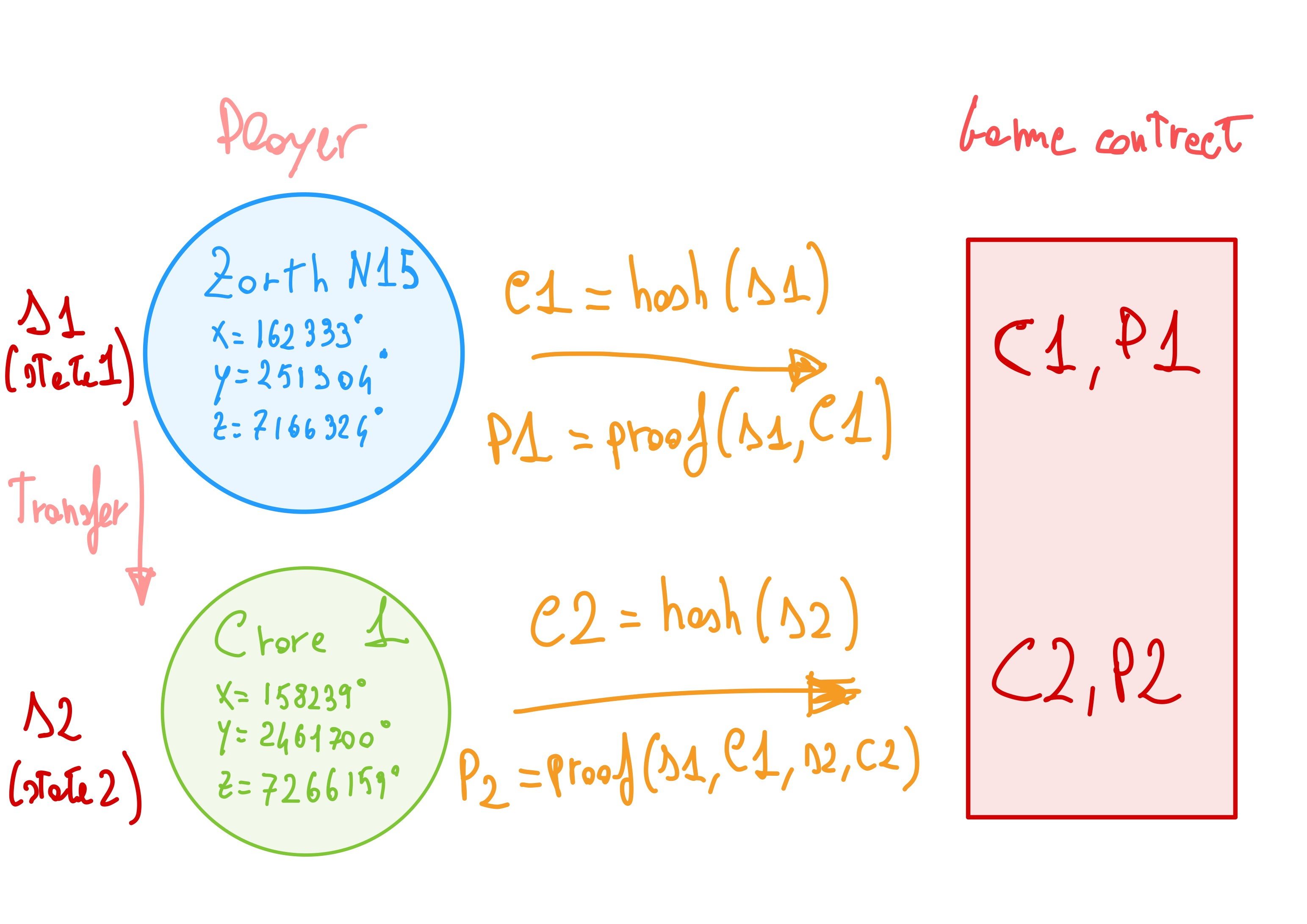
image description
Scheme from the Dark Forest BlogThe biggest disadvantage of ZKPs is that generating them is very computationally intensive.
But for real-time games, we hope that the ZKP generation time can be reduced to sub-second.
Delay
Delay
If tens of thousands of users are reading smart contracts hundreds of thousands of times per second by calling public RPC endpoints, it is possible to quickly overload the network. Ideally, every user should be able to run their local node on their browser/device.In addition, the security of on-chain games may be weaker than that of on-chain finance-related activities, since the financial losses caused by forgery attacks are orders of magnitude smaller. therefore,。
From a security point of view, running a local light node can be considered good enough
Ethereum's stateless client + Verkle tree, Mina's recursive zkSNARKs, and Polkadot's Substrate Connect are all steps toward this path.
However, the RPC congestion problem is only one of the latency problems. Due to the peer-to-peer nature of the network, players may experience high latency due to network topology.
One solution to the lag problem is the Xaya team's gaming channel. As a state channel, players can directly open an off-chain communication channel where they can play their actions while constantly updating the on-chain state.
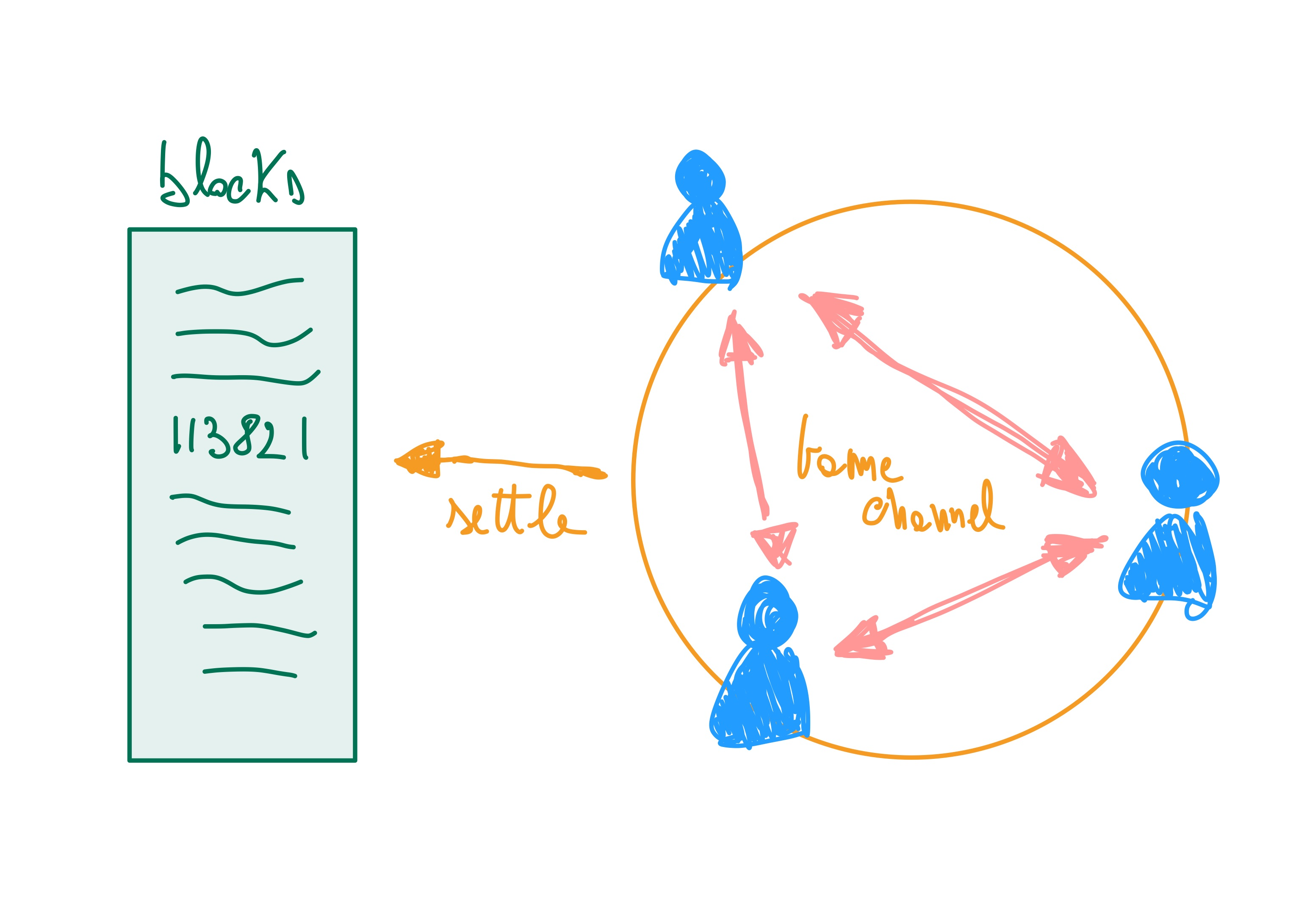 It will allow real-time interactions down to the latency constraints of minimal geographic distance between the parties involved.
Players interact off-chain in their direct communication channels and settle on-chain only when needed. However, opening off-chain channels between two parties can present two major disadvantages:
Establishing the sequence of events without the presence of a central authority;
Prevent denial of service.
Consider a game channel between two players of an FPS game with some delay between the two opponents. Sometimes, they would appear in front of each other and pull the trigger at the same time. From Player A's point of view, they go first. But Player B sees the opposite. How do we determine who shoots first? The above can be traced back to fundamental timing issues in distributed systems. Besides that, when opening a direct channel, players expose their IPs to each other, making them potentially more vulnerable to denial of service attacks.
It is unclear how to address these shortcomings in a scalable and trust-minimized manner.
On Bitcoin’s Lightning Network, third parties can run Watchtowers to detect and prevent dishonest counterparties from stealing users’ funds when they are offline or unable to respond during a breach.In a similar way,。
While the above scheme introduces a centralized component into the game, the most damage these third parties can do is to influence the outcome of a game round by providing incorrect information, but never to steal the user's funds. And, if they are caught acting dishonestly, they could lose their reputation, clients, and even their shares.
in conclusion
in conclusion
The above are just some of the challenges faced by strong on-chain games. We haven't touched on reverting transactions, data storage, etc. yet. Builders will have to develop their game around the technical challenges and negative externalities of blockchain architecture.
Still, on-chain composability and interoperability are very powerful tools. A whole new level of human collaboration, metagame, and MEV opportunities will emerge in the next few years.