






Japanese social giant LINE boards the train of encrypted payments


According to the official website announcement, starting from March 2022, LINE Pay, the built-in payment program of the Japanese social application LINE, will trial the cryptocurrency LINK as a payment option for online merchants in Japan. LINK is the native Token of the LINE blockchain, which is different from ChainLink's LINK. During the trial period, users will be able to pay commission-free with LINK on LINE Pay. Its goal is to expand users' "payment options, increase convenience, and increase real-life usage" for LINK.
This move also echoes LINE's own blockchain plan for 2021, which is to use a lot of manpower to establish connections with payment merchants.
When a user selects LINK as the payment method in LINE Pay, the LINK owned in the LINE BITMAX exchange will be immediately transferred to their LINE Pay account and the payment will be completed. In addition, to commemorate the launch of LINK as a payment method, if users complete the payment trial, they will receive LINK equivalent to 10% of the usage amount as an incentive.
As a long-term development goal, after the trial period, LINE Pay will also continue its efforts to expand the use of LINK, starting from some online merchants to move towards a cashless society in Japan. LINE Pay will continue to build LINK into a cryptocurrency that is closer to everyday life and can be used by anyone under the slogan "Designed for Everyone".
first level title
The beginning of LINE's popularity
LINE's success story began with the Great East Japan Earthquake in 2011. At that time, the sudden and powerful earthquake and tsunami forced many residents of Japan to be displaced. Traditional channels of communication have been disrupted by power outages and destroyed infrastructure, leaving family and friends disconnected. The whole of Japan suddenly fell into a situation of panic, fear and anxiety.
After LINE's parent company HNH's team in Japan noticed this phenomenon, they agreed that it was necessary to develop a "simple, easy-to-use, and fast-communicating" communication software, which can come in handy when telecommunications equipment cannot be used smoothly. With the approval of the parent company NHN, the development team completed the production of LINE and officially released it in just three months. Under the disaster, LINE took on the responsibility of disseminating news online and confirming the safety of residents.
first level title
LINE aims to be "the blockchain closest to life"
Having grown to this height, LINE is not satisfied with the status quo. On the contrary, LINE intends to further expand its field of activities and expand the user ecosystem to the financial technology industry, and the first thing to grasp is the blockchain.
LINE once stated that the core of developing the blockchain is to provide a blockchain service that users can use in their daily lives. "The goal is to integrate the user's life with the LINE blockchain."
In the company's annual strategy meeting in 2018, LINE proposed to use the blockchain to reinvent LINE, revealing its vision of vigorously moving towards the token economy (Token Economy). The first step is to establish two cryptocurrency exchanges within two years.
In 2018, LINE Tech Plus, a subsidiary of LINE in Singapore, launched the cryptocurrency exchange BITBOX, but because it has not obtained a Japanese operating license, it cannot provide cross-border services for Japanese people to use. Then in 2019, Line launched LINE BitMax through its subsidiary LVC, which is more like an exchange designed for Japanese users than BITBOX, which faces the global market.
In addition, there is another big difference between LINE Bitmax and BITBOX: BITBOX, which focuses on the global market, is an independent operation and has not been integrated into LINE; while LINE Bitmax is exclusively for the Japanese market, and its services are directly integrated into LINE, and LINK is the platform agent. Tokens, users can directly enter the exchange and trade in the "wallet".
Immediately afterwards, in order to move towards the goal of "token economy", LINE cooperated with the Korean blockchain company ICON to develop the decentralized blockchain network LINE Blockchain.
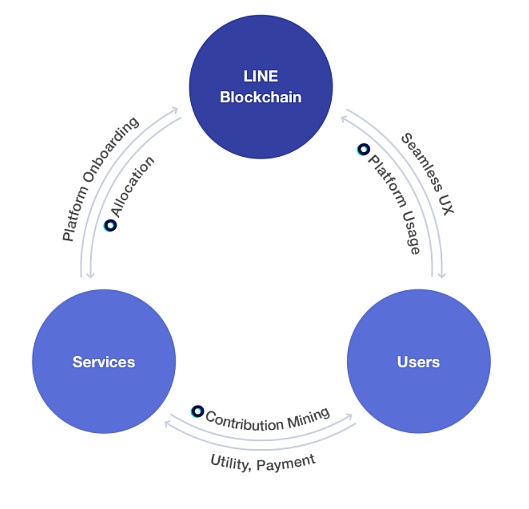
Although "1C0" (blockchain token issuance) was hot in 2018, LINE's native token LINK did the opposite, making Dapp the key to promoting the use and circulation of LINK in the ecosystem, and using LINK tokens as Bonus chips for user contributions. For this reason, Dapps in the LINE ecosystem are divided into two types:
1) Reward-type Dapp: This type of application is usually allocated by the LINK Secretariat (the organization responsible for planning and managing the LINE token economy within the company) after review, and users will get LINK for free when using the application or making contributions. The use cases of such applications can range from paying for music, movies, comics, and novels to in-app payments and remittances between individuals. The services cover content payments, commercial payments, social networking, games, etc. For example, SomeSing, which is built on the LINE blockchain, has a gameplay similar to "National Karaoke". Users upload their own songs and get LINK after getting likes.
2) General-purpose Dapp: All Dapps except reward-type, decentralized applications that any developer can build freely, similar to Dapps on the Ethereum blockchain.
In today's encryption market where "price and market value are regarded as indicators of project results", the strategy of not selling LINK, allocating LINK to users according to the degree of contribution, and early users being early investors can create a user and developer for the LINE ecosystem. The "co-creation relationship" in which the creators and creators grow together.
and
LINE announced in December that it had established a company called "LINE NEXT" to develop the NFT ecosystem. The goal of LINE NEXT is to create an easy-to-operate NFT trading platform, support global companies and creators to establish NFT markets, develop communities and ecosystems, and make it easier for ordinary users to trade NFTs.
Although there is an NFT market on the LINE Bitmax exchange itself, Japanese users can use LINK tokens to purchase NFT issued on the LINE blockchain, but this is only limited to Bitmax after all; and from the currently known information , "LINE NEXT" will be an open NFT platform on which creators can create, mint and directly sell NFTs, and the sales profits will be directly obtained by the creators. In addition, as long as users have a LINE account and its wallet BITMAX Wallet, they can transfer NFT to each other, and can also manage cryptocurrencies and NFT assets without a private key, which will greatly increase convenience and flexibility.
Gao Yongshou, CEO of "LINE NEXT", said: "NFT's technical architecture will subvert the existing industry landscape, including from content, games, communities to business, and comprehensively innovate user experience. As a technological innovator, LINE has Having proven ourselves to be one of the most popular technology companies in Asia with a successful 10-year track record, we will now join forces with our global partners to bet on the exciting new NFT space with the same focus."
From the perspective of these three-step development strategies, the core of LINE is still to create a blockchain service that is easy to use for both general users and developers, while LINK is the "connector" through which all this can happen. From this point of view, The reason why LINE Pay added LINK-based encrypted payments has a long history.
The most easily compared with LINE is the South Korean Internet giant KaKao. As an important platform for Korean people to realize the application scenarios such as "food, clothing, housing, transportation, and transactions", its blockchain department Ground X has also launched a district The blockchain network Klaytn is also based on "Proof of Contribution" and has achieved quite impressive results. In order to achieve global expansion, Klaytn has recently signed 5 cooperation agreements, including the Japanese technology giant GMO Internet Group, to jointly explore key areas of blockchain covering Metaverse and stablecoins.
According to the "Notice on Further Preventing and Dealing with the Risk of Hype in Virtual Currency Transactions" issued by the central bank and other departments, the content of this article is only for information sharing, and does not promote or endorse any operation and investment behavior. Participate in any illegal financial practice.
risk warning:
According to the "Notice on Further Preventing and Dealing with the Risk of Hype in Virtual Currency Transactions" issued by the central bank and other departments, the content of this article is only for information sharing, and does not promote or endorse any operation and investment behavior. Participate in any illegal financial practice.


