






How can DAOs move towards a capture-resistant governance framework?


Original translation: Block unicorn
Original translation: Block unicorn

We often see stories of resources and governance being captured, so we accept it as a fact of life. An executive embezzles company funds to take a lavish vacation, a politician accepts "campaign contributions" from an industry syndicate in return for legal support, unfairly crowds out a new competitor, and the chairman of the company's board of directors leads His company is buying a friend's business/company at an exorbitant premium.
Given the realities of the atomic world, the safest way to manage resources shared by many is to entrust them to a trusted few. An organization's internal governance policies strive to address risks that even a few cannot be trusted with, and are supported by external governance policies implemented by governments.
Each of these governance systems, in turn, is forced to place shared resources in the custody of a few, creating opportunities for bad actors to acquire an organization’s shared resources for selfish needs, or worse, to prevent resources from Acquired governance mechanism, first place.
This "safety" model of centralized hierarchies of power has long been the status quo, and while it has enabled organizations to help create the relatively lavish modern world we live in, it leaves a lot to be desired. If humanity is to address challenges like climate change and public goods infrastructure, we must figure out ways to manage shared resources and significantly reduce the risk of capture.
More recently, breakthroughs have emerged where blockchains and smart contracts have revealed a new trust model for shared resource governance that relies on a combination of cryptography and broad distribution of power. This model enables a new category of governance calledAnti-capture governance。
The promise of anti-capture governance is to manage shared resources in a way that prevents bad actors from capturing those resources. In doing so, it also opens up new areas of mutual possibility. The amazing fluidity, flexibility, and adaptability exhibited by the early web3-native community demonstrates that it is possible when our governance structures avoid capturing shared resources without the rigidity of traditional approaches.
This article introduces Anticapture, a tool for understandingA Framework for Anti-Capture Governance, Anticapture aims to understand the fundamentals of anticapture governance by examining how organizations (modeled as networks of agents) act to manage resources in the service of their goals.
When you finish reading, you'll have the beginnings of a taxonomy and a set of terms that can be used in the context of DAOs, decentralized communities, and anti-capture governance.
This article first defines the key components of the Anticapture framework, then tests them to answer a fundamental question:
1. Proxy and Network
2. Shared resources
3. Action and its four phases
4. Case Study: What Makes a DAO a DAO
first level title
1. Proxy and Network
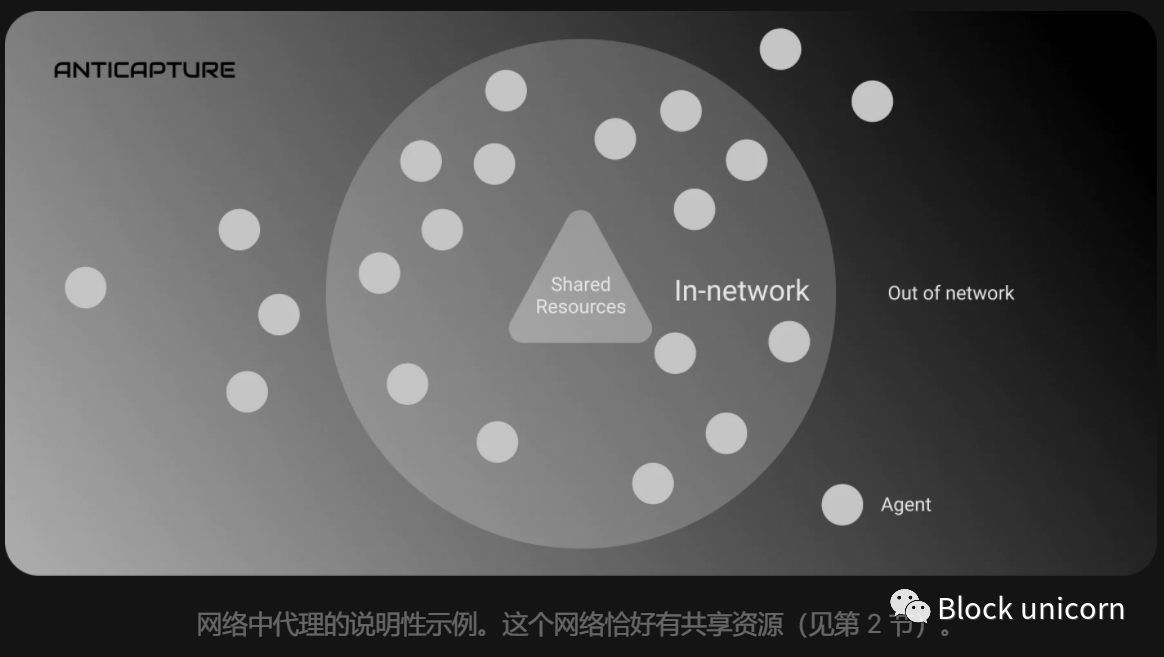
An agent is an individual entity capable of taking action. An agent can be an individual, software representing an individual or a group (e.g., an Ethereum client), or a group of multiple agents.
Anticapture models any group, community or organization of agents as a network. Networks provide the basis for formal analysis, including relationships between nodes, an example of how the strength of these relationships affects the capture sensitivity of the network.
first level title
2. Shared resources
Anything we can use to do or get what we want—from basics like energy, food, and water to more complex things like financial assets, tools, and social reputation—is a resource.
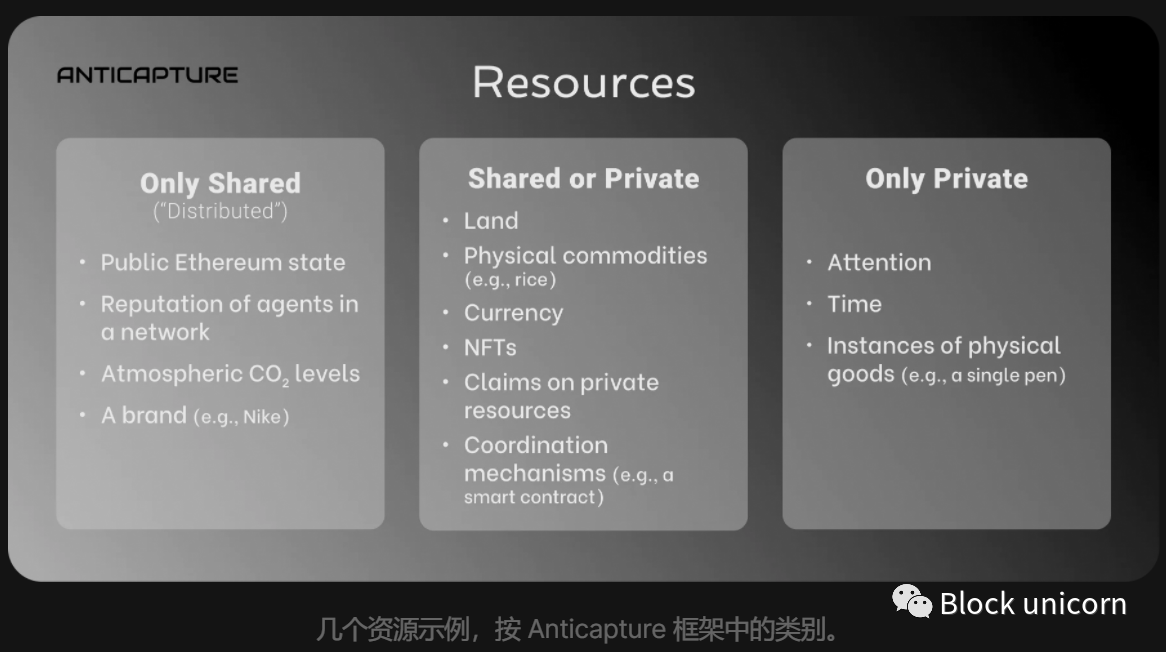
When a resource is under the authority of a single agent, we treat it asprivate resource. ¹ By definition, private resources cannot be captured by internal proxies. They can be captured by external agents, unless the agent controlling the resource is autonomous (see the Enforcement section).
When a resource is under the authority of a network of agents, we see it asShare resource. Historically, shared resources have been easily captured by proxies on and off the network.
An important difference between private and shared resources is their power structure. For example, money can be owned by a person, or by a company, government, etc.
Some resources can only be private, lacking mind control, no one can force you to focus or spend your time in a particular way. They may tempt you to do so by altering your motivation, but the actual resources of time and attention remain under your control. ²
Some resources can only be shared. Power over these resources is decentralized and cannot be privatized. We call these distributed resources. One reason many distributed resources cannot be controlled by any single agent is that they are an emergent property of some larger systems.
Agents Like actions (as we'll see in the next section), the Anticapture framework treats resources as recursive (recursive can understand the self-continuous replication process, you can go to Wikipedia or Baidu to understand) concepts. An agent can be a network of agents, where each action of a given agent is composed of smaller actions of sub-agents. Likewise, agents often use one resource to deploy a second with the intent of influencing a third.
The first-level resources in the previous sentence tend to be coordination mechanisms or governance structures, and while in day-to-day discussions these are often not considered resources at all, the Anticapture framework treats them as resources because actions taken by agents affect them, and They can be captured.
first level title
text
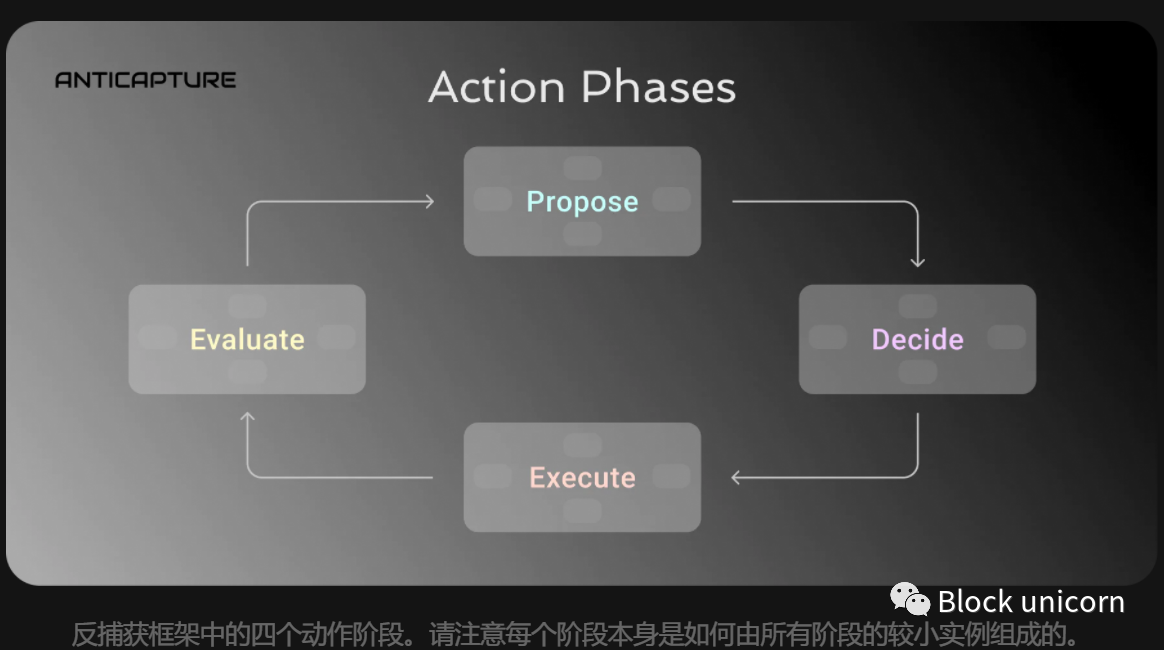
The four action stages in the anti-capture framework, notice how each stage itself is composed of smaller instances of all stages.
Actions are how agents use resources to achieve their goals, and all governance of shared resources takes place through actions. In the anti-capture framework, actions have four phases:
1. Suggestion: delineate the options on the form
2. Decision: Choose the preferred option
3. Execution: putting selected options into action
4. Evaluate: Analyze the impact of the action performed
These phases are recurrent, and the evaluation phase of one action often feeds into the proposal phase of subsequent actions, which are also recursive. Each stage is itself composed of all four stages, and network action is composed of the actions of individual agents, which is true on many levels.Organizational actions consist of actions taken by individuals, and individual actions consist of actions taken by networks of neurons.
The sections that follow examine each of these stages in turn, focusing on their role in the action lifecycle and their relationship to power control and sensitivities to access shared resources. As we move through each stage, remember the basic principles, power itself is a resource, and soft power capabilities are the power to influence people to have basic resources.
Note that while agents can gain access to shared resources by accumulating base or soft power, the greatest risks relate to base power. Networks are most vulnerable to capture during the operational phases in which basic power is used, so these phases are the most critical for anti-capture mechanisms.
a. to make suggestions
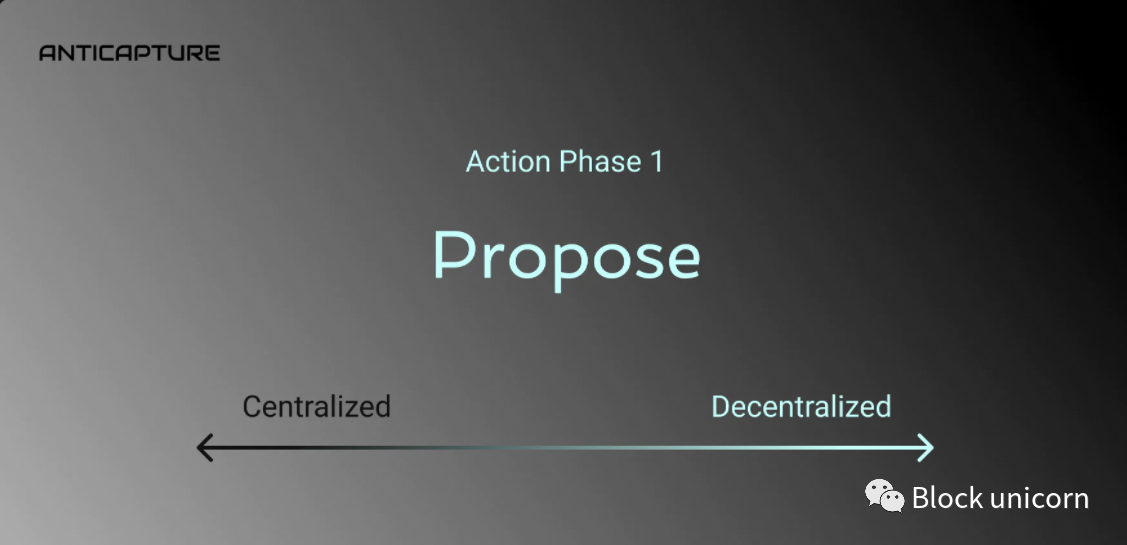
The agent's agenda is set during the proposal phase, what problems should the agent try to solve? What options should a surrogate consider?
Proposal stages within the participating network range from centralized to decentralized, describing how widely distributed power is to add options to the network's agenda.
In networks where the agenda is informal and does not define which actions can be carried out, proposed powers are influential, not fundamental. The proposal does not affect the shared resources of these networks, so the risk of capture is low and some degree of centralization is acceptable.
However, in networks where actions must go through a formal proposal process—especially those using anti-capture mechanisms—the power of a proposal is an expression of fundamental power, as it directly affects the proposal list shared resource. A decentralized proposal stage is critical to protecting such networks from capture.
b. to decide
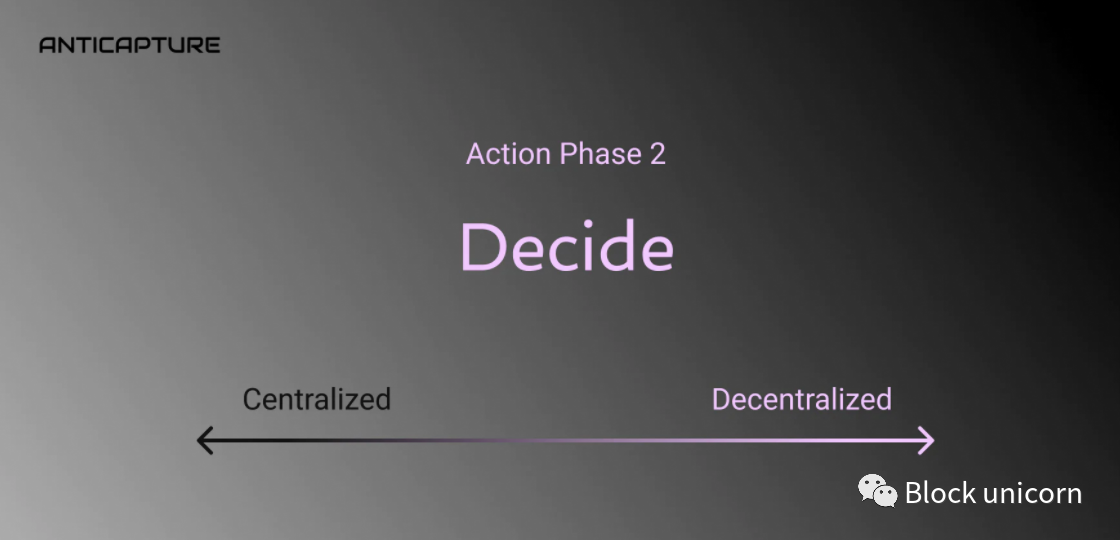
The options on the agenda are selected for execution at the decision stage. Should the agent execute the proposal? Which suggested options should the agent choose?
Participation in decision-making stages, from centralized to decentralized, describes the proportion of agents in the network that have a say in the decision-making process.
We often assume that decision-making is where power lies, after all, the boss makes the decisions, does the boss have power? Bosses are powerful, but not quite. In the context of cyber operations affecting shared resources, bosses are indeed the ultimate decision makers, but more importantly they have the authority to execute the actions they choose. In and of itself, decisions about what actions to take do not affect the network's shared resources, and for this reason decision-making must be coupled with execution.
Therefore, the risks captured at the decision stage are not catastrophic. While decentralized decision-making is beneficial in many situations, it is not a strict requirement for effective anti-capture. We'll see why in the next section.
c. to execute
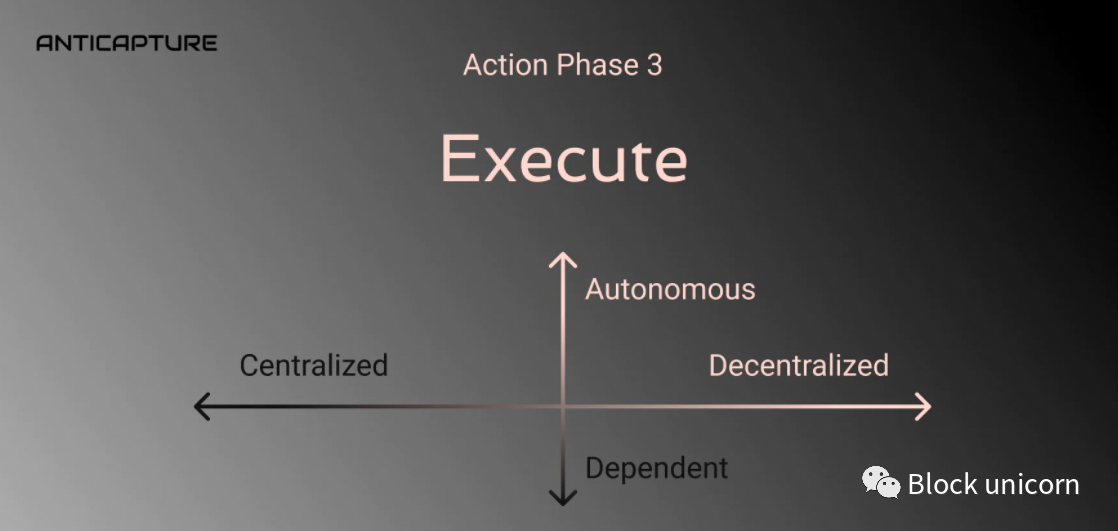
In anti-capture governance, execution is king. The Execution phase is the phase in which selected operations are performed, it is where actions are executed, and where resources are deployed and affected.
Participation in this phase ranges from centralized to decentralized and describes the proportion of agents in the network that share power to perform the actions chosen in the decision phase.
As we mentioned, in the network, agents that can participate in this phase exercise fundamental power in the form of direct control over network shared resources. If this power is concentrated in the hands of a few, the network can easily be seized by inside agents. Regardless of the degree of decentralization of the decision-making stage, there is nothing structurally that prevents those with executive power from ignoring the outcome and executing the actions they want.
Even if such a network avoids capture, centralized enforcement can have other negative effects. As we saw in the previous section, anyone involved in decision-making without executive authority must win the favor of executives to see their recommendations implemented. Even though the decision-making phase is technically decentralized, in practice a centralized execution phase exerts centralized power over the decision.
This is how many traditional organizations operate, non-executives are subservient and have much less chance of having a significant impact on the organization. ³
Decentralized execution is a game changer. Decentralized execution is strong support for other forms of capture where centralized execution would create an existential capture risk. As long as executive power in the network remains distributed among a majority of agents, the network has the flexibility to experiment with various forms of decision-making and evaluation.
The separation between decision-making and execution rights is only possible in an anti-capture structure. This is why decentralized decision making is not strictly required. This is why decentralized organizations can be fluid and adaptable. When executive power is decentralized, leadership can truly emerge from anywhere.
Execution has a second dimension due to its nature of changing the state of the world. This occurs on a scale from dependent to autonomous, describing the degree to which external agents can stop, alter, or otherwise interfere with execution.
Most traditional organizations rely on rules and regulations enforced by parent agencies to prevent internal capture. The actions they perform require the approval of external actors, which means they are easily captured by these actors. On the other hand, networks that perform actions autonomously are difficult to capture by external agents.
d. Evaluation
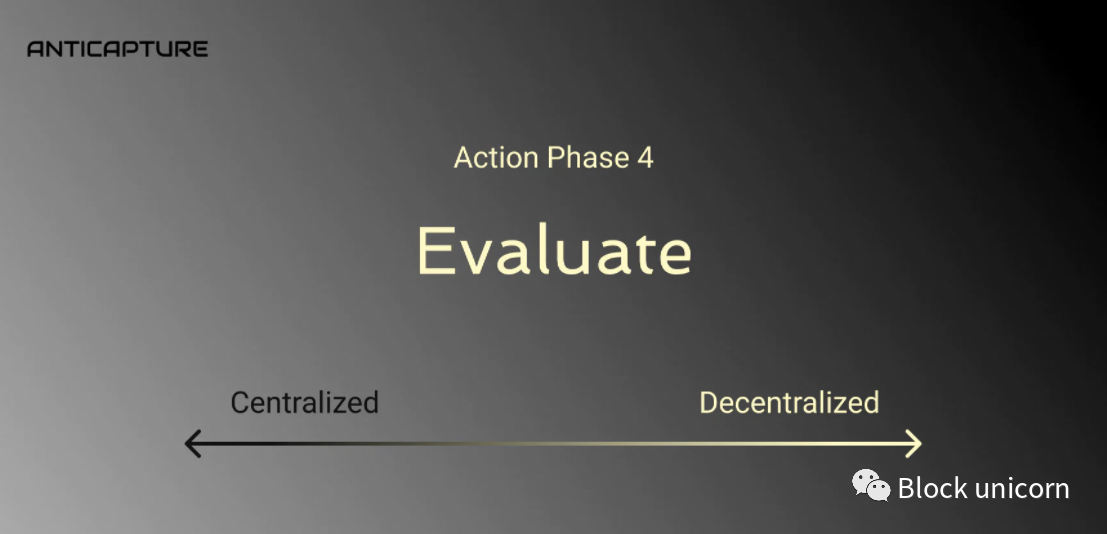
The agent analyzes the impact of executing actions during the evaluation phase. This assessment often becomes the input to the proposal phase of follow-up actions, thus starting a new cycle of action.
Participation in the evaluation phase ranges from centralized to decentralized, with the degree of decentralization often determined by the transparency of network operations. If the network is organized and communicates publicly on a public blockchain, even external agents can participate in evaluating its behavior.
first level title
image description
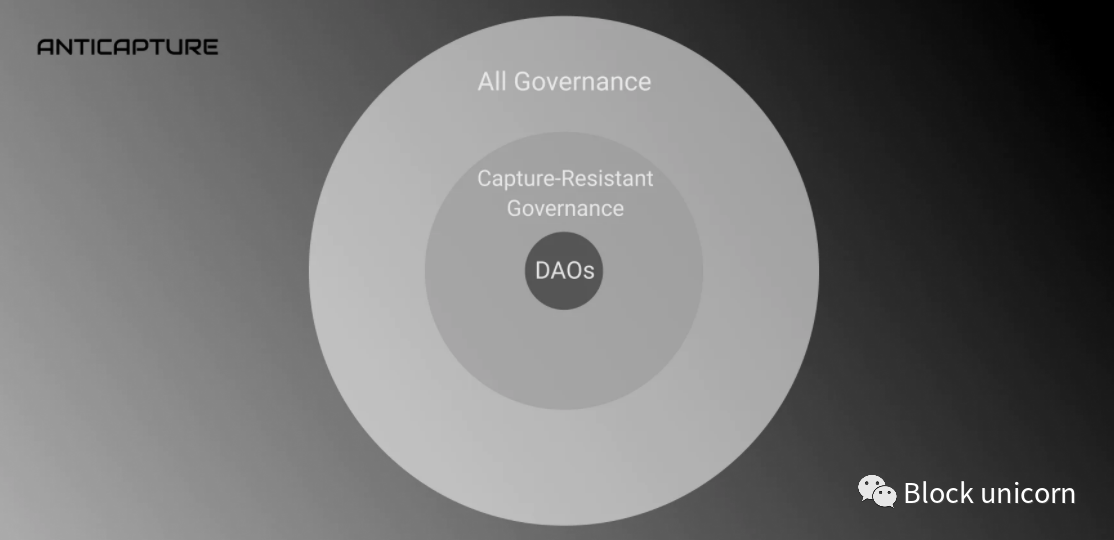
DAOs are the strongest form of capture-resistant governance
The Anticapture framework can be used to investigate many issues related to anticapture governance, many of which we will explore in subsequent articles. Today, we look first at one of the most pressing questions in the field:What makes a DAO a DAO?
Most approaches to answering this question to date have defaulted to referencing a specific technology (e.g., “DAO is an organization run through smart contracts”) or prescriptive structure (e.g., “DAO members own tokens and use them to vote on proposals”) . However, for a definition to go beyond existing implementations, it must remain calm and adhere to first principles.
With the Anticapture framework in place, we can conceptualize DAOs as a powerful form of anticapture governance. In a sense, this means that DAO inherits the basic properties of parent anti-capture governance. Like any instance of anti-capture governance, DAOs are networks of agents that manage shared resources, and they have a purpose.
The purpose of a DAO does not need to be explicit, and a DAO may have multiple purposes. In fact, the purpose of a DAO may even stem from the different motivations of the agents in its network. To say that the DAO has a purpose is to say that it has a purpose.
Finally, like other forms of capture-resistant governance, DAOs protect their resources from capture to some degree.
What distinguishes DAOs from other forms is the manner and strength with which DAOs resist capture, specifically, DAOs are difficult to capture at their most vulnerable point: the execution phase (described above) - the point at which the network takes action on its shared resources.
When a DAO takes actions that affect or exploit its shared resources, the execution of those actions occurs in a decentralized and autonomous manner. The decentralized aspect of execution requires all agents in the network to share the power to perform actions, and this is how DAOs primarily resist capture by internal agents. On the other hand, the autonomous aspect of enforcement requires that no agent outside the network has the authority to execute or alter the DAO's operations, which is how the DAO is primarily resistant to capture by external agents.
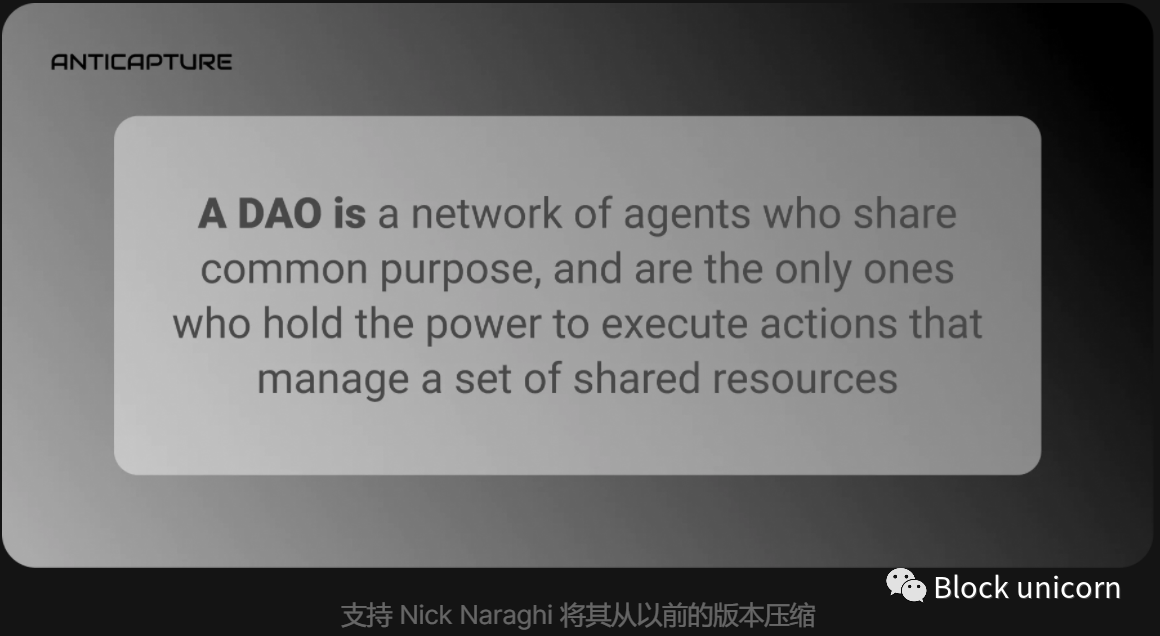
To sum up, we can summarize the single-sentence definition of DAO:
A DAO is a network of agents with a common purpose, and the only one authorized to perform governance, to operate a set of shared resources.
first level title
5. Where to go from here?
If you choose to accept, your task is to use the Anticapture framework in your thinking, discussion and work related to DAOs and other forms of governance. When encountering a new decentralized community, or working in your own, ask yourself how easy it is to be captured. What shared resources does it have and how are they managed? How distributed (or centralized) is executive power?
When you do this, you may find that many communities calling themselves DAOs do not meet the standards suggested by the Anticapture framework. Some of these aspiring DAOs may be structured as tokenized communities, with multi-signature libraries "controlled" by Snapshot signals, where execution power is concentrated in the hands of a small number of multi-signatures.
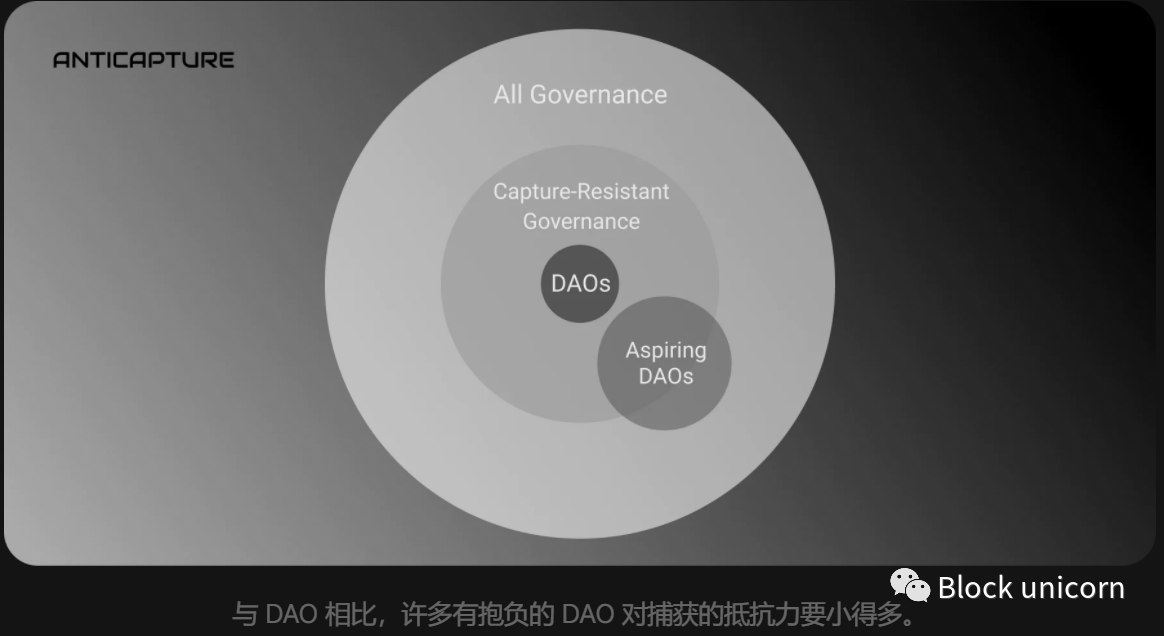
If you come across one of these less-than-trivial organizations, consider two things. First, how does it change its structure to become more resistant to capture? Second, what are its valuable properties that should be explored and possibly preserved in new structures?
In this article, we touch on the properties that make anti-capture governance a powerful new tool for human progress, and we use the framework in an example to better clarify what a DAO really is. In future articles, we will explore the Anticapture framework further and in more detail to develop a complete taxonomy of the many forms of anticapture governance.
first level title
final summary
1. In this context, "private" here refers to general concepts describing power and control, not to specific exercises of power in access control or obfuscated forms such as "privacy".
2. However, shares to such resources can be declared.
3. Social dynamics and reputation can moderate these effects, but only partially under certain conditions, such as when executives need to maintain public reputations.


