






Dex Perpetual Protocol Drives the Rise of Solana Ecosystem


Article translation: Block unicorn
Article translation: Block unicorn
SolanaIt has received a lot of attention from investors in the last quarter. SOL is up 50% over the past 30 days and nearly 500% against the USD over the past 90 days (24% and 249% against ETH, respectively). In many ways, price discovery has seen a healthy boost in all areas - $100M gaming fund announced, Brave announces native web3 integration, Reddit invests $100M for social media, Neon Labs raises $40M After USD was used to introduce EVM infrastructure, ppleasr launched NFT on Solana, FTX built NFT integration, and of course, Solana's DeFi ecosystem has achieved 4 times TVL expansion since September.
While Solana has certainly developed many growth catalysts recently, how is the ecosystem performing against the narrative from earlier this year? One of these is Solana's potential as a network that can support a high volume of transactional activity. Perhaps under the professional influence of some of the largest investors in the ecosystem, including Alameda and Jump Capital, among others. Solana now has a relatively high concentration of derivatives-focused protocols compared to other ecosystems.
Let’s step back and look at the Solana protocol, focusing on offering one of Crypto’s favorite trading products — perpetual contracts.
For some simple background, a perpetual contract is a futures derivative product that does not require a contract rollover, just a single product that provides continuous future exposure to a specific market. For traders, it's an easy way to gain leveraged futures exposure to an asset without the inefficiencies of actually buying the underlying asset. As such, it is by far the most traded product in the cryptocurrency. Perpetual notional volume on centralized exchanges (CEXs) for BTC and ETH markets alone hit $2.7T in October, while all CEX spot markets traded at $1.25T.
Decentralized exchange (DEX) perpetual markets still lag spot volume. For example, dYdX, the leading DEX perpetual protocol, has traded close to $3B in volume over the past 24 hours, while all DEX spot markets have traded over $7.5B. The biggest protocols in this space are dYdX (starkware), Perpetual Protocol (xDAI - soon to be Arbitrum), MCDEX (Arbitrum and BSC), and of course the Solana ecosystem: Mango Markets, Drift Protocol and Bonfida all offer perpetual contract products.
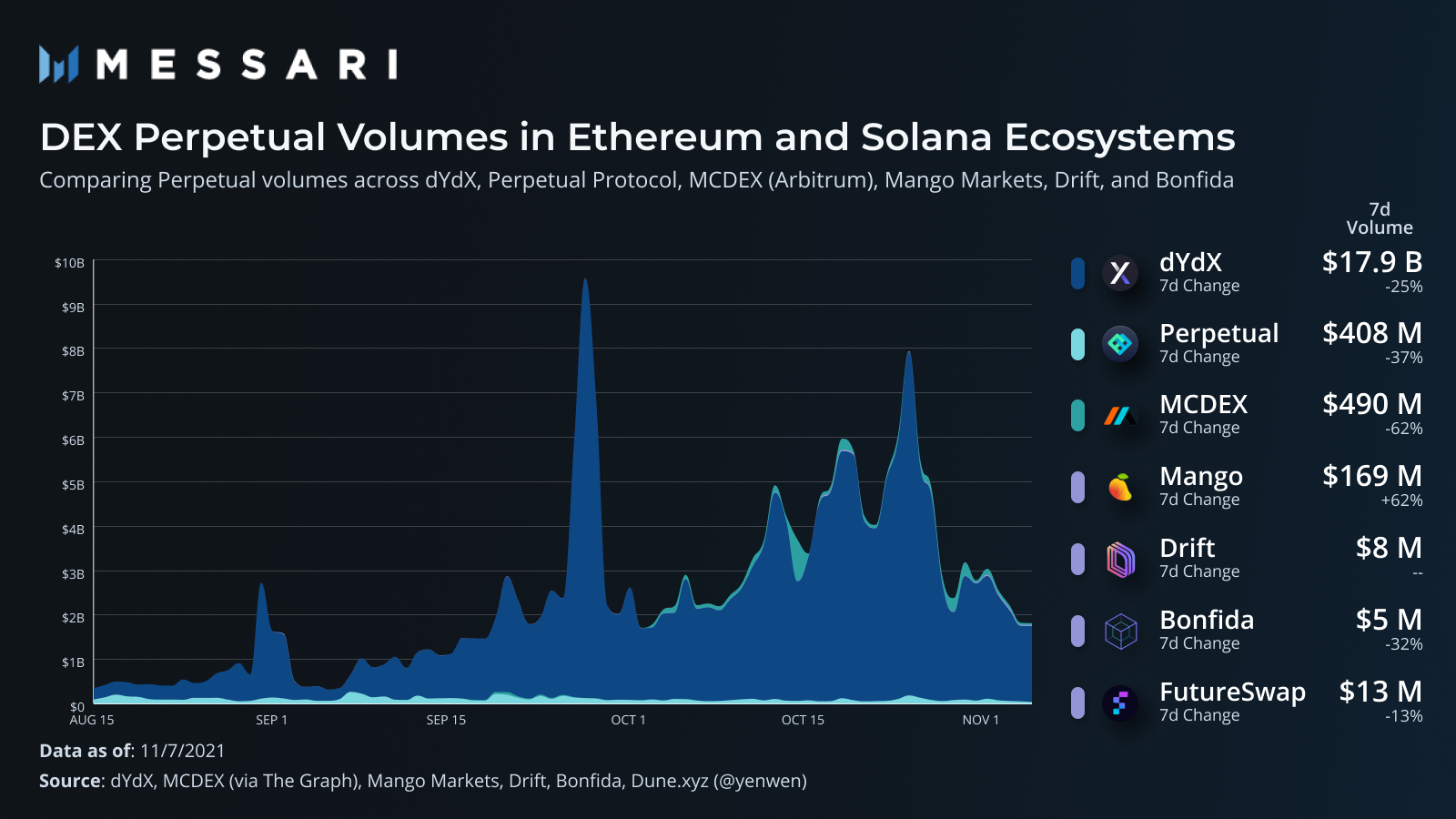
dYdX currently dominates the DEX market volume with over 97% of the 7-day volume. If you had a magnifying glass handy, you might have seen the 0.8% collective share the Solana ecosystem has gained thus far. No kidding, it is important to understand this chart and how quickly dYdX was able to attract a large number of users after launching its token and incentive rewards. In early August, Perpetual Protocol was the dominant protocol, accounting for 74% of the $100-$150 million daily trading volume. Once dYdX announced their token on August 3rd, the game changed. Daily DEX trading volume immediately more than doubled in August to $300 million to $500 million, with dYdX finding itself contributing an average of 78% of trading volume in the second half of the month. When token and liquidity incentives go live in early September.
To sum up, simply put, the market structure is constantly changing and change is defined at the margin. So, who is growing the fastest?What catalysts might accelerate or hinder this growth?
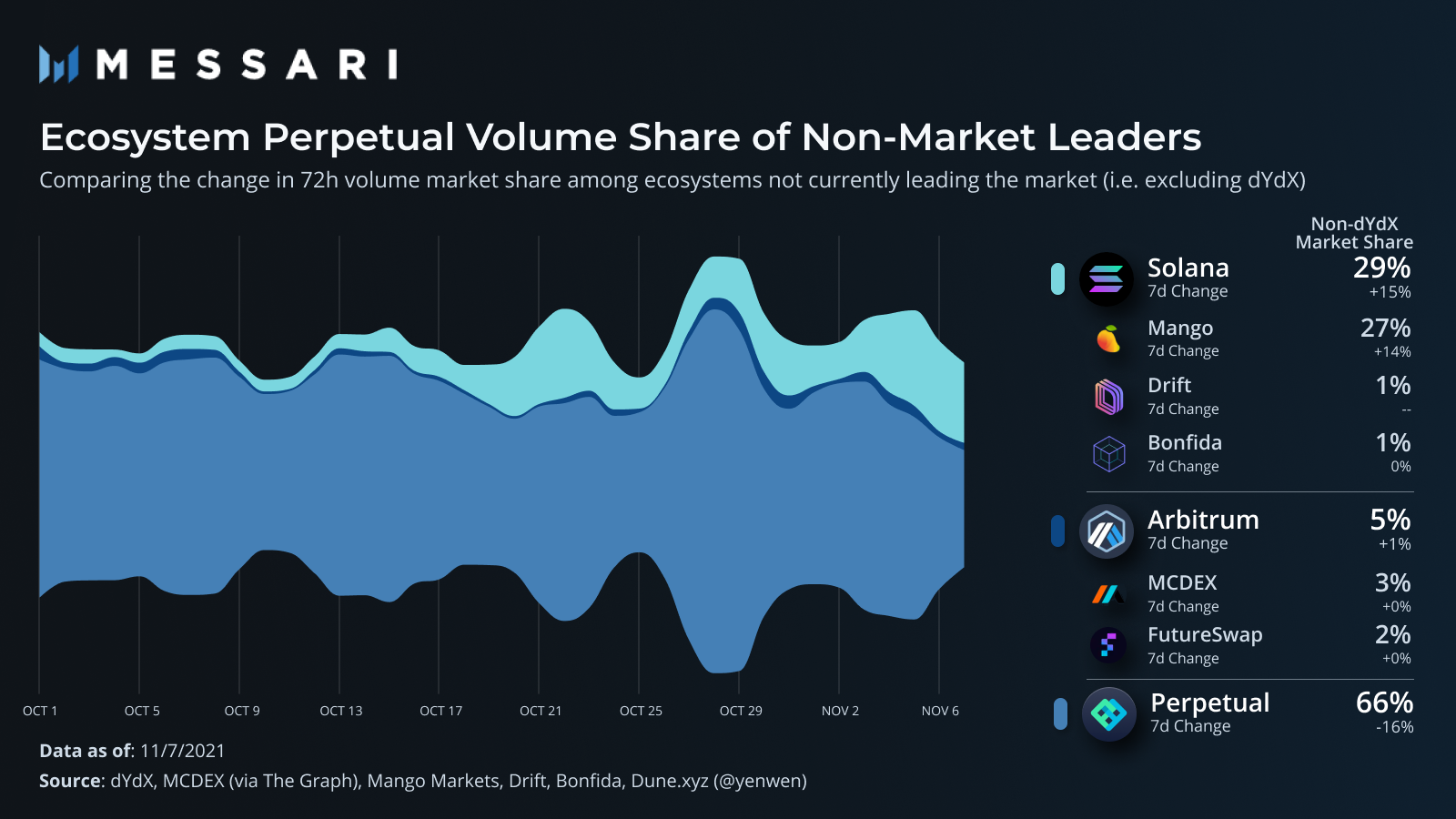
Pulling out dYdX to better understand the potential growth of non-market leaders, we can see that the Solana ecosystem has grown significantly in the last month. At the beginning of October, Solana accounted for about 5% of non-dYdX DEX perpetual trading volume. Fast-forward to early November, and the 7-day market share is only up 30%. Since late October, most of the growth has occurred in an environment where Solana transaction volumes increased while other protocols, such as Perpetual Protocol, contracted over the same time frame.
first level title
secondary title
Mango Markets
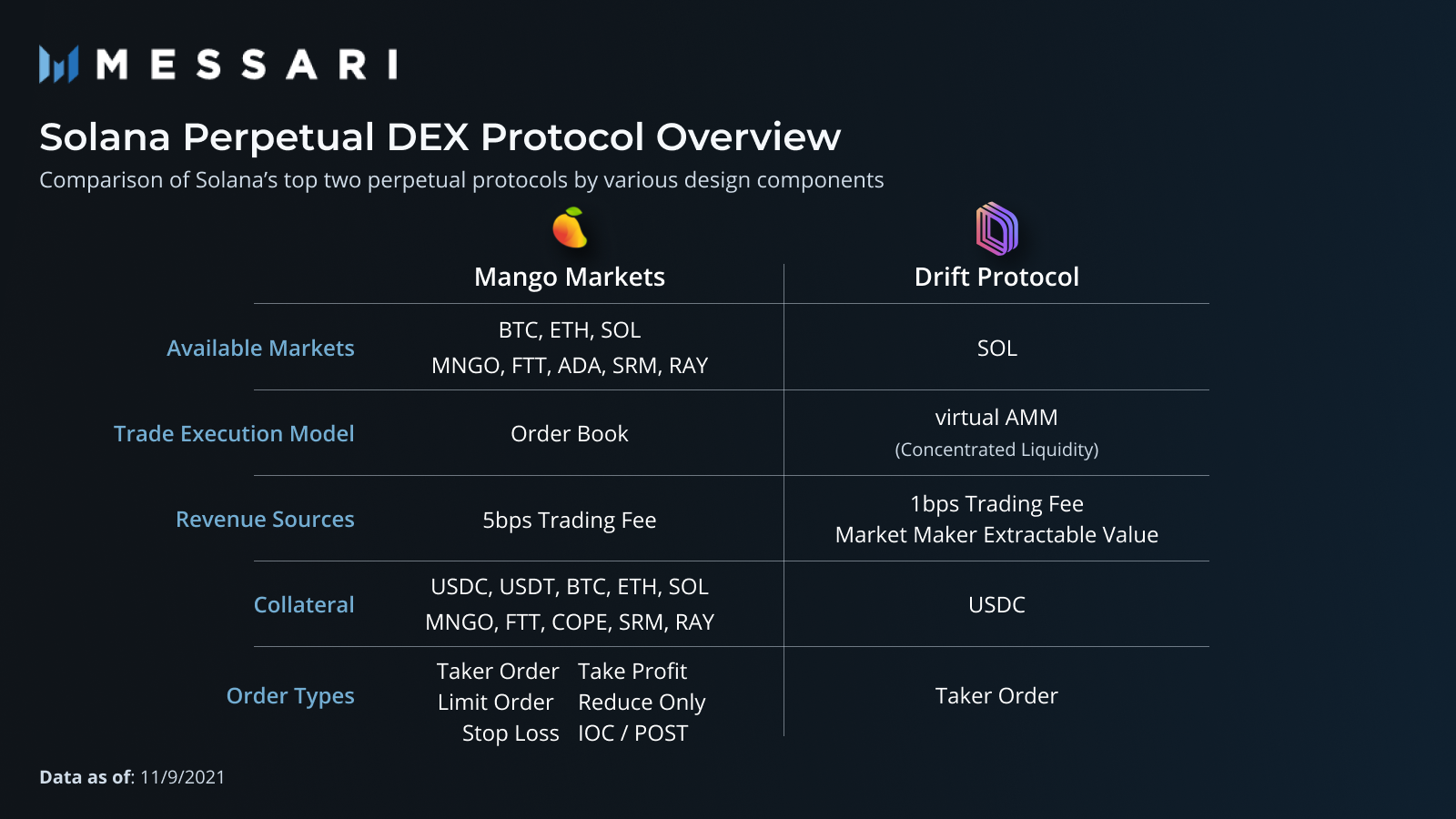
Mango Markets is currently the ring leader. It operates as a margin trading protocol, a perpetual trading protocol, and a money market (borrowing and lending). Mango's permanent market accounts for 93% of the total Solana ecosystem, and Mango provides traders with the most market participation. BTC was the first permanent market added in late August, followed by the SOL market in September. About one-third of Mango's last seven-day growth came from various new markets announced in early November: MNGO, ETH, SRM, RAY, ADA, and FTT.
Mango runs on an order book execution model and can be extended to provide traders with a variety of advanced order types such as limit orders, stop loss, take profit and more. Execution through the order book requires market makers to provide execution liquidity, so Mango provides a market maker incentive program. Taker orders are charged 5 basis points, while maker orders are free. Mango also does not charge fees for its lending marketplace.
secondary title
Drift Protocol
The Drift Protocol is a new addition to Solana's perpetual ecosystem. In late October, Drift released its closed alpha version on mainnet, which can be accessed by holding a Drift Alpha Ticket NFT. Tickets are awarded to users who provide value to the protocol during the devnet phase, and only 1,500 tickets means that there are fewer than 1,500 users using the protocol on the mainnet. Although SOL has gated access and only one real-time market, Drift has become the second largest perpetual protocol in the Solana ecosystem with $10M in volume over the past 7 days (5% of mango's 7-day volume).
Drift has a significantly different execution model, which leads to an inventive business model. Trade execution is done against a virtual AMM, similar to other perpetual protocols such as Perpetual Protocol, MCDEX, Futureswap. All "virtual" means the AMM price curve is used for price discovery, but doesn't actually hold the underlying asset - the trader's collateral acts as a source of settlement. Drift has designed a unique vAMM that combines centralized liquidity and related mechanisms for rebalancing centralized liquidity. Without getting into technical details, it is sufficient to say that this trade execution model is primarily for scaling the protocol without market-making incentives.
The interesting part of the vAMM execution engine is the ability of the protocol to capture value in case of slippage. When traders define slippage tolerances for trades that exceed the slippage offered on the vAMM price curve, the protocol can capture the additional slippage tolerance as a source of revenue. Co-founder Cindy Leow dubbed it "Market Maker Extractable Value," as the business model draws inspiration from the more common MEV (Miner Extractable Value) on live AMMs. In addition to this revenue stream, the protocol charges a fee of 1bps (0.01) in addition to clearing fees.
secondary title
Bonfida
first level title
market structure
In the context of understanding the micro-level of the protocols and the catalysts of each protocol, let's break down the current permanent market structure of Solana compared to other markets to understand user preferences and potential strongholds of the ecosystem.
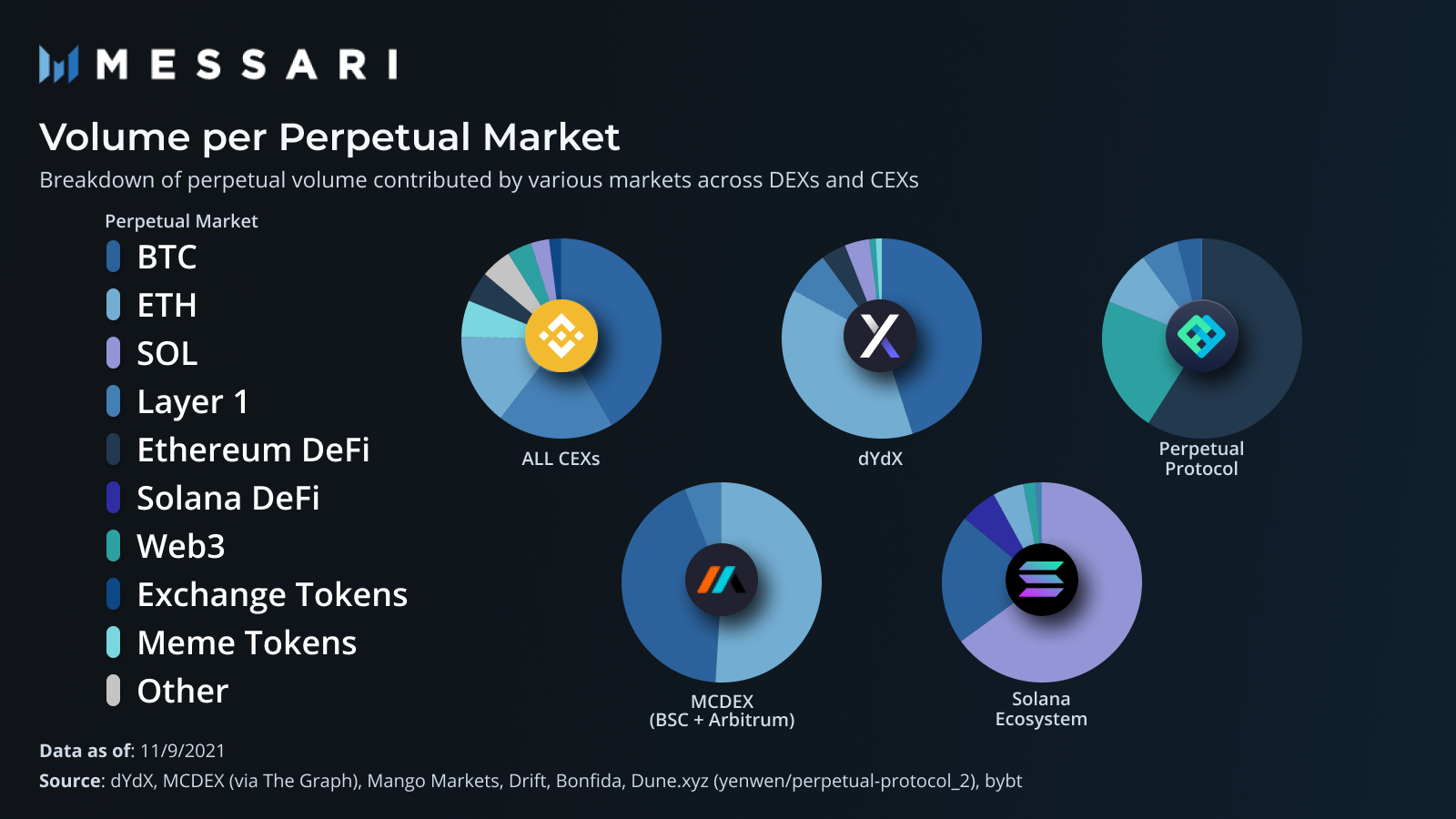
Perpetual traders in the Solana ecosystem are distinctly different compared to traders on CEXs and other DEXs. BTC and ETH markets are the vast majority of volume on dYdX, MCDEX, and CEX, while Solana traders (perhaps not surprisingly) prefer to trade SOL. A bit speculative, but this suggests that the community of traders on Solana is local and more enthusiastic about the Solana ecosystem, rather than traders migrating from existing platforms to trade on Solana's cheaper trading network.
Having a user base that is tightly integrated into the ecosystem is far more beneficial than mercenary users looking for the lowest cost alternative. From a business perspective and a competitive perspective, this enables the Solana Perpetual Protocol to gain a significant share of trading volume on Solana native markets such as Solana DeFi tokens. In fact, we can already see this happening.
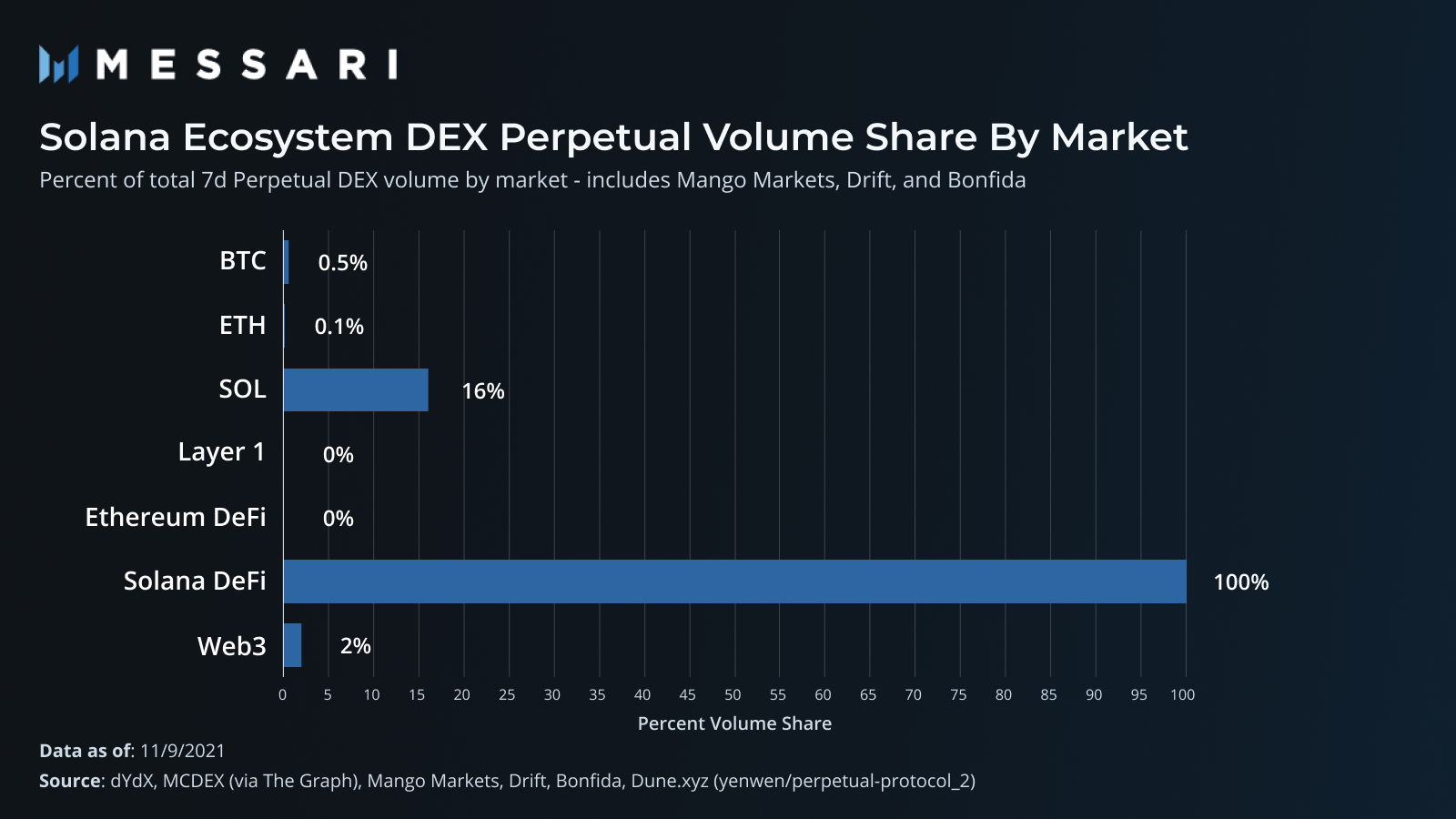
Recalling the first graph, where the volume of the Solana ecosystem was barely visible compared to dYdX, we now see a different, more nuanced landscape emerging. Solana DEX has accounted for 16% of all perpetual SOL market volume and 100% of perpetual contract Solana DeFi token volume across all DEXs (including dYdX) in the past few weeks. Much of this is driven by Mango, as it is the only DEX with a permanent market for Solana DeFi tokens.
So while Solana controls less than 1% of the total DEX permanent market, it has a significant market share in the markets that matter most to its users. This is a dangerous recipe for success if the Solana ecosystem continues to expand. Solana DEX is likely to be the first protocol to launch a market for Solana ecosystem tokens, and it will continue to attract capital from a tight-knit user base. This seed volume and liquidity grows, at which point these protocols become formidable competitors and become the protocol of choice in certain markets. It's a flywheel effect that's already showing up in the relative growth figures.
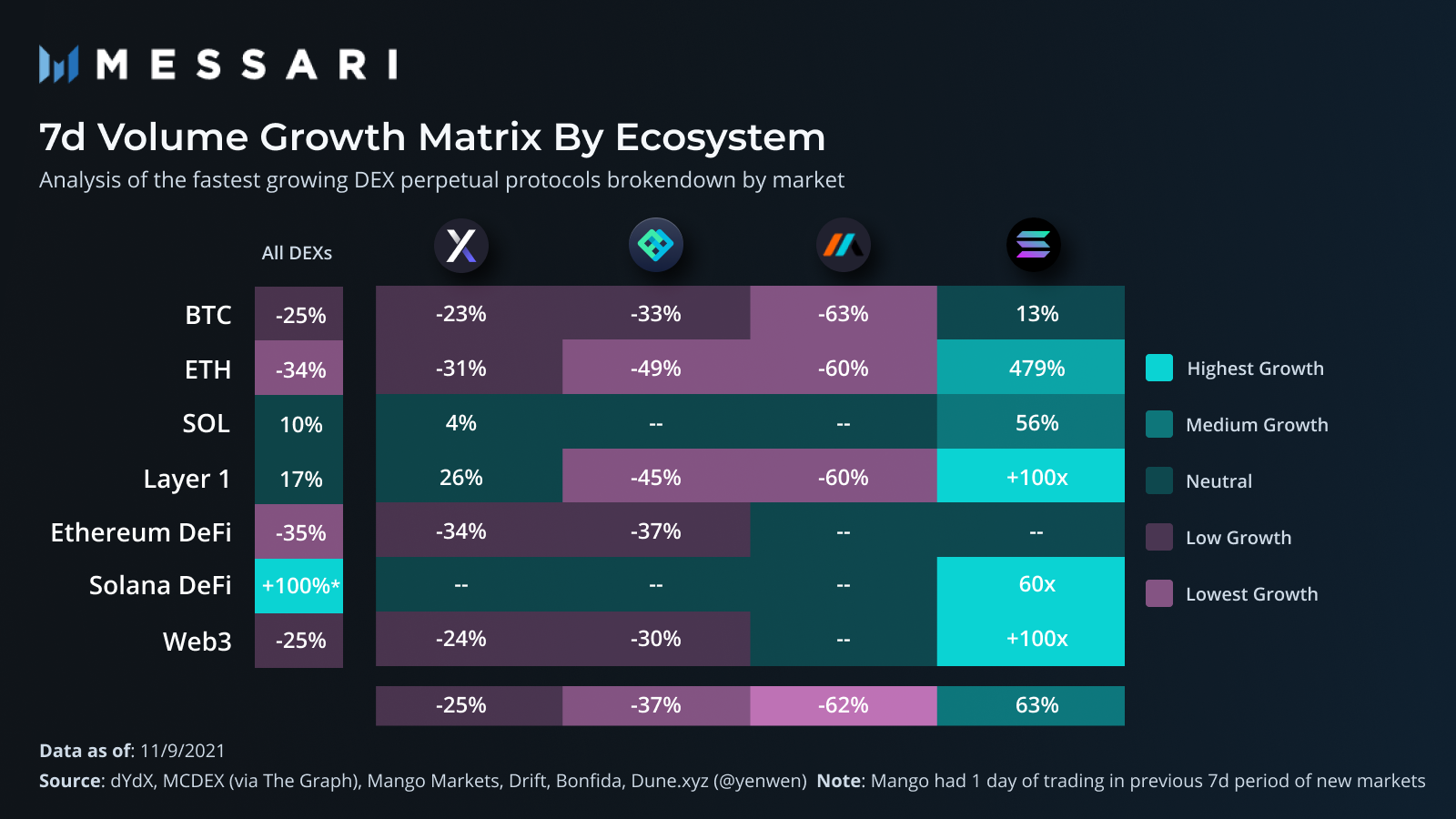
In an environment where other top perpetual DEXs have seen a considerable contraction in weekly trading volume, the Solana ecosystem is the only one to see an increase in trading volume. This is partly due to continued interest in Mango's new Solana Defi marketplaces (MNGO, SRM, RAY, COPE). However, most of the growth came from accelerated interest in the existing SOL market, which was up 56% from the previous week. Other markets such as ETH and BTC also saw positive growth compared to negative weekly growth for dYdX, MCDEX, and Perpetual Protocol.
first level title
valuation comparison
Actually quite a lot. The MNGO token accounts for 93% of the Solana ecosystem's transaction volume and is currently trading twice its 7-day volume ($426M CMC and $206M weekly volume). However, dYdX is trading at 0.06 times its 7-day trading volume, which is apparently the lowest valuation multiple in the industry. This means that Mango's transaction valuation is 37 times higher than dYdX's transaction volume (which is directly related to transaction protocol revenue).
Now, it's not entirely fair to isolate Mango's perpetual marketplace from the rest of the protocol's business. We can assume that, over time, Mango's perpetual markets cannibalize its margin trading business. This is a fairly large operation, roughly 50% larger than Mango's perpetual transaction volume. As for money market operations, the assumption of reduced margin trading leads to lower utilization, and Mango does not charge borrowing fees, which we can deduct from the valuation. Therefore, combining Mango's margin trading volume and perpetual trading volume, CMC values the 7-day trading volume at 0.9 times. That's still about 15x higher than dYdX and 4x higher than MCDEX's circulating valuation.
Summarize
Summarize
Solana has a variety of catalysts and narratives in various areas, becoming one of the destinations for traders and something we've seen initially with some success. Overall metrics and trading volumes are a far cry from industry leader dYdX, but the ecosystem's base of consistent emotional investing user base is reassuring. Not to mention that one of the most anticipated protocols in the space - Drift Protocol - has yet to open mainnet access to Solana's entire user base. It's a user base that continues to grow -- especially with major catalysts like the Brave browser bringing its 42 million active users to Solana. It will be worth keeping an eye on the growth of the ecosystem in the coming weeks to track how quickly the Solana perpetual DEX keeps up with recent growth.


