A glance at the layout of the NFT ecological track in 2021


Original title: "The Infinite Future of NFT: A Comprehensive Analysis of the 2021 NFT Track Map", author Ole Heine, early venture investor
NFTs have been the subject of many headlines this year. It seems like every outlet is trying to answer questions like "why would anyone pay for a jpeg that anyone can take a screenshot of?"
In this article, we take a deep dive into the NFT ecosystem and its latest developments.
March 11 ushered in the electronic age of digital art and non-fungible tokens. Mike Winkelmann, aka digital artist Beeple, sold his NFT artwork Everyday for $69 million. Not only is the price a new record for a purely digital artwork, but it also makes Beeple's work the third most expensive work ever sold at auction by a living artist.
A few weeks later, Twitter CEO Jack Dorsey sold a digitally signed copy of his first tweet in 2006 for nearly $3 million.
Events such as these have sparked intense interest in the NFT space. Although sales have declined in recent months, we are seeing more and more founders, artists, celebrities, and investors entering the ecosystem.
secondary title
NFT Market Map
Note 1: Many of the startups/projects listed fall into more than one category, I have chosen one for each category for simplicity.
Note 2: This is not an attempt to include every startup/project, but rather an overview of the most prominent payers in each category. Selection criteria were deal volume (USD), venture capital funding, and media coverage (if applicable).
image description
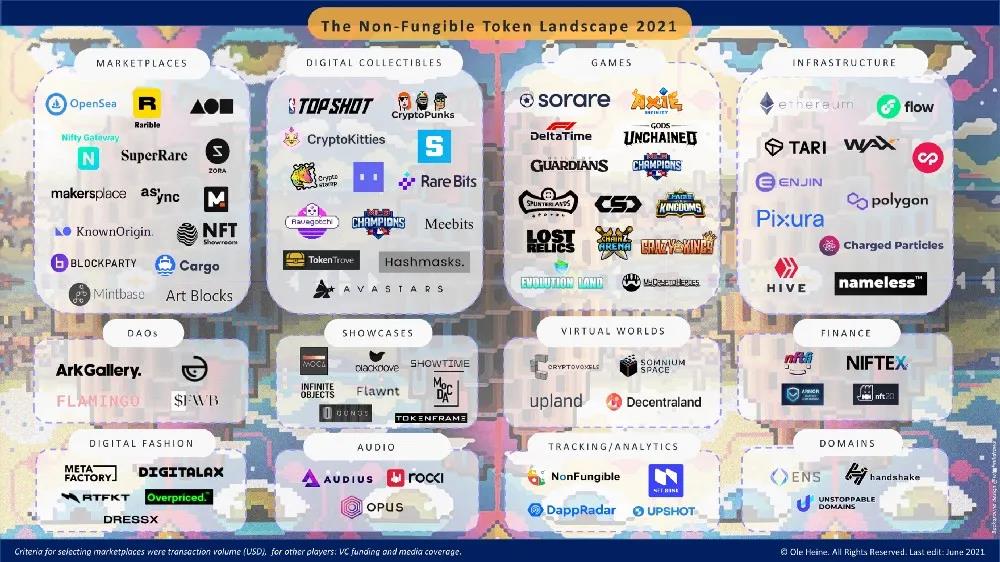
2021 NFT Landscape © Ole Heine
1) Market
Digital marketplaces are an integral part of the NFT ecosystem. While the rise of crypto art is driving the supply side (artists selling their works as NFTs), more and more collectors and investors are also entering the space.
OpenSea is one of the earliest and well-established marketplaces, a one-stop platform for users to create and trade NFTs. In March, OpenSea raised $23 million in funding led by Andreessen Horowitz, with angel investors including Naval Ravikant and Mark Cuban.
Another marketplace is Rarible. The digital art marketplace recently announced a $14.2 million Series A round from Venrock Capital, CoinFund, and 01 Advisors. At the heart of the platform is its Ethereum-based token, RARI. By owning RARI tokens, collectors can vote on proposals that impact the platform, vet creators, and curate featured artwork.
Curating and Open Markets
When assessing the market, one major difference is curation. While platforms such as OpenSea and Rarible do not require a license, other marketplaces (including SuperRare, Nifty Gateway, Foundation, Known Origin, and Makersplace) require a special application process.
royalties
royalties
Resale royalties are the percentage creators earn from secondary sales of their artwork. It is worth noting that different markets treat royalties differently. On SuperRare and MakersPlace, artists get a 10% royalty, while on Rarible, Foundation and NiftyGateway artists can designate their own royalties.
Other notable marketplaces include AsyncArt, Mintable, Zora, NFT Showroom, Blockparty, Cargo, Mitable, and ArtBlocks.
2) Digital collectibles
Digital collectibles are the second pillar in the NFT ecosystem, including items with little functionality but high sentimental value (think baseball or football cards).
Punks, Crypto Kitties and LeBron James
image description

CryptoPunk #7523 (Source: Larva Labs)
However, it was CryptoKitties that brought NFTs into the mainstream. Created at Canada's ETH Waterloo Hackathon in 2017, CryptoKitties featured a game that allowed users to collect, breed and trade virtual cats. "Generation 0" cats are sold at auctions, and new cats can also be resold on secondary markets such as OpenSea. The most expensive sale was a CryptoKitty named Dragon, which sold for 600 ETH or $172,000 in 2018.
Another notable project in this space is NBA Top Shot, a basketball moment trading card platform created by DapperLabs in partnership with the National Basketball Association. In April, an NBA shot by LeBron James imitating the famous Kobe Bryant dunk sold for $387,600.
Other collectibles include Sandbox, CryptoStamp, Avegotchi, MLB Champions, Meebits, TokenTrove, Hashmasks, and Avastars.
3) Games
Gaming platforms are an important pillar in the NFT ecosystem as they attract non-crypto users to the NFT ecosystem.
A notable example is Sorare, a Paris-based gaming platform for the creation and trading of football NFTs. In the game, players can form a five-card squad to face off against other Sorare fans and measure the performance of football players based on how they actually perform in football matches. Winners of the contest can earn rewards that can be exchanged for other cards or ETH. Sorare has raised €40 million in Series A funding led by Benchmark, with Accel and angel investors including footballers Antoine Griezmann and Rio Ferdinand.
One of the most famous crypto games is Axie Infinity, launched in 2018 by Vietnamese developer Sky Masis. The game follows a play-to-earn model where players fight, breed and trade digital creatures called Axies to build virtual kingdoms. In May, parent company Mavis Sky raised $8.75 million in funding from BlackTower Capital and Mark Cuban.
According to a Coindesk article, as the Covid-19 pandemic hit the Philippines, some Filipinos who lost their jobs were able to make a living playing and trading Axies.
"With the money earned playing Axie, gamers from Philipiness buy everything from baby diapers and milk to shoes and shirts for job interviews."
Other notable NFT games include Gods Unchained, F1 Delta Time, Guild of Guardians, Splinterlands, CSC, League of Kingdoms, Lost Relics, ChainZ Arena, Crazy Kings, Evolution Land, and MyCryptoHeroes.
4) Infrastructure
Ethereum dominates the NFT ecosystem, but there is still room for improvement. As of July 2021, 8 of the top 10 NFT projects by sales are built on Ethereum. However, high gas fees (the cost of conducting transactions on Ethereum), network congestion, and an unsatisfactory user experience are still a problem. This presents a market opportunity for new players.
A major distinction must be made between layer 1 and layer 2 solutions. Layer 1 "base layer" refers to the underlying main blockchain architecture, while layer 2 is the overlay network that exists on top of the underlying blockchain.
Layer 1 - Base layer: Ethereum, Flow
Layer 2 and sidechains: WAX, Polygon, Enjin, Charged Particles, Tari
5) Finance
Many interesting projects are developing at the intersection of decentralized finance (DeFi) and NFTs:
NFTfi: One of the first platforms for NFT collateralized loans. Users can earn by lending ETH to users who have their NFTs as collateral.
NIFTEX: A platform for NFT fractional ownership. It launched in May 2020, long before the NFT hype.
Other players include Armor.fi (DeFi asset coverage company) and NFT20 (NFT index fund provider).
6) Domain name
While traditional domains are mostly just website addresses, blockchain domains are associated with wallet addresses, making it easier to send and receive payments. Domain name NFT that replaces complex cryptocurrency wallet addresses with a simple, human-readable name.
Leaders in this space are Unstoppable Domains, Ethereum Name Service (ENS), and Handshake.
7) Tracking/analysis
Tracking and analytics platforms play an important role as they bring transparency to the NFT ecosystem.
The leading database and analytics platforms are Nonfungible.com, DappRadar, NFTbank, and Upshot.
8) Audio
Audio NFT platforms support musicians in the same way that digital art markets support artists: they open up new avenues for creatives to turn their work into digital assets.
Audio NFTs will help bring greater freedom to artists and greater openness and usability to users by eliminating centralized record labels.
Well-known decentralized music streaming services include Audius, Rocki, and Opus.
9) Decentralized Autonomous Organization
DAOs "Decentralized Autonomous Organizations" are member-owned communities that exist on a set of smart contracts. In the context of NFT, DAO can be used as an investment vehicle for NFT projects. Investors in a DAO can vote on proposals based on rules established in smart contracts, with each individual vote weighted by the number of tokens owned. If the proposed investment receives enough yes votes, the smart contract automatically triggers the transaction.
Flamingo: An NFT-centric DAO enabling its members to develop and deploy NFT-centric investment strategies.
ArkGallery: A DAO for buying Cryptopunks.
WHALE: The $WHALE token is a social token created by WhaleShark, one of the largest individual buyers of NFTs. Owners of this token receive a partial stake in Whale Shark's NFT collection.
FWB: $FWB is a social token representing a community of NFT artists and creators.
If you want to learn more about the world of DAOs, this article is a great resource.
10) Digital fashion
NFTs are about collectibles, and so is fashion. One of the most notable startups in the space is virtual fashion brand RTFKT, which recently announced an $8 million seed round from Andreessen Horowitz and C Ventures.
A virtual hoodie from NFT fashion brand Overprice sold for $26,000. Owners can virtually "wear" the garment by scanning a VR code on their smartphone.
Other NFT fashion brands include DressX, Digitalax, and MetaFactory.
11) Display cabinet
You're probably wondering by now: "What's the point of buying all these NFTs if you can't show them to the public?" There are multiple ways, and there's a whole new industry growing in this space.
Virtual Galleries: Crypto Art Museum, Flawnt and MOCDA are virtual galleries that allow collectors and artists to display their NFTs.
Digital Photo Frames: Digital photo frames/displays from Blackdove, Qonos, and Tokenframe allow NFT owners to display their purchased artwork in real life.
Other interesting projects in this space are Showtime (social network) and Infinite Objects (NFT printing service).
12) Virtual world
Have you ever played Minecraft, Fortnite or The Sims? Then virtual worlds might be for you.
Virtual worlds are computer-simulated worlds in which users connect with each other as they would in the real world.
image description
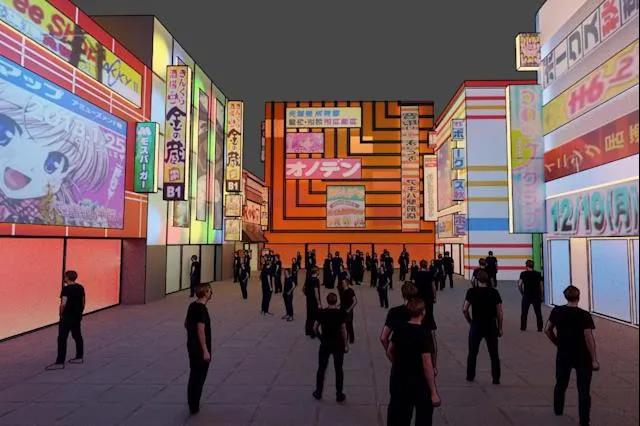
Metajuku, a shopping area where users can buy virtual clothes (Source: Decentraland)
In June, a piece of virtual land in Decentraland sold for over $900,000, making it the most lucrative NFT land purchase ever.
looking to the future
looking to the future
When comparing the history of NFT sales from May to today, the NFT bubble appears to have burst. Overall sales plummeted from a seven-day peak of $176 million on May 9 to about $8 million in mid-July, according to Nonfungible.
Many market observers have compared the phenomenon to the dot-com bubble of the late 90s. As post-crisis growth in the tech sector stabilized, Web2 companies such as Google, Facebook, and Amazon emerged and reshaped our everyday lives.
Which companies will lead the Web3 space? Maybe they're already on this map. We'll find out soon.