2021 Manta Network Privacy Transaction Research Report: 90% of people have peeped at other people's wallet addresses



Have you ever secretly opened someone else's wallet address to check their encrypted assets or transaction records? According to our research, the chances of you doing so are about 90%, i.e. 9 out of 10 respondents have peeked into someone else's wallet address. In the current blockchain world, it is very likely that the above actions have occurred without consent.
If Sally wants to see Billy's bitcoin holdings, she doesn't need any permission or login information, just Billy's bitcoin address. Using this, she can go to any Bitcoin block monitoring website, then enter Billy's address and view his assets and transaction information. By looking at the transactions, Sally can deduce what other wallets Billy has and his purchase or transaction activity. In the traditional financial field, such behavior is regarded as an invasion of privacy, because in traditional finance, transaction history, account balance, etc. can only be viewed by authorized users.
The implication of the invasion of privacy above goes beyond the meaning of "transactions and balance checking without consent" itself. As more and more users and institutional entities use blockchain for decentralized financial activities, privacy protection becomes an important link to prevent:
1. Data aggregation and collection for advertising purposes;
2. Acts aimed at extortion;
3. Policy and privacy at the merchant level.
The following are the key points of this report:
Privacy concerns in the blockchain space
Nearly three-quarters of respondents (73.2%) have hesitated to engage in a transaction or avoided it altogether due to their concerns about the transaction's impact on privacy.
Insufficient privacy of wallet address
84% of respondents expressed some level of concern about their wallet address being linked to their real identity. Combined with the public nature of assets, unauthorized bystanders can monitor the net assets of others who have been identified.
Binance Voted Most Trusted Centralized Exchange
53.5% of respondents answered that Binance is their most trusted cryptocurrency exchange. The most important reason among these is its brand recognition, followed by the SAFU fund offered by Binance.
Fee is the most concerned factor of DEX
The main reason respondents are not currently using DEXs is the high fees (gas fee and transaction fees) to conduct transactions.
Leadership is also very important
When it comes to trusting communications, 21 (5 percent) of respondents cited leadership as one of the reasons. Of the 21 companies, 18 mentioned Binance CEO CZ. On the other hand, Justin Sun was mentioned by 38% of respondents who did not trust Poloniex.
Research purposes:
Manta Network is a Layer1 interoperable privacy protection stack built for DeFi, and plans to run as a parachain in the Polkadot ecosystem. We conducted this survey to study the need for privacy-preserving decentralized exchanges. Our goal is to better understand the current perspective on cryptocurrency transfers and swaps from a privacy perspective and an overall trust in the use of centralized and decentralized exchange solutions.
During a two-week period beginning in December 2020, respondents received and filled out a Manta Network Exchange privacy survey; the report details the information and results of the study. In addition to related findings, the research also confirms the growing concern for privacy protection in the blockchain space. Existing solutions, including anonymous wallet addresses, are insufficient to protect user data stored on public blockchains from any unauthorized manipulation or data mining.
secondary title
key point
key point
Over 91% of respondents were male (91.5%).
Most respondents were aged between 29 and 35 (42.7%).
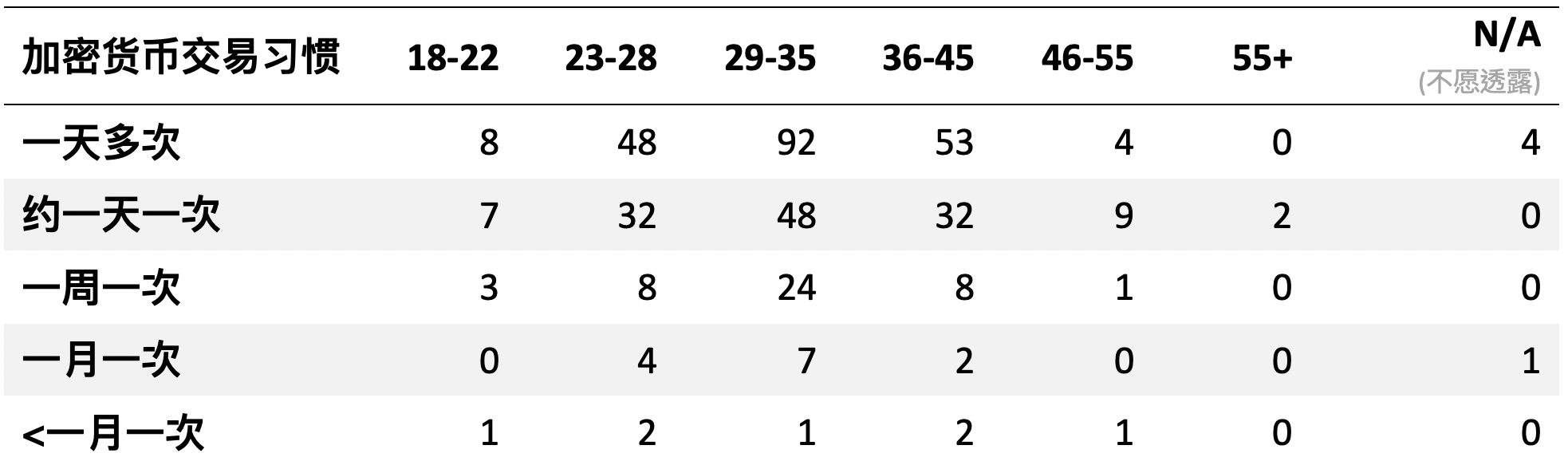
More than 98% of respondents conduct at least one cryptocurrency trading activity per month (98.3%).
Over a two-week period, we recruited 404 cryptocurrency participants for the survey. Participation in this research comes from relevant followers of Manta Network's followers, partners and investors. Because the research itself focuses on trust and privacy issues in centralized and decentralized exchanges, we focused our research on individuals with experience in cryptocurrency trading. We also specifically asked our respondents demographic questions to verify that our audience is relevant and to help us determine whether relevant underlying behaviors belong to a particular group.
Our respondents were mostly male (91.2% of the total sample); 27 female respondents (6.6% of the total sample); 1 identified as gender unstable; the rest tended not to Make your gender public. Due to the large proportion of male respondents compared with other gender categories, the analysis in this report does not use gender as an influencing factor for research comparisons.
In terms of age, the majority of study respondents (42.6%) were between the ages of 29 and 35. Nearly 90% of respondents were between the ages of 23 and 45. Most respondents are considered active traders (trading activity at least once per month). Only 7 out of 404 respondents (or 1.7%) averaged less than one cryptocurrency exchange interaction per month plus.
Cryptocurrency trading habits are not uncommon among respondents. The majority of respondents (93.2%) somewhat or strongly identify themselves as Crypto Maximalists (i.e. Crypto Supporters). Four respondents (1%) strongly disagreed with being classified as a crypto Maximalist, but at the same time their trading habits showed that they traded more than once a month. This data and phenomenon may seem slightly contradictory, but it may show that cryptocurrency traders do not necessarily need to be believers in the technology itself. Such behavior is also typical in traditional stock markets.
The majority of respondents (65.9%) were categorized as cryptocurrency traders due to their involvement in the cryptocurrency space. Overall, investors made up the second largest category of respondents: angel investors and institutional investors accounted for 59.6% of the total 404 respondents. In this question, respondents can choose from a variety of ways to participate in the cryptocurrency space: for example, institutional investors can participate in both angel investment and cryptocurrency trading.
secondary title
Level of Trust in Centralized Exchanges
Unlike decentralized exchanges, centralized exchanges need to be trusted by users. Even in traditional stock markets, user trust is crucial. In December 2020, the stock trading app Robinhood software was fined $65 million by the SEC for misleading users-the trading app resold user data to Wall Street companies so that these companies could facilitate users and transactions for commissions.
Binance and Coinbase lead the centralized cryptocurrency exchange industry in terms of user trust. Respondents generally rated Binance as the most trustworthy, receiving 53.5% of the 404 votes cast. Coinbase came in second, receiving less than half of the votes for Binance, accounting for 20.3% of the total votes cast. Respondents do not appear to accept other exchanges. Most of the rest of the votes were for “I don’t trust any of these exchanges” (marked as “None” in the bar graph of Figure 1 for centralized exchanges). In addition to Binance and Coinbase, responses from respondents also indicated that people have considerable distrust of centralized exchanges.
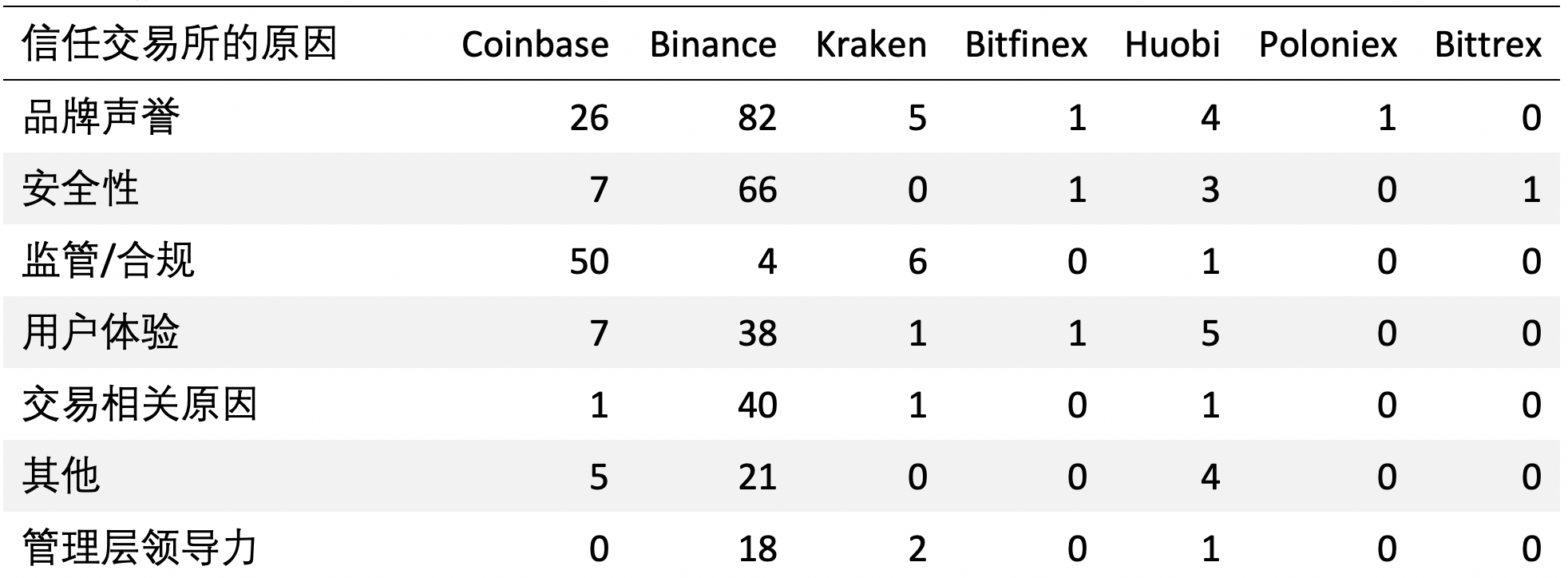
Additionally, the survey asked respondents to explain why they place more trust in a particular exchange. We group influencing factors into seven main categories (see Figure 2 for centralized exchanges):
1. Reasons related to the transaction: any factors related to the transaction experience, including transaction volume, optional transaction pairs, currency issuance and liquidation, etc.;
2. Management leadership: any reason that the founders themselves have strong beliefs and vision;
3. Brand Reputation: Indicates reasons related to the platform’s brand image in the domain, including respondents’ description of their reputation
4. User Experience: Any personal stories or comments related to the design of the exchange interface and user experience;
5. Regulatory/Compliance: any factors regarding the regulatory or legal framework for cryptocurrency transactions;
6. Security: any reason related to the protection of user identity or assets (including insurance);
7. Other: Any reason that does not fit the category above.
Number of Specific Reasons Respondents responded by themselves as some reasons fell into more than one of the above categories; for example, respondents could indicate both transaction-related reasons and management leadership as reasons for their preference for a particular exchange. Overall, brand reputation exerted the greatest influence in determining whether respondents trust a particular exchange. Security and compliance are also factors that build confidence among respondents. Other more usage reasons, including user experience and transactional reasons are also important, but they are not as important as compliance factors and good brand reputation.
Centralized Exchange Table 1
Reasons to trust Binance?
"The largest user base, huge fiat currency transaction channel, and largest transaction volume, led by CZ, who tries his best to protect his "children" (the exchange and the entire ecosystem behind it)."
"Funds are secured by SAFU."
Reasons to trust Coinbase?
"They are in the United States ... and subject to U.S. regulations."
"FDIC insured."
"Filing for an IPO...SEC compliant."
In addition to regulation/compliance, Binance ranks first for every reason listed in Table 1 above, while Coinbase is far and away the winner for compliance. In terms of compliance, Binance US provides a more regulated exchange for US users, but its core business is more flexible than other regulated exchanges. Coinbase is known for its compliance with regulators, which is the number one reason respondents trust the US-based centralized exchange.
In the cases of Binance and Coinbase, respondents both cited the security of their funds as a reason to trust the centralized exchange. Binance has established its own insurance fund, the Safe Assets for Users Fund (commonly referred to as the SAFU Fund), which is a user insurance fund designed by Binance itself. According to Binance, they will put 10% of all transaction fees into the SAFU fund.
Coinbase offers users two forms of insurance: Most respondents are familiar with FDIC insurance, which is a common reason why respondents trust Coinbase more than any other centralized exchange. The FDIC insures Coinbase users’ cash, and Coinbase has separate insurance for cryptocurrencies that are not covered by the FDIC.
In terms of brand reputation, respondents who supported Binance spoke about Binance’s leadership in the industry and other consumer-facing products and services. As for Coinbase, the interviewees emphasized that it is one of the earliest compliant exchanges, and users’ trust in it also comes from its compliance.
secondary title
Level of Distrust of Centralized Exchanges
Respondents’ responses to the question of least trusted exchanges mirror the overall trust-related difficulties of cryptocurrency exchanges. Unsurprisingly, the most trusted businesses, Coinbase and Binance, rank lowest on the list shown in Figure 3 (in this section, the lower the better).
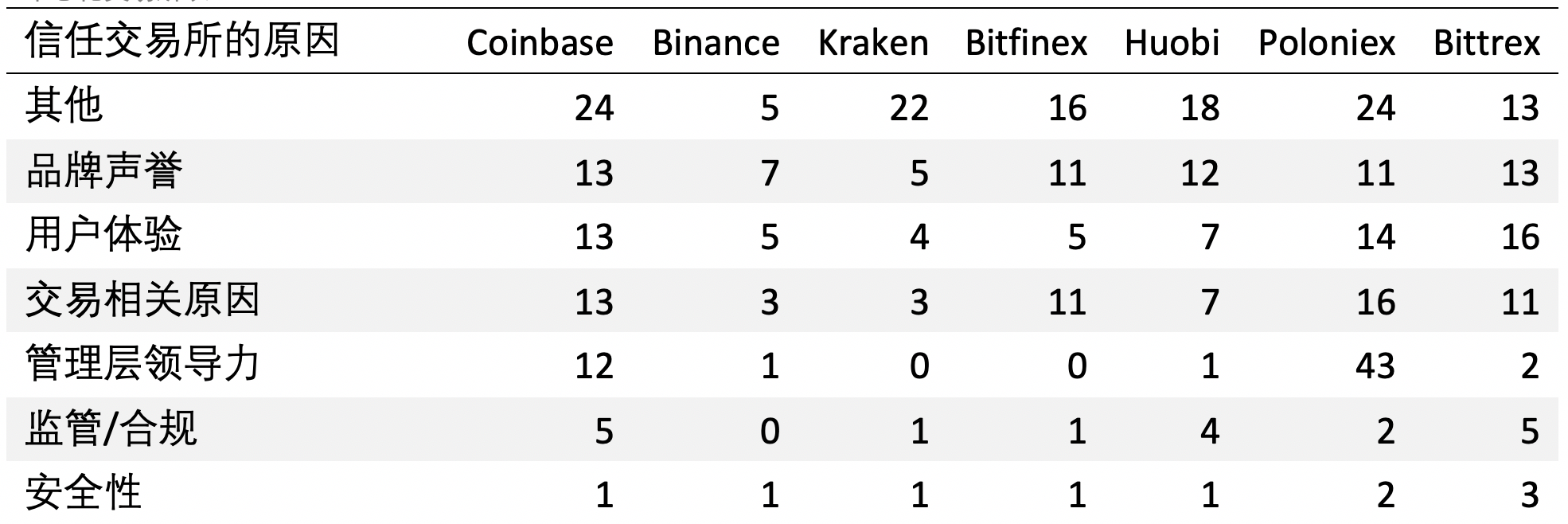
Unlike the previous section on “Respondents’ Reasons for Trusting Specific Exchanges”, we found that although many respondents clearly stated that they have the most trusted trusted exchange, but many people have trouble identifying which exchange they least trust. The results in Figure 4 illustrate this phenomenon: “Other” was the option that respondents voted the most for “Why do you trust this exchange the least?”.
Centralized Exchange Table 2
While the “Other” option was heavily represented in the survey, digging deeper into why respondents chose it revealed some key takeaways. First, respondents were wary of Tether (USDT), which is owned by Tether Limited. A 2017 New York Times article by Nathaniel Popper pointed out that Bitfinex and Tether Limited are owned by the same owner — both companies’ CEOs are Jan Ludovicus van der Velde.
The leader of Tether Limited has been opaque about the details of USDT’s U.S. dollar reserve backing. It is because of this lack of transparency that the crypto community has questioned the legitimacy of Tether’s issuance and backing by U.S. dollar reserves. According to the responses received in this study, the controversy about USDT, coupled with the relationship between Tether Limited and Bitfinex, led to the lack of trust of subsequent users in Bitfinex as an exchange.
Although Bitfinex is controversial due to the credibility of related projects, it is not the least trusted exchange. According to respondents in the survey, Poloniex was the least trusted exchange, with 43 respondents (38%) citing management leadership as their top reason for not trusting the exchange.
Why don't you trust Bitfinex?
“USDT”
Why don't you trust Poloniex?
Unknown relationship with Justin Sun
That is, Justin Sun admitted in an article published by Cointelegraph that "the news posted under Poloniex's official Twitter on November 12, 2019 stated that he was one of the investors who acquired Poloniex". Respondents in the study expressed distrust of Justin, a phenomenon similar to extreme trust in CZ. Poloniex employees see Justin Sun as a strong leader.
In an article published by Poloniex Director of Engineering James Seibel, he describes Justin as "data-driven, challenging, wants people to prove his position and ideas, and like many other entrepreneurs in the industry, he is very interested in The blockchain has its own ideas and visions and knows how to achieve these visions. At the same time, Justin looks at this industry from an idealistic perspective and a business perspective. He hopes that encryption technology can be better adopted and can be built on this technology. A better financial system with more users, transactions, and revenue. Marketing is one of the ways he gets there, and, for the most part, any news he gets is good regardless of the media coverage information."
secondary title
Use of decentralized exchanges
The use of decentralized exchanges (DEXs) in the blockchain space is becoming increasingly popular. Defiprime.com visualized transaction and volume data for the DEX ecosystem with data from Dune Analytics, a website that provides programmatic access to analytics on the Ethereum blockchain. According to Defiprime.com report, on January 11, 2021, the daily trading volume reached nearly 3 billion US dollars. According to data from the same website, DEX’s monthly trading volume surged from $40 million in January 2020 to billions of dollars in the summer, and has continued to exceed $10 billion per month since August 2020. A single DEX accounts for about half of the total daily and monthly trading volume.
When the above metrics are taken into account, it should come as no surprise that more than 90% of respondents to the survey said they were frequent users of decentralized exchanges. Although the total volume of DEX is relatively small compared to centralized exchange giants such as Binance and Coinbase, the rapid penetration and growth of its related volume and transaction volume indicate the growing popularity of DEX.
Please explain why you use a decentralized exchange:
"The cost is shared with community members."
“The AMM model is significantly more interesting and less manipulated than a traditional order book.”
"My keys are my crypto assets."
"My personal data will not be shared with others."
Respondents supported decentralized exchanges for a number of reasons. Some respondents provided more altruistic reasons for fee sharing — a feature that the entire community could benefit from, rather than centralizing revenue in a centralized entity. Others argue that the AMM model is more sacred than the traditional order book model. A large number of respondents responded that they care more about the degree of control they have over their assets-that is, traders have full control of their wallets and assets without having to rely on third-party custody.
The movement towards direct custody of crypto assets has always been at the heart of the blockchain and peer-to-peer philosophy. On January 3, 2019, the first Proof of Keys event was held to celebrate and increase awareness in the crypto community of owning crypto assets directly. In a sense, the success of decentralized exchanges echoes the idea of the “Proof of Keys” campaign.
secondary title
Concerns about decentralized exchanges
Please explain your reasons for not using a decentralized exchange:
"High fees... I wanted to sell (tokens) and tried twice, it cost me 60USDT, but both transactions failed."
“(Transaction) fees are high. Small transactions are not profitable with these transaction fees.”
While 90% of respondents consider themselves regular users of decentralized exchanges, around 10% avoid using them. Although the proportion of people who do not use decentralized exchanges is small and may not even be representative, it provides some consensus on why the penetration of decentralized exchanges is so slow.
Of the 40 respondents who avoided using decentralized exchanges, 52.5% (21 respondents) cited fees as the top reason. In a centralized exchange running on Ethereum, users also need to pay gas fees while being charged for their operations.
secondary title
privacy concerns
Privacy is considered a core value proposition of blockchain. But ironically, the privacy on the public chain is presented in an anonymous way. Although the wallet address can meet the needs of some activities, its own interaction will have some limitations. For example, suppose the receiver knows the identity of the sender. In that case, the recipient can now extrapolate the wallet address to an identity, negating the protection of anonymity provided by the wallet address itself. Although this example is simple, the data analytics tools available today make it easy to monitor and track user activity.
Judging from the survey responses of the respondents, they recognized the vulnerability to the anonymity embodied by the wallet address. Almost 84% agree to some extent that there is concern about the link between their wallet and their identity. There is much more to this connection than just the potential for someone else to snoop on another person's assets without their permission; namely: the number of assets that can be revealed to a high net worth individual making them a hacker and criminal The goal. From a corporate or institutional perspective, tracking the flow of assets in wallets can reveal trade secrets. For example, a computer manufacturer might let a competitor track the computer maker's wallet to identify the source and price of a part.
While anonymity may be limited in terms of providing privacy, this level of privacy protection is sufficient if participants on the blockchain respect each other's privacy. Unfortunately, this is not the case. When asked if they had ever queried someone’s wallet address to view their holdings or transactions, more than 90% of respondents answered in the affirmative.
From a purely demographic perspective, there is no group of respondents that is strongly characterized as respecting privacy, i.e. answering "no" to viewing other people's holdings/transactions. The distribution pattern of attributes (including age, gender, transaction frequency, professional level, etc.) for those who answered "No" matches the distribution pattern results of general survey demographics (as shown in the "Respondent Sample Distribution" section) .
According to the survey, it seems that most of the respondents are aware of this kind of non-consensus "peeping" behavior caused by curiosity. When asked if they had avoided or hesitated to make a transaction in the past due to concerns about the privacy of wallet addresses, about three in four respondents said yes.
This kind of psychology makes the transfer or exchange behavior for the purpose of privacy protection on the blockchain become a game problem. Both sender and receiver are aware of the possibility of counterparty processing and make different decisions accordingly. For example, a recipient may regenerate a new wallet address when receiving cryptocurrency, and a trader may confuse their original wallet address by trading through a centralized exchange.
end
end
The key points of each summary described in this report are shocking findings, but based on the continuous development and integration of privacy rights, trust in centralized exchanges, and the rise of decentralized exchanges, these three are the reasons for this research report. Cornerstone. At the same time, it is worth noting that this report interestingly quantifies the above topics. The privacy issues of the blockchain coexist with the blockchain itself. Still, this research shows that the privacy issue in cryptocurrencies is not just a matter of talk, but is actually reflected in the behavior and feedback of blockchain traders that allow cryptocurrencies to be transferred and exchanged. There is a measurable friction cost when changing.
Using "trust" to measure an exchange is a common but very appropriate word, because it indicates the success of an exchange. Much of the trust in a centralized exchange stems from its reputation, compliance, and the leadership of its management. Contrary to what people think (regardless of whether he has ever been involved in related activities within the blockchain), users seem to welcome centralized exchanges being regulated - which is the number one reason respondents trust Coinbase. A leader’s reputation has a significant impact on a centralized exchange, whether that influence is positive or negative.
On the other hand, users tend to trust themselves more than regulatory reasons or the status of leaders when it comes to decentralized exchanges. Respondents repeatedly expressed thoughts like “my keys are my crypto assets” as the main reason for their use of decentralized exchanges. Regardless of whether it is a centralized or decentralized exchange, trust is a prerequisite for users to use them. The only difference is whether the user is a credit-related centralized institution or trusts individual behavior.
Special thanks
Special thanks
Manta Network is an early blockchain project aiming at privacy protection as a DeFi Layer1 solution. We are a lean and humble team in the cryptocurrency space. Without the participation of our investors and partners, we would not be able to achieve such a high response rate on our surveys. We appreciate all the efforts and collaborations of those who supported our research. In addition, we would like to thank everyone who helped us throughout the process from getting respondents to reviewing and editing the report. Special thanks to Ashley Tyson of Parallel, Demelza Hays of CoinTelegraph, and our investors Rarestone Capital, TRG Capital, and Amplifi Capital for additional help in finding interviewees, reviewing content, and obtaining coverage.