






Chain Law Review | Selected as an Excellent Case of the National Court System in 2020: Bitcoin Property Damage Compensation Case


On December 8, 2020, the official WeChat account of the Supreme People's Court announced the "National Court System's 2020 Excellent Case Analysis and Selection Activity Winners List", which was sponsored by the Supreme People's Court and undertaken by the China Institute of Applied Law. Among them, "Li Shengyan, Brandon Smit v. Yan Xiangdong, Li Min, etc. Property Damage Compensation Dispute Case - The Legal Attributes of Bitcoin and Its Judicial Remedies" compiled by Judge Liu Jiang of Shanghai No. 1 Intermediate People's Court Among the 2,745 excellent case analyzes initially evaluated and selected by the Higher People’s Court, it stood out and was selected into the 2020 Excellent Cases of the National Court System.
image description
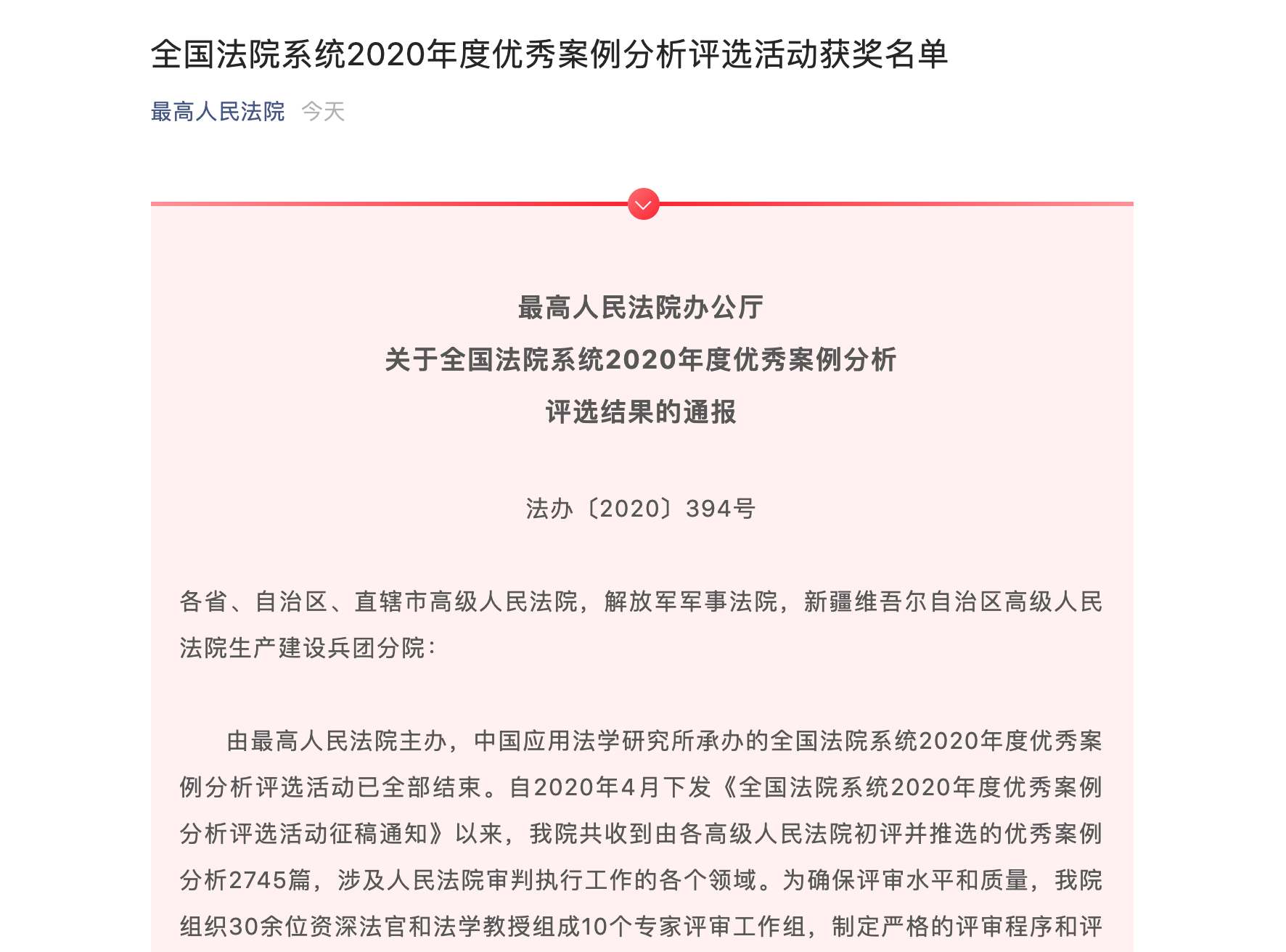
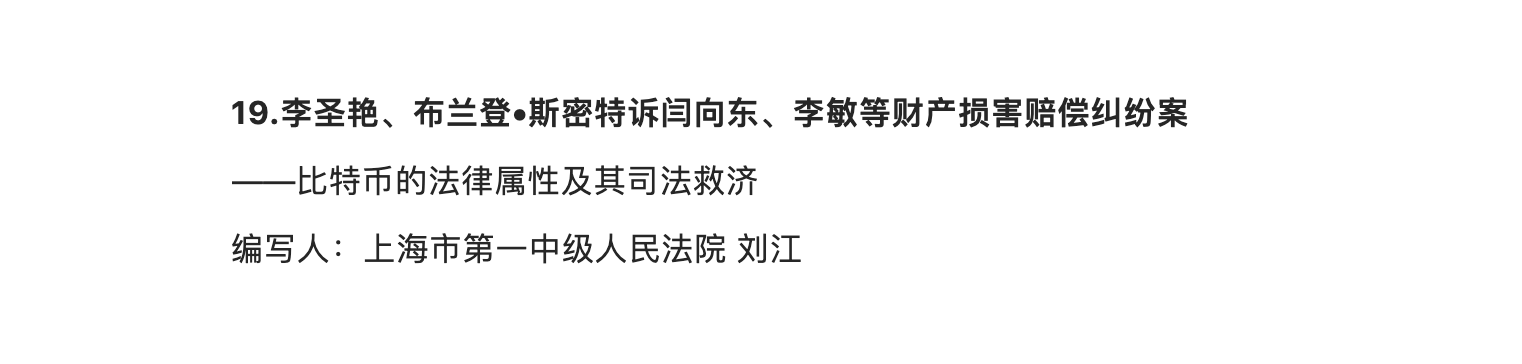
(Screenshot of the article on the official account of the Supreme People's Court)
Case file:
Trial court: Shanghai No. 1 Intermediate People's Court
Case number: (2019) Shanghai 01 Minzhong No. 13689
Trial Procedure: Second Instance
Trial Procedure: Second Instance
o1 Case brief
o1 Case brief
On June 12, 2018, Yan Xiangdong, Li Min, Cen Shengfang, and Sun Fei went to the residence of Li Shengyan and Brandon Smit in Jing'an District, Shanghai, and demanded that Brandon Smit Unlocked the frozen Skycoin account, during which Yan Xiangdong, Li Min and others beat and threatened Li Shengyan and Brandon Smit, after which Brandon Smit and Li Shengyan were forced to transfer Bitcoin and 6,466 sky coins were transferred to the account designated by Yan Xiangdong and others.
secondary title
o2 Viewpoint of the Court of Second Instance
1. Does Bitcoin have property attributes and should it be protected by law?
This court believes that Bitcoin is a network virtual property and should be protected by law. The reasons are as follows:
First, Article 127 of the "General Principles of the Civil Law of the People's Republic of China" stipulates: "If the law has provisions on the protection of data and network virtual property, follow its provisions." Therefore, the law has a positive attitude towards the protection of network virtual property .
Second, the disputed Bitcoin is a network virtual property and should be protected by law.
Bitcoin is an encrypted "currency" based on blockchain technology. Its generation mechanism is: generated by "miners" and "mining". "Mining" can be performed by anyone anywhere in the world." "Mining" refers to the process in which "miners" provide a certain amount of computer computing power according to the open source software provided by the designer, and obtain the special solution of the equation through complex mathematical operations. The "miner" who obtains the special solution obtains a specific number of bits coins as rewards. The physical form of Bitcoin is a string of complex digital codes. To obtain Bitcoin, it is necessary to invest in material capital for the purchase and maintenance of special machines and equipment with considerable computing power, and to pay the corresponding consideration for the power and energy consumption of machine calculations. It also takes considerable time and cost. This process and the acquisition of labor products Abstract human labor, at the same time, Bitcoin can be transferred through money as consideration, and generate economic benefits.
Because Bitcoin has the characteristics of value, scarcity, and disposability, it has the characteristics of a right object and meets the constituent elements of virtual property.
The People's Bank of China and other ministries and commissions have issued documents such as "Notice on Preventing Bitcoin Risks" (2013) and "Announcement on Preventing Financing Risks of Token Issuance" (2017), although such "virtual currencies" have been denied as currencies. However, the above provisions do not deny its property attribute as a commodity, and the laws and administrative regulations of our country do not prohibit the holding of Bitcoin. The "Notice on Preventing Bitcoin Risks" also mentioned that "in nature, Bitcoin should be a specific virtual commodity."
Therefore, Bitcoin has the attributes of virtual property and virtual goods and should be protected by law.
2. Should the Bitcoins involved in the case be returned? If there is a situation where the return cannot be made, should the losses be compensated and how is the compensation amount determined?
From a civil point of view, the behavior of Yan Xiangdong and others to force Li Shengyan and others to transfer out Bitcoin violated their property rights. And the effective criminal ruling also stated that Yan Xiangdong and others voluntarily returned the property obtained from Li Shengyan and others. Therefore, regardless of the legal provisions or the promises made by Yan Xiangdong and others in the lawsuit, the disputed bitcoins should be returned.
Misappropriation of other people's property, if it cannot be returned, it shall be compensated at a discounted price.
Usually, the determination of the compensation amount needs to take into account factors such as the market price at the time of the property damage, the price at which the infringed party obtained the property, the income obtained by the infringer, the amount of compensation claimed by both parties, etc., and shall be determined based on the actual situation of the case.
In this case, the CoinMarketCap.com website is not a virtual currency transaction price information release platform recognized by my country, so the transaction price data of Bitcoin on the website cannot be directly used as the standard for determining the loss of the appellee. The appellee could not provide the court with the price of the bitcoins he obtained, and the appellant stated that the bitcoins were frozen, that is, there was no profit amount for the infringer in this case.
o3 Chain Law Review
o3 Chain Law Review
image description
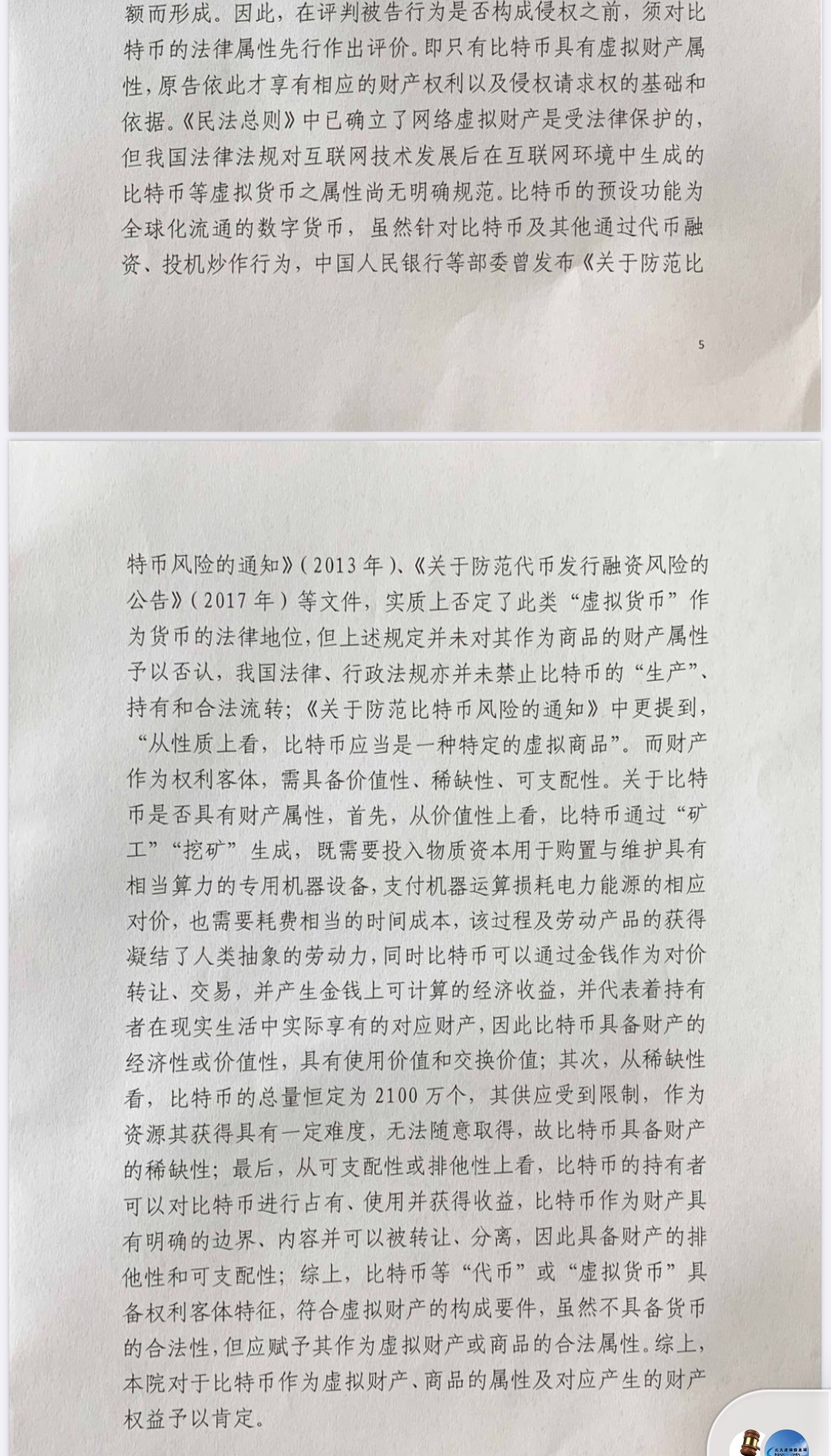
In its judgment, the court cited the protection of data and network virtual property in Chinese laws in the General Principles of Civil Law. In addition, the property attributes of Bitcoin are described in detail in terms of value, scarcity, and disposability. Right now:
In its judgment, the court cited the protection of data and network virtual property in Chinese laws in the General Principles of Civil Law. In addition, the property attributes of Bitcoin are described in detail in terms of value, scarcity, and disposability. Right now:
The process of obtaining Bitcoin condenses human abstract labor—value
Bitcoins can be owned, used, earned, disposed of—exclusively and disposablely.
Bitcoins can be owned, used, earned, disposed of—exclusively and disposablely.
Although this bitcoin case in Shanghai is not the earliest, it is gratifying that this case can be selected as an excellent case selected by the Supreme People's Court. The determination of property attributes and the judicial relief for Bitcoin-related cases have been recognized by the Supreme People's Court. Its typicality and guidance will also have an impact on the national court system in the future trial practice of Bitcoin-related cases. profound influence.
In addition to establishing the important content that Bitcoin should be protected as a virtual property, this case also has important significance for how to provide judicial relief for cases involving Bitcoin property damage. The main contents are as follows:
1. Bitcoin can be requested to return;
2. Compensation for discount: (1) The price of Bitcoin on overseas websites cannot be directly used as the standard for determining the loss. Similarly, the price of Bitcoin on major trading platforms may not be directly used as the standard for determining the loss, because these platforms Not a domestically recognized platform (actually none). However, according to the chain law, there are currently judgments that draw on the price data on Feixiaohao. (2) The determination of the amount of compensation needs to consider the market price when the property was damaged (the time of the incident), the price at which the infringed person acquired the property (the consideration for obtaining Bitcoin), and the income obtained by the infringer (the profit of the infringer) , the amount of compensation claimed by both parties and other factors.
Because this case was selected and announced by the Supreme People's Court, in addition to being typical, it also has a strong guiding significance for the future judgment of the national court system involving digital assets such as Bitcoin.


