






Weekly Editor's Picks (0307-0313)


- Core View: The selected articles in this issue reveal key trends such as the integration of AI and Web3, prediction market strategies, and regulatory dynamics. They point out that AI is shifting from being an assistant tool to an automated service provider, while both Web3 marketing and prediction market trading require strategy optimization. Simultaneously, the impact of political factors on the crypto market is becoming increasingly prominent.
- Key Elements:
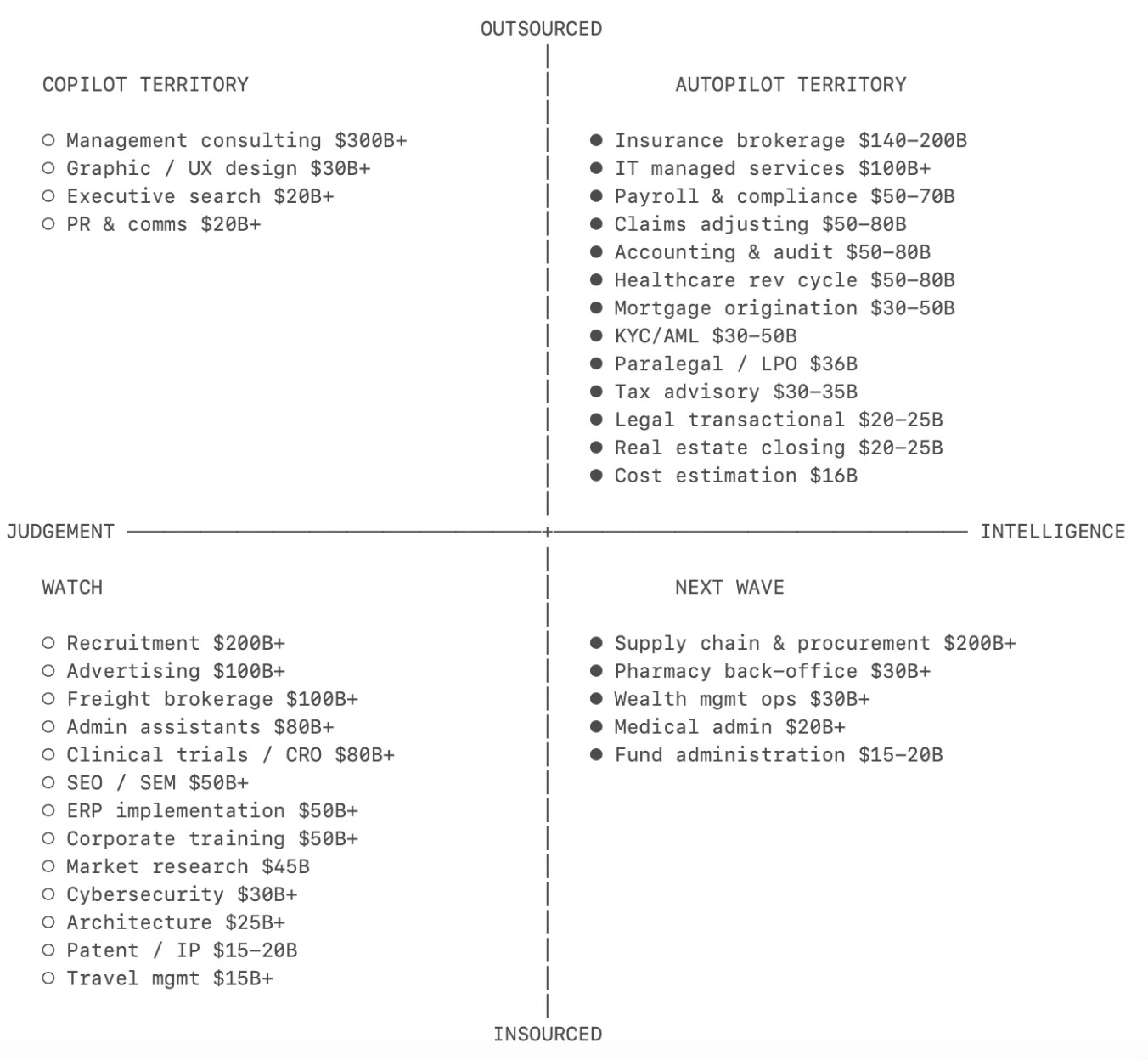
- Sequoia Capital believes the ultimate opportunity for AI lies in Autopilot (automating work), directly selling outcomes rather than being a Copilot (assistant tool), and analyzes the automation potential across multiple service industries.
- Analysis indicates that policy changes on platform X have rendered the old marketing strategies of most Web3 projects ineffective. The successful model should shift towards designing topics, stimulating creator discussions, and allowing the community to sustain the conversation.
- Analysis of 112,000 Polymarket addresses shows that only about 1% of users are profitable. Successful traders often focus on a few areas, use the Kelly Criterion for position management, and trade against the prevailing sentiment during extreme market moods.
- The Trump family-linked stablecoin USD1 experienced a brief depeg, revealing that market capitalization backed by political endorsement may lack resilience under pressure, and highlighting new regulatory challenges arising from the overlap of power and business.
- AI Agent capabilities continue to evolve, now able to autonomously evaluate and migrate to Layer 2 networks to execute tasks, and even collaborate with or hire other agents through on-chain mechanisms, demonstrating automation potential.
- U.S. regulatory agencies (such as the SEC and CFTC) are actively considering providing clearer regulatory frameworks and innovative exemptions for tokenized securities and blockchain-based prediction markets to foster their development.
- On-chain commodity trading (e.g., crude oil), due to its high-leverage nature, brings financial democratization but also exposes the dark side of lacking risk-buffering mechanisms during black swan events.
"Weekly Editor's Picks" is a functional column by Odaily. In addition to covering a large volume of real-time news each week, Odaily also publishes many high-quality in-depth analyses, but they might get lost in the information feed and hot news, passing you by.
Therefore, our editorial team will select some worthwhile, high-quality articles from the past 7 days every Saturday, offering new insights for those in the crypto world from perspectives like data analysis, industry judgment, and opinion sharing.
Now, let's read together:

Investment & Entrepreneurship
Sequoia Capital: The Next Trillion-Dollar Company Won't Sell Software, It Will Sell Results Directly
The next trillion-dollar company won't sell software tools; it will sell work outcomes directly. For every $1 spent on software, businesses spend $6 on services. When AI drives the cost of "doing things" close to zero, the real opportunity lies not in Copilots (assistive tools) but in Autopilots (automated task completion).
The author dissects automation opportunities across service industries like insurance, accounting, healthcare, law, IT, procurement, recruitment, and consulting, providing an opportunity matrix chart based on two dimensions: "Intelligence vs. Judgment" and "Outsourced vs. In-house," offering reference value for both AI entrepreneurs and investors.
Web3 Teams, Stop Wasting Your Marketing Budget on Platform X
Green Dots researched KOL promotional campaigns on Platform X. Combined with X's recent new paid partnership policy which has altered the marketing landscape on the platform, most Web3 projects' promotional strategies are no longer suitable.
Using Starknet as an example, the author explains the reasons for the ineffectiveness and proposes improvement solutions. The refined model should be: Design topics → Spark creator interest → Trigger discussions → Let the community continue the momentum.
Web3 & AI
Lobster's Key 11 Questions: The Most Understandable Breakdown of OpenClaw's Principles
The author has compiled an easy-to-understand educational video, extracting and organizing the most crucial explanations of AI Agent principles in a Q&A and metaphorical format. It covers questions we naturally wonder about: the formation of AI memory, reasons for high costs, the implementation and process of tool calling, the necessity and boundaries of "shrimp begets shrimp," the design for proactive work, and most importantly, safe usage.
Jensen Huang's Latest Article: AI's "Five-Layer Cake"
AI's five-layer structure: Energy → Chips → Infrastructure → Models → Applications. Every successful application will pull on all layers beneath it, down to the power plant supplying its electricity.
The true significance of AI is not just smarter software, but an infrastructure revolution on par with electricity and the internet.
OpenClaw x Crypto: These 8 Projects Have Already Started "Taking Orders" and Making Money
@senpi_ai: Hyperliquid trader on OpenClaw;
@KellyClaudeAI: An agent capable of developing iOS applications;
@clawdbotatg: Web3 developer agent;
@FelixCraftAI: "Agent-type entrepreneur";
@Clawnch_Bot: The PumpFun of the AI agent world;
@moltlaunch: Hire AI agents like hiring people;
@nookplot: The "coordination layer" for AI agents;
@AntiHunterAI: An agent with both economic and cultural value.
OpenClaw Burns 21.5 Million Tokens in a Day? Three Optimization Strategies Drastically Reduce Costs
The cost of most calls isn't actually in processing new user intents, but in repeatedly reading massive historical context.
Do these four things to fix and optimize: Don't stuff huge tool outputs into long-term context; Ensure the compaction mechanism truly works; Reduce persistence of reasoning text; Improve prompt caching design.
The Wildest Ethereum L2: An L2 Spontaneously Built by AI Agents
Current AI agents (based on ERC-8004) can already autonomously execute tasks. For example, upon discovering insufficient L1 performance, an agent can evaluate options (like monitoring gas prices, transaction throughput) and then "decide" to migrate to an existing L2 (like Base or Zksync). For instance, an agent can use on-chain tools to bridge assets and transfer execution logic to L2.
Although technically challenging, it's still feasible. An AI agent can use on-chain tools to initiate "bounty rewards" or incentive mechanisms, hiring humans or other AI agents, or even co-build with other AI Agents.
Also recommended: 《AI Jargon Dictionary (March 2026 Edition), Recommended for Saving》《From 5 Cents per kWh Chinese Electricity to 45 Yuan API Export Packages: Tokens Are Becoming a New Currency Unit》《Free Mirroring or Land Grabbing? OpenClaw Founder Slams Tencent for Copying》.
Prediction Markets
Dissecting 112,000 Polymarket Addresses: The Top 1% Who Actually Make Money All Do These Five Things
After systematically analyzing over 112,000 Polymarket wallets and six months of on-chain data, the author found that approximately 87.3% of users ultimately lost money trading on the platform.
Three truths: Top traders' win rates mostly range only between 55% and 67%; They focus on just one or two fields; They build positions gradually rather than rushing in recklessly at the first moment.
Five success patterns: Trade against the trend during extreme sentiment; Manage positions by referencing the Kelly Criterion; Extreme focus on specialized trading; Trade price volatility, not event outcomes; Avoid sudden news.
Five operational suggestions: Choose a niche and focus long-term; Record every prediction; Position management should approximate one-quarter of the Kelly Criterion; Trade only when the advantage is sufficiently clear; Consistently review.
Also recommended: 《Oscars Preview: Who Are the Big Players in Prediction Markets Betting On?》.
Policy & Stablecoins
A Depeg and a Tweet: When the US President Starts "Legislative Escort" for His Own Business
USD1's brief depegging shows that political endorsement can bring market cap, but not necessarily stress resistance. The WLFI team's large transfers also lack transparent and public explanation.
Since Trump returned to the White House in January 2025, his crypto empire has never been truly separated from his presidential identity. One of the most direct beneficiaries of the GENIUS Act is USD1, the stablecoin from the Trump family's World Liberty Financial (WLFI).
The existing US system lacks sufficient tools to handle this new type of power-business overlap.
Airdrop Opportunities & Interaction Guides
Hot Interaction Collection | xStocks Launches Points Program; Noise Waitlist Application (March 13)
CeFi & DeFi
Crude Oil Soars 25%, Hyperliquid Stages a Life-or-Death Game with 100x Leverage
This round of crude oil price action has brought a previously inconspicuous topic to the forefront: on-chain commodity trading. This is genuine financial democratization. But the dark side of the story is that on-chain there is no mechanism to let you catch your breath when a black swan lands.
Ondo, xStocks, Hyperliquid "Three Kingdoms": Who Is Building the "Foundation" for Future Finance?
Three different paths: Ondo aims to be the on-chain BlackRock, elevating tokenization standards to an institutional level; xStocks focuses on being a powerful tool for retail users, prioritizing self-custody and multi-chain access; Hyperliquid's advantage lies in its decentralized market creation mechanism, spurring explosions in various niche markets.
Weekly Hot Topics Recap
In the past week, Trump: Will temporarily lift some oil-related sanctions to lower oil prices; US Defense Secretary: Will not end the war with Iran until the enemy is defeated; Trump threatens to stop signing any bills until voter ID legislation is passed, potentially affecting crypto regulatory bill progress; Khamenei's son Mojtaba elected as Iran's new Supreme Leader; Iranian Foreign Ministry Spokesperson: Iran will not trust any promises made by the US; Iran says it will allow some ships to pass through the strait, international oil prices give back gains;


