24H Trending Coins & News | Jensen Huang Resigns, CFO Cress Takes Over as Interim CEO; MSCI Removes Strategy, Metaplanet, and Upexi (November 13)


- Key Takeaways: The crypto market is broadly declining, with BTC, ETH, and other major coins down 2%-5% over 24 hours, while U.S. market purchasing power remains sluggish; however, localized hotspots are active, with meme coins and some small-cap tokens surging against the trend. Meanwhile, Nvidia CEO's resignation has rattled the AI sector, and North Korean hacker attacks and security incidents are occurring frequently.
- Key Elements:
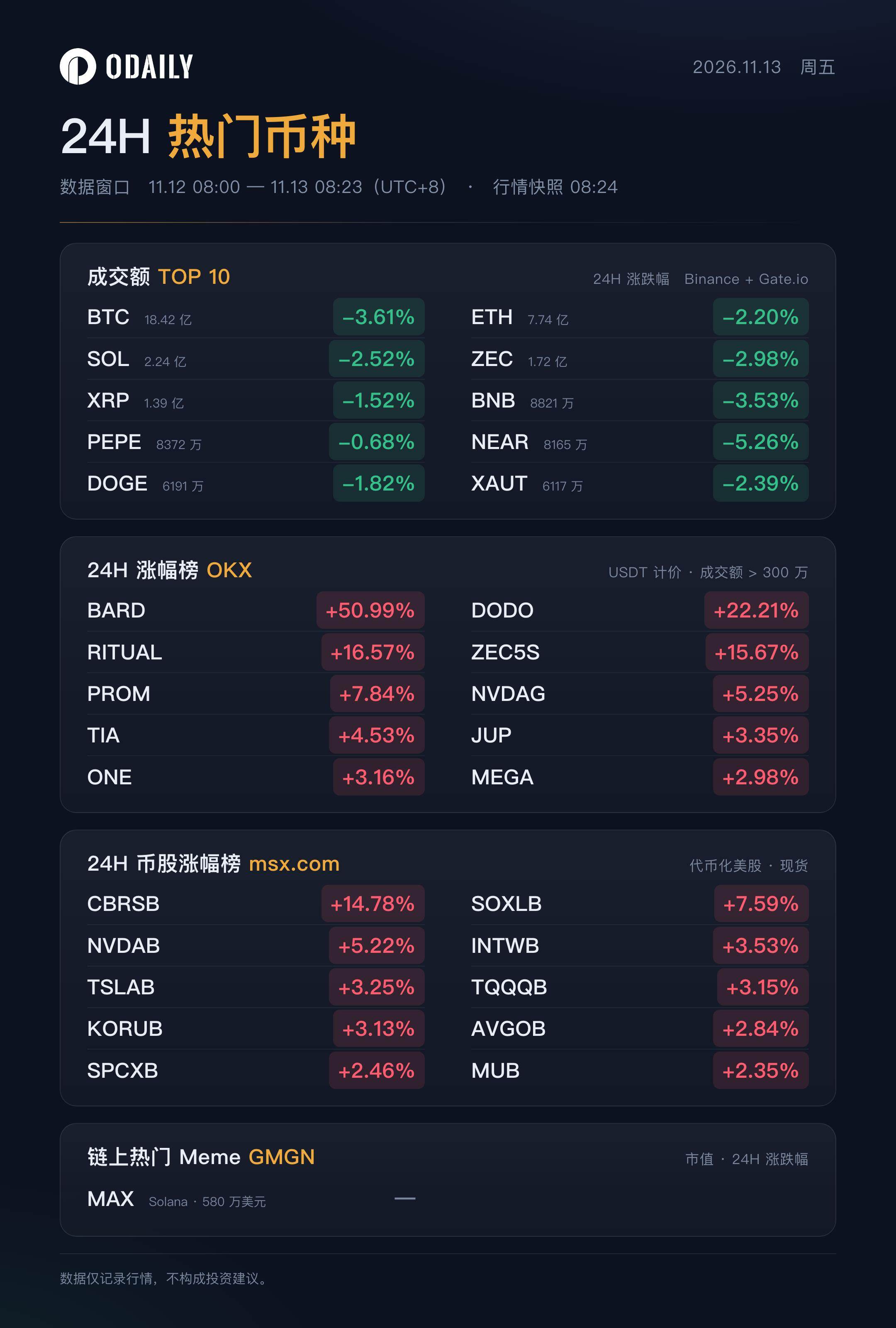
- All top 10 coins by trading volume on CEXes declined, with NEAR leading losses at 5.26% and BTC down 3.61%; on OKX's gainers list, BARD rose 50.99% and DODO rose 22.21%.
- The Coinbase Bitcoin Premium Index has been negative for 50 consecutive days (latest: -0.13%), reflecting weak buying pressure in the U.S. market.
- Nvidia CEO Jensen Huang has resigned, with the CFO temporarily taking over; the stock has fallen more than 30% from its all-time high, and its forward P/E ratio has dropped to about 12x, a 14-year low.
- The U.S. Department of Justice has frozen over $2.7 billion in stolen Binance assets, involving North Korea's "FaceStealer" attack, which caused over $400 million in losses over 18 months.
- MSCI has removed three crypto treasury companies — Strategy, Metaplanet, and Upexi — effective after the close on November 30.
- South Korea plans to have banks lead the issuance of won-denominated stablecoins and intends to allow exchanges to proactively suspend withdrawals in suspected hacking attacks.
- Anthropic's IPO received approximately 6x oversubscription, with plans to raise up to $64.4 billion, potentially making it the largest listing in history.

Trending CEX Coins
Top 10 CEX tokens by trading volume and 24-hour change:
- BTC: -3.61%
- ETH: -2.20%
- SOL: -2.52%
- ZEC: -2.98%
- XRP: -1.52%
- BNB: -3.53%
- PEPE: -0.68%
- NEAR: -5.26%
- DOGE: -1.82%
- XAUT: -2.39%
Top 24-hour gainers (data source: OKX):
- BARD: +50.99%
- DODO: +22.21%
- RITUAL: +16.57%
- ZEC5S: +15.67%
- PROM: +7.84%
- NVDAG: +5.25%
- TIA: +4.53%
- JUP: +3.35%
- ONE: +3.16%
- MEGA: +2.98%
Top 24-hour tokenized stock gainers (data source: msx.com):
- CBRSB: +14.78%
- SOXLB: +7.59%
- NVDAB: +5.22%
- INTWB: +3.53%
- TSLAB: +3.25%
- TQQQB: +3.15%
- KORUB: +3.13%
- AVGOB: +2.84%
- SPCXB: +2.46%
- MUB: +2.35%
2. Top Onchain Meme #1 (data source: GMGN):
- MAX (Solana) — A Solana Meme token launched via the X account of Elon Musk's child, Saxon James Musk. Its market cap briefly surpassed $13 million and currently stands at $5.8 million.
Headlines
Nvidia Announces CEO Jensen Huang Resigns; CFO Colette Kress Appointed Interim CEO
Nvidia (NVDA.O): CEO Jensen Huang has resigned from his roles as President, Chief Executive Officer, and Board member effective immediately. The company has appointed Colette Kress as Interim CEO; she will continue to serve as Executive Vice President and Chief Financial Officer. Harvey C. Jones has been appointed as the company's first Chairman of the Board. (Jin10)
U.S. DOJ: Over $2.7 Billion in Stolen Binance Assets Frozen, Over $1.2 Billion Approved for Seizure
The U.S. Department of Justice announced on November 12 that it had taken joint enforcement action against the North Korean government's use of cryptocurrency theft to fund the regime and illegal weapons programs. The DOJ has seized cloud infrastructure used to carry out the "FaceStealer" social engineering attack, which has caused over $400 million in cryptocurrency losses over the past 18 months, primarily targeting cryptocurrency and Web3 industry personnel as well as open-source software supply chain developers.
MSCI Removes Three Treasury Companies
MSCI has published its November 2026 index review results. Strategy, Metaplanet, and SOL treasury company Upexi were all removed, with the related adjustments effective after the close on November 30. Strategy will exit the MSCI USA Index, Metaplanet will exit the MSCI Japan Small Cap Index, and Upexi will exit the MSCI USA Micro Cap Index. All three crypto treasury companies had previously been on the potential deletion list, and their removal has now been formally confirmed.
Industry News
Nvidia's Forward P/E Falls to 14-Year Low; Shares Down Over 30% from Record High
Nvidia (NVDA.O) shares have fallen sharply recently, with its forward P/E ratio dropping to about 12x, the lowest level since 2012. Following Jensen Huang's resignation, Nvidia shares fell over 4% on Thursday and are down about 11% for the week, more than 30% below the record high set on October 6. In addition to management changes, the market is also concerned about a potential slowdown in AI data center construction. Nvidia CFO Colette Kress is currently serving as interim CEO while the company searches for a permanent successor. Analysts are still maintaining expectations for strong earnings growth at Nvidia, expecting chip demand to continue outpacing supply. The market expects Nvidia's October-quarter revenue to grow 92% year-over-year, with net income exceeding $60 billion, up 89% year-over-year. Nvidia will report earnings next Tuesday, and investors will focus on Kress's comments on the company's future performance outlook; her guidance may draw more attention than the earnings report itself.
According to CoinGlass data, the Coinbase Bitcoin Premium Index has been negative for 50 consecutive days, most recently at -0.13%, with a 30-day average of -0.15%. The Coinbase Bitcoin Premium Index measures the Bitcoin price difference between Coinbase and Binance, used to observe buying and selling pressure in the U.S. market relative to the global market. A persistently negative index usually means Coinbase quotes are relatively lower, which can reflect weak buying or heavy selling pressure in the U.S. market, but it should not be used alone to conclude that institutional capital is flowing out. Previously, on August 24, the Coinbase Bitcoin Premium Index turned positive for the first time since May 19, briefly ending a record 97-day streak of negative premium.
Project News
Ethlabs published an article on the Ethereum community forum proposing to move up Ethereum's goals of achieving post-quantum (PQ) and post-AI attack resistance to 2027, under the codename "pqai27," and recommending it be made the highest priority in protocol development. The team believes that AI is accelerating the cracking of mathematical problems and the discovery of software vulnerabilities, and that the timeline for quantum computing threats is also moving forward. Ethereum needs to enhance long-term network security by adopting cryptographic schemes with fewer security assumptions, strengthening client security, and formal verification. To advance this goal, Ethlabs recommends reassessing the scope of the upcoming Hegotá hard fork, reconsidering features not on the pqai27 critical path, and announcing the withdrawal of Quick Slots resources previously sought for Hegotá to redirect them to pqai27. The preliminary roadmap includes: achieving a post-quantum consensus mechanism and account signature scheme during the Hegotá phase to enable Ethereum to operate in a post-quantum manner; and later achieving full-capacity operation through signature aggregation and post-quantum data availability solutions. Ethlabs emphasizes that achieving "pqai-ready" by 2027 is the core goal, while reaching full-capacity "pqai-scaled" is a more challenging stretch goal.
Dunamu Vice Chairman Kim Hyoung-nyon said at a digital asset policy conference in Seoul that shares of Korean flagship companies Samsung Electronics and SK Hynix can only be traded overseas via tokenized stocks, calling the current situation regrettable. He also formally announced that Dunamu has completed the technical preparation for stock tokenization and can launch related services at any time once the regulatory framework permits. In addition, the conference discussed the legislative progress of the Digital Asset Basic Act. Min Byung-duk, a lawmaker of the Korean Democratic Party, argued that the bill should be passed during the current regular session of the National Assembly, no later than January 18 next year. Park Soo-min, a lawmaker of the People Power Party, said legislation should not be rushed and called for fully allowing institutions and corporations to invest in crypto assets. (Yonhap)
Binance Security Chief Had Warned of Fake Interview Code Attack Months Before $6.3 Billion Theft
Binance Chief Security Officer Jimmy Su said in a July interview that fake job interviews could trick employees into running malicious code on company devices, leading to device takeover, credential theft, and use for infiltrating internal networks. In September, a Binance software engineer downloaded a malicious coding assignment onto a work computer during a fake interview; Binance's preliminary investigation said the incident became part of a multi-stage attack behind the October theft. Jimmy Su also noted that attackers could exploit seemingly normal technical assessment steps to bypass antivirus tools. Binance's subsequent investigation said the malicious assignment's installer evaded endpoint security tools through obfuscation and other evasion techniques. Binance said it has intercepted 57 suspected North Korea-linked cyber threats so far this year, about one every five days. After the October attack, Binance said it has strengthened device and access controls, rebuilt affected wallet systems and internal AI tools, and increased investment in endpoint protection and development environment security. (Cointelegraph)
Reseller Network Cut by About 80%; Trezor Confirms 3 Safe 5 Devices Contain Malicious Implants
Bitcoin News posted on X that Trezor has confirmed that 3 Safe 5 devices sold by CryptoBilis contain malicious implants capable of stealing recovery phrases and passphrases. The implants capture screen data and send it to attacker-controlled servers via mobile networks. Trezor said firmware 2.13.1, released on November 11, can neutralize the discovered implants, and that its reseller network has been reduced by about 80%; no customers have reported stolen funds so far. Customers who purchased devices through CryptoBilis since March 2026 can request replacements; affected users should still move funds to a wallet using a brand-new recovery seed, as firmware updates cannot eliminate information that has already been leaked.
Funding & Investment
Anthropic's IPO Receives About Six Times Over-Subscription
According to people familiar with the matter, demand for Anthropic's IPO has reached about 6 times the number of shares available. The company and its co-founders plan to raise up to $64.4 billion through the IPO, along with $26 billion in concurrent private financing, bringing the combined fundraising to $90.4 billion, which could make it the largest listing in history. Some sources said underwriting banks have told potential investors that Anthropic will prioritize existing investors' subscription demand, and some potential buyers may ultimately receive fewer shares than expected. (Bloomberg)
OpenAI Raises $15 Billion at $1.25 Trillion Valuation
OpenAI has raised $15 billion, bringing the company's valuation to $1.25 trillion. (CNBC)
Griffin Closes $20 Million Series B Led by Octagon Partners
Griffin announced the completion of a $20 million Series B round led by Octagon Partners, with participation from existing investors including Notion Capital, A+ Ventures, Nordic Ninja, and Breega. The company's valuation exceeds $100 million. The funds will be used to expand card issuance and stablecoin-related services. Griffin completed a $24 million fundraising round in March 2024 led by MassMutual Ventures, Nordic Ninja, and Breega, and obtained a full banking license at that time.
Regulatory Developments
South Korea's draft Digital Asset Basic Act, expected to be published this month, will propose that a bank-led consortium be responsible for issuing won-denominated stablecoins. However, even if banks handle issuance, exchanges and third-party payment platforms may still handle the circulation link connecting consumers and merchants, with user access and application scenarios becoming key competitive factors. A South Korean financial regulatory official noted that if stablecoins are used for electronic payments, related businesses may need to comply with the Electronic Financial Transactions Act, with clear obligations regarding protection of deposited and settlement funds, transaction information management, and dispute resolution. (zdnet)
White House Submits Bipartisan CFTC and SEC Commissioner Nominees to Senate
The White House formally submitted bipartisan nominee lists for the U.S. Commodity Futures Trading Commission (CFTC) and the U.S. Securities and Exchange Commission (SEC) to the Senate on Thursday, pending confirmation. Democrat Kristin Johnson was nominated as an SEC Commissioner for a term expiring in 2029; Republican Steven Levine was nominated as an SEC Commissioner for a term expiring in 2030. Democrat Matthew Rowland was nominated as a CFTC Commissioner to fill a vacancy with a term expiring in 2028; Republican Nathan Anonick was also nominated as a CFTC Commissioner for a term expiring in 2031. The move comes after last week's midterm election losses, as Donald Trump's Republican Party is set to lose Senate control in January next year.
South Korea Plans to Allow Crypto Exchanges to Suspend Withdrawals on Suspected Hacks
South Korea's Financial Services Commission (FSC) plans to allow cryptocurrency exchanges to suspend deposits and withdrawals when a hack is suspected, without waiting for confirmation of an attack. The FSC said Thursday it will issue a no-action letter allowing exchanges to preemptively suspend relevant operations under certain conditions. The FSC also requires exchanges to implement round-the-clock monitoring and incident response, increase cold wallet holdings, and strengthen insurance coverage and reserves. Exchanges unable to maintain continuous monitoring may only process deposits and withdrawals when staff are on duty, with advance notice to users. South Korean crypto exchange GOPAX suspended trading, deposits, and regular withdrawals on Friday after receiving a hacker threat; its representative said no security breach occurred. (Cointelegraph)
U.S. DOJ, U.S. Chamber of Commerce and Others File Briefs Opposing Illinois Digital Asset Tax
The U.S. Department of Justice filed a statement of interest on November 6, saying that Illinois' digital asset tax harms federal policy and U.S. leadership in digital assets, and that the tax's wording is vague and discriminatory. The tax imposes a 0.2% levy on the full value of digital assets processed by brokers, without requiring a sale or profit. The U.S. Chamber of Commerce and the Securities Industry and Financial Markets Association (SIFMA), which represents broker-dealers, banks, and asset managers, filed amicus briefs warning that the tax could affect traditional banks, custodians, and advisors that offer digital asset products. (Decrypt)
Voices