


SK Hynix Posts Record-High Earnings: Buy the Stock, Index ETFs, or Leveraged Products?


Jointly produced by BIT Securities × CSOP
1. Being Bullish on a Company Doesn't Mean You Have to Buy Its Stock
When investors are optimistic about a company's growth prospects, the most direct approach is to buy its stock. But if what you're bullish on is an entire industry or supply chain, must you bet on a single company?
Take the AI memory industry as an example. As AI data center construction continues to advance, memory products such as high-bandwidth memory (HBM) have attracted market attention. As a key supplier in the HBM space, SK Hynix recently reported another record-high quarter for Q3 2026: quarterly revenue reached KRW 104.62 trillion, operating profit reached KRW 83.33 trillion, and operating margin was approximately 80%.
However, being bullish on an industry does not mean you can accurately judge every individual company's performance. Even if a company's fundamentals are strong, its stock price may still be affected by valuation, market expectations, industry cycles, and the macroeconomic environment.
Beyond investing directly in individual stocks, investors can also participate in the market in different ways through exchange-traded funds (ETFs).
2. What's the Difference Between Individual Stocks and ETFs?
Investing in Individual Stocks: Focusing on One Company's Performance
Buying SK Hynix stock means investors directly bear the risks arising from the company's operating performance, competitive landscape, financial results, and changes in market valuation. If the company's results exceed expectations, the stock price may benefit; but if product demand, earnings expectations, or market sentiment change, the stock price may also fluctuate significantly.
The advantage of individual stock investing is that the target is clear and allows concentrated participation in a company's growth opportunities; correspondingly, investment outcomes depend more heavily on one's judgment of that company.
Investing in ETFs: Gaining Market Exposure Through a Basket of Assets or a Specific Strategy
ETFs are funds traded on exchanges. Different ETFs have different investment scopes and strategies: some track broad-based indices, some focus on specific industries, and some track a single stock using leveraged strategies.
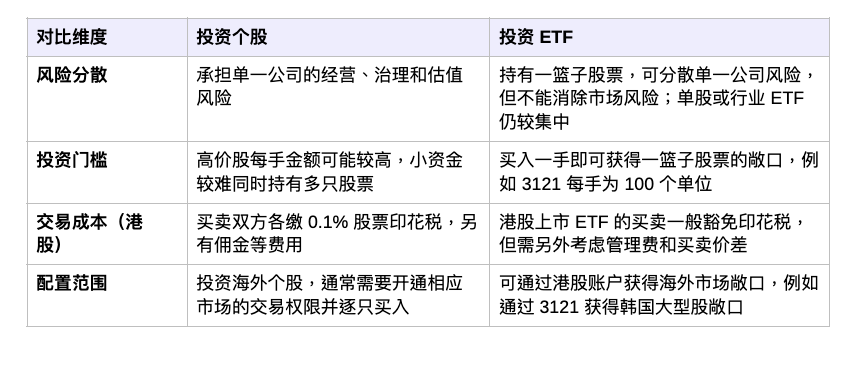
For investors who want exposure to a market or industry but don't want to concentrate their investment entirely in one company, ETFs covering multiple stocks can help diversify company-specific risk and reduce the work of screening and managing multiple stocks one by one.
What Are the Features of ETFs?
Diversification of single-company risk: For ETFs holding multiple stocks, the negative performance of a single constituent stock typically won't affect the entire portfolio as completely as directly holding that stock. However, diversification cannot eliminate market risk.
More convenient access to industries or markets: Investors can gain exposure to a basket of stocks through index ETFs without having to buy each constituent stock individually.
More investment strategy options: The market offers traditional index ETFs as well as sector ETFs, leveraged products, and inverse ETFs. Investors can research different tools based on their own objectives and risk tolerance.
Relatively intuitive trading: ETFs can generally be bought and sold on exchanges like stocks. However, actual trading costs, liquidity, bid-ask spreads, and fund fees still need to be compared individually.
It's important to note that ETFs are not necessarily less risky than individual stocks. For example, ETFs tracking a single stock remain highly dependent on that stock's performance; sector-focused ETFs may also experience significant volatility due to high industry concentration. Leveraged products involve additional strategy risks.
Therefore, choosing an ETF does not mean it is necessarily safer or easier to profit from. The key is to understand the product structure and determine whether it aligns with your own investment objectives.
Individual Stocks vs. ETFs Comparison
3. Taking SK Hynix as an Example: How Do the Three Investment Approaches Compare?
With the AI memory industry continuing to attract attention, investors can compare different investment tools based on the market exposure they wish to obtain.
Approach 1: Directly Invest in SK Hynix
Suitable for investors who want concentrated exposure to SK Hynix's own operating performance and are willing to bear the volatility risk of a single company.
SK Hynix's latest quarterly results were strong, reflecting the boost that AI memory demand provides to the company's business. But investors still need to consider whether the market has already priced in growth expectations in advance, as well as the potential impact of future competitive dynamics, capital expenditure, and industry cycles.
Strong company results do not guarantee that the stock price will continue to rise.
Approach 2: Gain Exposure Through a Korean Market Index ETF
For example, 3121.HK CSOP KOSPI 200 ETF tracks the KOSPI 200 Index, providing investors with index exposure to the Korean large-cap stock market. The product was listed on the Hong Kong Stock Exchange on June 18, 2026, adopts a full replication strategy, directly holds index constituent stocks, and has a management fee of 0.99%.
Compared with directly holding SK Hynix, an index ETF covers multiple companies and can reduce reliance on a single company. For investors who are bullish on the Korean market as a whole but don't want to bet entirely on one company, this is an approach worth researching.
However, an index ETF does not mean there is no concentration risk. The KOSPI 200 Index is highly concentrated in Samsung Electronics and SK Hynix, both of which are in the semiconductor industry. According to the 3121 product summary, their combined weighting may account for over 50% of the product's net asset value. In other words, holding 3121 still provides substantial memory semiconductor exposure. It is more suitable for investors who are bullish on Korean semiconductor leaders but don't want to bet on just one company. Investors should check the latest constituent stocks and weightings on the product website to understand what they are actually investing in.
Approach 3: Amplify Single-Day Exposure Through Single-Stock Leveraged Products
For investors bullish on a particular company, besides buying the stock directly, they can also research leveraged products that track a single stock.
For example, 7709.HK CSOP SK Hynix Daily Leverage (2x) Product provides leveraged investment exposure to SK Hynix. Unlike traditional index ETFs, these products do not diversify risk by holding a basket of stocks; instead, they amplify the daily price movements of the underlying stock through a leverage mechanism.
Compared with directly holding the stock, these products have several characteristics in use:
- Trading convenience: Can be bought and sold through a Hong Kong stock account, traded in HKD, with 100 units per board lot, without the need to open a separate Korean market account.
- Losses limited to invested principal: Unlike margin trading, buying the product does not trigger margin calls, and the maximum loss is the invested principal.
- Scale and trading volume: As of early October 2026, 7709 had approximately USD 4.5 billion in assets under management, making it the largest product of its kind across Hong Kong and the US, with relatively active trading.
At the same time, investors need to understand its operating mechanism before use:
- Single-day trading tool: The product only seeks single-day leveraged performance. Both the issuer and the Hong Kong SFC explicitly state that this type of product is not designed to be held for more than one day.
- Holding costs: The management fee is 1.6%, and the annual ongoing charges ratio is approximately 2.00%, which does not include swap fees. According to the product summary, the longer the holding period, the more pronounced the cost impact.
- Volatility and drawdowns: Leverage amplifies both gains and losses. For example, from late June to the end of July this year, SK Hynix fell approximately 49% from its high on a cumulative basis, while 7709's net asset value drew down over 80% during the same period. After a drawdown, the product's net asset value requires a larger gain to return to its original level. Investors should assess their tolerable losses based on worst-case scenarios before investing.
Investors should pay special attention to the fact that a daily leverage target is not equal to a fixed multiple of long-term cumulative returns. In persistently volatile markets, the compounding effect may cause the product's performance to differ significantly from the underlying stock's cumulative return over the same period. Therefore, in addition to focusing on the underlying company's fundamentals, investors also need to fully understand the product mechanism, holding period, and potential drawdowns.
Comparison of the Three Approaches
The table below puts the three approaches side by side for easy comparison of their differences:
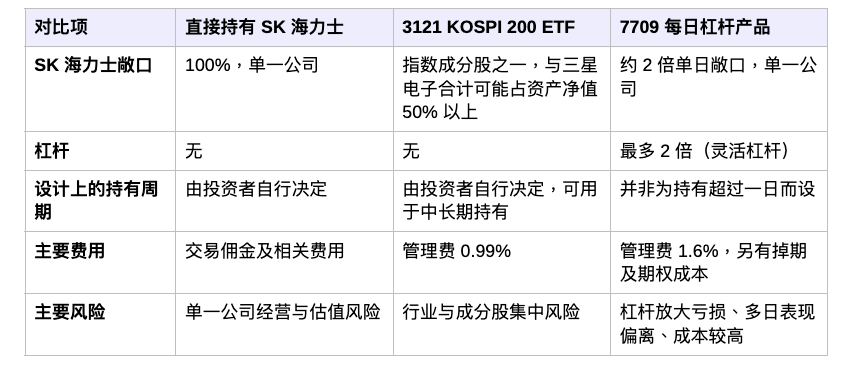
Note: Fee and weighting information comes from product summaries and issuer announcements and may change. Please refer to the latest information on the product website.
4. Before Investing, First Clarify What Exposure You Want
Before choosing individual stocks or ETFs, you can ask yourself a few questions:
- Am I bullish on one company, or the entire industry or market? If your judgment is concentrated on a specific company, individual stocks may be more direct; if you want exposure to a basket of stocks, you can research the corresponding index or sector ETFs.
- How long do I plan to hold? Traditional index ETFs and daily leveraged products are designed with different objectives and cannot be viewed with the same holding logic. Daily leveraged products are not designed to be held for more than one day.
- How much volatility and drawdown can I tolerate? Don't just focus on potential gains when prices rise; also consider potential losses when the market moves against you.
- What are the product's actual trading conditions? Compare management fees, bid-ask spreads, trading volume, tracking performance, and product terms. Avoid making decisions based solely on recent price movements.
5. ETF Investment Pitfall Avoidance Guide
Common Misconceptions
- Holding too many similar ETFs: Buying a large number of ETFs with similar themes at the same time may result in highly overlapping holdings, with an effect close to holding just one broad-based ETF, while increasing management difficulty.
- Looking only at names or popular themes: ETFs with the same "Korea" or "semiconductor" theme may differ greatly in underlying holdings, weightings, and rules. Investors should review holdings and product summaries before buying.
- Looking only at recent gains: Products with large recent gains do not necessarily suit your investment objectives and holding period.
- Treating daily leveraged products as ordinary ETFs: Daily leveraged products are not designed to be held for more than one day and cannot be held in the same way as ordinary index ETFs.
Practical Considerations
- Compare similar products: If multiple products exist for the same theme, compare scale, fee rates, tracking error, and trading volume.
- Watch for premiums and discounts: An ETF's trading price may deviate from its net asset value. For products investing in overseas markets, deviations are more likely during periods when the underlying market is closed or after market close.
- Pay attention to trading hours and order types: Prices during the pre-market auction session for Hong Kong stocks may be more volatile. Consider using limit orders to control execution prices.
- Watch for currency effects: ETFs investing in overseas assets will have their performance affected by exchange rate movements of the relevant currencies.
Summary
Individual stocks and ETFs do not have a simple better-or-worse relationship; rather, they correspond to different investment objectives and risk characteristics.
Individual stock investing more concentratedly reflects one company's performance; ETFs holding multiple stocks can help investors gain broader market exposure. Special products such as leveraged ETFs involve additional strategies and risks and should not be confused with traditional index ETFs.
Taking the AI memory industry as an example, whether investors choose to directly invest in SK Hynix or research Korean market index ETFs or single-stock leveraged ETFs, they should first understand the product structure, risks, and costs before determining whether it aligns with their investment objectives.
Producer and Important Disclosures
Producer: This article is jointly produced by BIT Securities and CSOP.
BIT Securities: BIT (formerly Matrixport) Group's US and Hong Kong stock trading service platform, operated by its wholly-owned subsidiary Matrix Gelephu Pte. Ltd. (holding a Bhutan Special Economic Zone financial services license), with Hong Kong stock services provided through a Hong Kong SFC-licensed partner broker.
CSOP Asset Management: Hong Kong's largest ETF issuer and the first overseas subsidiary established by a mainland China public fund company, focusing on the issuance and management of ETFs and leveraged/inverse products.
Data sources: Product information for 3121 and 7709 mentioned in this article is provided by CSOP Asset Management Limited. Fee and weighting information comes from product summaries and issuer announcements and may change. Please refer to the latest information on the product website.
Risk disclosure: This article is for general market information and investor education only and does not constitute investment advice or a recommendation to buy or sell any securities or funds. Securities and ETF investments may result in loss of principal; leveraged and inverse ETFs carry higher risks. Investors should read the relevant product documents and fully understand their risks before investing.





