


Anthropic races toward a U.S. IPO: revenue up 14x in half a year, what is the investment logic behind the $80.7 billion mega-loss?


The competition in the AI industry is extending from model capabilities to commercialization and the capital markets.
On October 26 local time, Anthropic, the AI company behind Claude, submitted an IPO registration statement to the U.S. Securities and Exchange Commission (SEC), planning to list on Nasdaq under the ticker symbol ANT. As its financial information gradually becomes public, the cost structure, profitability, and potential risks behind this frontier AI company's rapid growth are also beginning to face scrutiny from the public markets.
For investors focused on the AI sector and U.S. IPO opportunities, in addition to researching the company's fundamentals, they can also pay early attention to related stock information. Currently, the BiyaPay App already supports searching for Anthropic's corresponding ticker symbol ANT, making it convenient for users to promptly find and track relevant information once trading officially opens.
Most notably, Anthropic generated revenue of $16.286 billion in the first half of 2026, roughly 14 times that of the same period last year; however, its net loss for the same period reached $80.748 billion. The market had previously seen discussions of potential valuations of roughly $1.5 trillion to $2 trillion, but the final offering price and valuation have not yet been determined.
Rapid revenue growth, massive book losses, and continuously increasing compute investment—these three things happening simultaneously are precisely what constitutes the key to understanding Anthropic.
For investors, the real question is not whether the AI industry has room for growth, but on what basis Anthropic can command a high valuation. Does the $80.7 billion loss mean the business is out of control? If it successfully goes public in the future, what impact will it have on companies across the related supply chain?
Where does Anthropic's value lie? Why are enterprise customers willing to keep paying?
To judge the commercial value of an AI company, one cannot look only at how models perform in tests, but also at whether they can enter real business processes and keep customers paying.
Anthropic's core product, Claude, is no longer limited to chat-based Q&A. As AI coding, knowledge processing, and enterprise workflow applications continue to expand, the model is gradually becoming part of enterprise software development and daily operations. Products such as Claude Code are further pushing AI from assisted answers toward executing more complex tasks.
The commercial significance of such applications lies in the fact that what enterprises buy is not a one-time technological experience, but a work capability that can be used repeatedly. If AI can shorten development cycles, process large volumes of documents, or reduce repetitive labor, enterprises will have the incentive to incorporate it into their long-term budgets.
From a revenue model perspective, Anthropic primarily charges based on model usage while also offering subscription services. According to public filings, in the first half of 2026, its usage-based revenue was approximately $13.1 billion, accounting for about 80% of total revenue; subscription revenue was approximately $3.2 billion.
This means that revenue growth depends not only on new customers but also on how frequently existing customers use the models, the complexity of their tasks, and the scale of their spending.
Customer data also reflects the expansion of its enterprise business. As of September 30, 2026, Anthropic had more than 11,900 customers that contributed at least $100,000 in revenue over the past 12 months, of which more than 1,900 contributed at least $1 million in revenue.
But there is also an issue worth noting here: customers being willing to pay does not mean Anthropic has already established an unshakable competitive moat. OpenAI, Google, and other model providers are still competing for enterprise customers, and model performance, service pricing, data security, and product experience can all influence customer choices.
Therefore, whether Anthropic's high-growth logic holds ultimately depends on whether it can continue to expand enterprise applications while maintaining customer stickiness and pricing power.
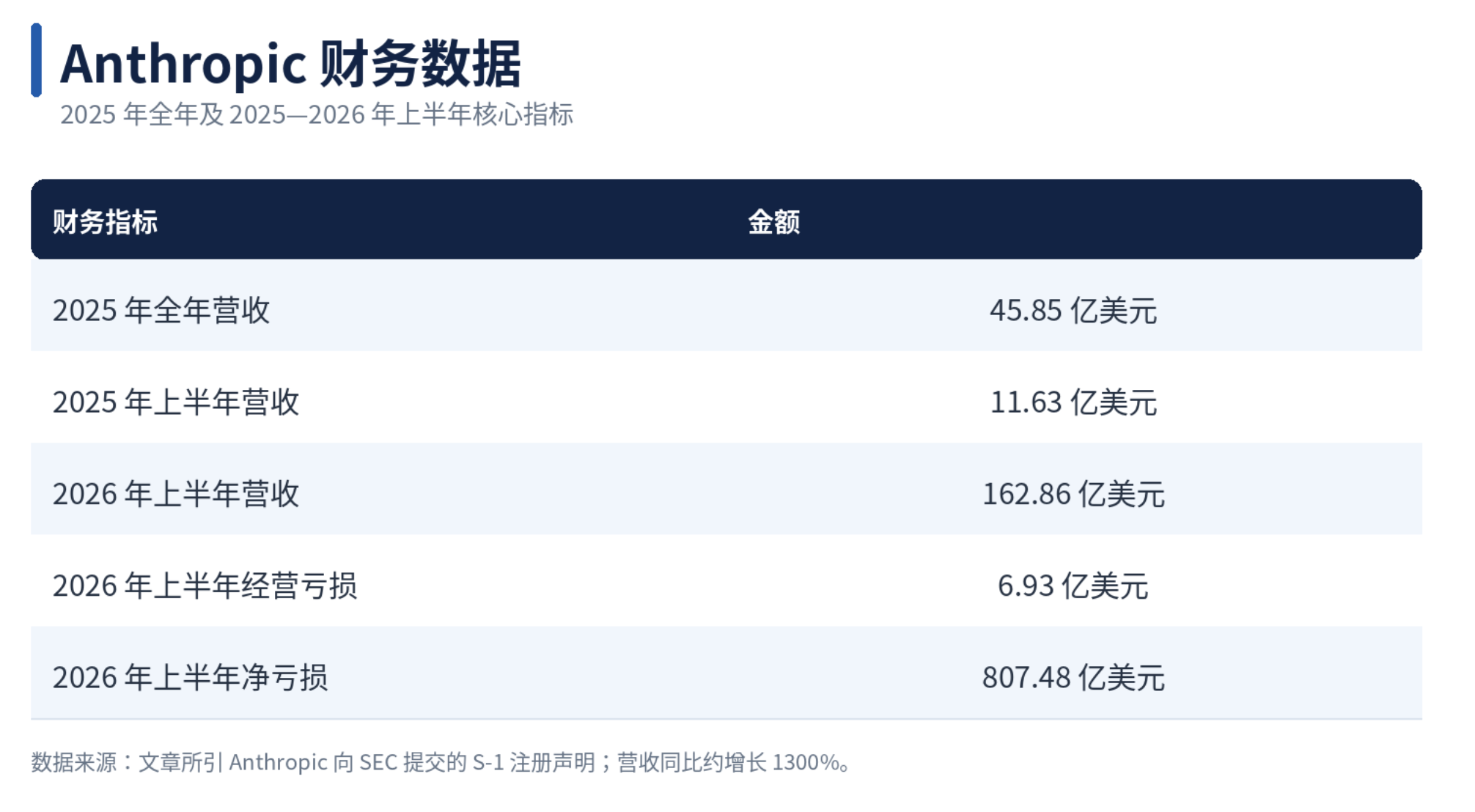
How fast is revenue growing? Half-year revenue already exceeds three times last year's full-year total
First-half revenue grew approximately 1,300% year over year, reaching about 14 times the same period last year.
More notably, Anthropic's first-half 2026 revenue has already exceeded three times its full-year 2025 revenue. This is not merely growth from a low base; it also reflects the rapid expansion of enterprise AI demand.
However, the quality of revenue growth still needs to be viewed in the context of the business structure. The usage-based billing model can expand revenue as customer call volumes grow, but customer demand may also be affected by budget adjustments, product pricing, and business cycles. For enterprises using AI, paid demand is more likely to be sustainable only when the value created by the model can cover the cost of use.
Another signal worth noting is that Anthropic achieved approximately $974 million in quarterly operating profit in the second quarter of 2026, but because the first quarter still had an operating loss, its overall operating loss for the first half of 2026 was still approximately $693 million.
This shows that the company has already shown signs of operational improvement at the quarterly level, but it cannot be concluded from this that it has entered a stage of stable profitability. Whether revenue can maintain growth going forward and whether costs can be controlled as scale expands still determine whether profitability can be sustained.
For investors, revenue growth can explain why the market is willing to give high expectations, but it cannot by itself prove that the valuation is reasonable. What really matters is whether growth can continue and whether revenue can gradually translate into profit and cash flow.
What does the $80.7 billion net loss actually mean?
This may be the most easily misunderstood part of Anthropic's financial disclosure.
The net loss of $80.748 billion appears to far exceed its first-half revenue. But according to the S-1 filing, approximately $72.388 billion of it comes from fair value changes related to financial instruments such as convertible notes, derivative liabilities, and simple agreements for future equity.
Simply put, the book value of some financing instruments adjusts as the company's valuation and related contract terms change. Under accounting rules, such changes may be recorded in current profit and loss, but they do not necessarily mean the company paid out an equivalent amount of cash during the same period.
Therefore, the $80.7 billion net loss cannot be directly understood as Anthropic burning $80.7 billion in cash over half a year.
To judge its operating condition, one also needs to look at operating loss and cash flow. In the first half of 2026, Anthropic's operating loss was approximately $693 million, significantly lower than approximately $2.135 billion in the same period last year. In addition, according to an analysis of its public financial data, the company's operating cash flow was positive during the same period.
This means that the net loss includes large accounting items, and the loss at the main business level has also narrowed. But this does not mean financial risk has disappeared: operating loss is not the same as cash flow, and positive cash flow in a certain period does not mean there will be no need for substantial financing or capital investment in the future.
Investors should look at the three metrics separately:
• Net loss: Reflects overall profit and loss under accounting standards, and may be affected by items such as changes in the valuation of financial instruments.
• Operating profit: More directly reflects the relationship between main business revenue and operating expenses.
• Operating cash flow: Used to observe the actual generation or consumption of cash by the business, but still needs to be judged in conjunction with capital expenditures and long-term payment obligations to assess funding pressure.
What really needs to be tracked is whether Anthropic can continue to improve operating profit and cash flow, rather than merely looking at whether a single loss figure is shrinking.
Will compute drag down profitability? Behind high growth, there are also long-term costs
There is an important difference between the business model of AI companies and traditional software companies: model services require continuous consumption of computing resources.
Anthropic's spending on computing and infrastructure in the first half of 2026 was approximately $8.945 billion, equivalent to about 55% of its revenue during the same period. This shows that even with rapid revenue growth, compute remains an important variable affecting the company's profitability.
As customers use models more frequently, revenue has the opportunity to grow accordingly, but model training, inference services, and execution of complex tasks also require more computing resources. For Anthropic, the key is not just how much revenue scale has expanded, but how much additional cost is required for each additional unit of revenue.
If model efficiency continues to improve, the computing resources required per unit of task decline, and customers are willing to pay for higher-value services, profit margins have room to improve. Conversely, if service prices fall faster than costs decline, revenue growth may not necessarily bring about a corresponding increase in profit even if it continues.
Another factor that cannot be ignored is long-term compute contracts.
Media previously reported that Anthropic's commitments in cloud services, computing, and infrastructure over the coming years reach hundreds of billions of dollars. Related reports have provided an estimate of at least $518 billion, but the statistical basis of long-term contracts, minimum payment obligations, and optional procurement arrangements may differ, and these figures cannot be simply understood as cash the company has already paid.
Locking in compute in advance helps the company support model research and future customer demand; but if actual demand falls short of expectations, or if a new generation of models reduces the need for some computing resources, long-term contracts may also limit the company's financial flexibility.
Anthropic also noted in its public filings that after additional computing resources are invested, related costs may be fully reflected before the revenue they support; when demand exceeds long-term locked capacity, the company may also procure short-term compute at a higher unit cost.
Therefore, in the future, investors should not only track Anthropic's revenue growth, but also pay attention to the ratio of compute expenses to revenue, changes in operating profit margin, and whether long-term contracts can be absorbed by real demand.
Is a trillion-dollar valuation expensive? What expectations exactly are investors paying for?
The market had previously discussed a potential valuation for Anthropic of roughly $1.5 trillion to $2 trillion, but this does not represent the final IPO pricing.
To understand what such a valuation means, a simple scenario calculation can be made.
Media previously reported that Anthropic's third-quarter revenue was approximately $16.8 billion, higher than $11.6 billion in the second quarter, representing quarter-over-quarter growth of about 45%. This figure comes from media reports on information from related investor meetings and should not be confused with the first-half financial data disclosed in the S-1.
If third-quarter revenue is simply multiplied by four to obtain annualized revenue of approximately $67.2 billion, and then compared with valuations under different assumptions, one can see the growth expectations implied by market pricing.
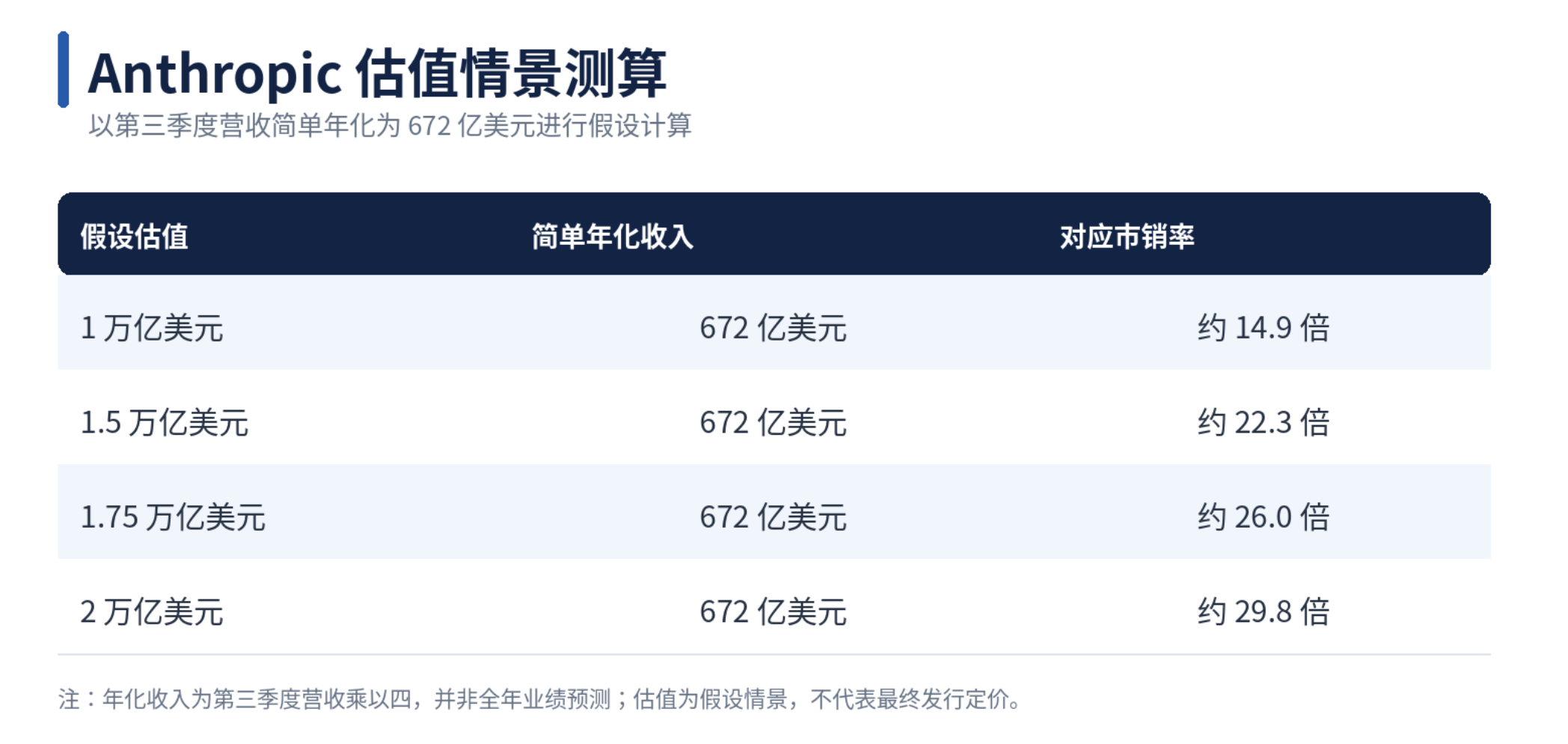
The significance of this calculation is not to directly determine whether Anthropic is "expensive" or "not expensive," but to illustrate that if the final valuation falls within the above range, what investors are buying is not just current revenue, but also expectations for growth, market share, and profitability over many years to come.
High-growth companies can typically command higher valuations than mature companies, but the higher the valuation, the higher the requirements for future performance delivery. Once growth slows, cost declines fall short of expectations, or competition pushes down model service prices, the market may reassess its valuation.
For ordinary investors, there is also a practical issue: a high company valuation does not mean the stock price will necessarily rise after the IPO. Final performance also depends on the offering price, supply of tradable shares, market sentiment, lock-up arrangements, and post-listing financial performance.
Before the official offering price, offering size, and final trading arrangements are clear, any potential valuation can only serve as an analytical scenario, not a basis for buying.
With Anthropic going public, which U.S. stock supply chain companies are worth watching?
Anthropic's IPO may become an important pricing event for the AI industry, but it cannot be simply inferred that all AI-related stocks will benefit. Different companies have different revenue sources, business relationships, and risk exposures.
Amazon (AMZN) and Alphabet (GOOGL) are worth watching because they have multiple ties to Anthropic, including cloud services, investment, and commercial distribution. Cloud platforms can gain business opportunities from model training, inference, and enterprise customer services, and related equity investments may also be affected by changes in Anthropic's valuation.
But these relationships are not only positive. Large cloud platforms both provide computing resources to Anthropic and are developing their own AI models and products. They are both suppliers and investors, and may also be competitors. Whether Anthropic's growth can translate into actual profit for related companies still depends on contract terms, resource costs, and revenue recognition methods.
NVIDIA (NVDA) and other AI chip and network infrastructure suppliers are more directly related to the industry's overall compute demand. Expanding demand for model training and inference may drive demand for accelerated computing, storage, and high-speed interconnect, but actual performance is also affected by customer capital expenditures, supply chain competition, in-house chips, and product iteration cycles.
AI cloud service providers and data center-related companies may also gain opportunities from industry expansion, but high capital investment does not automatically equal high returns. The market still needs to judge whether newly added compute can be fully used by customers, whether contract prices can cover costs, and how long it will take for infrastructure investment to be recovered.
Therefore, when observing the supply chain impact of Anthropic's IPO, it is best to return to specific companies: through exactly what business are they related to Anthropic? How large a proportion of the company's overall business does the related revenue account for? How much profit will new investment bring, or will it first increase pressure from capital expenditures?
This is more helpful for judging potential impact than simply labeling stocks based on the "AI concept."
When following overseas assets, besides researching companies, you also need to understand trading and funding tools
For users following the Anthropic IPO, the first thing to distinguish is that company fundamentals and trading channels are two different things. Researching the company's growth, valuation, and risks is the prerequisite for deciding whether to participate; trading services, currency exchange, and cross-border payments relate to how to manage funds across different markets.
BiyaPay positions itself as a global one-stop multi-asset allocation platform, with related services covering U.S. stocks, Hong Kong stocks, digital assets, commodity futures, and foreign exchange, and providing functions such as fiat currency exchange, cross-border remittances, related wealth management services, and a virtual Visa card.
For users focused on U.S. and Hong Kong stocks, BiyaPay provides digital asset exchange and U.S. and Hong Kong stock-related trading services, real stock trading, dividend rights, and zero commissions, with multiple assets and services concentrated in one place, reducing cross-platform switching. For users who need to follow different markets and manage multi-currency funds, one-stop services help reduce the operational cost of switching between different platforms.
As for Anthropic-related stock trading services, official announcements and the actual trading page should also be taken as the standard. Before service availability, the nature of the underlying asset, and trading rules have been confirmed, it should not be described as already tradable, and private equity, IPO subscriptions, and post-listing common stock trading must not be conflated.
The real test is turning AI growth into sustainable returns
Anthropic's IPO process gives the market a deeper look at the commercialization performance of a frontier AI company.
Rapid revenue growth shows that enterprise-level AI demand is expanding; narrowing operating losses indicate signs of improvement in the main business. But the massive accounting loss, continuously increasing compute costs, and long-term infrastructure commitments also remind investors that revenue growth does not mean profitability is already solid.
Next, the official offering arrangements, final valuation, operating profit margin, cash flow, and the return efficiency of compute investment will all affect the market's judgment of Anthropic.
For investors, what is most worth watching is not a single revenue figure, nor the "trillion-dollar valuation" itself, but whether the company can continue to translate model capabilities into customer payments and then turn revenue into stable operating returns.
The AI industry is moving from competing on model capabilities to competing on commercial efficiency. Anthropic's listing process is both a financing event and an important window for the market to test the AI business model.





