






ether.fi回应「积分缩水」争议:质押机制不同,但前端显示的确有误


The re-pledge track is in full swing. Data shows that the TVL of the EigenLayer-based Ethereum re-pledge protocol has reached US$3.8 billion. Among them, the ether.fi protocol is firmly in the lead, with a TVL of US$1.3 billion, an increase of more than 280% in the past month. But recently, ether.fi suddenly fell into the controversy of stealing points.
Eigen Layer shrunk by half, where did the points go?
On February 19, a community memberreaction, when the number of pledges and pledge time are the same, compared with Renzo Protocol, ether.fi has about 10% less eigenlayer points than Renzo Protocol. But someone pointed out at the time that this might be the result of different staking mechanisms.
Today, some members have calculated and found that the TVL of ether.fi at this time is 1.42 billion, and the TVL of Renzo Protocol is 364.36 million, which only accounts for about 1/4 of ether.fi. The points on ether.fi are only 1.81 of Renzo Protocol. times. If calculated based on the ratio of Renzo Protocols TVL and EigenLayer points, the points on ether.fi should be about twice what is currently displayed. This gap cannot be explained by the different staking mechanisms, but ether.fi has not responded to this issue before.
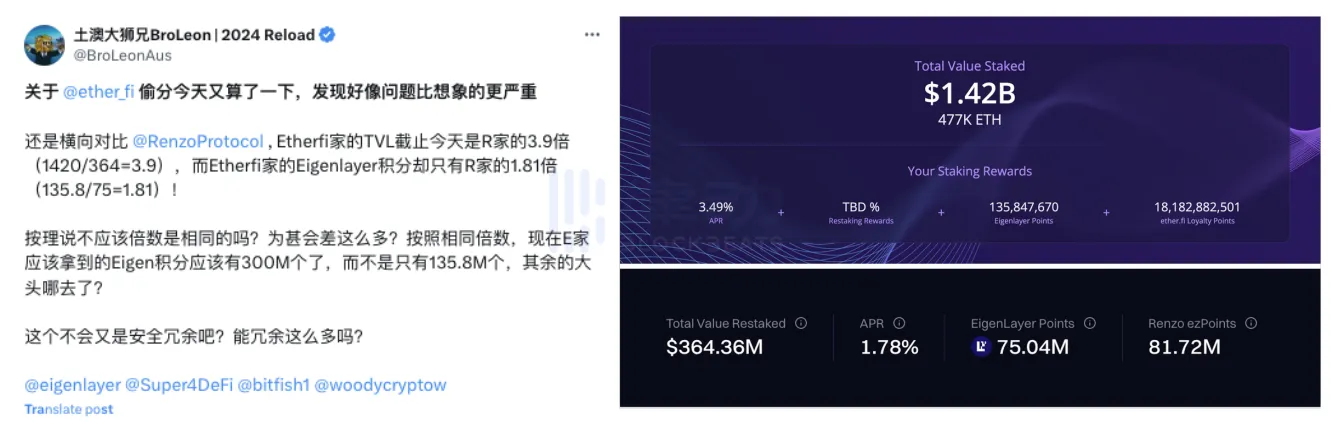
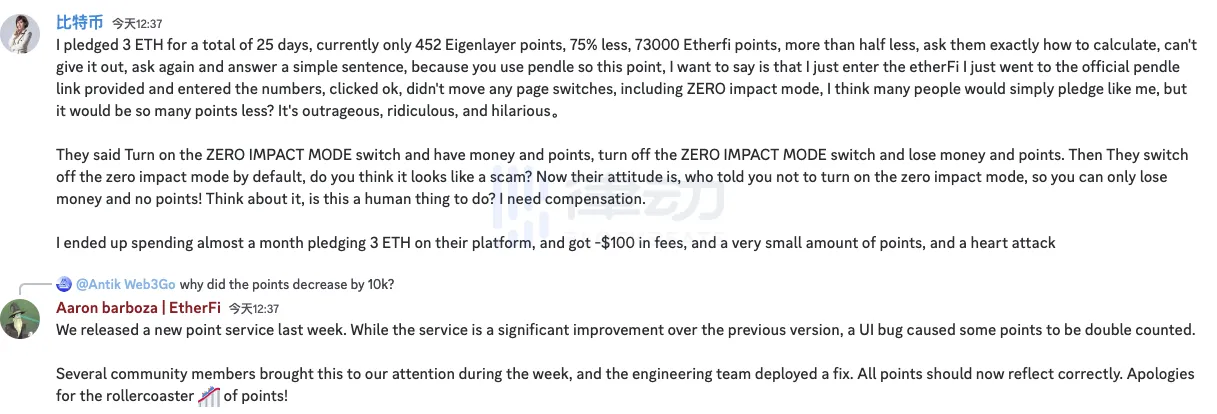
Shrunk by half, where did the undercounted points go? Such a discovery sparked discussion in the community, but there was no response. Community members raised the matter to the teams character and way of doing things. In the Discord community of ether.fi, someone replied to members who found that their points were reduced, If you only lose 10k points, you are still lucky. On Twitter, some early followers of ether.fi said they were not surprised at all.
Team response: The staking mechanism is different and the total points displayed on the front end are incorrect.
Why do points disappear for no reason? Is there really a situation of stealing points on ether.fi? BlockBeats asked the ether.fi team for verification on this incident and obtainedexclusive response。
The ether.fi team initially explained this situation as the platforms ETH liquidity management strategy. 100% of the EigenLayer points earned by users staking ETH will be directly transferred to users. However, the ETH received by ether.fi is not pledged immediately, but liquidated. It is stored in the form of a sexual pool, and users can instantly withdraw ETH and transfer it within and outside the protocol. Therefore, under normal circumstances, users will not receive 24 points every day.
The only way to get 24 points every day is to join EigenPod, but this way you will lose the opportunity to participate in other DeFi protocols. Since other liquidity staking protocols usually do not provide withdrawal functions, ether.fi will look a bit special.
But will different staking mechanisms make such a big difference?
Shortly after explaining the staking mechanism, the ether.fi team once again asked BlockBeatsexpress, the points displayed on the protocol homepage are indeed incorrect. The actual EigenLayer points earned by users are much higher than the current incorrectly displayed data. The number of points each user sees on their own dashboard is completely correct, but the number of points displayed on the homepage is completely correct. The total is not reported correctly. The ether.fi team will fix this issue tomorrow.
At the same time, the ethet.fi team also apologized and responded to members who raised points issues on Twitter and Discord, and the points shrinkage crisis was temporarily resolved.
LRT track points battle continues
The LRT track is bullish because it has 3 key elements, namely innovative technology, money printing opportunities and compelling narratives, and LRT provides higher ETH yields. With LRT, users can obtain Ethereum staking yield (~5%) + Eigenlayer re-staking rewards (~10%) + LRT protocol token emissions (~10% and more). When Eigenlayer is fully online, ETH returns are expected to reach approximately 25%.
Although Lido has achieved a leading position in the LST field, with the birth of a large number of LRT protocols, the LRT competition has just begun.
In the first stage of this competition, points became the main weapon. Puffer is a good example. As a latecomer, Puffer provides 3x points for re-stakers who withdraw stETH from Eigenlayer and deposit it into Puffer, which is largely responsible for its rapid rise in market share. to 22%, ranking second.
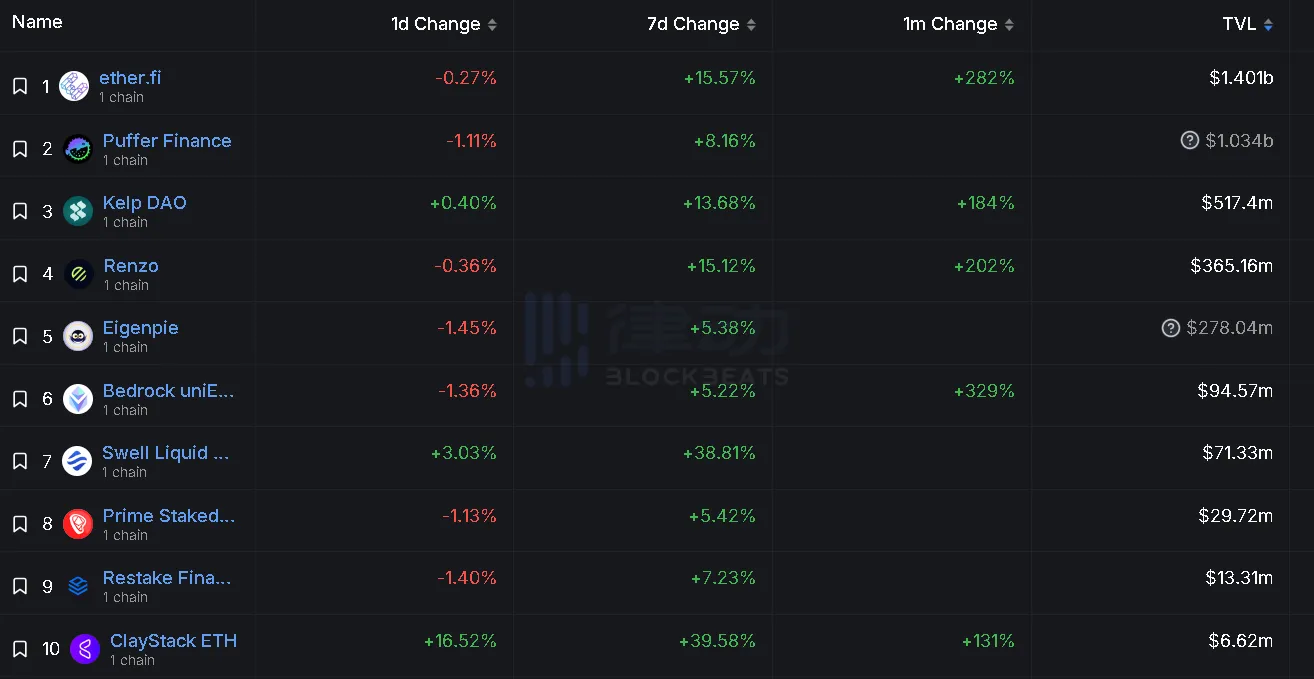
As a project supported by BitMEX co-founder Arthur Hayes, ether.fi created LRT eETH through EigenLayer local re-pledge. Currently, eETH occupies a leading position in the LRT market, with a market share (MS) of 39%. In fact, the total value locked (TVL) of eETH in Eigenlayer even exceeds that of stETH.
In addition to staking rewards and the possibility to use eETH in DeFi, this recurring flow also enables depositors to earn both ether.fi loyalty points and EigenLayer re-staking points, both of which may involve short-term investment. It is reported that as of February 10, EtherFi has provided 2 million Eigenlayer points (in addition to EtherFi points) from its treasury to new depositors.
Following the pace of Puffer, various LRT protocols have also launched point incentives. Among them, Eigenpie, which entered the market late, proposed that in the first 15 days (as of February 12), users can get 2 times the points bonus. Points will be used to airdrop EGP tokens, accounting for 10% of the total supply. With this measure, Eigenpie quickly accumulated a TVL of US$184 million and a market share of 6%.
Related Reading:Risks and best operating practices of EigenLayer re-staking》
Since points mean airdrop expectations, stealing points will naturally trigger heated discussions in the community. However, in addition, since the current Restaking protocols on the market are basically built based on EigenLayer, for users, participating in Restaking means that they will You are exposed to the following risks. After all, if the EigenLayer contract is attacked, related project funds will also be lost.





