


Bankless: Possibility and potential challenges of Ethereum spot ETF approval


Original title: Is the Ethereum ETF Happening?
Original author:Jack Inabinet
Original compilation: Luccy, BlockBeats
Editors note: With the approval and listing of the Bitcoin spot ETF, the approval or disapproval of the Ethereum ETF has become the focus of discussion. While the market rejoiced at the approval of the Bitcoin spot ETF, factors such as GBTC redemptions and crypto traders unwinding bets on the approved Bitcoin ETF have had a dampening effect on prices.
Regarding the prospects of the upcoming Ethereum spot ETF, Bankless analyst Jack Inabinet pointed out that the market has some doubts about the approval of the Ethereum spot ETF. Some experts believe that the SEC may need to clarify its non-security status before approving the spot ETF, but at present Gensler’s regulatory stance on Ethereum is unclear.
In addition, Jack Inabinet analyzed in detail the differences between futures ETFs and spot ETFs, as well as the reasons why market participants are relatively less optimistic about the approval of Ethereum spot ETFs, and raised some potential challenges that the market may face. BlockBeats compiles the original text as follows:
After a decade of delays and denials, last week the U.S. Securities and Exchange Commission (SEC) gave emergency approval to list a Bitcoin ETF on U.S. stock exchanges, sending the entire crypto industry into jubilation.
Last Thursday, the Bitcoin spot ETF product began trading. While Bitcoin hasn’t produced the “God candle” that some in the crypto industry were hoping for, where traditional finance imitates our investments, ETF inflows have met analysts’ expectations, with newly formed instruments attracting Nearly $2.9 billion in capital inflows.
While GBTCs $1.2 billion in redemptions and crypto traders unwinding bets on the Bitcoin ETFs approval are two factors currently suppressing prices, the long-term impact of the ETFs approval cannot be underestimated.
For the first time in history, pure crypto asset exposure is now available through every (or at least most) traditional brokerage account in the United States, opening the door to a whole new group of capital with the ability to purchase crypto assets. Even better, the traditional financial giants who are the issuers of these new Bitcoin ETFs now have a financial incentive to promote our asset, or at least Bitcoin, in an attempt to generate by expanding the AUM held by their products More fee income.
With the launch of a Bitcoin spot ETF, traders are now keeping a close eye on Ethereum and trying to get a head start on its upcoming spot ETF, which has a final approval deadline of May 23.

There are always some bull runs in the crypto space, and the narrative focus has once again turned to Ethereum, resulting in a healthy buying spree that has put ETH/BTC up 25% this week, shaking off the turmoil that has plagued holders since the Merge A year and a half downtrend!
While traders have begun preparing in earnest for the arrival of Ethereum spot ETFs, not everyone is convinced they will arrive.
Why was the Ethereum spot ETF rejected?
Bloomberg senior ETF analyst Eric Balchunas would give the odds of approval just 70%, lower than the 90% chance he gave the Bitcoin spot ETF.
Even more pessimistic is Nikolaos Panigirtzoglou, director of global market strategy and alternative digital assets at JPMorgan Chase. He believes that the SEC needs to classify ether as a non-security before approving spot ETFs. Before May, he did not believe that the agency had more than 50% Chances are it does.
SEC Chairman Gary Gensler, the decisive vote to approve the Bitcoin spot ETF, has always maintained that Bitcoin is not a security under federal securities laws, but he has refused to provide any regulatory clarity regarding Ethereum.
There are concerns that Ethereum’s proof-of-stake design and ability to generate yield may mean it will automatically be considered a security.
Is the Ethereum Spot ETF Approved?
Skeptics of the Ethereum ETF’s approval appear to be numerous online. Fortunately, theyre also probably wrong.
In the crypto space, many are concerned that the SEC will veto an Ethereum spot ETF by classifying Ethereum as a security, as the agency has stated that it considers the vast majority of crypto assets to be investment contracts subject to federal securities laws. Nonetheless, Ethereum’s status as a non-security seems to have been solidified.
The SEC has sued multiple crypto exchanges for listing cryptoassets that are considered securities, including other L1 tokens such as SOL, NEAR, and ATOM. None of these enforcement actions have listed Ethereum as a potential security.
JPMorgan’s Panigirtzoglou believes the SEC needs to make a decision on Ethereum’s security status, but the agency already approved an Ethereum ETF holding commodity futures contracts in October last year, providing clarity for Ethereum to be considered a non-security. information.

While the SEC insists that their action to approve a Bitcoin spot ETF does not indicate the commission’s willingness to approve ETFs for other crypto assets, it is this approval that clears the way for an Ethereum spot ETF!
Central to Chairman Gensler’s approval of a Bitcoin spot ETF is the U.S. Court of Appeals’ decision that Grayscale’s proposed Bitcoin spot ETF should be sufficiently similar to two approved Bitcoin futures ETFs to warrant similar regulatory treatment.
With futures ETFs gaining approval for Ethereum, just as they were for Bitcoin, the U.S. Court of Appeals decision creates a precedent that will likely prevent the SEC from dismissing an Ethereum ETF over concerns about fraudulent or manipulative trading practices, which is This was their reason for denying the previous Bitcoin ETF application.
Additionally, the legal precedent established by the SEC’s case against Ripple found that digital tokens themselves do not meet the Howey test and are securities only when sold as investment contracts, leaving questions about whether Ethereum’s ability to generate proceeds from staking constitutes Investment contract concerns become irrelevant to the approval of an Ethereum spot ETF because this type of transaction has no bearing on securities laws involving the staking aspect of ether.

Are Ethereum Spot ETFs Bullish?
The approval of an Ethereum spot ETF could have bullish long-term implications, but it also has a high probability of being a sell-news event. Even Bitcoin, whose ETF debut largely met analyst expectations, is down 12% from its launch high.
When the Ethereum Futures ETF was launched last year, demand for the Ethereum Futures ETF was disappointing, with the entire group only able to reach $1.7 million in trading volume in the first few hours of listing, while Bitcoin futures and spot products saw significant gains in the first few hours of trading. The transaction volume that can generate hundreds of millions of dollars in a few hours is dwarfed by comparison.
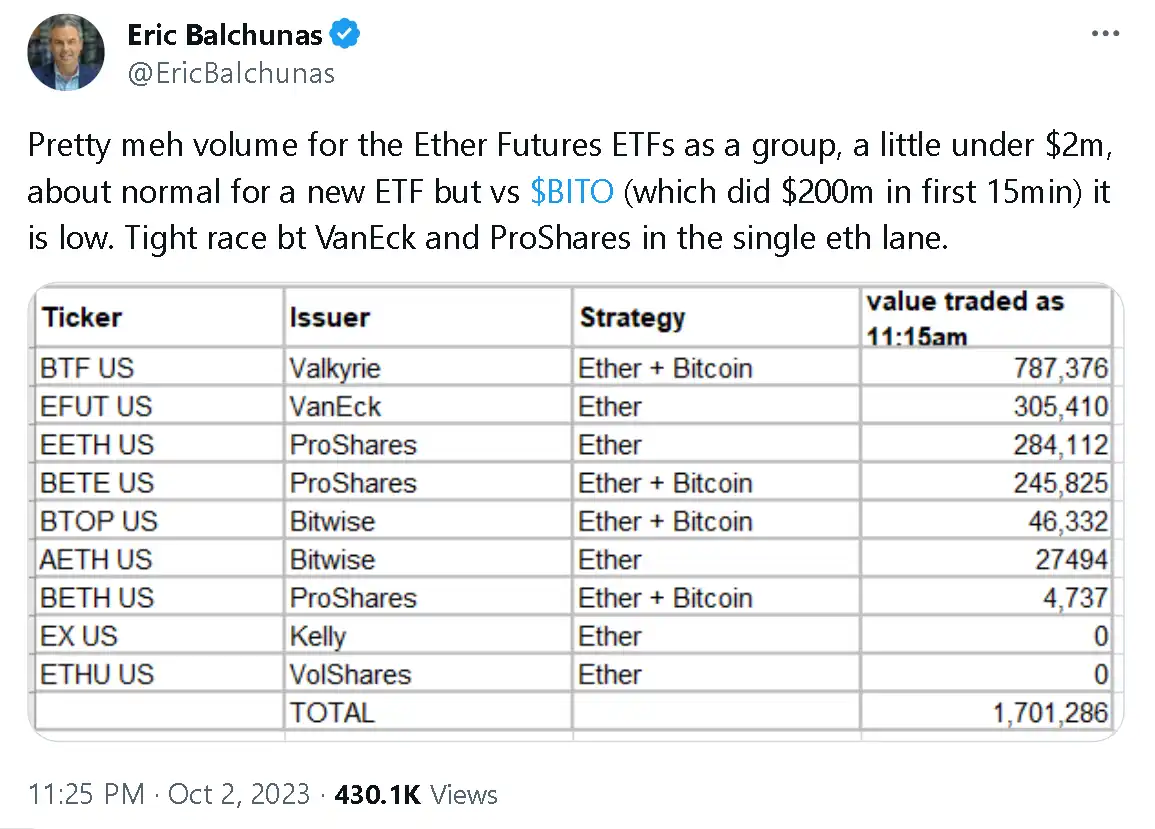
Although futures products are inferior to spot products because they expose investors to contango and discount effects (i.e., the price of the following months contract may be higher or lower, respectively, than the price of the expiring contract), there is little interest from traditional financial market participants in The almost complete lack of demand for Ethereum exposure may indicate that future demand for spot products will also be insufficient.
Issuers will need to attract organic demand for their Ethereum spot ETF products to succeed, and it’s unclear where they plan to find that. Perhaps traditional finance intends to create this demand by selling Ethereum to ordinary people on CNBC.
While it’s unclear how much demand spot Ethereum products will receive, market participants are clearly more pessimistic about the likelihood of an Ethereum spot ETF being approved than they are about the likelihood of a Bitcoin spot ETF being approved.
The unexpected approval could lead investors to realize their position was inappropriate and lead them to imitate Ethereum, meaning a spot ETF for Ethereum debuts, unlike the case for Bitcoin, which has been underperforming in the first six months due to trading The early appearance of large-scale capital inflows for approval has the potential for bullish unlocking.





