一文梳理ETH生态利好因素及潜力标的


On January 11, the U.S. SEC announced the approval of 11 Bitcoin ETFs. This milestone event opened a new chapter in the encryption industry. The crypto market will usher in more funds, and as the biggest boot of the Bitcoin ecosystem lands, the market turns its expectations to the ETH ecosystem. Today, ETH has increased by 7%. BlockBeats has compiled the ETH ecological benefits and key targets in the coming months.
Positive factors for the ETH ecosystem in the coming months
Cancun upgrade
In order to achieve the positioning of World Computer, Vitalik planned an upgrade roadmap for Ethereum at the beginning of its birth, namely: Frontier (Frontier), Homestead (Homestead), Metropolis (Metropolis), Serenity (Tranquility) 4 stage. Currently, Ethereum is in the Metropolis stage and is facing limitations from performance issues and high gas fees.
The Cancun upgrade, also known as the Cancun-Deneb upgrade, is another upgrade to the Ethereum main chain after the Ethereum Shanghai upgrade. It will effectively enhance the scalability, security and availability of the Ethereum network, improve the TPS of the main chain and reduce gas fees. , to achieve the expansion of the Ethereum main chain.
After the Cancun upgrade is completed, Ethereums network utility will be significantly improved, its infrastructure will be more complete, and its status as the King of Public Chains will also be consolidated. In addition to Ethereum itself, the Layer 2 sector will also welcome Come to unprecedented development and prosperity.
On January 5, lightclients, a developer of the Geth team, issued a document stating that the 178th Ethereum Core Developer Executive Meeting (ACDE) has ended. This meeting reconfirmed that the Goerli testnet Cancun upgrade time will be January 17, and will January 30th and February 7th are the dates for Sepolia testnet upgrade and Holesky testnet upgrade respectively. If all goes well, the developers will release the Goerli client next week and the Sepolia/Holesky client the week of January 22nd.
 Related Reading:How will the Layer 2 market structure evolve after Cancun is upgraded?》
Ethereum ETF
The Bitcoin ETF has been approved and has been delayed several times by the SEC. The application for the Ethereum ETF has become the next focus of the community.
On December 19, the U.S. SEC postponed its decision on ARK/21 Shares and VanEck’s Ethereum spot ETF applications, and the new resolution deadline is late May 2024. According to a report from The Block on the same day, the SEC has also postponed its decision on the Hashdex Nasdaq Ethereum ETF and Grayscale Ethereum Trust conversion applications.
Bloomberg analyst James Seyffart hinted on the Unchained podcast that the U.S. SEC may shift in its stance on Ethereum. Seyffart pointed out that the SEC’s recent approval of an Ethereum futures ETF indicates that the SEC may be subtly acknowledging that Ethereum is a commodity, not a security.
On January 11, Cointelegraph reported that Bloomberg ETF analyst Eric Balchunas stated that there is a 70% chance that the spot Ethereum ETF will be approved in May, and also hinted that “I heard in behind-the-scenes channels that the spot Ethereum ETF would be good.”
However, digital asset lawyer Joe Carlasare believes that the approval of spot Ethereum ETFs may take longer than expected. At the same time, the U.S. Securities and Exchange Commission is also working hard to carefully create a precedent that allows them to retain when deciding which digital asset ETFs are allowed to enter the market. Some discretion.
Layer 2 Scaling Narrative
On the one hand, the implementation of the Ethereum Cancun upgrade EIP 4844 Proto-Danksharding proposal will bring more possibilities to Layer 2 Rollup projects. On the other hand, Layer 2s have developed a thriving market in exploring the scalability direction of Ethereum. In addition to the Cancun upgrade, in the “capacity expansion battle” that will start in the summer of 2023, Layer 2 also launched their own expansion plans.
Since its development, the community has witnessed the various possibilities of the Layer 2 ecosystem, taking the leading Layer 2 players Optimistic and Arbitrum, and the newly popular Layer 2 Metis as examples. It is foreseeable that in 2024, Layer 2 will continue to bring more imagination to the Ethereum ecosystem.
Related Reading:How will the Layer 2 market structure evolve after Cancun is upgraded?》
Optimistic: OP stack opens the Super Chain Universe
Currently, Optimistic and Arbitrum account for the vast majority of the capital share in the Layer 2 market.
In October 2022, Optimism introduced the OP Stack, which is a highly scalable, highly interoperable modular open source blueprint of various types. Optimistic proposed the Superchain strategy in February 2023 and adopted the L2 of the OP stack. Due to the consistency of the technical architecture, they can achieve safe, efficient, atomic-level communication and interaction of information and assets, similar to Cosmos. Interchain is called Superchain.
After OP stack was launched, it has been widely adopted. Many public chains such as Coinbase, opBNB, Zora, and Worldcoin have given OP Stack good brand endorsement. In June 2023, Optimism Blockchain announced that it would be renamed OP Mainnet to distinguish OP Mainnet from the Optimism ecological chain built on OP Stack. It is foreseeable that the multi-chain universe of OP stack will be more prosperous in 2024.
Arbitrum: Orbit drives ecological Layer 3 blowout
On January 3, Binance’s new Launchpool project Xai (XAI) attracted the attention of the community. After several consecutive days of decline after its release, XAI had over 25% of its battle servers on January 11th. As the Oribit network customized and developed by Arbitrum to meet the needs of large-scale Web3 games, Xai (XAI) and the Oribit network ecosystem it represents are of great strategic significance to Arbitrum.
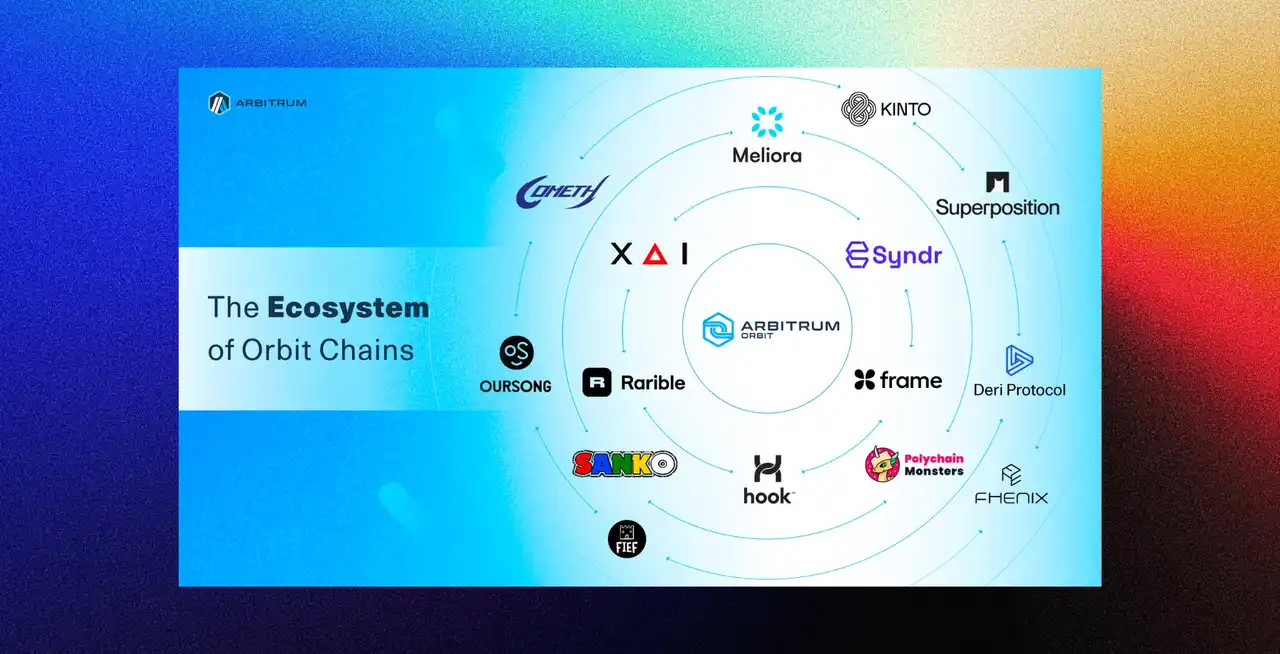
Arbitrum Orbit Ecology
In June 2023, the Arbitrum development team Offchain Labs released the Arbitrum Orbit development tool, aiming to help developers develop more easily on the L3 blockchain Arbitrum Orbit and manage their own Arbitrum Rollup and AnyTrust chains.
Arbitrum Orbit has the same compatibility as the EVM+ launched by Stylus. This means that developers can directly use Solidity, C, C++ and Rust to deploy EVM-compatible smart contracts without giving up the language and tool chain they are using. In addition, the Arbitrum Orbit platform has added support for custom Gas tokens. These tokens are used to pay transaction fees. This development allows the Orbit blockchain to use specific ERC-20 tokens that meet technical standards to handle gas or transaction fees on its network. Previously, the Orbit chain could only use Ethereum as its Gas token.
The community believes that Orbit will be able to promote the Arbitrum ecosystem to achieve more breakthroughs. In December 2023, TreasureDAO on the Arbitrum ecosystem announced that it would build a game chain and planned to use MAGIC as the Gas token. In the future, the measures taken by Layer 2 to attract developer resources will also bring more liquidity to the Ethereum ecosystem.
Metis: decentralized sorter
In addition to veteran projects such as Optimistic and Arbitrum, the imagination of Layer 2 can also be seen in Metis, which has increased by more than 350% in two weeks. In December 2023, MetisOs TVL exceeded US$700 million, surpassing Base and zkSync to rank third.
Metis is an Ethereum Layer 2 expansion solution developed based on Optimistic Rollup. It is a Layer 2 expansion and general infrastructure project co-founded by Elena Sinelnikova, Kevin Liu and Yuan Su in 2018.
Layer 2 is generally criticized for the centralization of sorting. Most project parties prefer centralized operation and maintenance in the early stage to ensure security and stability. After the Metis Foundation announced the establishment of an ecological development fund composed of 4.6 million METIS tokens, Metis is expected to become the first decentralized sorter’s Optimistic Rollup early next year. The growth of Metis has also updated the technical narrative of the sorter. Added to the positives. The decentralized sorter is just the beginning of Rollup Layer 2’s potential. The community’s longed-for Layer 2 native DeFi, ecological explosion and other visions must be based on this.
Related Reading:With a price increase of over 190% in one week, what are the potential projects worthy of attention in the Metis ecosystem?》
Each ZK Rollup: Starknet airdrop is coming soon, and the ecosystem is ready to go.
On December 1, 2023, the Starknet Foundation stated that it had conducted an airdrop snapshot and would distribute STRK tokens to certain past active users and contributors in the first quarter of 2024, while unlocking tokens issued in the past.
RabbitX is a derivatives platform built on Starknet. Its token RBX rose by more than 400% between October and November 2023, but has now fallen back. In addition to DEX, Loot Realm, the chain game ecosystem on Starknet, has also gained market attention with the concept of full-chain games. Loot Realm is driven by the Loot NFT community DAO and contains multiple sub-games. Its token LORDS has increased by nearly 10% in the past month. 90%.
Related Reading:Starknet will issue airdrops and unlock tokens. Which ecological projects are worthy of attention?》
In addition to Starknet, zkSyncs airdrop expectations are also becoming stronger. Currently, DEXs worthy of attention on zkSync include SyncSwap, Mute.io, etc. Syncswaps daily trading volume exceeds US$9 million, and its total token SYNC is 100 million, of which airdrops will account for 15%. Mute.io is the first batch of native DEX on zkSync Era. In addition to trading, it also provides various income amplifiers. Users can purchase bonds with a 7-day lock-up period at a discount through bonds similar to the (3, 3) mode. MUTE token. As of writing, MUTE has increased by more than 15% in the past 24 hours.
In addition, ConsenSys’s Layer 2 network Linea cannot but be paid attention to. According to Dune Analytics data, as of December 24, 2023, the Linea mainnet has exceeded 290,000 ETH, and the number of interactive addresses has exceeded 390,000. Currently, there are more than 40 protocols on Linea, among which Mendi Finance is the native lending project on Linea, ranking second in the TVL ecosystem, and its token MENDI has increased by more than 48% in the past 24 hours.
Mantle Network is a unified ecosystem and EVM-compatible Layer 2 network created by the merger of Mantle and BitDAO. It adopts a modular architecture and uses EigenLayer as the DA solution to provide new scalability possibilities for Ethereum. Recently, Trader Joe launched the DEX Merchant Moe specifically for the Mantle ecosystem. JOE holders will receive an airdrop of 2.5% of the total project tokens in the new token MOE TGE, and an additional 5% will be distributed in the next 12 months.
Related Reading:Modular Layer 2 Mantle Mainnet Alpha Ecosystem Overview》
The TVL of FusionX, the native DEX on the Mantle network, has tripled in the past two months and is $25 million at the time of writing. FusionX is the first community-driven AMM on the Mantle network. It has a special feature that allows users to Obtain preferential purchase qualifications for new tokens by staking specific tokens.
On January 10, EigenLayer announced the launch of three new liquidity staking tokens and provided restaking services for them, including Mantle LSPs receiving token mETH, with an annual interest rate of 7.2%.

Taiko, the Type 1 zkEVM network favored by celebrity VCs and approved by Vitalik, deserves attention. In June 2023, Taiko announced that it had raised US$22 million in two rounds of seed funding, the first with US$10 million led by Sequoia China, and the second with US$12 million led by Generative Ventures. Taiko is considered by the community to be one of the most promising projects in the current zkEVM field. It aims to become a fully decentralized, zero-knowledge extended zkEVM equivalent to Ethereum, which can enable developers and users to safely experience Ethereum and trade. The fees are lower and no changes are made to Ethereum.
Currently, Taiko is still in the testnet stage. In December 2023, Taiko launched a developer incentive program with a bonus of US$30 million and launched community education activities. Users who complete tasks will receive loyalty points.
Related Reading:An in-depth interpretation of Ethereums zkRollup head project Taiko proposes a new solution for expansion - Basic Controversial Rollup (BCR)》
Low market capitalization L2 target
Compared with Arbtrum and Optimism, which have a circulating market capitalization of US$3 billion, some Layer 2 companies that have recently developed and have lower market capitalization often have more novel narratives, and their value discovery is still in the early stages, and they are expected to show greater value in the new round of bull market. investment space.
On December 7, 2023, the ZK L2 community network ZKFair officially announced that the testnet was online and open to all community users. ZKFair is the first L2 network based on Polygon CDK, Celestia DA Lumoz ZK-RaaS. Once launched, it attracted great attention from the community with its innovative model of 100% community Fair Launch. On the day the testnet was launched, there were more than 3 W users. Influxed into the network for interaction, three days after going online, ZKFair’s TVL exceeded US$12 million.
On January 10, ZKFair announced the launch of the ZKF staking mechanism. Users who pledge ZKF can receive 75% of the gas fee of the ZKFair chain. The calculation and distribution of income will begin on January 15. At the same time, from January 14th to January 20th, users who stake ZKF will also receive airdrop benefits from Sideswap (SIDE), the first Fair launch ecological project on ZKFair.
Related Reading:Understand the ZKFair economic model in one article》
In the field of encryption, there is still room for imagination in chain games. Hypr Network is a layer 2 blockchain built on Ethereum, aiming to enhance its functions and solve its limitations. Hypr specializes in providing a fast and cost-effective platform for zero-knowledge on-chain gaming. By leveraging zero-knowledge proofs, Hypr ensures enhanced data privacy and security for gaming applications, allowing players to transact and interact without leaking sensitive data. According to Coingecko data, its token HYPR has increased by 25% in the past week.
EigenLayer activates the Restaking economy
The concept of re-pledge (Restaking) introduced to Ethereum by EigenLayer in June 2023 has become a hot topic of discussion. Restaking allows users to re-stake their already pledged Ethereum or Liquidity Staked Tokens (LST) to provide additional security for various decentralized services on Ethereum and earn additional rewards for themselves.
However, the Restaking model limits the liquidity of capital to a certain extent, so LST tokens came into being. BlockBeats has compiled LST sector projects worth paying attention to.
Restake Finance is the first protocol to launch modular liquidity re-staking for EigenLayer. After users deposit the LST generated by liquidity staking into Restake Finance, they can deposit it into EigenLayer through the project and allow users to generate reaped ETH (rstETH) as re-staking. By staking the certificate, users can participate in various DeFi protocols and earn income through rstETH, and will also receive points rewarded by EigenLayer.
Restake Finance has ushered in a bright moment recently, and its token RSTK has increased by more than 200% in the past two weeks. In addition, as one of the entrances to the EigenLayer ecosystem, EigenLayers LRT and strategy management platform Renzo Protocol officially launched the Ethereum mainnet on December 19, and announced the launch of the points program Renzo ezPoints on January 4, aiming to reward contributions to the protocol. Users who contribute can earn points by casting ezETH.
In the re-pledge track, there are many projects that have transitioned from the LSD business. KelpDAO is an organization focused on the field of liquidity re-pledge supported by the LSD protocol Stader Labs. Its business model is also similar to Restake Finance. It is worth noting that Kelp DAO currently has no token, while Stader Labs’ token SD has achieved an increase of more than 100% in the past month.
On October 18, DeFi protocol ether.fi announced the launch of Liquid Staking Token (LST) eETH, allowing users to generate rewards by staking Ethereum (ETH). As of the time of writing, ether.fi TVL has exceeded US$150 million. According to the roadmap announced by the team, ether.fi will issue tokens in April.
The Ethereum staking infrastructure SSV Network announced on January 4 that it has started a re-staking business, allowing the responsibilities of EigenLayers validators to be distributed to SSV, leveraging the distributed and non-custodial features of SSV to enhance the performance and security of its validators. . It is worth mentioning that SSV’s re-pledge nodes are very distributed and can currently be combined with four nodes, ANKR/Forbole/Dragon Stake/Shard Labs, to provide re-pledge services. In the past week, SSV has increased by more than 30%.
Swell, which was originally positioned as an Ethereum staking protocol, is now gradually moving closer to Restaking. By combining token distribution with Restaking, its derivative LST token swETH is the third largest TVL token on EigenLayer after stETH (Lido) and ETH, with a pledged amount of over 110,000. The Restake version of swETH is called rswETH and focuses on the Restaking track. The Liquid Restaking Committee established by it has already been joined by projects such as AltLayer and InfStones.
On January 11, Pendle, a revenue strategy protocol positioned as LSD+RWA, stated on social platforms that it would launch ether.fi’s liquid pledge token (LST) eETH and officially enter the Restaking/LRTfi field. Users can use its Liquid Restaking Tokens (LRT) to get more bang for your buck. On the same day, PENDLE rose by more than 30%.
Related Reading:RSTK doubles in one day, take a look at the Restaking track ecological project》
Since EigenLayer detonated the Ethereum re-staking track, other EVM and non-EVM ecosystems have also begun to have their own re-staking concept projects. Picasso is a network that supports cross-ecosystem IBC. Its native token PICA is designed and deployed as a unified network token that supports multiple L1 blockchains such as Polkadot, Kusama and Cosmos. Recently, Picasso has brought the re-pledge concept into the Solana network, and users can pledge SOL, mSOL, jitoSOL and other LP tokens to support the validators of Solanas cross-chain IBC.
Layerless, the Omnichain Liquid Restake protocol powered by EigenLayer and LayerZero, is also creating Omnichain Restake Tokens (ORT). When a user deposits LST (such as stETH, cbETH or rETH) into EigenLayer, he or she will receive an ORT (Omnichain Restaked Token), which represents the users EigenLayer share, making it liquid, composable, and usable in DeFi protocols use. Currently, Layerless plans to launch a testnet in the first quarter.
Related Reading:The restaking narrative is hot. What are the re-staking projects outside the Ethereum ecosystem?》
LSDFi, RWA, DEX and other concepts
The Shanghai upgrade in 2023 has brought unprecedented prosperity to the LSD track and also brought a lot of liquidity to the Ethereum ecosystem. According to DefiLlama data, a total of 32 billion US dollars of funds are pledged, of which Lido has a total of more than 24 billion US dollars worth of ETH pledged, accounting for 75% of the market share, which is much higher than other competitors. As more funds flow into Ethereum, it can be expected that the LSD market will continue to heat up. On January 10, LDO briefly exceeded $3.8, rising by more than 18% in 24 hours.
In addition to releasing liquidity around EigenLayer, Prisma, which has a small market capitalization and luxurious endorsements, is also worthy of attention. Prisma is jointly endorsed by the founders of multiple projects such as Curve Finance, Convex Finance, Swell Network and CoingeckoFinance, as well as Frax Finance, Conic Finance, Tetranode, OK Venture, Llama Airforce, GBV, Agnostic Fund, Ankr Founders, MCEG, Eric Chen Waiting for first-line well-known projects to participate in investment.
Currently driven by RWA, the potential market capitalization of RWA could reach tens of trillions of dollars within the next five years. MakerDAO, which provides stablecoins for Ethereum, already has a layout in the RWA direction.
MakerDAOs first formal RWA project, New Silver, was established in 2021, with a debt ceiling of US$20 million. The underlying assets are mortgage assets (Mortgage Loan) sponsored by New Sliver. Through New Slivers issuer SPV, Centrifuge Tokenized platform financing. In addition, BlockTower Andremeda, a U.S. debt RWA project initiated by BlockTower Capital, is currently one of MakerDAOs largest RWA projects, with a debt ceiling of US$1.28 billion and current asset size of over US$1 billion.
Related Reading:Inventory of popular MakerDAO RWA projects and analysis of DeFi’s transaction structure for capturing off-chain assets》
In addition, Uniswap v4, Uniswap X and other intent-based DEX are also becoming themes in 2024.
In June 2023, Uniswap released the Uniswap v4 code draft, with the vision of allowing anyone to make trade-off decisions by introducing hooks. According to Uniswap Labs officials, Uniswap V4 will be launched after the Dencun upgrade. A month later, Uniswap announced the launch of UniswapX, a non-custodial, Dutch auction-based protocol. According to the team, Uniswap v4 optimizes pool customizability to maximize expressiveness, while Uniswap X optimizes routing to maximize output tokens. Combined, the two protocols provide traders with the best possible trading experience while maintaining their commitment to a decentralized, censorship-free and permissionless marketplace.
Projects that also rely on intent narratives include CowSwap, a DEX aggregator that integrates batch transactions, intent, and MEV protection. It uses batch auctions as its core price discovery mechanism. CowSwap All transactions determine a unified settlement price, eliminating issues such as front-running common in the instant execution model. Batch auctions can also settle many transactions simultaneously, thus optimizing gas fees.