






ETH Research: Post-MEV-Burn simulation and statistics


Original title: In a post MEV-Burn world - Some simulations and stats
Original author: @Nerolation, Ethereum Research
Original compilation: Kaori, BlockBeats
TL;DR:
In the past, miners profits have exceeded Ethereums internal consensus layer rewards, making miners profits the main economic incentive to participate in the Ethereum consensus.
Taking into account no change in bidding dynamics, MEV burning (MEV-Burn) will cause approximately 90% of miner profits currently flowing to validators to be burned; the amount of Ethereum that will be burned in the past two months 35,000 ETH was reached.
The proposed median MEV profit per block could decrease from approximately 0.05 ETH to approximately 0.002 ETH, a decrease of 96%.
MEV-Burn may reduce absolute inequality in MEV payments/profits but increase relative inequality.
Although MEV lotsteries larger than 10 ETH are becoming very rare (assuming no changes to slot times and Δ time d < 2), we still regularly see prize pools larger than 1 ETH.
Setting the payload base cost Δ time d between the end of the slot may have a linear relationship. A higher d will result in a relatively higher MEV Burn tip for the validator.
How does MEV-Burn work?
MEV-Burn is proposed as an add-on component to ePBSs in an attempt to resolve the negative externality issues associated with MEV and PBS.
MEV-Burn aims to solve several problems. First, validators are overpaid for completing security tasks; second, the unpredictable and sporadic nature of the rewards generated by MEV and the economic dynamics associated with it.
MEV-Burn determines the load base charge by setting a fixed deadline within a time slot. For a specific number of seconds within that slot, the highest bid becomes the load base fee and is then destroyed. The highest observed out value before the deadline is burned, and the difference between the highest out value at the end of the slot and the burned portion is paid to the validator as a MEV-Burn tip.
Other validators are watching and will only confirm blocks that match their local view of the minimum base fee. There is also a time interval d to ensure that everyone has enough time to determine the highest bid before the deadline. With MEV-Burn, the time slot development process looks like this:
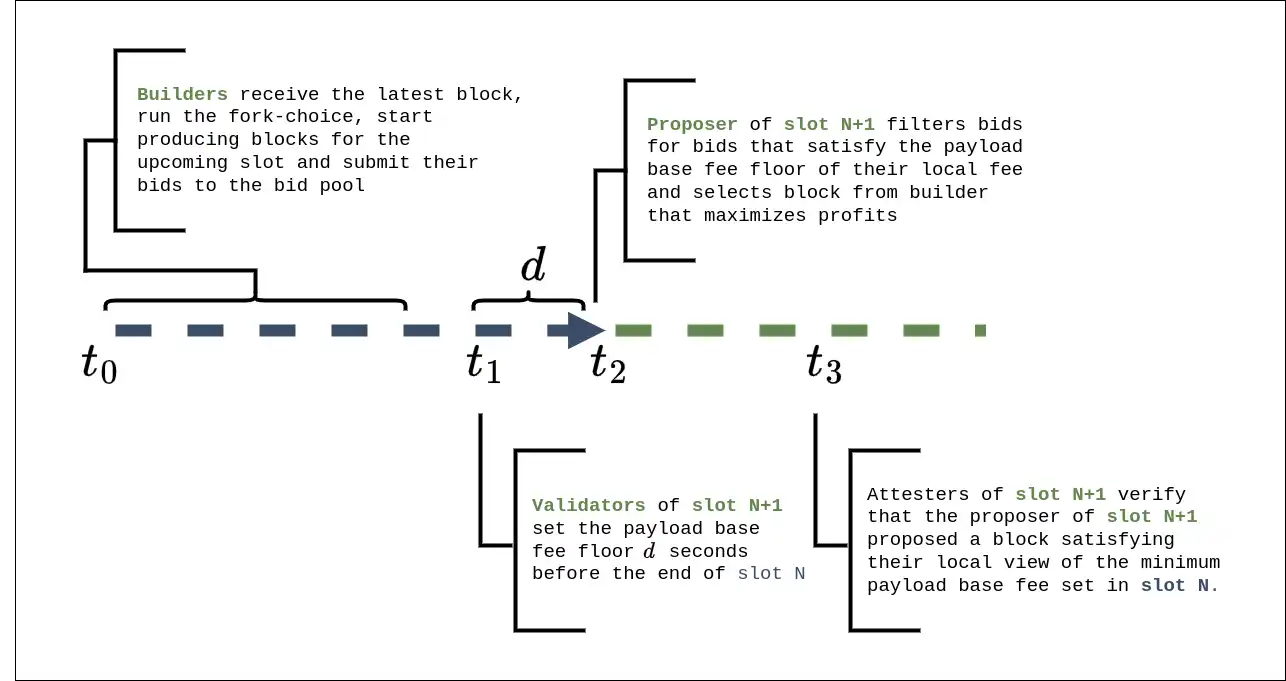
As usual, starting at t 0th second (i.e., the moment the block builder observes the latest block), the block builder starts building at the nearest head of the chain. At the t 2th second of the time slot, the proposer selects the most valuable bid that brings the greatest benefit to them.
The change introduced by MEV-Burn is that the highest bid value observed at the t 1 second of the time slot will be burned. This destruction is enforced by the protocol such that a valid block must always destroy the amount of ETH approved by the majority of provers in the current epoch.
Therefore, within the time slot, block builders bid to the second t 2 . Then, at the second moment t 2 perceived by the witness, the witness checks the highest bid as of the first t 1 and remembers that value. Next, the witness will only witness for blocks that at least Burn its perceived minimum payload base fee.
In a world where ePBS is implemented, block builders would submit their bids to a public bidding pool. The upcoming proposer and witness committee for the upcoming slot pay special attention to the payload base charge determined d seconds before the end of the slot. Witnesses for an upcoming slot perform Burn by witnessing only blocks that have at least Burn the payload base fee in their local view, and at least Burn the portion they consider to be the lowest.
Either the block burns at least the amount approved by the majority of witnesses, or nothing burns because it did not enter the canonical chain.
Visual data analysis
The chart below shows the amount of ETH that will be burned after MEV-Burn is implemented (blue), and the MEV-Burn tip that will still be distributed to proposers (orange).
The chart shows that approximately 10% of the MEV currently flowing to validators will continue to flow to validators. The remaining 90% will be burned, which will benefit ETH holders as a whole.
Judging from the cumulative data over the past two months, the situation is as follows:
Impact of MEV-Burn
The figure below uses a Lorenz curve to visualize the difference between MEV-Boost payments and MEV-Burn tips. These curves are commonly used in economics to illustrate population income inequality. Here we can use them to effectively demonstrate the uneven distribution of MEV gains among validators.
In this initial step, I sort the MEV payments from smallest to largest and plot the cumulative sum against the validator ratio. The x-axis shows the cumulative percentage of validators, and the y-axis shows the cumulative share of MEV payments.
The equality line represents an ideal scenario where MEV payments are evenly distributed among validators - for example, 50% of validators receive 50% of MEV payments. The greater the deviation from the equality line, the greater the inequality in payments.
The above figure shows that in both the existing MEV-Boost system and the MEV-Burn world, the payment gap between block producers is large. In fact, after the introduction of MEV-Burn, the relative inequality of the additional benefits of block producers will increase. However, in absolute terms, with MEV-Burn, most of the total MEV payments are burned in a slot, thus reducing inequality.
It is worth noting that as the absolute payments decrease, their impact on the total validator reward (CL reward + EL reward, where EL reward = MEV payout) also decreases. This is very ideal.
A lower absolute amount has the benefit of reducing the incentive to conduct a DoS attack on a block producer in order to steal MEV profits from that block producer. Additionally, this could make staking pool providers like Rocketpool less likely to block"rug-pools"At the same time, lower their minimum pledge amount.
The chart below shows the share of rewards earned by validators over time for various tasks performed. The image above shows the reward distribution under the current MEV-Boost setting, while the image below shows what the reward distribution will look like in a post-MEV-Burn world. Assume that the delta time d is 2 seconds.
Although MEV has a reduced impact on validators regular rewards, a massive lottery affected by the event in the last d seconds after the load base fee is determined may still occur as it does now.
If the load base charge is set relatively low, and a significant MEV opportunity occurs during the last d seconds of the slot, the MEV-Burn tip may significantly exceed the load base charge. This can result in larger proposers paying out, but only a fraction of them being burned.
Depending on the substantial MEV opportunity resulting from events in a single time slot, MEV lotteries may become smaller, but they will not disappear entirely.
The chart below shows the reduction in MEV profits for validators. Median MEV profit dropped from 0.05 ETH to 0.002 ETH, a decrease of 96%.
Over the past 60 days, we have observed some unusual data, with a total of 177 blocks in which MEV-Boost payments exceeded 10 ETH. Assuming that the MEV-Burn time interval (delta time, d) is 2 seconds, we will still have 19 blocks of MEV-Burn tips exceeding 10 ETH paid to the proposer. Still, the sheer size of these huge bonuses will be significantly reduced.
perfect delta time
The incremental number of seconds d introduces a synchronization assumption whose value can be adjusted to find a balance between synchronization between provers and maximizing Burns MEV.
The delta time d between setting the payload base charge must be chosen carefully:
It must be long enough to allow provers to agree on a common base fee, ensuring that all validators see the bid in a timely manner.
It must also be short enough to ensure that a sufficient number of MEVs are burned. If we assume that MEV increases linearly within a time slot and d is 2 seconds, then Burn 5/6 of MEV per time slot.
The graph below plots the percentage of Burn MEV at various d settings over the past 60 days.
The upper graph shows the effect of d on the MEV Burn tip, and the lower graph shows the effect of d on the payload base fee, called MEV Burn.
We can see that setting d to 1 second causes 90% of MEV payments to be burned, leaving the remaining 10% to the proposer. When d is 2 seconds, 80% of the total will be destroyed.
Bypassability and Collusion
Much like current ePBS designs, MEV Burn may suffer from Bypassability. Collusion between block builders and validators can effectively deactivate Bypassability.
There are concerns that large block builders may establish private connections to validators (e.g., by establishing private relays). The payload base charge will then be set at a level that is too low.
At least one competitive block builder is required to establish the payload base fee for all block builders.
There is an argument that block builders will not abandon the public bidding pool (perhaps validators only look there) and use it in parallel with private channels just for security reasons.
In my opinion, the response from the block builders is not 100% clear.
We may see the same situation as today with MEV-Boost:
Large block builders do not submit to the public bidding pool, risking validators missing out on their bids. We see the same situation with MEV-Boost, where large block builders start bidding relatively late in the slot, compared to smaller block builders, risking validators requesting blocks early that they miss out on Opportunity risks.





