






Coin Metrics: On the first anniversary of the Ethereum merger, what changes have occurred?


Original author: Matías Andrade Cabieses, Kyle Waters
Original translation: Luffy, Foresight News
The Ethereum Merge has been a year now. This is a milestone upgrade for Ethereum, which brings Ethereum into the era of Proof of Stake (PoS), fundamentally redefining the security and economics of the Ethereum network.
However, the merge is not the final goal of Ethereum. Instead, it lays the foundation for the evolution and future development of the Ethereum network, gathering stricter economic security and paving the way for a more inclusive L2 scaling paradigm. In this article, we re-examine the predictions made for the now defunct mining business of Ethereum, study key network data to help understand how the PoS ecosystem of Ethereum continues to develop, and consider new directions and future upgrades under research.
The Decline of Ethereum Miners
During the twilight of Ethereum's Proof of Work (PoW) era, the end of mining is undoubtedly one of the most influential outcomes of the merge. At the peak in May 2022, the Ethereum network's hashrate exceeded 1000 TH/s. This is not surprising, as Ethereum mining is a billion-dollar industry, generating over 2 billion USD in revenue per quarter, with total revenue exceeding 40 billion USD, of which 30 billion USD comes from block rewards and 11.3 billion USD comes from transaction fees.
Source: Coin Metrics
However, with the merge and the transition of Ethereum to Proof of Stake, all of this came to an end. Last September, we discussed the prospects of the merge causing a chain reaction for GPU miners and prices, and we predicted a decline in hardware prices and a gloomy future for GPU miners.
Unlike Bitcoin ASICs (specialized hardware), Ethereum is "mined" using GPUs, which are general-purpose devices that can also be used for gaming, video editing, graphic design, 3D animation, CAD, and AI acceleration (recently popular). As we explained last year, ETH miners lacked comparatively profitable alternatives. While some large-scale industrial miners with higher-quality chips were able to seamlessly jump into the new AI-driven computing resource rush, this has proven to be an exception, and the choices for most small-scale miners remain limited.
Other PoW chains that can be mined with GPUs, such as Ethereum Classic (ETC) or ETHPoW, have much less on-chain activity and applications compared to ETH. These ecosystems lack the demand for instant transaction inclusion, resulting in lower fees and a lack of MEV infrastructure. For example, the decoupling trend between ETC's hashrate and price highlights the declining attractiveness of this alternative solution, despite the surge in hashrate after the merge indicating miners entering the network, they are unlikely to achieve a balance of expenses and profits.
Source: Coin Metrics
Ethereum Validator Landscape
Since the merge, validators have become the main driving force of the Ethereum network. Therefore, understanding the validator ecosystem and its evolution is crucial to assessing the health of Ethereum in the proof-of-stake paradigm.
One noteworthy observation is that the largest validator pool to date is under Lido, currently accounting for 30.6% of the total active validators (787,755). After the April upgrade allowing beacon chain withdrawals, a wave of new validators entered Ethereum.
Source: Coin Metrics
For individuals who are unwilling to stake independently, liquidity staking has always been one of the most popular ways to participate in Ethereum staking - either due to lack of funds totaling 32 ETH or lack of technical knowledge or unwillingness to run their own node, or simply because they want to keep these funds liquid rather than locked in staking. Lido's ETH derivative (stETH) is also one of the most important collateral assets, providing economic utility for staked ETH in addition to protecting network security.
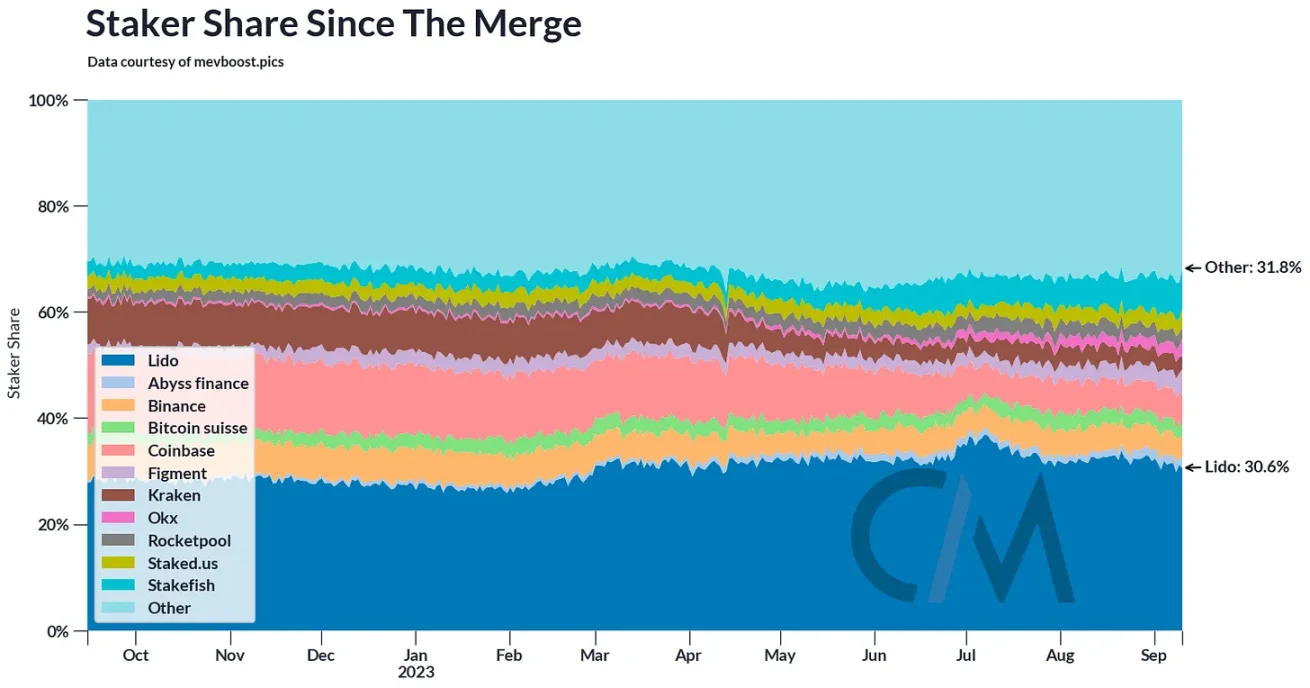
Source: mevboost.pics, detailed by the Coin Metrics research team
However, Lido's prominent position in the staking ecosystem is not without controversy. The existence of a large group of stakeholders under the control of a single entity raises serious concerns. This is because, in principle, they could be exploited by malicious actors to launch attacks, including time-based attacks and other coordinated attacks. However, this impression is exacerbated by the belief that Lido is a single entity, when in fact it is composed of multiple independent operating nodes of staking operators, while also providing additional protection against coordinated attacks.
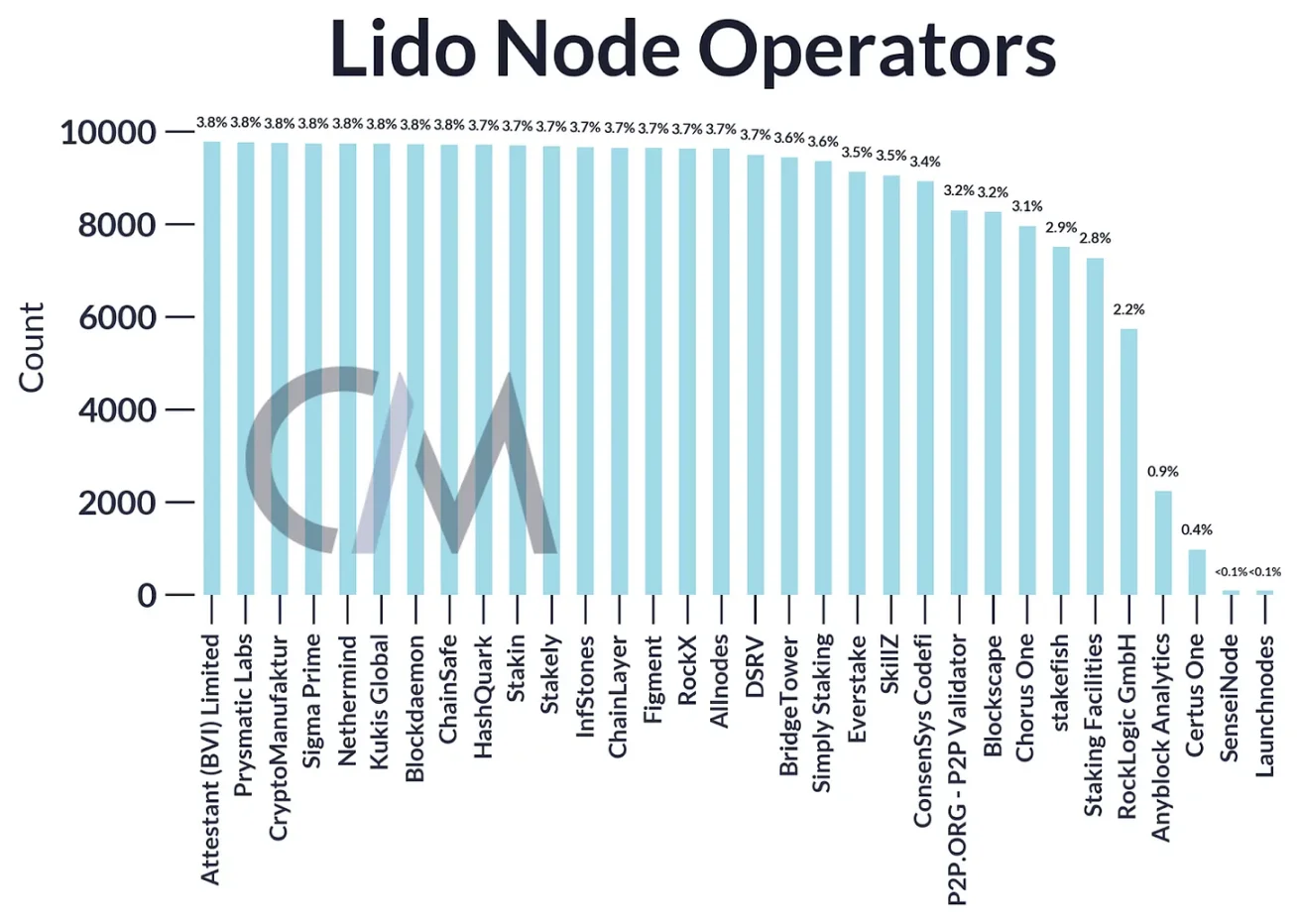
Source: mevboost.pics, detailed by the Coin Metrics research team
From the chart above, we can see that Lido stakers are evenly distributed among different node operators. This further indicates that Lido is essentially decentralized, consisting of many different participants, with no single node operator holding more than 5% of the stake validator pool in Lido. In addition, the node operator allocation limit for Lido is set as the maximum value by the Lido governance mechanism, allowing users to track and decide whether to allow a single node operator to operate at a specific threshold. However, such a large provider may bring new risks to the staking ecosystem still in its infancy. As Ethereum continues to evolve, this will be a constantly debated topic.
Validator profitability and Ethereum's monetary policy
For the security of the network, it is crucial that the agents responsible for protecting and processing transactions are economically sustainable. However, as new validators join the network, the profits for each validator decrease as the income is shared among all validators. The predictable income source for validators has been steadily decreasing over the past year, with only slight fluctuations when withdrawals were enabled in April. On the other hand, the revenue obtained by validators is variable and depends on user demand and network activity. In the past few months, priority fees have contributed approximately 0.7% to 0.9% to the average yield for validators.
Source: Coin Metrics
After the implementation of EIP-1559, the base fee burn mechanism was introduced, and a portion of the fees paid to validators is now burned, completely removed from circulation. Therefore, while validators still receive priority fees and newly issued ETH as rewards for fulfilling their validator duties, a delicate balance needs to be considered when evaluating whether the Ethereum network as a whole is inflationary or deflationary. As shown in the chart below, although Ethereum has been in a deflationary state for most of the past year since the merge, it has recently shown an inflationary trend due to lower user activity on the network. Overall, the Ethereum supply has decreased by approximately 300,000 ETH, which is around -0.25% annually.
Source: Coin Metrics
Ethereum Roadmap
Despite achieving many successes so far, Ethereum's expectations from users and developers far exceed its current state. Over the long term, the goal has been for billions of people to be able to transact and develop decentralized applications on the platform. However, the journey towards realizing this grand vision is paved with a series of additional technical upgrades. These upgrades may be inherently technical, but their goals are clear.
Despite a recent trend of cost reduction, the fees on Ethereum's Layer 1 (L1) still pose a barrier for high-frequency, low-value transactions. Over the past month, the average transaction fee has hovered around $4. While such fees may be insignificant for million-dollar stablecoin transfers, they become a significant obstacle for games, micro payments, and mainstream consumer-facing applications. The demand for a more affordable fee structure has always been a persistent challenge.
Source: Coin Metrics
The current scalability strategy for Ethereum revolves around the "Rollup-centric roadmap." This approach emphasizes the use of Rollup (a Layer 2 scaling solution) to enhance the network's throughput. The upcoming EIP-4844 (also known as "Proto-Danksharding") provides a dedicated "blob" data space and a custom fee market tailored for Rollup data. This upgrade is expected to reshape the fee landscape, especially with the attention garnered by Rollup solutions like Arbitrum, Optimism, and Coinbase's newly launched Base chain.
Meanwhile, Ethereum is not only expanding its transaction capacity but also improving user experience. Account abstraction is another upcoming upgrade that aims to simplify the daunting task of managing mnemonics and private keys. By making these cryptographic necessities more user-friendly, Ethereum aims to lower the entry barriers for ordinary users, potentially ushering in a new wave of adoption and attracting new use cases.
From an analytical perspective, these developments are not only technological milestones but also introduce new dimensions to fundamentally assess Ethereum. For example, EIP-4844 will impact the fee market economics, and subsequently, the cost analysis and economics of Rollup operators will need to be recalibrated with the reduction in Layer 2 solution fees. Additionally, the rise of smart contract wallets may alter traditional adoption metrics, forcing analysts to seek new on-chain indicators.
In line with the tradition of naming protocol upgrades after cities, the upcoming upgrade is referred to as "Cancun." However, the EIP-4844 upgrade is not the only improvement in the Cancun upgrade. Other EIPs include:
EIP-1153, which aims to reduce the cost of on-chain storage data and improve block space;
EIP-4788, which aims to enhance the design of cross-chain bridges and staking pools;
EIP-5656 , added subtle code changes related to the Ethereum virtual machine;
EIP-6780 , aims to eliminate code that can terminate smart contracts to improve contract security.
As of today, developers are still busy testing early versions of each improvement proposal, and the release dates for these upgrades have not been determined. The Cancun upgrade will occur at the execution layer where all protocol rules reside, and the consensus layer that verifies blocks will be upgraded through the "Deneb" fork. The name "Dencun" is a combination of the names of these simultaneous upgrades.
Conclusion
As Ethereum continues to evolve, it is moving towards the vision of enabling billions of users to transact and develop decentralized applications on the platform. We have spent a year evaluating the impact of the changes in proof of stake on the network, including Shapella's withdrawal, Lido's dominant position in staking, validator rewards, and the overall stability of Ethereum in the face of these profound changes. With many important upgrades on the horizon and the potential for significant improvements in L2 scalability scenarios, we must closely monitor the situation.





