






ETH Weekly Report | ARK Invest and 21Shares jointly submitted two Ethereum futures ETF applications; the Holesky public test network will be officially launched on September 15 (8.21-8.27)


Organize | Odaily
Author | Qin Xiaofeng
1. Overall overview
Bloomberg ETF analyst James Seyffart tweeted that ARK Invest and 21 Shares have once again jointly submitted two Ethereum futures ETF applications, namely ARK 21 Shares Active Ethereum Futures ETF (ARKZ) and ARK 21 Shares Active Bitcoin Ethereum Strategy ETF. (ARKY).
Ethereum Foundation engineer Barnabas Busa posted on the X platform (formerly Twitter) that the Holesky public testnet genesis file has been generated recently and merged into the main branch of the Ethereum client Holesky GitHub library. The Holesky public test network is expected to be launched at 22:00 on September 15, 2023, Beijing time. It will have 1,460,000 verification nodes and is the largest public network to date. The Ethereum Foundation will distribute more than 2 billion hETH during the genesis phase of the Holesky public testnet.
In terms of the secondary market, the current ETH price may continue to consolidate in the short term, with a support level of $1,650 and a resistance level of $1,700.
2. Secondary market
1. Spot market
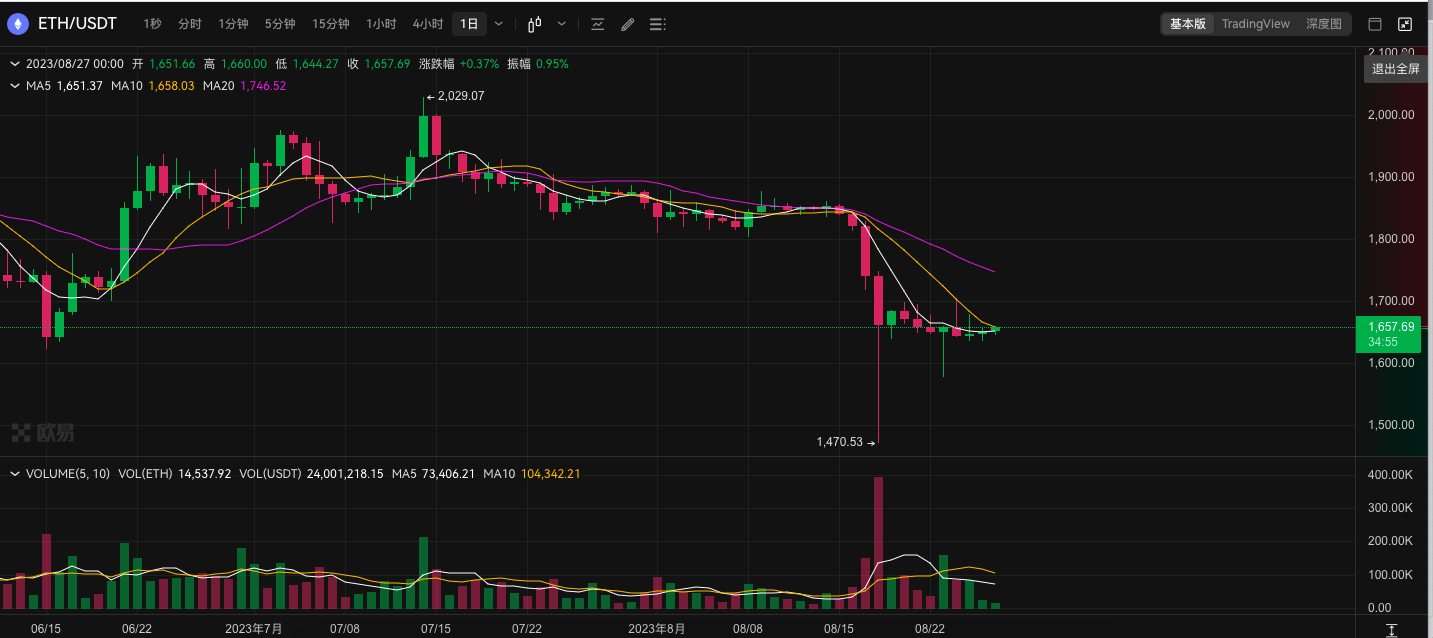
OKX QuotesThe data shows that ETH once fell to 1576 USDT last week, and closed at 1657 USDT during the week, a month-on-month decrease of 1%
ETH daily chart via OKX
The daily chart shows that the price is currently consolidating around $1,660. The lower support is $1,650. If it falls below, it may fall further to $1,600; the upper resistance is $1,700.
2. Network operation status
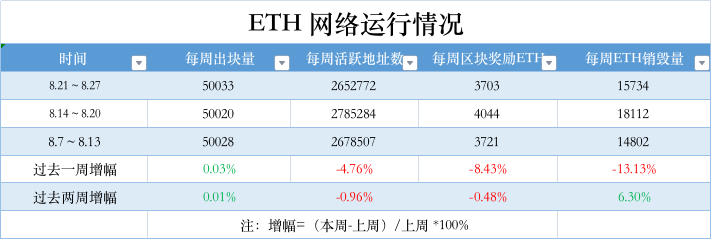
EtherscanData shows that the number of blocks produced by the Ethereum network in the past week was 50,033, basically consistent with the previous week; the number of weekly active addresses was 2,652,772, a month-on-month decrease of 4.8%; the block reward income was 3,703 ETH, a month-on-month decrease of 8.4%; each The weekly ETH burning volume reached 15,734, a decrease of 13.1% from the previous month.
3. Large amount changes
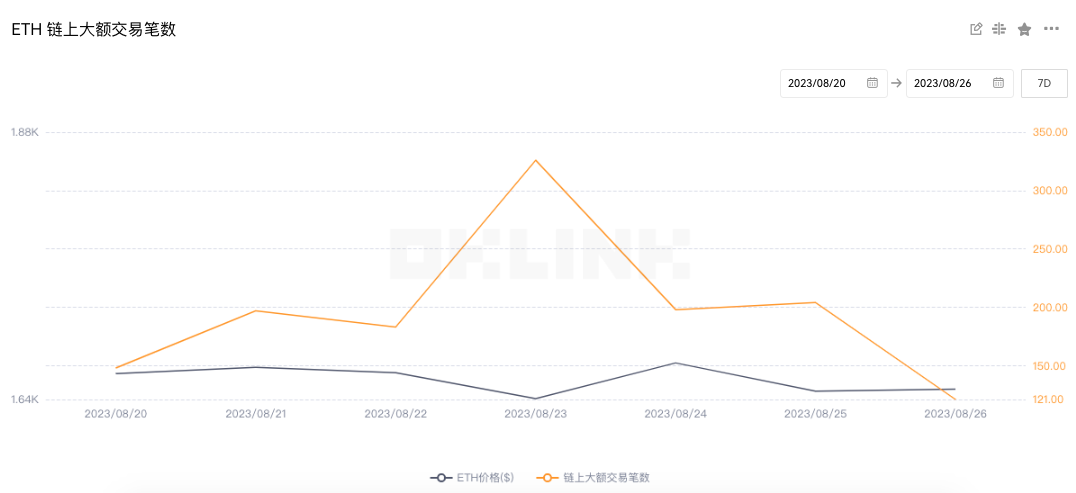
OKlink dataIt shows that the number of large-value transactions on the chain reached 1377 last week, a 21.1% decrease from the previous week (1747), and the trading enthusiasm of giant whales has dropped significantly.
4. Rich list address
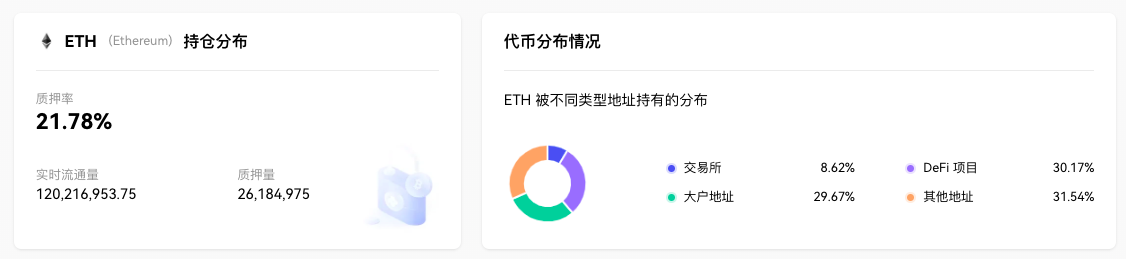
OKLink dataIt shows that the current total deposits of ETH 2.0 have reached 26.18 million ETH, and the pledge rate is 21.78%; from the perspective of ETH holding address distribution, exchanges accounted for 8.62%, a month-on-month decrease of 0.09%; DeFi projects accounted for 30.17%, a month-on-month increase of 0.26% ; Large addresses (the top 1,000 addresses and excluding exchanges and DeFi projects) accounted for 29.67%, a month-on-month decrease of 0.05%; other addresses accounted for 31.54%, a month-on-month decrease of 0.1%.
5. Lockup data
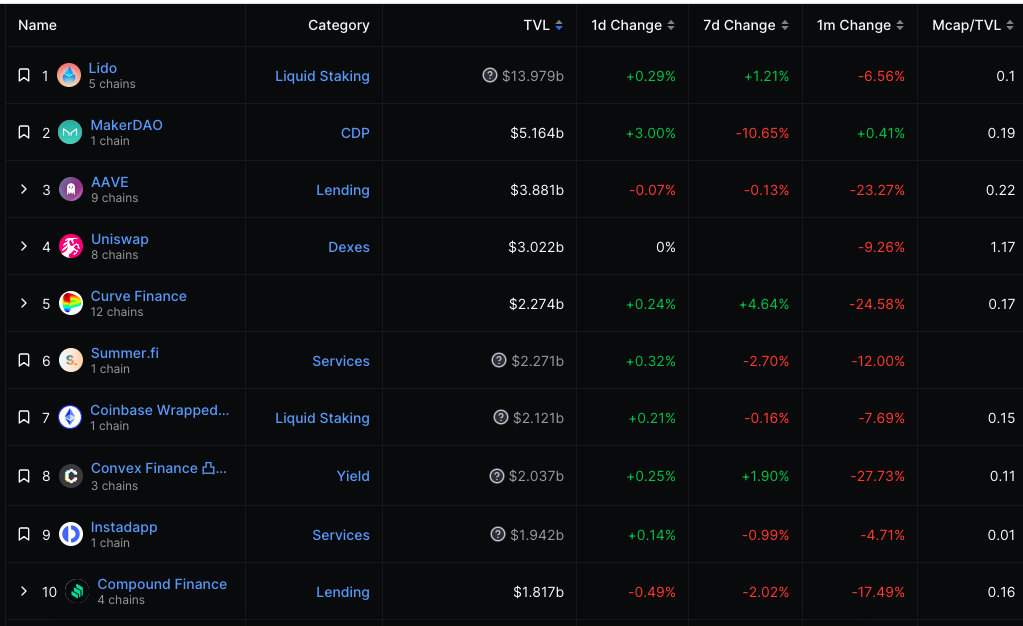
DeFiLlamaData shows that the value of on-chain locked collateral remained at around US$22 billion last week, with basically no major changes. Looking at individual projects, the top three lock-up values are: Lido at US$13.97 billion; MakerDAO at US$5.16 billion; Aave at US$3.88 billion;
3. Ecology and Technology
1.Technological progress
(1) 116th Ethereum ACDC meeting: All EL and CL clients have joined Devnet #8
Christine Kim, vice president of research at Galaxy, published a post summarizing the 116th Ethereum Core Developer Consensus Conference (ACDC), discussing the Dencun testnet Devnet #8 launched on August 16, a comprehensive testing overview of each part of the Dencun upgrade, and the move to Devnet #9 plans and some unresolved minor issues with launching the Holesky testnet, etc.
First, regarding the Devnet #8 update, the developers stated that all EL and CL clients have joined Devnet #8. The two EL clients that have not yet run the validator on the testnet are Besu and Erigon.
Secondly, Jayanthi submitted a Dencun Testing Overview document detailing specific testing areas for the Dencun upgrade that will be developed in the coming weeks, including EVM-related testing for Dencun EIP that affects EVM, synchronized testing between EL and CL clients Blocks and blobs, chaos testing to evaluate different chaos conditions, public testing including more Devnet and shadow forks, MEV related testing, regression testing, bad block and blob testing, blob specific testing.
Third, the developer introduced the launch plan of Devnet #9. The only major change in the code specification between Devnet #8 and Devnet #9 is the deployment strategy of EIP-4788. He also shared how to continue the testnet after the launch of Devnet #9 idea. Additionally, developers will agree on the approximate timing of Devnet #9 and other upcoming testnet upgrades at the next ACDC meeting.
Finally, the developers sorted out three unresolved issues during the launch of the Holesky testnet, including the developers agreeing to adjust the Epoch time of the Shapella upgrade on Holesky from 10 to 256 to more accurately reflect the environment of the Ethereum mainnet, and Agree to use a validator of 28 (instead of 16) for exit balances, etc.
Ethereum Foundation engineer Barnabas Busa posted on the X platform (formerly Twitter) that the Holesky public testnet genesis file has been generated recently and merged into the main branch of the Ethereum client Holesky GitHub library. The Holesky public test network is expected to be launched at 22:00 on September 15, 2023, Beijing time. It will have 1,460,000 verification nodes and is the largest public network to date. The Ethereum Foundation will distribute more than 2 billion hETH during the genesis phase of the Holesky public testnet.
2. Voice of the community
Joseph Lubin, co-founder of Ethereum and founder of Consensys, stated that Web3 empowers communities economically, socially, and politically, while enabling individuals to exercise autonomy. In Web3, people are not just passive consumers (or worse, products monetized by social media companies), but active builders. Regardless of the specific activity an individual is engaged in, whether creating an NFT, developing a DApp, participating in a DAO, setting policy, or designing a protocol, all contribute as builders of the next-generation web.
3.Project trends
(1) RISC Zero launches Ethereum’s open source ZK block prover zkEVM Zeth
RISC Zero launched the open source zkEVM Zeth. Zeth is based on RISC Zero zkEVM and Bonsai. It is scalable and scalable. Developers can use it to verify zero-knowledge proofs for any Ethereum module, reducing ZK rollups, zkEVM, Difficulty in building lightweight clients and cross-chain bridges. According to previous news, RISC Zero completed a $40 million Series A round of financing, led by Blockchain Capital.
(2) Trader Joe’s Liquidity Book has integrated DEX aggregator OpenOcean on the Ethereum mainnet
According to official news, decentralized exchange Trader Joe’s Liquidity Book has integrated DEX aggregator OpenOcean on the Ethereum mainnet. Trader Joe was deployed to Ethereum in early August and introduced the centralized AMM Liquidity Book to the Ethereum ecosystem.
(3) Hope.money releases a new roadmap to build Next Gen Money in three phases
The distributed stablecoin project Hope.money announced a new project roadmap to the community today. From the project announcement in March 2023 to Q1 2024 is the first phase - the infrastructure construction period. Hope.money will focus on creating a series of protocols including HopeSwap, HopeLend, HopeConnect, etc. on Ethereum, enriching the usage scenarios of $HOPE, and connecting DeFi and the real world through HopeConnect integrated applications such as HopeCard and Nebula.
The second stage is the strengthening period. From Q2 in 2024 to Q2 in 2025, Hope.money will attract new users to join the HOPE ecosystem through multi-chain deployment, cross-ecological construction, and native protocol V2 upgrade, combined with the new Bitcoin halving cycle, and further expand the usage scenarios of $HOPE.
From 2025 to 2026, Hope.money will usher in the third phase of prosperity. During this period, Hope.money will build its own application chain HopeChain. By integrating native protocols and multi-chain, cross-ecological applications, DID, social and other middleware, it will create super applications on the chain, and truly open up the usage scenarios of DeFi, CeFi, and TradFi.
(4) AltLayer will integrate Sovereign SDK to optimize its Rollup
According to official news, the Ethereum expansion project AltLayer announced the Sovereign SDK. Sovereign provides a standard interface that enables Rollups to communicate with Data Availability (DA) layers, allowing Rollups to be easily deployed on new Data Availability layers and enabling new chains to support existing Rollups.
(5) DeFi yield protocol Pendle will use sDAI and fUSDC in its first RWA product
DeFi yield protocol Pendle Finance developers say the protocol will use MakerDAO’s Boosted Dai Savings (sDAI) and Flux Finance’s fUSDC in its first RWA-based product. Pendle co-founder and CEO TN Lee said: Fixed income and RWA have some untapped large-scale markets in DeFi. I firmly believe that these will play a key role in attracting large off-chain institutional investors. It is reported that, Pendle was launched on Ethereum last November and has expanded to Arbitrum, BNB Chain and Optimism this year. As of press time Thursday, the agreement’s TVL was just under $120 million. (CoinDesk)
(6) ARK Invest and 21 Shares jointly submitted two Ethereum futures ETF applications
Bloomberg ETF analyst James Seyffart tweeted that ARK Invest and 21 Shares have once again jointly submitted two Ethereum futures ETF applications, namely ARK 21 Shares Active Ethereum Futures ETF (ARKZ) and ARK 21 Shares Active Bitcoin Ethereum Strategy ETF. (ARKY).





