


ETH Weekly Report | Ethereum Deneb/Cancun upgrade test network Devnet 8 has been launched; Volatility Shares Ethereum Futures ETF will be listed in October (8.14-8.20)


1. Overall overview
On August 17, the developer of the Ethereum community, terence.eth, tweeted that Devnet 8, the official testnet for the Deneb/Cancun upgrade, has been launched and is progressing smoothly. It is reported that Devnet 8 is a dedicated test network that contains all completed EIPs for the Cancun/Deneb upgrade.
The Ethereum futures ETF launched by Volatility Shares is scheduled to go public on October 12. According to previous reports, after Volatility Shares submitted an Ethereum futures ETF application on July 28, Bitwise, Roundhill, VanEck, Proshares and Grayscale (Grayscale) followed suit on August 1, respectively, namely Bitwise Ethereum Strategy ETF, Roundhill Ether Strategy ETF, Ethereum Strategy ETF, Proshares Short Ether Strategy ETF and Grayscale Ethereum Futures ETF (ETHG).
In terms of the secondary market, the current ETH price may continue to consolidate in the short term, with a support level of $1,650 and a resistance level of $1,700.
2. Secondary market
1. Spot market
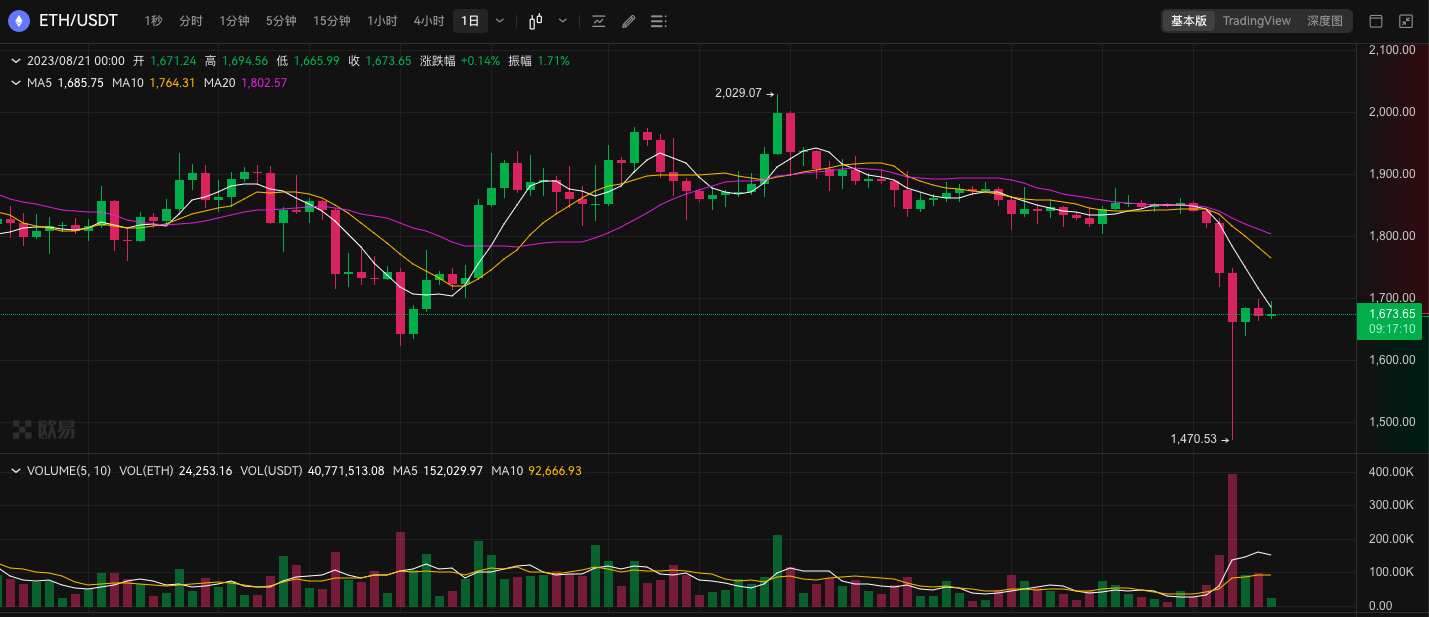
OKX QuotesThe data shows that ETH once fell to 1470 USDT last week, and closed at 1671 USD during the week, down 9.5% month-on-month
ETH daily chart via OKX
The daily chart shows that the price is currently consolidating around $1670, the lower support level is $1650, and if it breaks, it may fall further to $1600; the upper resistance level is $1700.
2. Network operation status
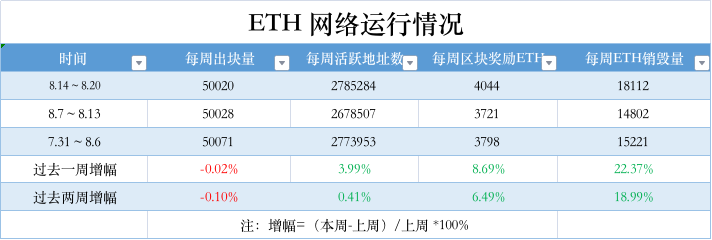
EtherscanData shows that the number of blocks produced by the Ethereum network in the past week was 50,020, which was basically the same as the previous week; the number of weekly active addresses was 2,785,284, a month-on-month increase of 4%; the block reward income was 4,044 ETH, a month-on-month increase of 8.7%; The weekly ETH burning volume reached 18,112, a month-on-month increase of 22.3%.
3. Large amount changes
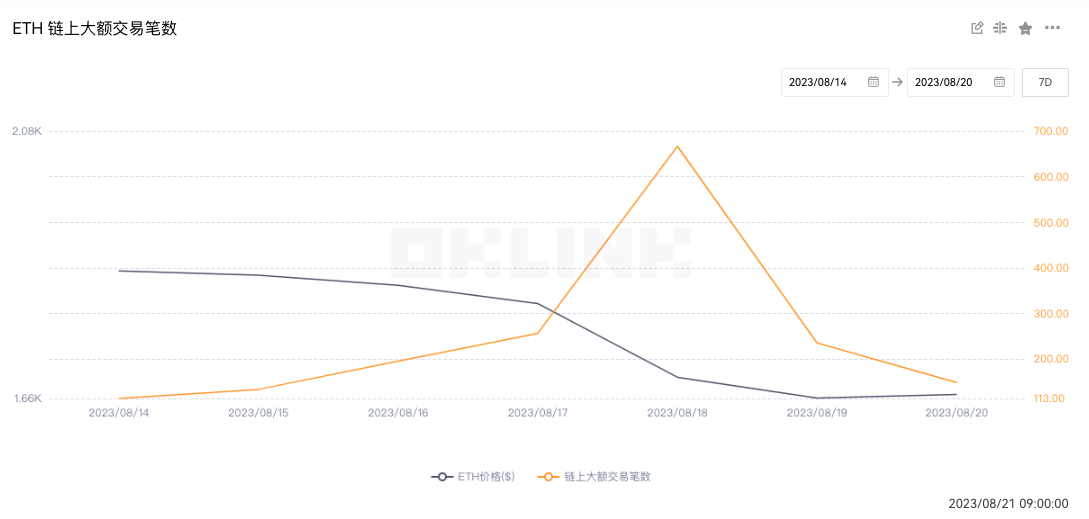
OKlink dataIt shows that the number of large-value transactions on the chain reached 1747 last week, a 72% increase compared to the previous week (1015), and the trading enthusiasm of giant whales has increased significantly.
4. Rich list address
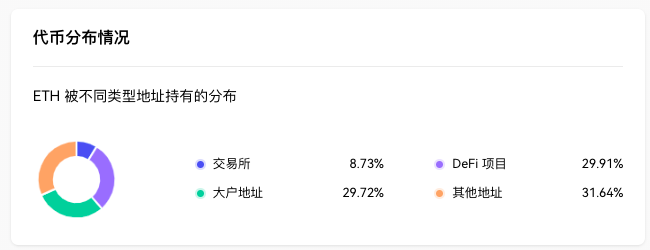
OKLink dataIt shows that from the distribution of ETH holding addresses, exchanges accounted for 8.73%, a month-on-month decrease of 0.11%; DeFi projects accounted for 29.91%, a month-on-month increase of 0.22%; large addresses (top 1,000 addresses and excluding exchanges and DeFi projects) Accounted for 29.72%, down 0.05% month-on-month; other addresses accounted for 31.64%, down 0.06% month-on-month.
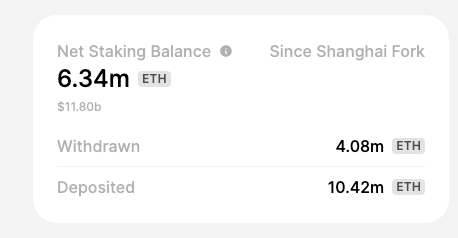
token.unlocksIt shows that the current total amount of ETH pledged across the entire network is 23.74 million ETH, with a pledge rate of 19.5%; since the Shanghai upgrade, the cumulative deposit amount is 10.42 million ETH, last week’s data was 10.03 million, and 390,000 new ETH were added in the past week; a total of 4.08 million has been withdrawn Last weeks data was 4 million; the total net pledge amount increased by 6.34 million, compared with the previous weeks data of 6.03 million, an increase of 310,000 over the previous week.
5. Lockup data
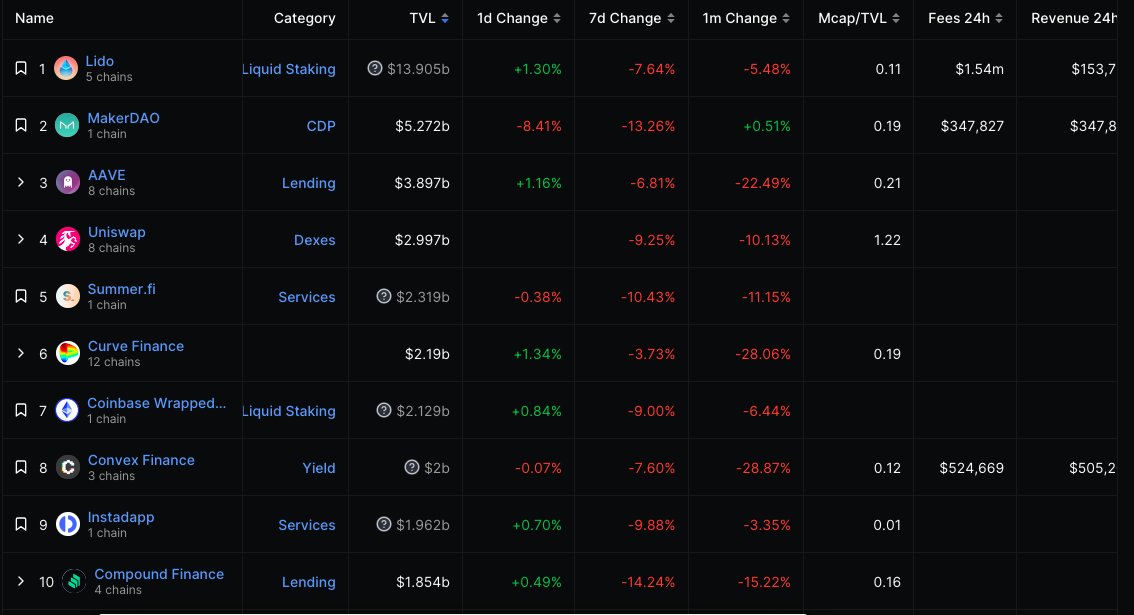
DeFiLlamaThe data shows that the value of locked collateral on the chain dropped from $24.5 billion to $22.05 billion last week, a 10% month-on-month drop. From the perspective of individual projects, the top three lock-up values are: Lido $13.9 billion; MakerDAO $5.27 billion; Aave $3.89 billion;
3. Ecology and Technology
1.Technological progress
(1) Ethereum Deneb/Cancun upgrade test network Devnet 8 has been launched
On August 17, the developer of the Ethereum community, terence.eth, tweeted that Devnet 8, the official testnet for the Deneb/Cancun upgrade, has been launched and is progressing smoothly. It is reported that Devnet 8 is a dedicated test network that contains all completed EIPs for the Cancun/Deneb upgrade.
(2) Ethereum developers released the main points of the Ethereum ACDE meeting
Ethereum core developer Tim Beiko summarized the latest Ethereum Core Developer Executive Meeting (ACDE), including Devnet 8, ElP-4788, Holesky test network, EIP editorial updates, EIP-7212 and other aspects of progress. The specific contents are as follows:
1. In the recently launched Devnet 8, bugs were found in some clients, but most have been fixed and other fixes are in progress. Devnet 8 has established a basic support infrastructure. Lighthouse is experiencing issues due to the previous removal of nplex support, which will be re-added.
2. Regarding ElP-4788, the developers agreed to use regular smart contracts instead of precompiled to store historical beacon roots. This means that bugs in the contract cannot cause consensus to fail. The last detail that needs to be agreed upon is whether to deploy this contract via a regular transaction, or whether the deployment should be included in the upgrade logic itself.
3. The Holesky testnet update is scheduled to start on September 15th. There is already a public process for requesting genesis allocations, with a total supply of 1.6 billion HETH.
4. EIP editorial update that the repo split is in progress and ERC will be moved to a separate repo. Efforts are underway to standardize its governance process to manage multiple repos in the future.
5. The developers are numbering the EL fork specification in the Github repository.
6. For the newly proposed EIP-7212, precompile for secp 256 r 1 curve support, the same curve used by Ethereum on EL, but with different input parameters. This may be the ElP adopted by L2 before L1, about which ElP still needs to be discussed.
2. Voice of the community
Vitalik Buterin, co-founder of Ethereum, published an article to share his views on the Community Notes function of the X platform (formerly Twitter). Community Notes is a fact-checking tool that sometimes attaches contextual notes to tweets as a fact-checking and counter-misinformation tool. It was originally called Birdwatch and first launched as a pilot project in January 2021.
Vitalik said what’s most interesting about Community Notes is that, while it’s not a “crypto project,” it’s probably the closest thing to an instance of “crypto value” seen in the mainstream world.
Community Notes are not written or curated by a few centrally selected experts; instead, they can be written and voted on by anyone, and which notes are or are not shown is determined entirely by open source algorithms. The Twitter website provides a detailed and extensive guide describing how the algorithm works, and users can download the data containing published comments and votes, run the algorithm locally, and verify that the output matches what is visible on the Twitter website. Its not perfect, but surprisingly, it comes close to meeting the ideal of trustworthy neutrality. At the same time, its impressively useful even in controversial situations.
3.Project trends
(1) The distributed liquidity pledge protocol Diva is launched on the Operator testnet
According to official news, the distributed liquidity staking protocol Diva said on Twitter that the Diva Operator Testnet has been launched. This is the first Ethereum liquidity staking solution powered by Distributed Validators (DVT). Diva Operator nodes enhance Ethereum by efficiently performing validation duties. It connects to Ethereum, uses MPC DKG to coordinate with other Diva nodes for key management, and uses Diva’s DVT for collaborative verification.
According to previous news in January, Diva completed a US$3.5 million seed round of financing, led by AT Capital, with participation from Gnosis, Bankless, OKX Ventures, Metaweb, DCV Capital, Alphemy Capital, Very Early Ventures, Staked.vc and others. Diva plans to build a cooperative decentralized staking pool.
(2) PYUSD will start trading on Kraken on August 21
According to the official announcement, PayPal’s USD stablecoin PYUSD has been launched on the Kraken platform, and users can start depositing. PYUSD will start trading on Kraken on August 21. Users can deposit PYUSD through the funding page, but must use the Ethereum network, and deposits on other networks may be lost. PYUSD is collateralized by U.S. dollars, U.S. Treasury bonds and other assets, and aims to achieve a 1: 1 link with the U.S. dollar. Kraken said PYUSD enables users to transfer funds between PayPal and external wallets, make person-to-person payments, and exchange between PayPal-supported cryptocurrencies. Note: Once liquidity conditions are met (when a sufficient number of buyers and sellers enter the market so that their orders can be effectively matched), trading can be conducted through the Kraken App and Instant Buy.
(3) Compound is launched on the Base network, supporting ETH and cbETH as collateral
DeFi lending platform Compound has launched on the new Ethereum Layer 2 Base, supporting ETH and cbETH as collateral. Jared Gray, CEO of decentralized exchange SushiSwap, also said that due to project needs, SushiSwap V2 will also deploy Base, and V3 has been deployed on the network before. Further communications on the move are expected this week.
(4) Shiba Inu L2 solution Shibarium mainnet has been launched
Shiba Inu developers have launched Ethereum L2 scaling solution Shibarium mainnet. Applications built on the network will use BONE, TREAT, SHIB and LEASH tokens. Shibarium will focus on the deployment and development of Metaverse and gaming applications. It is reported that during the Shibarium test network, users have created more than 21 million wallet addresses.
Shibarium will utilize Heimdall validators and Bor block production nodes, similar to the Polygon ecosystem. Heimdall will be based on the Tendermint consensus engine, while Bor will be fully interoperable with the Ethereum Virtual Machine. Users must lock 10,000 BONE in the Shibarium network to become a validator. 21 million BONEs will be reserved as rewards for validators and delegators within the Shibarium ecosystem and used to pay authorized gas fees.
Ouyi OKX market shows that SHIB is currently trading at 0.000009027 USDT, with a drop of 9.80% in 24 H. (CoinDesk)
The Ethereum Foundation announced the project and activity funding status of the Ecosystem Support Plan in the second quarter, distributing a total of US$9,218,158.34 in financial support to 57 projects. It includes more than ten conferences such as the Paris DeFi Security Summit and the Ethereum Argentina Conference, as well as multiple studies on cryptography and zero-knowledge proofs, such as Ethereum KZG Ceremony, the email verification system ZKEmail using zero-knowledge proofs, and smart phones using zk-SNARKs. Contract wallet, etc.
Since its launch in July, Aave’s new stablecoin, GHO, has been trading between $0.97 and $0.99, below its expected price of $1. Benjamin Levit, co-founder and CEO of stablecoin research firm Bluechip, believes this is due to GHO’s lack of a proper redemption mechanism and insufficient demand for the token. “The anchor is not restored through arbitrage because GHO has no actual arbitrage mechanism to create demand,” he said.
Aave founder Stani Kulechov defended GHO, arguing that GHO will regain its anchor when improvements such as the GHO stability module are rolled out in the coming months. The GHO Stability Module (GSM) allows users to mint GHO using other stablecoins as collateral. GHO minted via GSM can redeem underlying collateral 1:1, creating arbitrage opportunities on a portion of the token supply. Kulechov tweeted: The focus of the current model is on the growing debt in the GHO, which is growing quite nicely (nearly 20 million). I think the focus on the peg to the US dollar should come after this.
According to official news, the decentralized lending protocol Silo Finance launched the risk isolation design protocol Silo Llama on Ethereum, using crvUSD as the only cross-chain asset. Silo Llama adopts a risk isolation design in which each token asset has its own lending market and is paired with crvUSD. Silo will initially launch CRV, LINK, rETH, OHM, YFI, LQTY, USDC, UNI, LDO, cbETH and SNX Capital pool.
(8) The Ethereum futures ETF launched by Volatility Shares is scheduled to be listed on October 12
Eric Balchunas, senior ETF analyst at Bloomberg, tweeted that the Ethereum futures ETF launched by Volatility Shares is scheduled to be listed on October 12. According to previous reports, after Volatility Shares submitted an Ethereum futures ETF application on July 28, Bitwise, Roundhill, VanEck, Proshares and Grayscale (Grayscale) followed suit on August 1, respectively, namely Bitwise Ethereum Strategy ETF, Roundhill Ether Strategy ETF, Ethereum Strategy ETF, Proshares Short Ether Strategy ETF and Grayscale Ethereum Futures ETF (ETHG).
(9) Valkyrie submits Ethereum futures ETF application
Bloomberg ETF analyst Eric Balchunas tweeted that Valkyrie submitted an Ethereum futures ETF application, which is a supplement to their previous 497 filing, aiming to implement the strategy change of the Bitcoin + Ethereum futures ETF earlier. According to previous reports, Bloomberg ETF analyst Eric Balchunas said that Valkyrie submitted a document and planned to convert the Valkyrie Bitcoin Strategy ETF (BTF) into a Bitcoin + Ethereum Futures ETF on October 3, which will be better than other The 13 ETF application documents were scheduled to be released two weeks earlier.





