


On Base, how much does it cost to release a meme?


Without relying on "Odyssey" or air drops to build momentum, Coinbase's Layer 2 network Base exploded the market with a meme legend that saw a thousand-fold increase, attracting countless attention.

Within about 14 hours, it had experienced a 2000-fold increase. Around 5 pm yesterday, it still had a market value of nearly $56 million, with 8774 WETH in the pool. Considering that during the rise, many still believed that Base could only enter assets but not exit (note: it is actually possible to exit, recommended reading: Tutorial|A step-by-step guide to withdraw ETH from the Base chain), the size of this pool formed a huge contrast with the perception that it is easy to scare people away with the "only in, not out" concept, making players feel very unbelievable. People even joked that $BALD is Coinbase's "advertisement," and this meme has spread widely on Twitter and various WeChat groups:
Smart public chain: We have a Shiba Inu that increases a thousand or ten thousand times a day
Foolish public chain: We are about to start a 2-month Odyssey event
But in just over 3 hours, $BALD revealed its fangs and destroyed everything. The project team suddenly withdrew a total of 8660 ETH and 179 million $BALD in liquidity within 7 minutes, causing a sharp drop in the price of $BALD, with a maximum decline of up to 80%. Currently, according to data from dexscreener, there is only 12 ETH left in the liquidity pool for $BALD, and the TVL of the Base network has also plummeted from around $42 million to $9.42 million.

Changes in TVL of Base Network
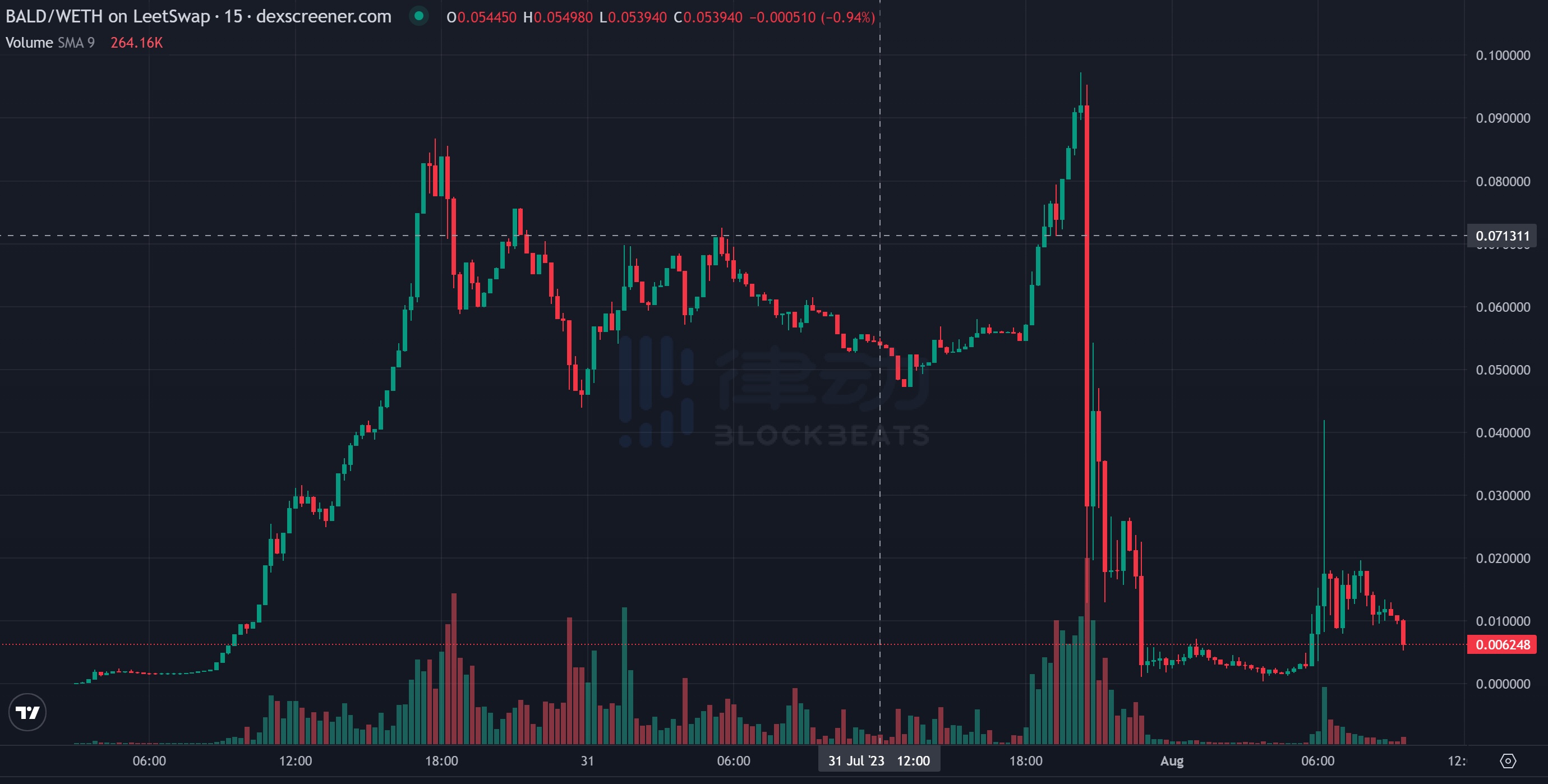
The "guillotine" trend of $BALD, like a game, like a dream
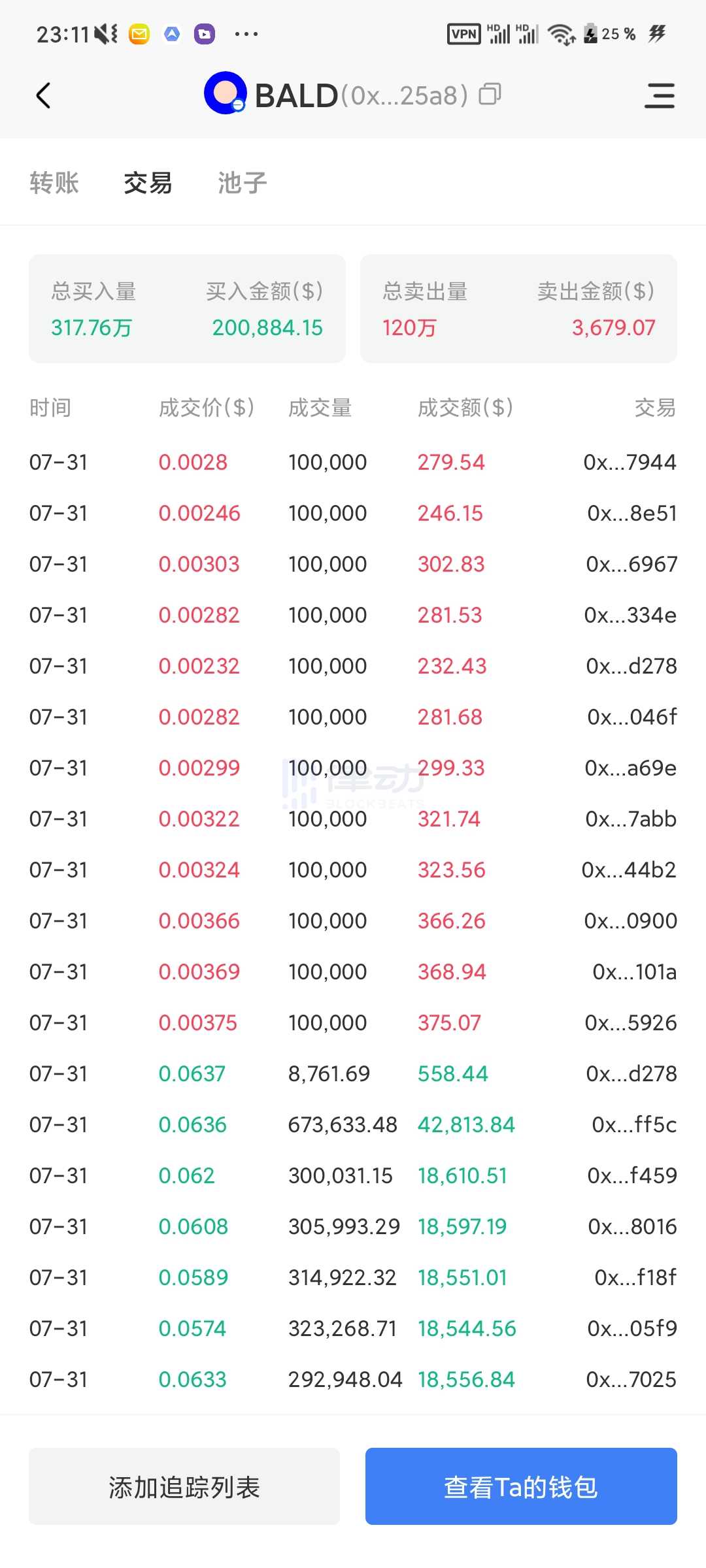
Players who have suffered significant losses
"Mud Dog" is an extremely cruel "PvP game". Crypto players know that this is like licking blood on a knife point, but they are always tempted by stories of getting rich quick and willingly hand over their fate to anonymous project parties on the other side of the screen who may be leisurely drinking beer. I tried to create a "Mud Dog", the process was so easy and enjoyable, it made me feel helpless and ironic...
It only cost $14 and a few clicks of the mouse to create a "Mud Dog"
After connecting the wallet and signing in on Thirdweb, click on "Contracts" and then click on "Deploy contract".

Next, we can select the type of contract to deploy. There are many types to choose from, including one-click deployment of ERC-20, ERC-721, and ERC-1155 tokens with no code, as well as the ability to deploy an ERC-721 token with staking functionality, rentable NFT ERC-4907, and even a trading market like OpenSea, and so on. Here, I will simply deploy an ERC-20 token, so I choose "Token":

Then click on "Deploy now" to enter the settings page:

The settings page is as follows:

- Image: Token pattern.
- Name: Token name.
- Symbol: Token abbreviation.
- Description: Token description.
- Primary Sale Recipient: Address for the income of token pre-sale. This is actually not applicable here because the chosen "Token" contract does not have a pre-sale price.
- Platform fees: Additional taxes can be applied to the income from token pre-sale. Also, if deploying a service like an NFT marketplace, taxes can be levied on all secondary transactions that occur in this contract.
After setting all these, finally choose which network to deploy on. I chose Base:

The "Name" I set is "ZaicheshangBuhuibaHaimeimai 111 Shufule", the "Symbol" is SHUFU, the "Description" is "GM SHUFULE", and the "Image" is a comfortable Tieba emoji pack. After successfully deploying at a cost of $2.26, the effect is as follows:

The contract can already be seen on basescan:

Back to the settings center, there is a "Token" option in the left menu bar. Clicking on it allows me to mint a given quantity of tokens. I minted 111111111111111 tokens, and then put them together with 0.186 ETH into LeetSwap to create a liquidity pool. This way, this token can be traded on LeetSwap just like $BALD.
Minting the token cost me $0.42, and setting up the liquidity pool on LeetSwap cost me $11.35. The cost of creating a "Tugou" was only $14.03, plus some vigorous finger clicking on the mouse.
Later, I closed the liquidity pool and removed all permissions in the "Permission" feature on the Thirdweb settings page. The experiment is over.
However, when using Quick Intel to scan the contract created by Thirdweb, there are still many yellow and red lights:

Use Quick Intel to check the contract of $BALD, the situation will be much better:

Thirdweb failed to implement the buy/sell transaction tax function, so I searched and found a one-click deploy Token tool that can set the buy/sell transaction tax. It's so smart...

I cannot verify the security of this tool. However, the principle of this tool for one-click contract deployment is roughly as follows: This tool itself is a contract. After setting and confirming the deployment, the contract will execute the "Deploy Token" operation to complete the deployment with the corresponding settings. I randomly selected a contract deployed using this tool for testing, and the light is better than Thirdweb:

Conclusion
I highly recommend everyone to use Thirdweb to deploy their own Token and give it a try. Although it's just a simple process, experiencing it personally can bring you some different experiences (but don't do anything malicious).
Indeed, to create a "meme coin" with a market value of millions or even billions of dollars, you still need to create an official website, carry out various viral marketing activities, and cause a chain reaction. However, as a "crypto player" like me, when we rack our brains to evaluate whether a project has a "big enough vision," does all of this make you feel a bit ironic?
Handing over our fate to the "meme coin generator" and the " 400 U Team," will we make a profit or a loss? Is this the crypto world that you desire, and that I desire?





