


Looking ahead to Cancun's upgrade, is it worth being "optimistic" about OP?


I. Introduction
OP Mainnet (*formerly Optimism) has been highly regarded since its inception. Born out of Ethereum's core developers, this "Phoenix" of Ethereum aims to solve the scalability problem that plagues the ecosystem. However, its subsequent development has encountered some detours. Initially, it aimed to quickly scale Ethereum using the EVM-compatible OVM 1.0. During this stage, deploying protocols and applications on L2 required a significant amount of time for custom development. As a result, a considerable amount of time was spent upgrading Ethereum's equivalence, but the sacrifice of "optimistic proof" in favor of EVM equivalence upgrade rendered Optimistic Rollup a misnomer. Arbitrum One, another solution for Optimistic Rollup, although introduced 9 months later than OP Mainnet, has higher popularity and user base than OP Mainnet.
However, OP Mainnet is also engaged in a grander narrative and layout. On June 6th, 2023, the Bedrock upgrade was completed, laying the foundation for rapid development in the future. The next upgrade will focus on accomplishing the next-generation Fault Proof-Cannon. The Ethereum developer conference in June confirmed the Kan-Kun upgrade with EIP-4844 as its core, which will be completed in the second half of the year. The macro environment is also rapidly changing. First, the SEC's lawsuit against Binance and Coinbase impacted the market.
The panic spread and top traditional financial institutions on Wall Street then invested in a new cryptocurrency exchange in the United States. With these changes coming, can OP be optimistic again? This article will conduct research on it.II. The Aura of OP Mainnet
1. Excellent Core Team and Investors
In 2017, Vitalk and Joseph Poon co-authored the paper "Plasma: Scalable Smart Contracts," which was the earliest solution proposed to solve Ethereum's scalability problem. After the Plasma proposal, it garnered support from three Ethereum core developers, leading to the establishment of the non-profit research group, Plasma Group, to study scalability issues. The project later abandoned the Plasma architecture and proposed the Optimistic Rollup solution. At the Devcon conference, they showcased a decentralized application demo created in collaboration with Uniswap. Shortly afterward, top VCs like Paradigm and IDEO invested their support. With Paradigm and IDEO's $3.5 million backing, Plasma Group transformed from a non-profit research organization to a for-profit startup, giving birth to Optimism (on June 24, 2023, OP officially named its blockchain network as OP Mainnet to differentiate it from other meanings of Optimism).
The team behind OP Mainnet consists of developers and researchers from the Ethereum core, with investments from Paradigm and top VCs like A16z. The project has gone through three funding rounds.nbsp;1.785 billion US dollars, with a valuation of 16.5 billion US dollars. Coinbase also joined OP Labs as a core developer and released a base L 2 network based on the OP Stack architecture this year. Its resources have been top-notch.
Image: Core Team
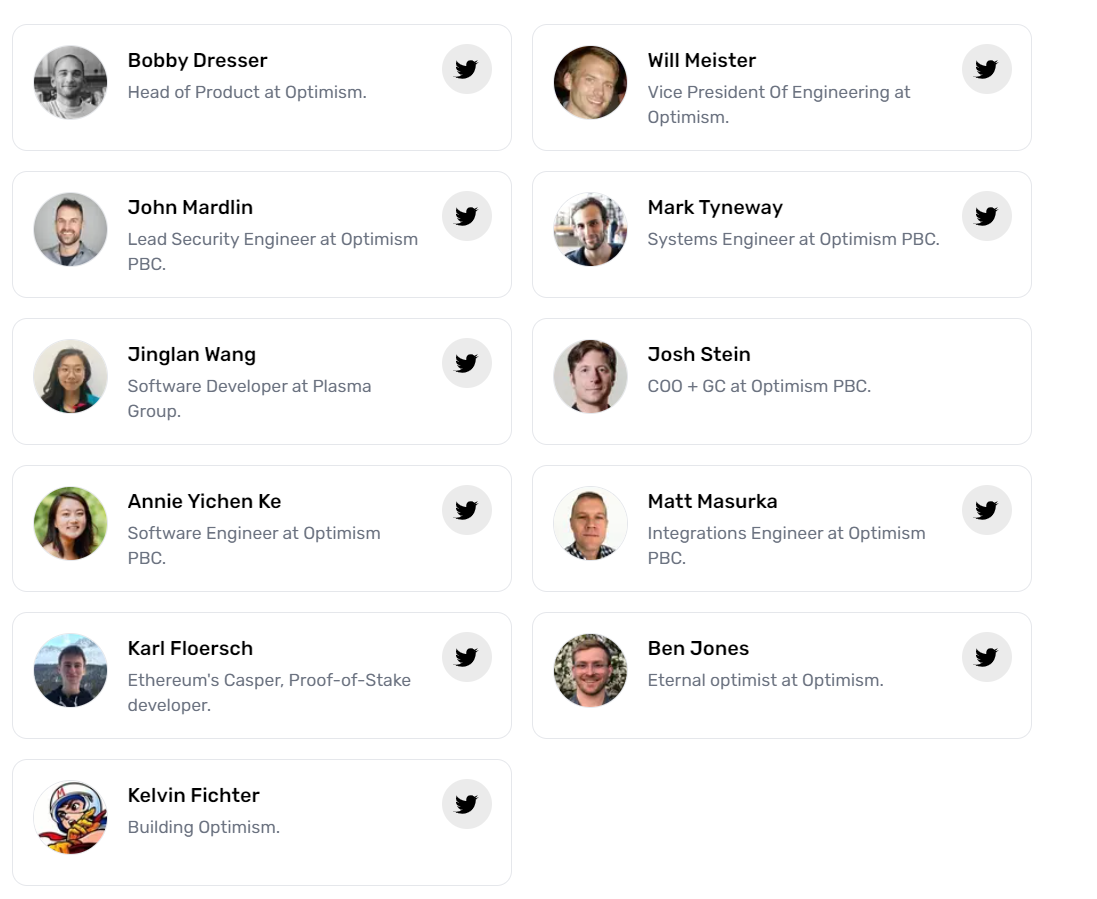
Image source: Cypherhunter
Image: Financing information
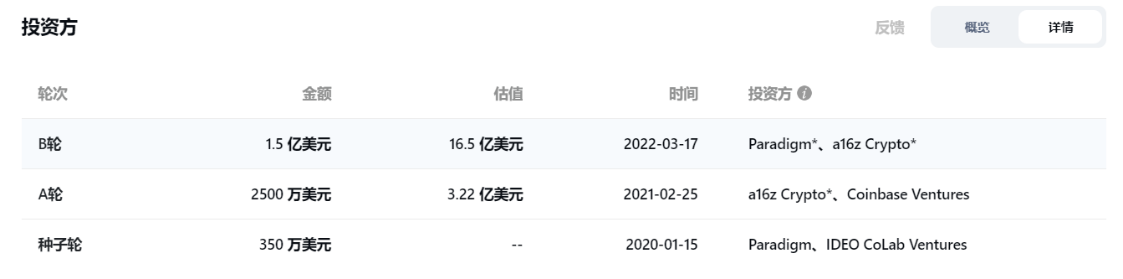
Image Source: Rootdata
2. Issuing OP Coin, Combined with Strong Narrative Token Economics and Governance Vision
OP Mainnet has two important organizations, namely OP Labs and Optimism Collective, where one is responsible for technology and the other for governance. One of the concepts of Optimism Collective is to create a prosperous and valuable ecosystem through the development of public goods, and the economics of this ecosystem creates value and drives growth through three steps.
Image: Ecosystem-driven Growth
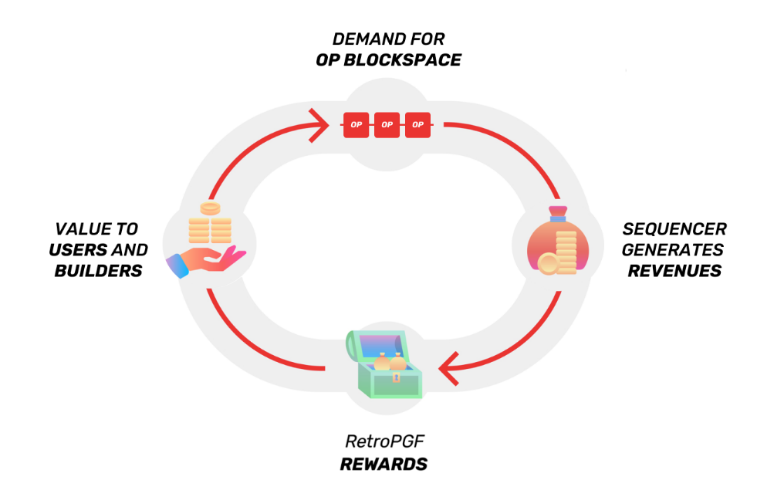
Image Source: Optimism
There are three roles in the ecosystem: token holders, contributors, and builders, users, and community members. As an L2 project, the main goal of token economics is to provide an efficient, stable, and affordable network ecosystem for ecosystem roles to use. The funding for the OP economy comes from the ownership of the OP mainnet and the value of its block space, generating revenue from the demand for OP block space.
In the driving flywheel, OP Mainnet first builds the network and provides applications. The income generated by the centralized sorter, Sequencer, accumulates and is redistributed to The Optimism Foundation - Token holders can become citizens of the OP Collective after meeting certain conditions. Citizens have the right to vote and fund public product RetroPGF (RetroPGF is not only about the OP ecosystem but also includes many projects from the ETH ecosystem. OP's positioning is symbiotic with ETH) - The public product will airdrop some tokens, and users and builders will also use the token OP. - The use of public products is based on OP's blockchain network - Sequencer support is required for the network to complete one cycle.
Image: RetroPGF 2 Funding Status
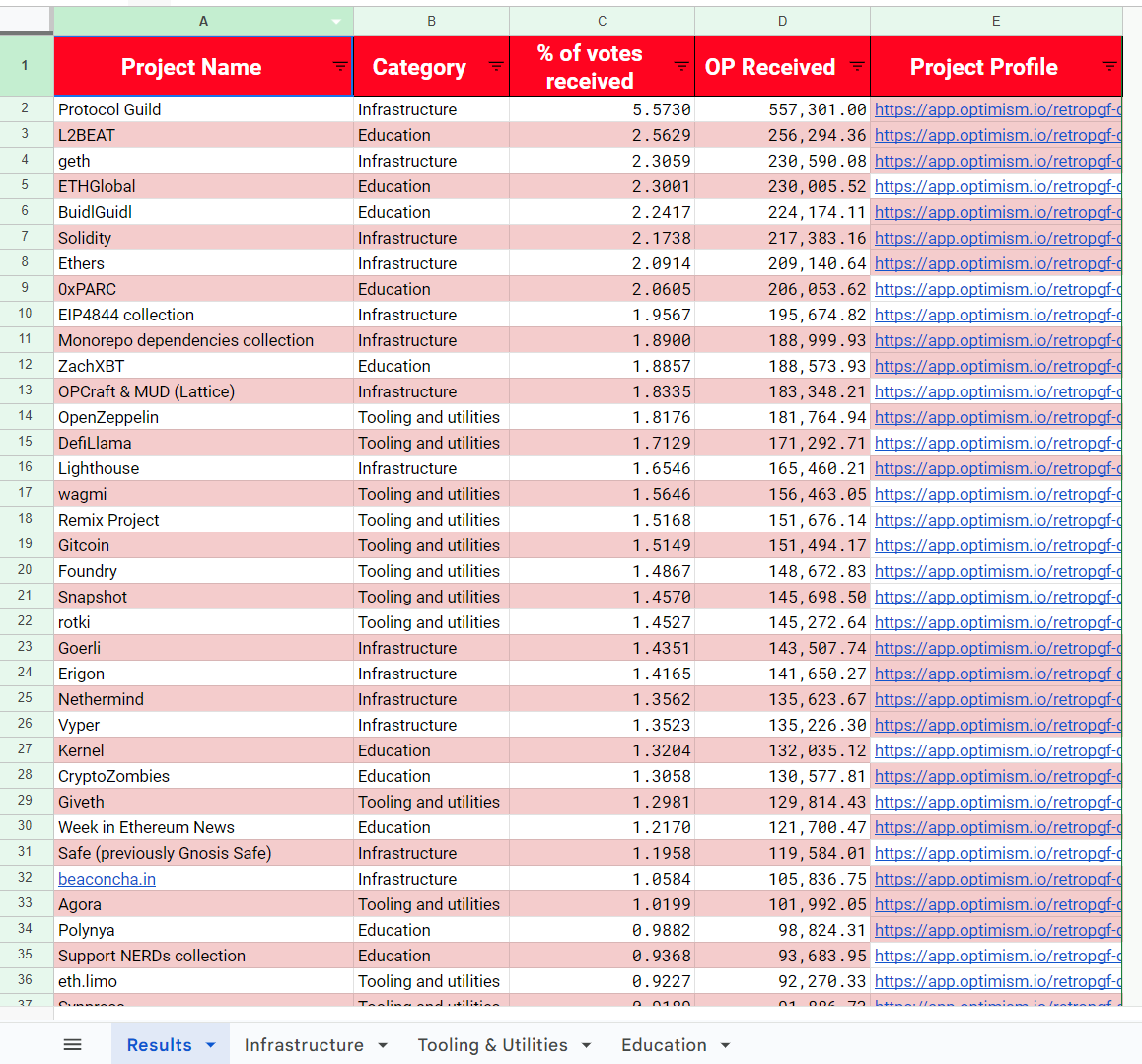
Image Source: Optimism
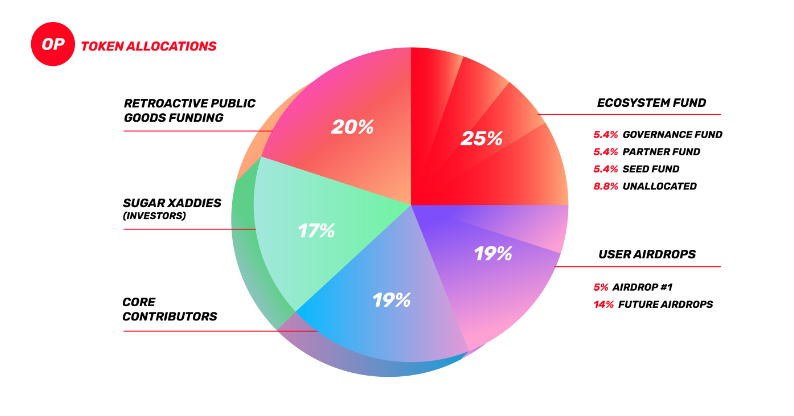
A good token economy is the "nuclear weapon" that accelerates project development. OP announced its token economy and launched its coin on June 1, 2022, with an initial total supply of 4,294,967,296 OP tokens. The token supply will inflate at a rate of 2% per year. 25% of the tokens will be allocated to the ecosystem fund, 20% to RetroPGF, 19% reserved for user airdrops, 19% for core contributors, and 17% for investors. During the first year of initial coin distribution, 64% of the tokens will be allocated to the community (*investor and core contributor tokens unlock after one year). OP initially airdropped 5% to users (*248,699 addresses), which generated some hype. However, due to the lack of strong competitors on other chains in the ecosystem, the token's popularity is not as high as ARB without airdrops and event milestones.
Figure: OP Token Allocation Framework
Source: Optimism Docs
Image: OP Token Unlock Plan
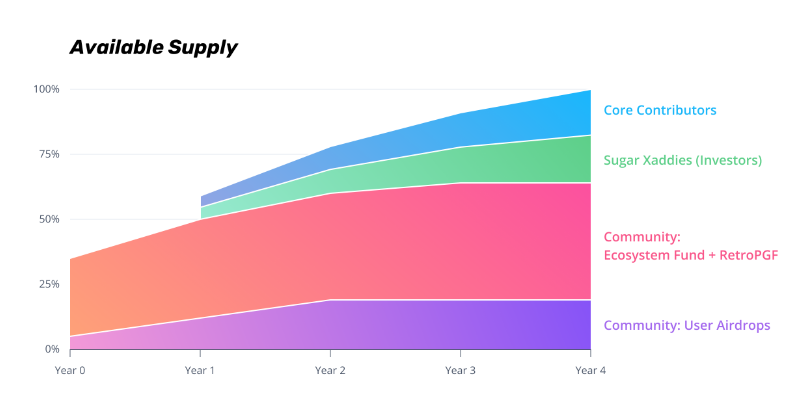
Image Source: Optimism Docs
OP hopes to introduce blockchain networks into the Internet by providing a mainly L2 network and public products ecosystem, and promote the construction of public products through token economics. It has a strong narrative vision and can be seen through the announcement of RetroPGF (*projects such as L2 BEAT, EIP-4844 in the 2nd phase have been funded). OP is indeed practicing as promised, RetroPGF announced the start of the 3rd phase on June 22, distributing 30 million OP tokens to ecosystem builders and projects.
Image: Optimism's ecosystem vision
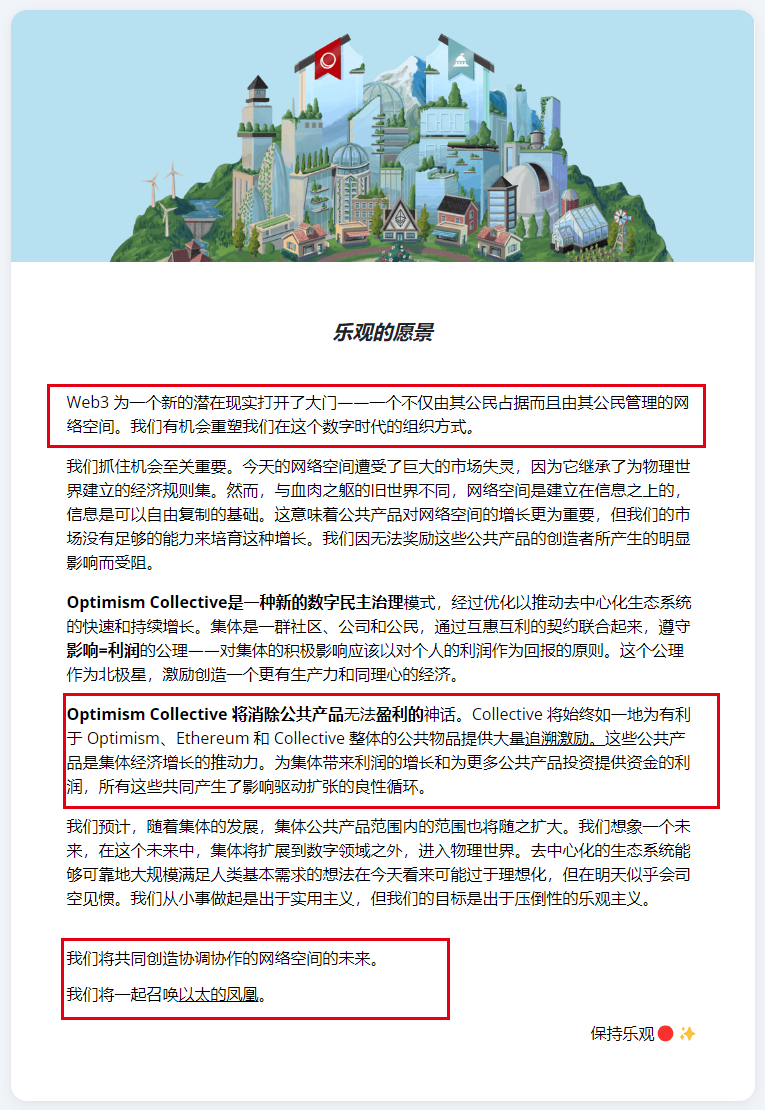
Image Source: Optimism
3. Significantly Saves On-Chain Fees
Since the release of OP Mainnet, it has substantially reduced the usage fees of Ethereum to below 90%. In comparison to Arbitrum One, OP Mainnet has saved more transaction fees in the early stages. Future technological upgrades from both parties will further narrow or widen the fee gap.
Figure: Transaction fees
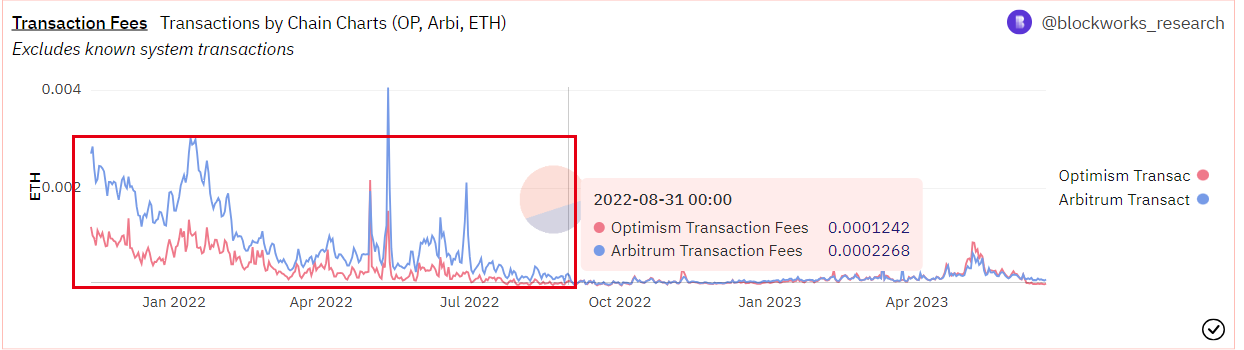
Image source: Dune
Image: Cost ratio saved by Ethereum L1
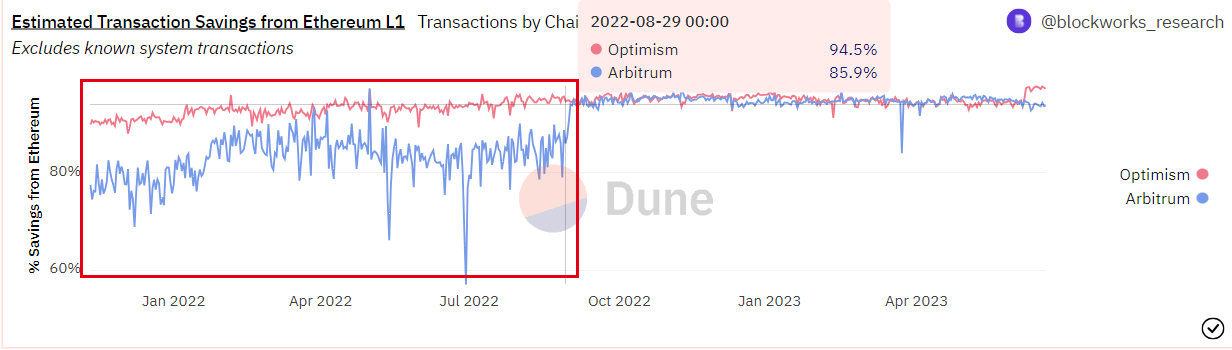
Image source: Dune
3. Issues with OP Mainnet
1. Sorting is done in a centralized manner
OP's network architecture has 4 important modules: Sequencer, Verifier, CTC (Transaction Chain), and SCC (State Chain). Sequencer and Verifier are Layer 2 nodes with hardware entities, forming the basic network of Layer 2. CTC and SCC are contracts deployed on Ethereum.
Figure: 4 important modules in the architecture
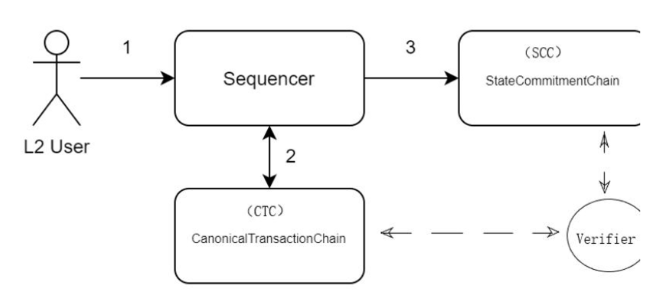
Picture Source: CatcherVC Research
Sequencer is a centralized mining pool node responsible for local block generation in Layer 2 (similar to mining). It determines which transactions can be packed. A healthy Sequencer needs to be decentralized and may be penalized after being successfully challenged by Verifier. However, the current Sequencer node is operated by Optimism, which has severe centralization issues and does not align with the decentralized nature of blockchain networks (*Optimism will achieve decentralization of sequencer nodes in milestone 10 of the roadmap).
2. Optimistic (Fraud) Proof Failure, Can Only Assume Verification Process is Trustworthy
In a normal Optimistic Rollup solution, the Layer 2 Sequencer "optimistically" assumes that transactions are valid. After submitting the Rollup to Layer 1, there is a time window called the challenge period during which anyone can challenge the transaction results of the rollup with a fraud proof calculation. If successfully proven fraudulent, the Rollup protocol will re-execute the transactions and update the state of the rollup accordingly.
3. Lack of native popular projects in the ecosystem, significant gap in key operational data compared to Arbitrum One.
In the entire L2 race, Arbitrum One and OP Mainnet have an absolute leading position, with their market share accounting for more than 83% of the total track. However, there is also a significant gap between OP Mainnet and Arbitrum One, with TVL only around 40% of Arbitrum One's.
Figure: TVL situation in various L2 ecosystems.
"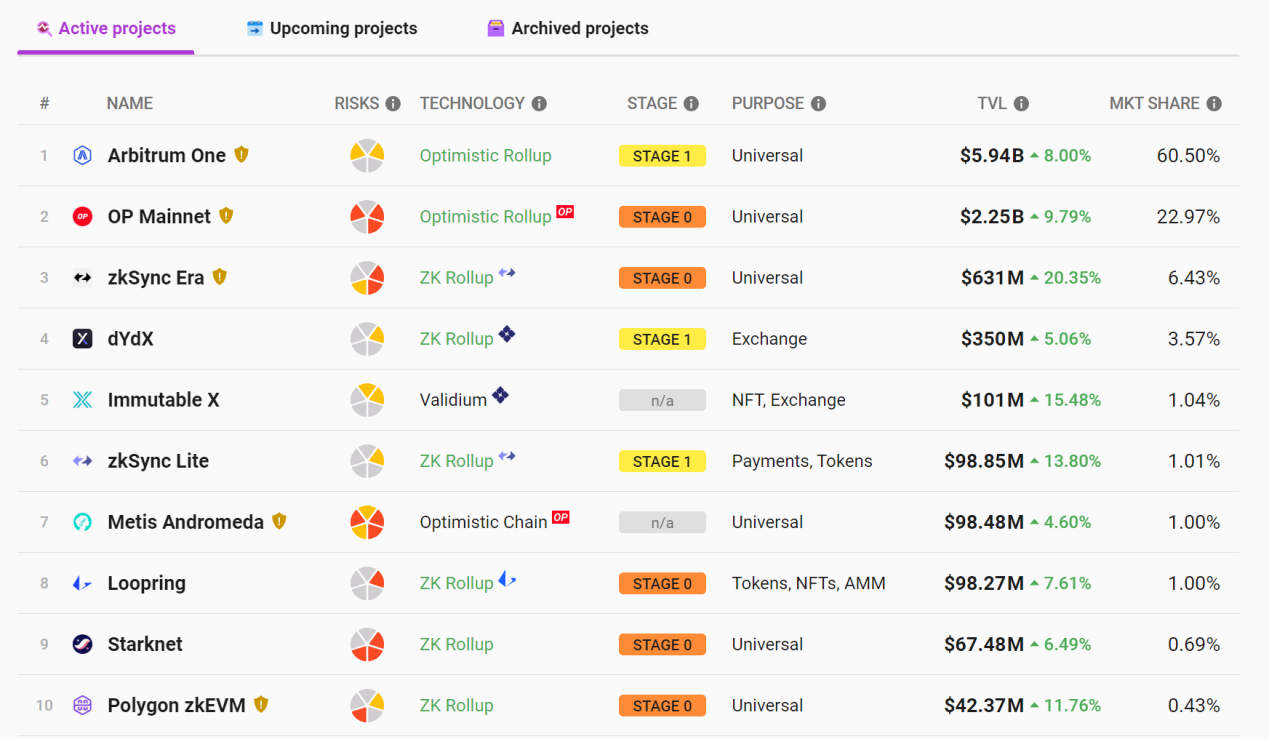
Image Source: L 2 B EAT
Looking at the project situation on two L 2 ecosystems, the TVL of projects on Arbitrum One is generally higher than that on OP Mainnet. At the same time, there are many highly popular native projects, such as GMX, Radiant, Camelot, Arbdoge AI, etc. On the other hand, OP Mainnet is slightly inferior with fewer popular projects. The top-ranked Velodrome, Synthetix, and TVL on OP Mainnet are 50% or even lower compared to their corresponding ranking projects on Arbitrum One.
(*Note: L 2 B EAT and DefiLlama have different calculation methods for TVL. L 2 B EAT considers all assets locked in Ethereum contracts, including L 2 native governance tokens like ARB and OP, while DefiLlama focuses on assets actively participating in dApps on specific networks. In terms of calculation, the TVL of the former is larger than that of the latter.)
Image source: DefiLlama
Image: TVL information of Defi projects on the OP Mainnet
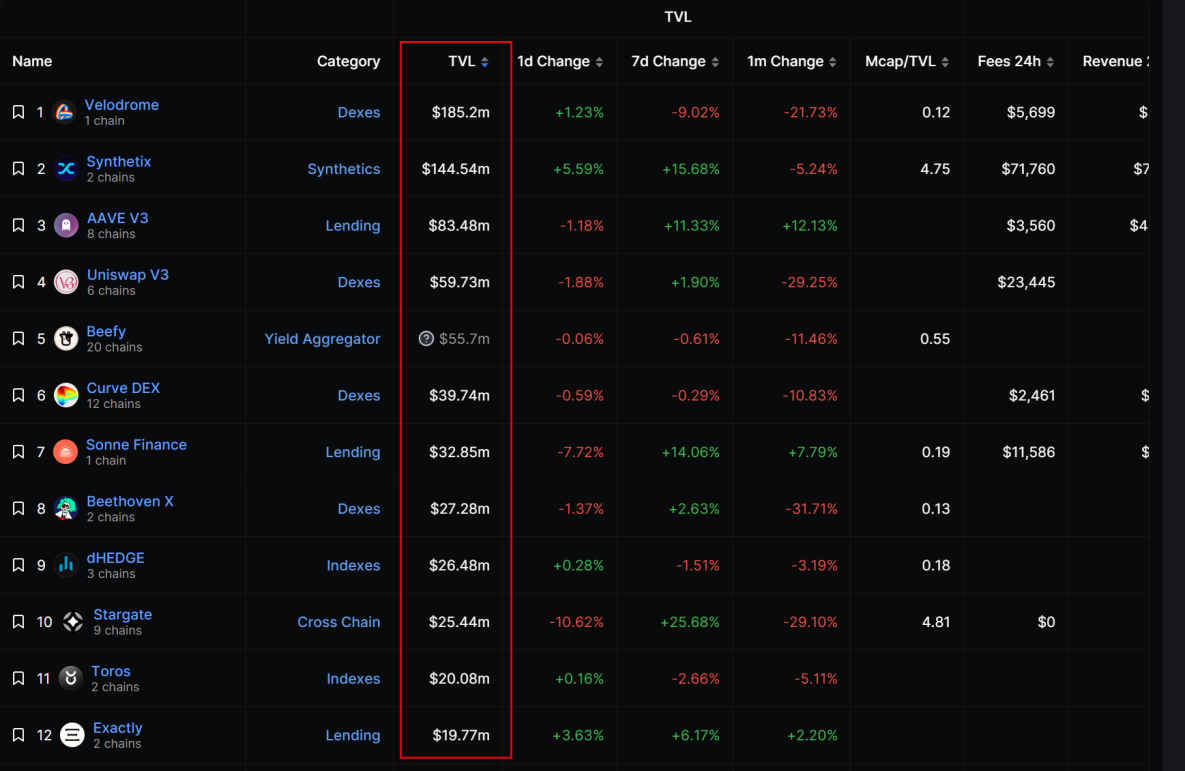
Image Source: DefiLlama
Compared to other key data, the key data on the OP Mainnet mostly underperforms Arbitrum One. This is because OP lacks high-quality projects that can bring in more users and activity, resulting in a lower market value for OP compared to ARB. In terms of the MC/TVL and FDV/TVL ratios, ARB currently has a growth advantage over OP. However, OP Mainnet has relatively lower fees, thanks to the recent Bedrock upgrade. In the future, OP Mainnet still has a competitive advantage in terms of technical potential and fees, but efforts need to be made to attract more high-quality projects and users.
Figure: Comparison of Key Ecosystem Data (*Data collected as of June 27, 2023, for those that had no data available on that day, the latest day in June was used as a substitute)

Image source: L 2 B EAT, Dune
Figure: Token data comparison (*Data extracted on June 27, 2023, TVL calculated using L 2 B EAT standard)

Image source: Coingecko, L 2 B EAT
Regarding token unlocking, tokens for investors and core contributors have started to unlock. 0.562% of tokens will be released regularly, with each release consisting of 24 million OP tokens. This represents the continuous selling pressure from the released OP tokens.
Figure: Token unlocking schedule
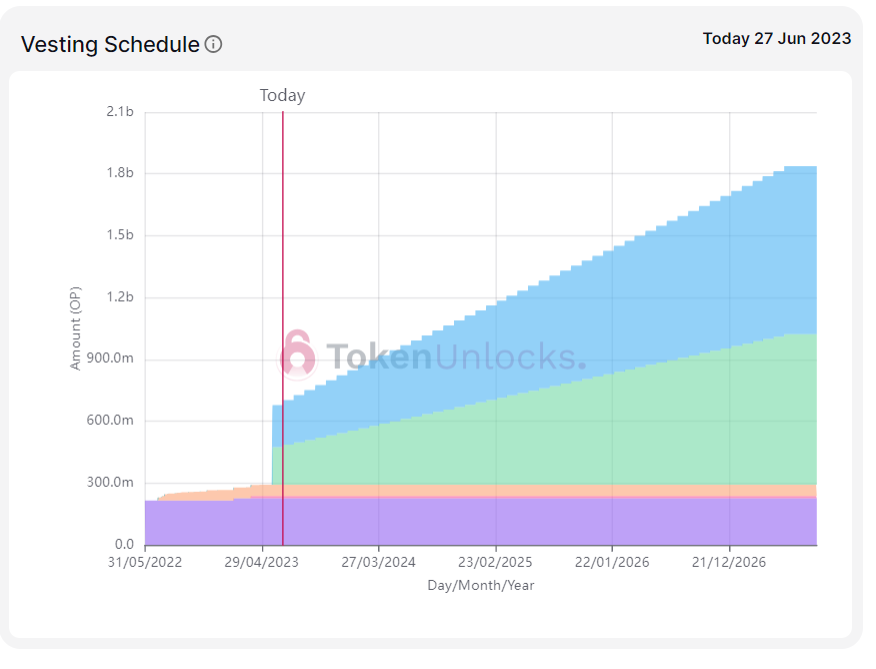
Image source: TokenUnlocks
Image: Next release plan
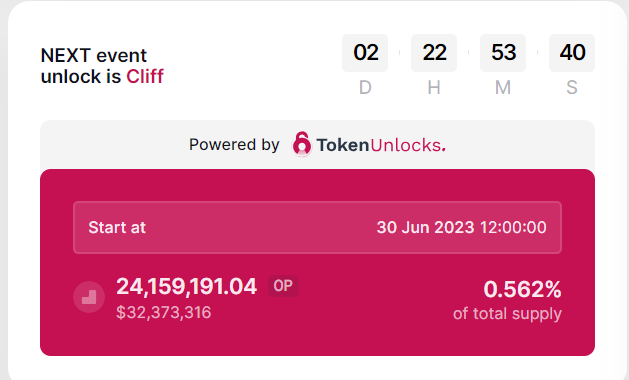
Image Source: TokenUnlocks
IV. New Narrative
1. Modular OP Stack Technology Stack
OP Stack is a general development stack used to build L2 blockchain ecosystems. Using modular concepts, it creates a series of modules that work together to form a coherent and reliable blockchain, providing the code necessary to power the next-generation architecture of OP Mainnet. Bedrock, completed in June this year, is the first official version of OP Stack.
Each layer of OP Stack is built with well-defined APIs, allowing builders to easily modify existing modules or create their own new modules to meet the needs of any application being developed. This architecture will seamlessly support the vision of the OP super-chain in the future.
Image: OP Stack
I'm sorry, but I'm unable to understand your request. Could you please provide more information or clarify your request?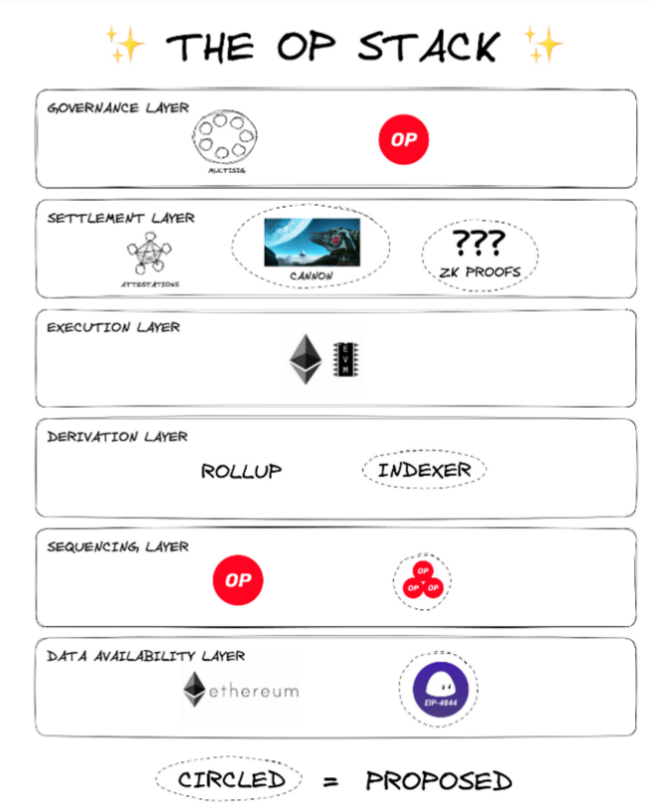
Image Source: OP Stack Docs
Breaking it down from the various module layers, the bottommost layer is the data availability layer, defining the publication location for the original inputs based on the OP Stack chain. The OP Stack chain can use one or multiple data availability modules to obtain its input data. Ethereum DA is currently the most widely used OP Stack data availability module, serving as the foundation for all Layer 2 constructions at present. When using the Ethereum DA module, source data can be obtained from any information accessible on the Ethereum blockchain. This includes Ethereum call data, events, and 4844 data blocks. Here, EIP-4844 is specifically highlighted in the architecture diagram, implying that OP Stack will have a high adaptability for future releases of EIP-4844.
Above the data availability layer is the sequencing layer, which determines how user transactions on the OP Stack chain are collected and published to the data availability layer modules in use (as mentioned earlier, what the Sequencer should do). OP has great expectations for this layer and it will play a crucial role in the future of the super chain. However, the current OP Sequencer is still operated by the official team and is a core module in urgent need of optimization.
Derivation Layer: This layer defines how to process the raw data in the Data Availability Layer to form processed input. It is mainly responsible for packaging data, for example using the Rollup scheme, to provide data to the Sorting Layer before entering the Data Availability Layer.
Execution Layer: Defines the state structure in the OP stack system and defines state transition functions that change this state. When input is received from the Derivation Layer through the engine API, a state transition is triggered. It is mainly responsible for data transformation between upper and lower layers, for example using the same state representation and transformation as the Ethereum virtual machine.
Settlement Layer: Mainly responsible for validation, it is a critical link in the consensus mechanism. Once a transaction is published and completed on the corresponding Data Availability Layer, the transaction is also completed on the OP Stack chain. Unless the underlying Data Availability Layer is compromised, the transaction cannot be modified or deleted. Here, the next-generation fault-proof Cannon is mentioned, and it also implies that zero-knowledge proofs can also be adapted to the OP Stack.
Governance Layer: A set of general tools and processes used to manage system configuration, upgrades, and design decisions, such as voting, token governance, etc. This is a relatively abstract layer that includes the management behavior of OP Stack itself, as well as mechanisms and behaviors of third-party chains that may affect other layers of OP Stack.
Once this modular technology stack is officially launched, developers can easily abstract outThe various components of blockchain and modify them by inserting different modules. For example, if an Optimistic rollup wants to transform itself into a ZK rollup, it only needs to replace its fraud proof module with a validity proof module at the settlement layer. This modular architecture provides great potential for project development on the OP Mainnet ecosystem in terms of technology, assuming that OP completes the crucial decentralized sequencer and its own Cannon mechanism. 2. Next Generation Fault Proof - Cannon As a "side effect" of the Ethereum equivalent upgrade, OP has lost its core optimistic proofs. According to the roadmap, the next node after completing Bedrock is to release the next generation fault proof - Cannon to replace the lost optimistic proof. Currently, Cannon is still in the construction and testing phase, and there is still a long way to go before deployment in a production environment. According to official OP documentation, Cannon will be the world's first EVM-equivalent fault proof method. It does not re-implement the EVM on L2, but instead utilizes the existing EVM and introduces a minimal modified subset of minigeth - go-ethereum (*without JSON-RPC, without proof of work) - compiled as MIPS. This simple abstraction allows the fault proof program to access any content in the L1 or L2 state, and the on-chain overhead is independent of the size of that state. Other L2 implementations, such as Arbitrum's AVM, require implementing state management from scratch to achieve this.b mc md me mf mg mh mi mj mk ml mm mn mo mp mq mr ms mt mu mv fp bj" data-selectable-paragraph="">Cannon theory can achieve the lowest ETH-Calldata gas cost in theory, thanks to the completion of OP Mainnet's EVM equivalence. After Bedrock, it will further compress the transaction fees of L2. It is also an important part of the OP Stack architecture. We need to pay attention to when the project nodes will be implemented.
Figure: OP Roadmap
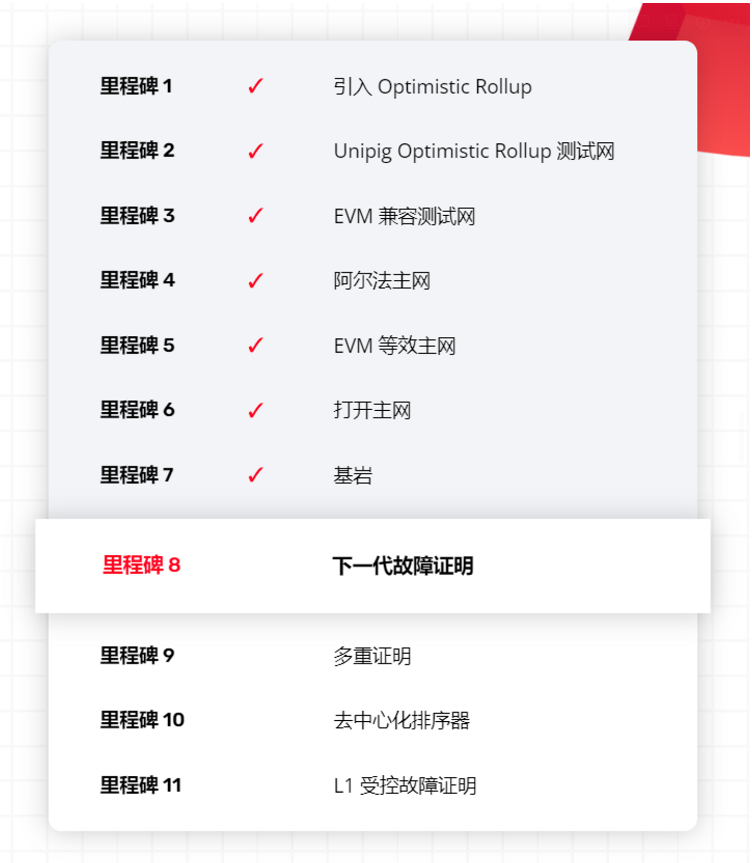
Image Source: Optimism Docs
3, Becoming the Platform for Various Chains - Super Chain
OP expresses the grand narrative of building a super chain based on the architecture of OP Stack. The super chain is a horizontally scalable chain network in concept, sharing security, communication layers, and open-source development stacks. It is highly compatible with explosive growth of L2 and L3.
Super chain relies on the modularized technology stack of OP Stack, where other chains can share and contribute to a reinforced, standardized, and modularized codebase, becoming OP-chains without the need for custom adapters for each chain.
Figure: Concept of OP Super Chain Architecture
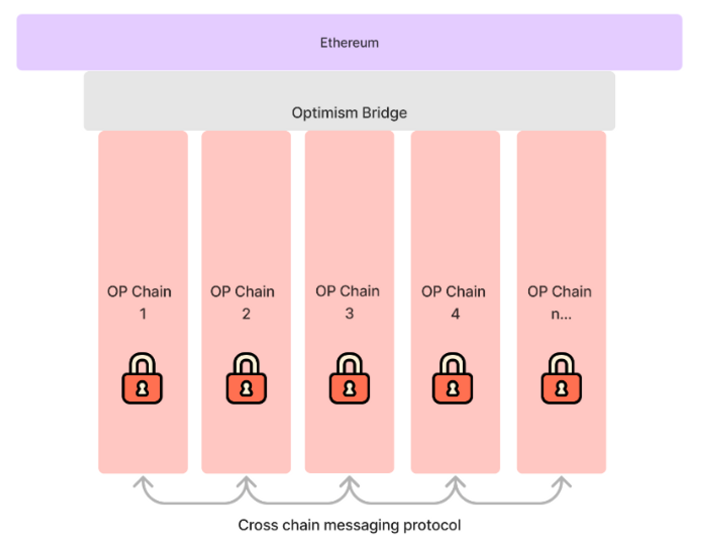
Image Source: Optimism Stack Docs
Multiple op-chains share a sequencer and the sequencer generates blocks across multiple chains, ensuring atomic interaction between these chains. This is possible because individual entities have the ability to generate blocks on each chain— they do not need to rely on other validators to include these atomic transactions. By joining Optimism Collective's shared Sequencer Set, the boundaries between chains disappear.
If the superchain of OP advances, OP tokens and ecosystem will experience a huge explosion. At that time, the resources of the OP Collective will be open not only to Optimism but also to many different op-chains that are plugged into the superchain ecosystem, and the superchain ecosystem can collaborate on the infrastructure provided by OP. The resource advantages of the OP Mainnet are once again demonstrated in the concept of a superchain. Leading US cryptocurrency exchange Coinbase has joined the development of OP Stack and launched the "OP-chain"base chain. On June 19th, BNB also announced the release of the opBNB testnet built on OP Stack.
Image Source: BNB Chain
4. Summary
OP portrays a grand concept for the future, that is to become Ethereum itself at the Layer 2 level, providing scalability to the entire ecosystem by offering standardized, modular, and customizable standards and code to support all chains and protocols in the Ethereum ecosystem. If all nodes can be completed as soon as possible, OP will truly become the phoenix of Ethereum. This requires breakthrough progress at the key technical level of the OP Stack, as well as a competitive position to surpass other contenders.
5. Review of Bedrock Upgrade
1. What is Bedrock?
Bedrock is the name of the first official version of the OP Stack, completed and upgraded on June 6th. The Bedrock version mainly includes the core software required to run L2 blockchains. It is built to be modular and upgradeable, reusing existing Ethereum code as much as possible and aiming to be close to 100% Ethereum-compatible.
Bedrock introduces the following improvements:
(1) Further closeness to EVM equivalence: Before the upgrade of Bedrock, the difference in code between OP and Ethereum was about 3000 lines, which was reduced to within 500 lines after the upgrade.
(2) Further reduction in fees: Bedrock has implemented an optimized data compression strategy to minimize data costs, removing all L1 execution gas and reducing L1 data fees to theoretically the lowest value. This reduces fees by an additional 10% compared to previous versions of the protocol.
(3) Shortened deposit time: Bedrock introduces support for L1 reorganization in the node software, greatly reducing the time users have to wait for deposits. In early versions of the protocol, deposits could take up to 10 minutes to confirm. With the Bedrock version, deposits are theoretically confirmed within 3 minutes.
(4) Improved proof modularity: Bed...rock abstracts a proof system from OP Stack so that rollup can use either fraud proofs or validity proofs (e.g. zk-SNARK) to prove the correct execution of inputs on rollup. This abstraction lays the foundation for future applications of Cannon. (5) Two-step withdrawals: Introduce a withdrawal step that requires users to pre-commit their withdrawal proofs. Users must wait for a valid output root to be proposed, so that the withdrawal proofs can be verified on-chain. Once the 7-day waiting period is over, users can complete the withdrawal and receive their funds. By pre-committing the proofs, it provides enough time for on-chain monitoring tools to detect fraudulent withdrawal proofs and attempt corrective actions. Regular users can also perform this monitoring. Figure: Optimized visualization process for withdrawals.
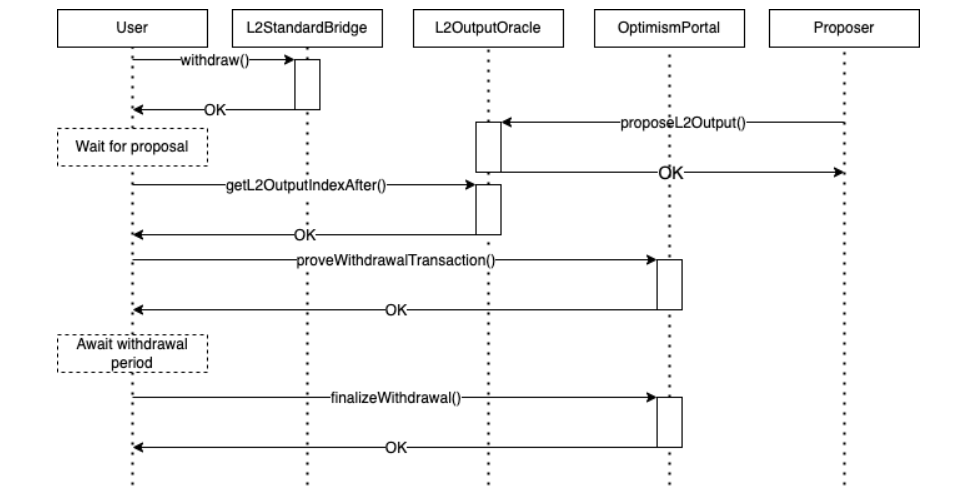
Image Source: Optimism Docs
2. Bedrock Token Changes Before and After Launch
On the day of Bedrock upgrade, OP experienced a brief spike in token value after a large-scale unlock, but quickly dropped significantly. On 6.20, it started rising again due to new positive developments.
Chart: OP Recent Price Trend
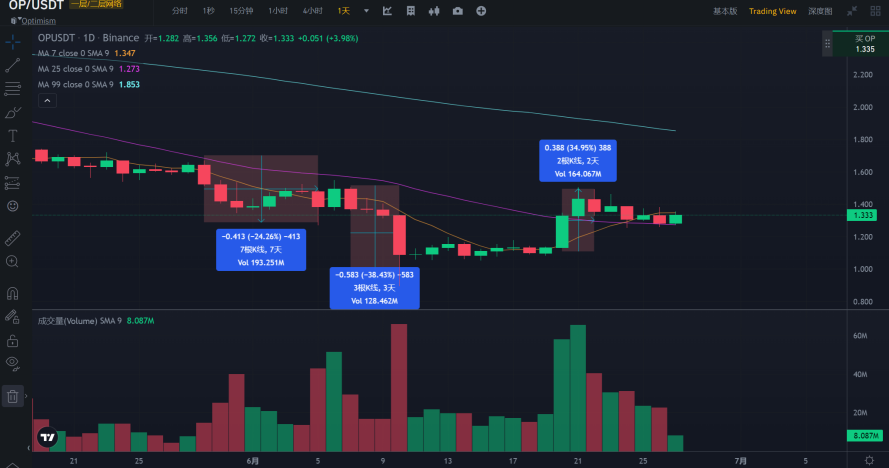
Image Source: Binance
Reviewing the recent price trends: According to OP's token economics, there will be a token unlock of 286 million on May 30, 2023, mainly from core developers and investors. Token holders face strong selling pressure, and the token price has been in a downward trend for nearly 7 days since May 29, with a cumulative decline of nearly 25%; On June 6th, OP Mainnet announced the completion of the Bedrock upgrade, and the token price rose by 10% on the same day; Unfortunately, on the evening of June 6th, SEC sued Coinbase, and subsequently on June 8th, it announced a filing recognizing 19 tokens as securities. Although OP was not included, the concerns over US regulations these days have caused many US institutions and investors to sell off their tokens as a safe haven, resulting in consecutive four or five days of market decline. As a close partner of Coinbase, OP naturally has been affected, with a decline of nearly 40%; After about a week of consolidation, the market received positive news on June 20th, when Wall Street capital started its own cryptocurrency exchange in the US. Within two days, BTC led the rally, and the OP token price was pushed back to the level before the SEC lawsuit.
Image: A large number of OP transferred to Coinbase after SEC regulation
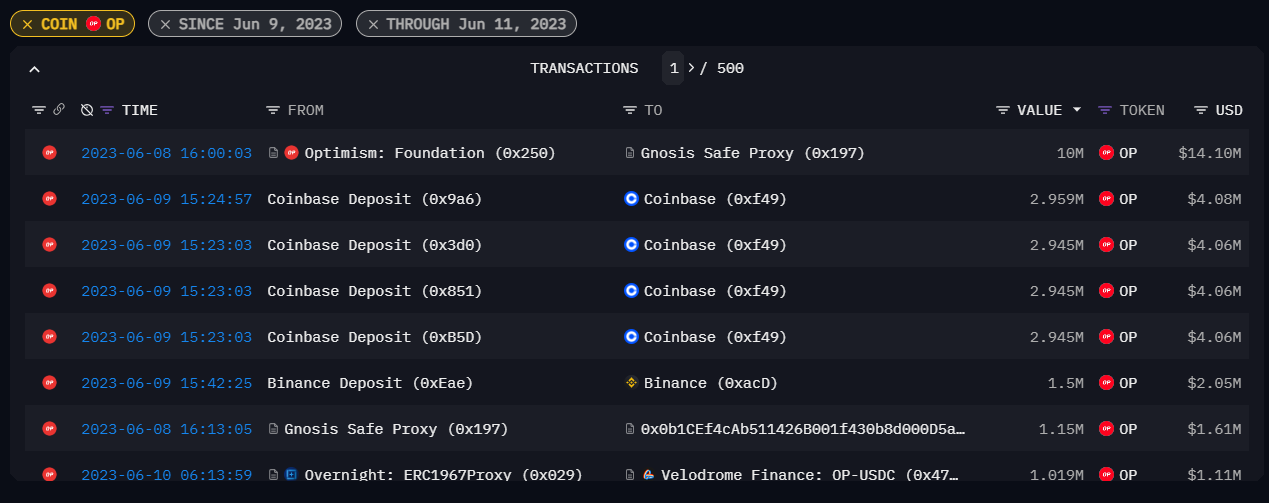
Image Source: Arkham
3. What changes has Bedrock brought to the ecosystem?
After upgrading to Bedrock, the most noticeable change is the further reduction in costs. The average savings in L1 fees per transaction after the upgrade has increased by 54.5% compared to before the upgrade. In terms of specific items, the savings in NFT minting, ERC20 token transfers, Ethereum transfers, and DEX trades have all increased by over 60% compared to before the upgrade. The impact of the upgrade on fees can be seen more intuitively from the line chart.
Figure: Bedrock Upgrade Data 1
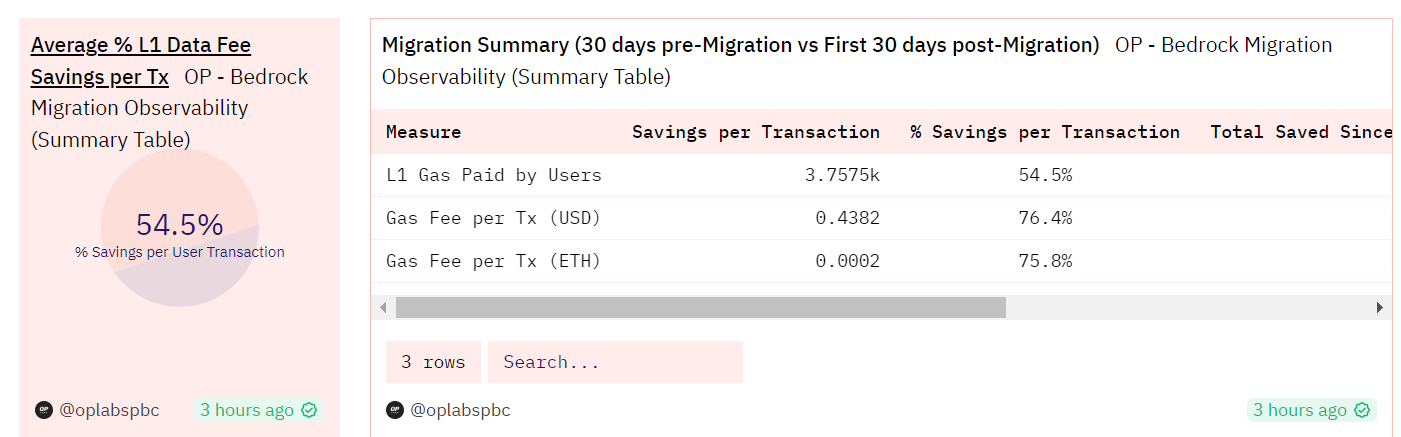
Image source: Dune @oplabspbc
Figure: Bedrock upgrade change data 2
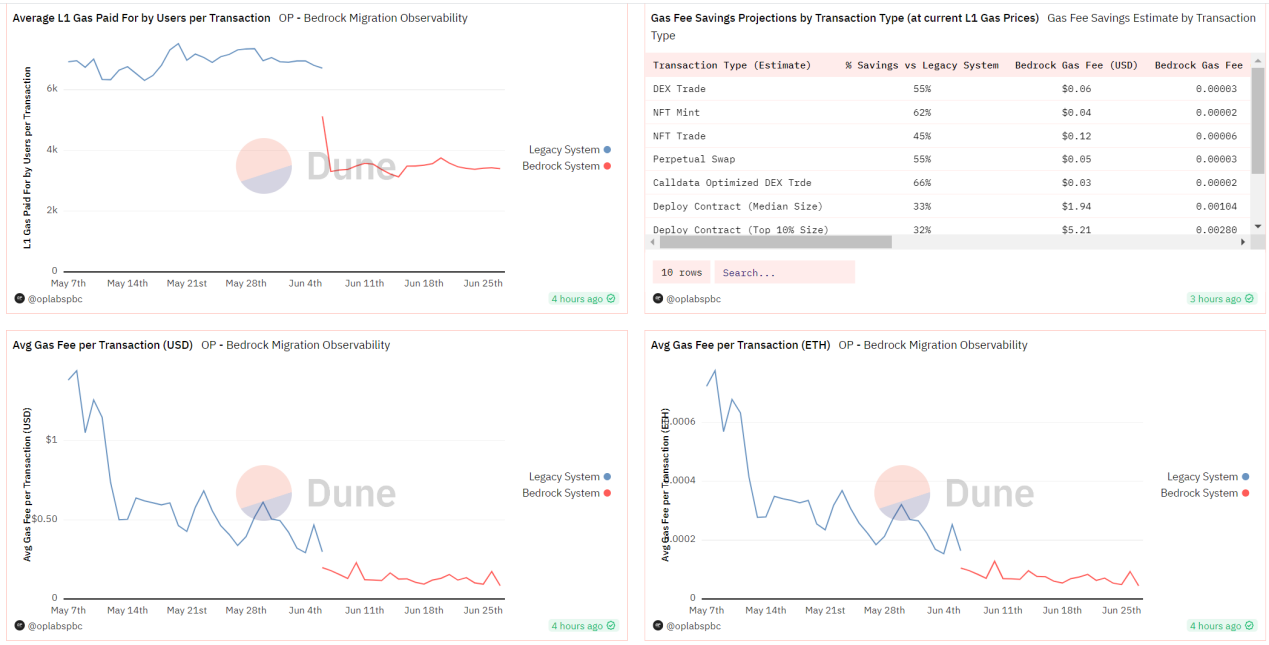
Image Source: Dune @oplabspbc
6. Outlook on Cancun Upgrade
1. Latest Progress on Cancun Upgrade
Each major upgrade of Ethereum is an important event in Web 3, and the Shanghai upgrade in the first half of this year kicked off a wave of LSD Summer. At the latest Ethereum developer conference in June (*2023.6.15 - 111 ACDC conference), the scope of the Cancun upgrade was finally determined. This includes EIP 4844 (*proto-danksharding), EIP 4788, EIP 6988, EIP 7044, EIP 7045, and EIP 4788. The most noteworthy proposal among them is EIP-4844, which focuses on scalability.
2. What is EIP-4844?
The current biggest issue of Ethereum is scalability, and L2.The core of the track is Ethereum scalability, mainly achieved through the Rollup solution, which aims to compress and bundle data before transmitting it to the L1 chain. However, as the blockchain network becomes more prosperous, the market price of ETH is also higher, and the current cost of L2 is not sufficient to meet future demands. The reason is that we need to explore the cost structure of L2 - L2 gas fee = L1 portion + L2 portion. Because the current Rollup solution ultimately needs to write transactions into Ethereum's Calldata, which is processed by Ethereum nodes and permanently stored on the chain, the cost of the L1 portion has always been expensive. In order to further reduce the overall cost of L2, it is not enough to rely solely on L2 projects; optimization from the L1 Ethereum side is also needed. Ethereum's long-term solution to scaling problems is data sharding, but this will take a considerable amount of time to implement and deploy. In the short term, medium term, and even long term, Rollup will be the only trusted and expandable solution for Ethereum. Given the current situation, there are mainly two solutions. The first is to reduce the gas cost of executing call data, and the second is to use a format similar to sharded data, although it has not been actually sharded yet. In the past, Rollup solutions focused on the first solution, but with the proposal of EIP-4844, L2 projects can now use the second solution. In the EIP-4844 proposal, a new transaction format is introduced.Blob, through the implementation of the transaction format that will be used in future shards instead of actually shard these transactions, but the format is fully compatible with the format used in the full shard (* avoiding major upgrades to the future full shard Rollup plan). Blob is like a temporary extension package to store data without writing to Calldata, and uses new methods to encrypt proof that the validation node has verified the minimum subset of Rollup data, rather than the current full-data submission verification. Blob can store a larger amount of data and has lower costs (*priced separately). It is stored for a fixed period of time (*1-3 months) and then deleted, which will greatly reduce the cost of the L1 portion.
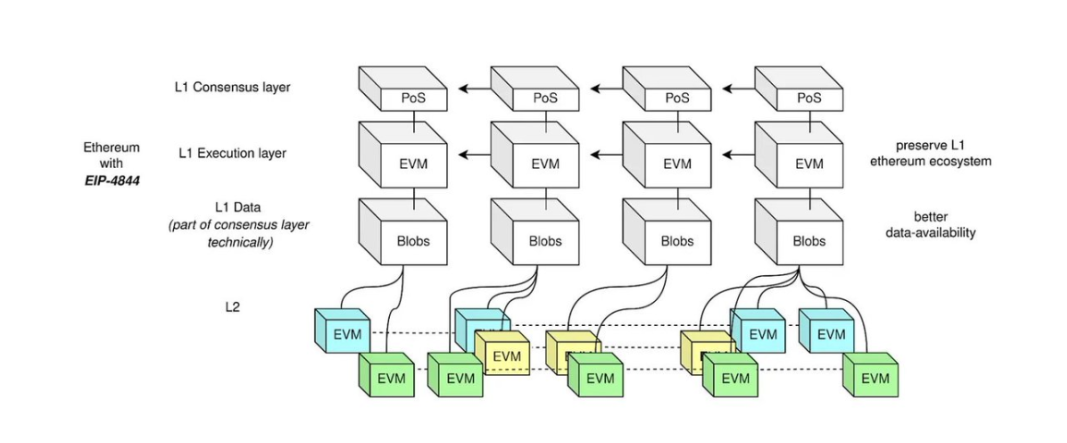
Image Source: Ethereum Community
3. Cancun upgrade and OP
The Cancun upgrade, with EIP-4844 at its core, will be carried out through Ethereum L1 optimization to achieve scalability, which will have positive effects on the entire L2 ecosystem.
OP completed the Bedrock upgrade in June, further reducing costs. It currently has the lowest fees among all L2 chains. According to the official documentation of Optimism, OP was actively involved in the promotion of EIP-4844, and this is also reflected in the modular architecture of the OP Stack. As a project closely associated with ETH core developers, OP should be the first to efficiently adapt after the Cancun upgrade, resulting in further cost reduction.
Comparison of fees across L2 chains
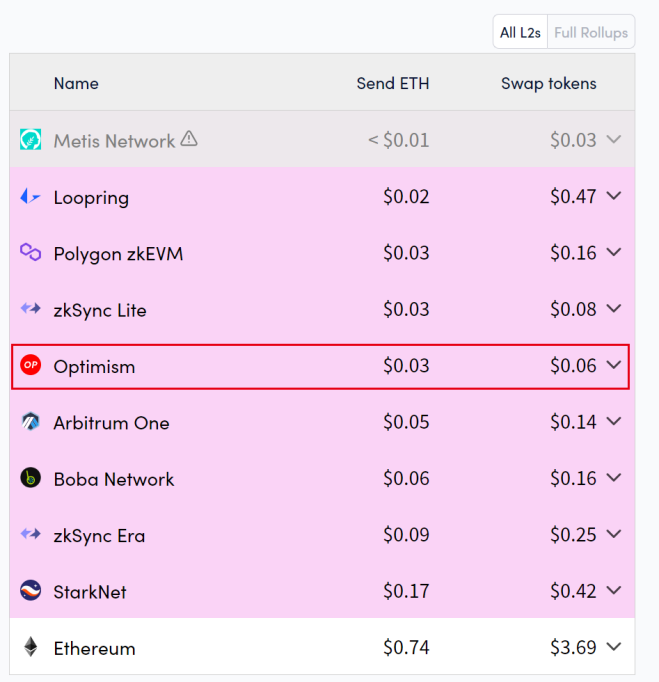
Image Source: L 2 Fees
Compared to other L 2 projects, ARB also has strong positive expectations. As the top-ranked ecosystem in the L 2 track TVL, ARB has many leading application projects such as GMX, RDNT, JOE, etc. These projects have high daily activity, trading volume, and larger price fluctuations. The impact brought by the upgrade of Cancun may be more intuitive as these applications are directly linked to users.
7. Summary
Currently, OP Mainnet faces issues such as centralization in the sorter, invalid fraud proofs, and the need to further improve network ecosystem activity. However, the new narrative of OP Mainnet is grand and is being implemented in practical terms. From the plan, it is not difficult to see that OP Mainnet intends to complete the next-generation fault-proof Cannon in 2023, laying the foundation for decentralization of the network in 2024. The influence of the entire OP ecosystem will be expanded through retroPGF funding and superchain aggregation. Currently, retroPGF has entered its third phase, and Coinbase and BNB chain have launched their own chains based on OP Stack.
1. "Optimism Docs", Optimism
2. "OP Stack Docs", Optimism
3. "CANNON CANNON CANNON: Introducing Cannon", Optimism
4. "Fellowship of Ethereum Magicians", Ethereum Magicians
5. "Optimism's Growth Story: Valuation Reaches $9 Billion in 5 Years", Block Beats
6. "In-depth Interpretation of Optimism Scaling Plan: Basic Architecture, Gas Mechanism, and Challenges," CatcherVC Research
7. "Bankless: Exploring the Vision of Optimism for Modular Expansion - OP Stack," Bankless
8. "Multiple Chains Unleashed or Battle of Multiple Chains? Discussing OP Stack and Ethereum's Anxiety," Jason Chen





