


Comprehensive review of the Polygon zkEVM ecology: slow but steady


Compilation of the original text: Deep Tide TechFlow
Compilation of the original text: Deep Tide TechFlow
first level title
1 Introduction
In 2022, many ZK rollup networks are caught in a fierce competition. Many of these networks have launched their mainnets and are actively developing their ecosystems. On March 23, 2023, Arbitrum's airdrop was successful, which led to users migrating to the ZK rollup, hoping to benefit from the ensuing airdrop. This shift is particularly evident in zkSync Era, StarkNet, and other ZK rollup networks that have yet to issue their own tokens.
Unlike other emerging ZK rollup networks that do not yet have tokens, there is a ZK rollup network that has received less attention, but its technology is very stable and has a developer-friendly environment, and it is Polygon zkEVM. Polygon zkEVM is one of the ZK rollup networks developed by the Polygon Foundation, formerly known as Polygon Hermez. The main technical difference between Polygon zkEVM and other ZK rollup networks is its high EVM compatibility.
Unlike other ZK rollup projects (such as StarkNet, zkSync Era) that build their own virtual machines, translate Solidity into a zero-knowledge-friendly language and compile into bytecode, Polygon zkEVM supports Ethereum's opcodes. So Polygon zkEVM may not be as scalable as other ZK rollup networks, but it has the advantage of providing developers with an easier-to-use environment to build dApps leveraging existing Solidity code.
In Polygon zkEVM, ETH tokens are used as Gas fees, while MATIC tokens are tokens used to incentivize Sequencer and Aggregator, which respectively determine the order of transactions on the network to create batches, and generate ZKP for these batches . Since both tokens were issued, many users believed that Polygon zkEVM would not be airdropped, which is why initially it did not perform as well as other networks in terms of network activity. However, if you look at the recent trends in the Polygon zkEVM network, you will see that users and TVL are growing rapidly for several reasons.
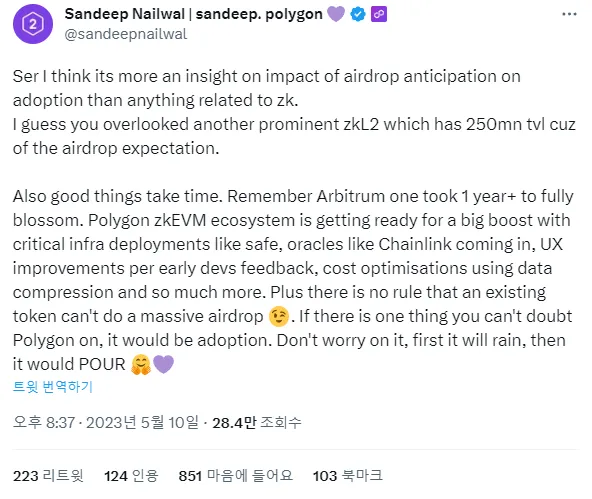
The first and most telling reason is a tweet from Polygon co-founder Sandeep Nailwal. In response to a tweet mocking Polygon zkEVM's low TVL, Sandeep posted the above tweet, which included the line "There is no rule that existing tokens cannot be mass-airdropped." After this tweet, many users started using the Polygon zkEVM in anticipation of the airdrop.
The second reason is that Polygon zkEVM was mentioned in Vitalik Buterin's workshop at EDCON 2023. Previously, Vitalik published an article in the Ethereum community Ethereum Magicians, introducing the milestones that the Rollup network needs to achieve, dividing it into three stages: 0, 1 and 2. During a workshop, Vitalik made a statement that Polygon zkEVM has reached the first stage, while other competing networks have not reached this stage. This achievement has drawn attention to the Polygon zkEVM. It is important to note that to reach Phase 1, unlike Phase 0, there must be a Proof of Work system (such as Fraud Proof or Proof of Validity), and measures must be taken to protect the upgrade mechanism of the Rollup smart contract.
first level title
text
2.1 DeFi (AMM DEX)
2.1.1 Quickswap
text
2.1.2 Mantis Swap
text
2.1.3 Antfarm Finance
text
2.1.4 Balancer
text
2.1.5 Others
In addition to the aforementioned DEXs, there are many other protocols, including:
DoveSwap is a native zkEVM DEX that supports the same liquidity-focused feature as Uniswap V3, where liquidity can only be provided within a specific price range.
Kokonut Swap is a Klaytn-based AMM DEX that has also begun to support the Polygon zkEVM network. Kokonut Swap uses Curve's stablecoin exchange AMM to handle assets of comparable value, and uses dynamic PEG to handle assets of different value, providing more focused liquidity than ordinary CPMM.
secondary title
text
2.2.1 0 vix
text
2.2.2 Aave
text
2.2.3 Qi Dao
text
2.2.4 Others
secondary title
text
2.3.1 Clober
text
2.3.2 Satori
text
2.3.3 Others
secondary title
text
2.4.1 Gamma
text
2.4.2 Gelato
text
2.4.3 Others
secondary title
text
2.5.1 OnePlanet
text
2.5.2 Others
Gameswift (formerly known as StarTerra on the Terra blockchain) is an integrated gaming platform offering IGOs, INOs and gaming services.
secondary title
text
2.6.1 Orbiter Finance
text
2.6.2 Hyperlane
Hyperlane is a protocol that enables cross-chain communication in a modular manner, enabling anyone to adopt Hyperlane, whether it is L1, L2 or Lisk. Currently, Hyperlane only works with EVM chains, but support for non-EVM networks will be available in the future. The authentication method uses an external validator. The introduction of Hyperlane will improve composability with other networks that enable Hyperlane on Polygon zkEVM.
2.6.3 Rhino Fi
Rhino Fi is a one-stop DeFi platform specifically targeting the Ethereum ecosystem and supporting multiple Rollup networks including Optimism, Arbitrum One, Polygon zkEVM, and zkSync Era. In addition to supporting exchanges, liquidity pools, and various vaults, users can also bridge to the Polygon zkEVM network.
2.6.4 Magpie Protocol
text
2.6.5 Others
Layerswap is a cross-chain bridge protocol that supports 17 exchanges and 20 blockchains. Unlike other bridges, it also supports bridging with CEX.
XY Finance is a cross-chain exchange protocol in which liquidity providers provide liquidity to the Y pool on each network, and traders can use the liquidity on each network to exchange it for any desired asset through the X exchange function .
Bungee is a cross-chain exchange protocol based on a cross-chain protocol called Socket, which supports various EVM networks. Fund transfers happen through the liquidity layer.
Meson Fi is a cross-chain stablecoin exchange protocol that allows users to exchange stablecoins between multiple networks by leveraging the liquidity provided by liquidity providers to each network. It utilizes HTLC atomic swap as a bridging method.
Interport Finance is also a cross-chain DEX protocol that allows users to simultaneously perform cross-chain exchanges and utilize the liquidity provided by liquidity providers.
Symbiosis finance also supports the cross-chain DEX protocol of multiple EVM networks. For bridge security, it relies on validators maintained through an incentive mechanism called Symbiosis Relayers.
secondary title
text
2.7.1 Pyth
text
2.7.2 API 3
secondary title
text
2.8.1 Unmarshal
text
2.8.2 Others
Defillama is one of the most famous DeFi analytics sites, aggregating DeFi-related on-chain data from multiple networks.
DeBank is an asset dashboard service dedicated to the EVM network, which displays the assets of a specific wallet with a convenient UI. Additionally, it offers messenger services and other features.
Dexscreener is a service that analyzes and provides data from DEXs that are less accessible than CEXs, allowing users to view price charts for tokens listed only on the DEX or access data from various liquidity pools.
L 2b eat displays information about various Ethereum Layer 2 networks, and users can view quantitative data such as TVL, Tx number, and qualitative analysis of risks.
first level title
3. Conclusion
Recently, Polygon outlined its vision of building an L2 chain network based on ZK technology and proposed a roadmap called Polygon 2.0. While more details will be revealed at a later date, we can expect the Polygon ecosystem to expand around the Polygon zkEVM and related technologies. For such a future roadmap, the initial Polygon zkEVM ecosystem will play a very important role. Due to the recent proposal to extend Rocket Pool's rETH to Polygon zkEVM, it is expected that more Dapps and users will join Polygon zkEVM in the future.





